Author: TechFlow
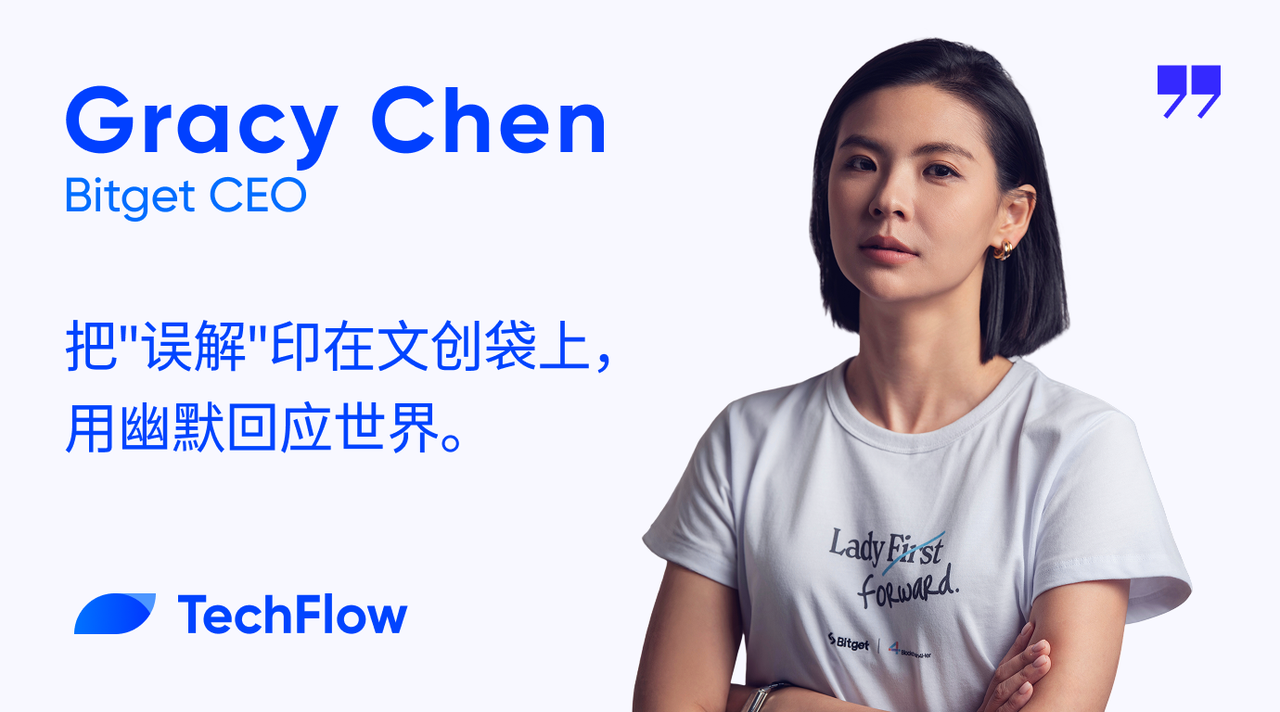
She is jokingly referred to as "very good at pretending," yet she boldly printed this teasing remark on a cultural bag, taking it into the industry conference.
As the leader of the global leading cryptocurrency exchange Bitget, Gracy has led this giant vessel of two thousand people in her two years since becoming CEO, turning its focus from "pursuing quantity" to "pursuing quality."
From a deep cultivation of the Chinese market to a global layout, from taking the lead in launching the UEX strategy to embrace traditional assets to going all in on AI to welcome the silicon-based life era, Bitget is rapidly reshaping the trading ecosystem at an extraordinary evolutionary pace.
During the Web3 carnival, we had an in-depth conversation with Gracy, who shared for the first time her comprehensive insights into Bitget's strategic evolution and business logic, from personal opinions and company strategies to family. She also shared her transformative journey from Managing Director to CEO. In this uncertain period, let's see how this female leader manages a "larger stage" with her "dedicated calmness." After shedding the aura of a CEO, she embodies the softness and resilience of a single mother.
Facing criticism head-on, with "misunderstanding" printed on the cultural bag
Q1: You often appear in the Chinese market. In your view, which regions is Bitget currently most focused on, and how does the Chinese market differ from other regional markets?
Gracy:
The regions Bitget focuses on are the most active areas in the entire cryptocurrency industry.
The user base and trading volume in the Chinese-speaking region account for 25% to 1/3 of the global market share, with the US market having a similar proportion. The European English-speaking market has a large volume, but it is decentralized, with differences in languages and cultures across countries, and Eastern and Western European markets have distinctly different characteristics. In the contract trading field, some East Asian countries perform exceptionally; however, if we look at the spot market, the aforementioned core regions are all major markets, while emerging areas in Latin America, Southeast Asia, and Europe represent new growth points.
Bitget has been deeply involved in the industry for over seven years, serving over 100 countries globally with a perspective on global operations. Most core team members are Chinese, and I personally grew up in the Chinese-speaking region, where Chinese is my mother tongue. Many team members come from traditional finance and the Web2 tech industry, so our focus on the Chinese market is undoubtedly significant. The Chinese market is the business area we are most familiar with and also one of the mainstream markets globally.
Q2: I often see your travel and personal growth posts on Xiaohongshu. How do you balance travel and your CEO work? What is your favorite travel destination, and why?
Gracy:
Such questions are quite enjoyable to chat about; it shouldn't always be about work.
New Zealand was my travel destination during last year's National Day holiday. Major holidays like Christmas, National Day, Labor Day, and Spring Festival are times when many in the team choose to take vacations. During last year's National Day, I was invited to participate in a local innovation and entrepreneurship competition in New Zealand and gave a speech while interacting with several local friends, including a buddy from my MIT days, now a female member of the New Zealand Parliament, who even accompanied me to the New Zealand Parliament. I prefer deep cross-border travel, typically staying five to six days, but I stayed in New Zealand for seven or eight days, allowing for a very immersive experience, which I enjoyed immensely.
Travel is significant for me, and while our company is indeed very competitive, and we are even humorously known as the Huawei of the crypto space, I want to clarify that our so-called badge of being the Huawei of the crypto space doesn't mean our work hours are excessively long. It's closer to a "Work hard and play hard" mentality. For instance, we don't require everyone to clock in at work or insist they come to the office daily, even though we have offices worldwide; we value results more. As long as you achieve the results, you have flexibility.
Our team members also deserve vacations, but we care a lot about ensuring work still gets done during these times. Thus, I usually travel during such holidays. This year during Labor Day, I just happened to be in Miami for Consensus since we are processing some business in the US.
If it's pure travel, I probably enjoy exotic places like Morocco and Turkey the most among the places I've currently visited. However, for more leisurely travels, I really enjoy Italy. But there are still places on my list I have yet to visit, such as Tanzania, to see the animal migration, as well as both polar regions, which are more adventurous types of travel that I look forward to.
Q3: On Xiaohongshu, you faced some negative comments; what do you think are the most misunderstood evaluations of yourself? What is the truth?
Gracy:
There has been a very popular bag recently, right? At this year's conference, since we did not have a booth, our marketing colleague suggested: "Since we don't have a booth, let's create a mobile booth." Then they asked me if I minded using your photo to make an eye-catching bag. I immediately said yes without thinking. I remember one slogan on it that says, "I'm socially anxious, but this bag is very confident." So I feel there's a misunderstanding; everyone really thinks I'm very socially confident, but I'm actually not socially anxious; I have recently started to enjoy spending time alone.
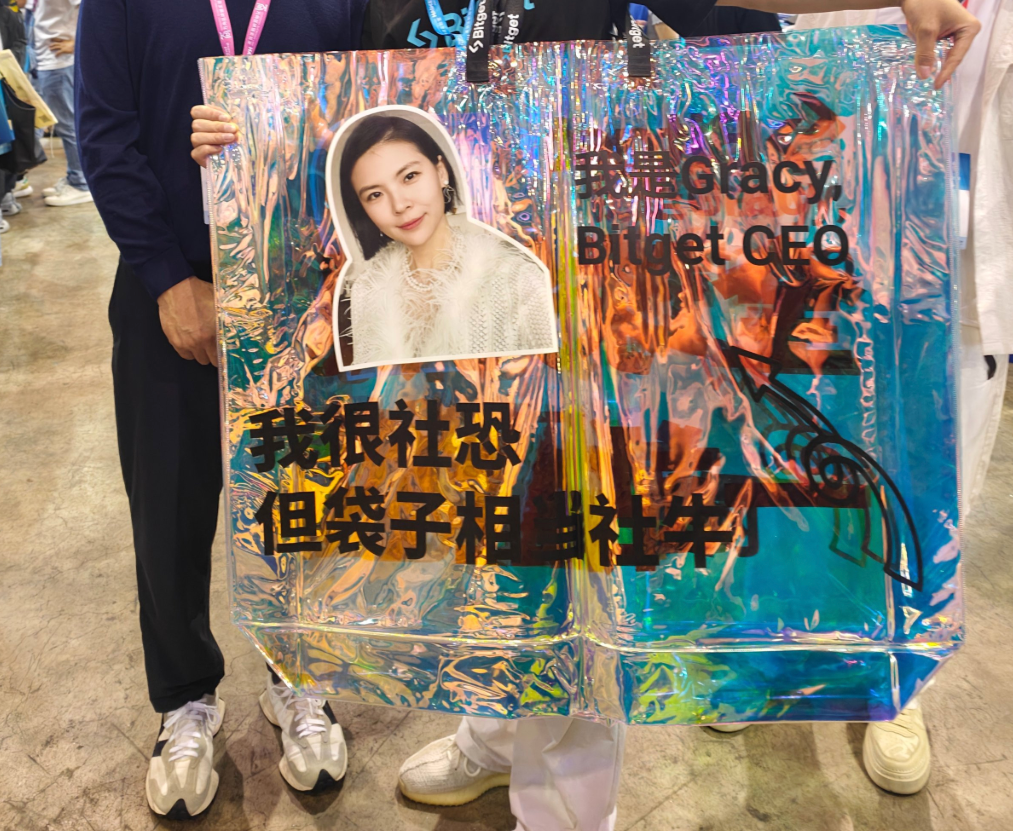
I believe at my core, I am an E person, but due to this job, I have become increasingly I. I believe another misunderstanding presented on that bag states, "I'm very good at pretending." So we boldly printed these misunderstandings directly on the bag as my response, and I feel that in this highly competitive industry, attracting everyone's attention is also a good thing in my view. Thus, as they say, bad engagement is still engagement.
On the other hand, in today's era, everyone is becoming more tolerant. For example, people are very accepting of female CEOs or female leaders who can be strong and have sharp viewpoints, as well as their softer sides in life. Meanwhile, I think people are also becoming more tolerant of brands using creative methods for marketing.
However, there was a more controversial incident where Bitget Wallet used a well-known kissing photo in Dubai for a promotion. Our Wallet team had obtained the consent of both individuals involved, but it was released without my approval, and when I saw it, I felt it might be a bit much; later, many netizens criticized it, so we pulled it offline.
What I want to say is that from the company's perspective, we are open to innovation. I believe that during such processes, similar situations will occur that require us to find the right balance. I think we must first encourage innovation because if we are not tolerant of even small mistakes, then no one will dare to innovate, and the core communicative and creative power of the brand may lie in these areas.
Breaking the deadlock and reshaping: UEX strategy, RWA wave, and the new trading paradigm of the silicon-based life era
Q4: Bitget was the first to actively launch stocks, IPOs, and precious metals-related assets. I heard some exchange users already account for a significant portion in stock trading volume. Could you please share what changes occurred in user behavior and position structures after the launch of traditional assets at Bitget? From a data perspective, how much do you think Bitget's UEX plan has achieved?
Gracy:
UEX is our long-term strategy, and gathering various assets is only the first step. From the data, we have already seen some shifts. For instance, in Q1 this year, the trading volume of non-crypto assets (non-crypto) on our platform was close to 40%. At the same time, we discovered that the user acceptance of non-crypto assets in the UEX sector has notable regional characteristics.
Taking US stock tokens as an example, in regions where there are asset controls, foreign exchange restrictions, and difficulties in opening US stock accounts, users show a higher acceptance of our products. Firstly, we do not do business with sanctioned countries; for instance, even if Iran offers us money for business, we would not accept it. However, in many regions, it is indeed difficult to open accounts for US markets, and we notice that these users are naturally drawn to us when making global asset allocations because they previously had no other channels. We are not an optional existence, but a necessity, so such regions display such characteristics and demonstrate higher acceptance.
Secondly, over half of Bitget's users come from Asia. In January and February of this year, geopolitical conflicts led to significant fluctuations in the prices of precious metals and oil, which caused trading volumes to suddenly soar; on peak days, the trading volume of gold on our platform was almost comparable to Bitcoin's trading volume.
Since launching the UEX strategy in September of last year, we completed a large number of US stock assets by Q4; in January of this year, we achieved layouts for commodities like gold and oil through CFDs, as well as foreign exchange assets. However, users must adapt to new products, and unexpected events like geopolitical conflicts become catalysts for improving user acceptance. For example, during significant corrections in gold prices, user trading activity also increases, and combined with leverage factors, certain liquidation situations occur, which are normal in high-volatility markets.
Looking at the UEX strategy now, I believe we are still in the first stage. The first stage, as I define it, is to comprehensively cover these assets. In the next stage, we need to continuously optimize the products we have launched.
For instance, US stock tokens are currently viewed as a relatively mainstream thing in RWA. However, many existing models, like Ondo and xStocks, have already been nearly a year in the making. Although we launched ours around last September-October, we still encounter numerous issues. For example, a major user issue is regarding whether dividends will be issued or not. The design of the mechanism for issuing dividends is quite obscure; however, dividends are provided, but they cannot be directly credited to your account. The mechanism works through the underlying SPV purchasing the asset backward, thus reflecting it in the pricing. Therefore, while you are entitled to receive the economic rights of the dividends, you won't directly see the dividend in your account. Because of this mechanism, the underlying SPV's price, for instance, let's assume that the tokenized product of Meta currently at $500 after it pays a dividend, might increase to $510, but the underlying Meta remains at $500, leading users to feel confused about the widening price gap. All such problems are hard to perceive.
If you do not engage in trading, you might not understand these issues, and they are precisely what we need to continuously optimize in this second stage. For example, can we explore ways to clarify the dividend distribution mechanism, or how can we help users perceive this better? Extended trading hours like 24/7 or 24/5 sound enticing, but truly optimizing liquidity during weekends when the US stock market is closed poses challenges. There are many such issues we encounter while dealing with traditional assets.
Q5: I noticed that Bitget recently launched IPO Prime, which I understand is a key step in extending from the secondary market to the primary market in the UEX strategy. What is the logic behind choosing to partner with Republic and launching preSPAX? In your view, how does Bitget's design of "compliant SPV + structured subscription" compare to on-chain models and reservation and derivative models from other exchanges?
Gracy:
I wrote an article sharing some stories behind our collaboration with Republic. I've known the two co-CEOs of Republic Crypto for many years. There’s a little backstory—when I was with them at Dragonfly, we participated in some closed-door meetings together, and we won a championship together, which turned out to be a very interesting experience and strengthened my personal relationship with Republic and Andrew.
We contemplated launching the Pre IPO product last year because I knew they had a deep layout in this area, so I directed our team to discuss with Republic. However, it couldn't be just because Gracy and Andrew had a good personal relationship; we had to be objective. In fact, our team conducted a lot of market research, and it ultimately led us to Republic because they have extensive licensing across the US and Europe, and they have already issued pre-IPO tokens with other exchanges, allowing us to learn from their pitfalls to prevent issues, such as risks in terminology. For instance, when promoting the product, we refer to it as a debt claim rather than equity, as we do have a third-party SPV holding those equities, but we manage the compliance risks through our communication.
We chose Republic primarily because of their licensing, their existing experience, and their transparent mechanisms.
The Pre-IPO product from Republic is slightly more challenging than typical US stock products because predicting the timing and price of a company going public is not entirely feasible. For example, in the case of SpaceX that we are currently focusing on, it is up to Elon Musk to decide when it will go public. We started designing this product last year, but in March this year, an event occurred with SpaceX merging with xAI, acquiring Grok along with it, causing all previously negotiated terms with sellers of secondary shares to change abruptly, resulting in everyone needing to renegotiate. There are many such details that only become clear when you genuinely engage in the product development.
Moreover, we aim to provide this to users at cost price; hence, we don't seek to profit from this product but focus on issuing user benefits.
Many users will ask why this time we are valuing it at $1.5 trillion, while Reuters estimated its post-IPO valuation at $2 trillion. Currently, on some platforms, the trading valuation has exceeded $2 trillion. Users may doubt why Bitget is so cheap and whether it poses some mapping risks of not being 1:1. I want to explain that this is because we required our third-party SPV to acquire and confirm a valuation in the market six months ago. Thus, the low valuation users receive today represents a timing difference—the valuation we secured six months ago now being quoted at today’s price, allowing users to pick up a bargain instead of implying a lack of mapping. For us, 1:1 mapping is our utmost priority when launching all RWA products. From the design of the Pre-IPO product mechanism, we will ensure that after the IPO, the price of “pre-sale” tokens aligns 1:1 with the stock tokens of the asset.
Q6: You previously mentioned in an interview that "the four-year cycle still exists, but it has now been 'smoothed out' by Wall Street capital represented by ETFs + DAT." The global market is rapidly reassessing macro risks. What impact do you think this has on exchanges, and what strategic shifts are you making?
Gracy:
Of course, we have made significant strategic adjustments. The reason why we came up with the UEX concept is that we noticed that pure crypto no longer satisfies our users or align with our development cycle. There are certain clear trends in the market that we have observed that we need to capture.
For instance, the growth of stablecoins. Stablecoins are rapidly attracting more traditional funds, even from family offices, endowments, and particularly in cross-border payments. The other day, a friend of mine, who runs many stores in Yiwu and is not directly related to us, told me he holds a lot of USDT. I asked him why he has so much USDT, and he replied that it's widely used in Yiwu because it's the most convenient asset for cross-border transfers.
There are many similar scenarios, and I am confident that the number of stablecoins held by individuals will only increase. Additionally, they will account for a higher proportion compared to fiat currencies. Thus, we hope to capture the incremental trading of stablecoins since Bitget mostly focuses on trading. Bitget Wallet and some of our other sister companies deal more in payment scenarios, but we believe that as stablecoins become more prevalent in payment processes, they will likewise become used more in trading. Thus, this is the first opportunity we wish to seize—utilizing U for transactions.
The second opportunity relates to RWA, where the market capitalization of US stock tokens currently sits at just 0.1%. In markets like money market funds and private credit, this figure may have reached at least 0.5% - 1%. I believe that the tokenization of US stocks will accelerate significantly with the involvement of the New York Stock Exchange and Nasdaq, possibly reaching a singularity, as in our discussions, we find these institutions are deeply engaging with new public companies to explore direct token issuance. While they will still operate under existing structures like ATS, including custodial arrangements under DTCC within the original US stock framework, the pace of tokenization is rapid, as they have submitted applications to the SEC and are awaiting approval.
We are also looking to collaborate with them on certain channels, but overall, RWA is growing; gold can be tokenized, oil can be tokenized, and as mentioned, US stocks can be tokenized, even pre-IPOs. Many financial assets can be tokenized.
However, we do recognize certain boundaries. For instance, the RWA of real estate is a hot topic, but as a global exchange, the RWA of a property in Hong Kong is too disparate from one in Dubai, and they face different local regulations regarding recognition and compliance. Many such diverse rules exist, making it not an asset that users typically wish to trade. We will predominantly be supporting more standardized financial assets for RWA.
Thus we have essentially decided not to engage in RWA for collectibles or real estate but to firmly support fairly standardized financial assets beyond that.
Q7: Bitget is quite prominent in AI, whether in the internal usage by employees or through the launch of GetAgent. Why are you so optimistic about AI, and do you worry about an AI bubble? Bitget should have around 2200 employees now; if everyone utilizes AI, in what areas do you believe it could lead to qualitative changes for the company?
Gracy:
I think there is a bubble in AI assets, such as certain US stocks where prices are already inflated, especially some long-tail stocks. I think Nvidia is relatively stable but still expensive; some long-tail AI stocks indeed bubble. However, in terms of the application of AI, I believe there’s no bubble.
Firstly, from our company's perspective at this time, I just spoke with our VIP team lead and asked him how many scenarios they are currently implementing AI in, and then I shared how I am using AI.
I’ve tried various AI tools, like creating images with Nano Banana with my son, which is somewhat personal life-oriented. I’ve been using AI for image and video generation for a while now; back when Midjourney emerged, I was already utilizing AI for graphics. Recently, I'm particularly fond of Manus and eagerly await my monthly 8000 credits. One interesting aspect of Manus is that, for instance, as we are working on our US operations, which I lead personally, I provide my Manus, a specialized American strategy AI agent, with lots of content while avoiding information leakage. I feed it information that I feel can be shared with AI, informing it about who I’m meeting and what we’ll discuss or whom I need to search for on LinkedIn; I let AI handle sending quick messages. If I need to do something else, I also let the agent quickly research on existing surveys to suggest potential collaborations.
I’ve built a knowledge base, so it inherently understands who Bitget is, who Gracy is, and knows my position and goals. Thus, when generating these contents, it does so rapidly without requiring repetitive groundwork. There’s even a fun agent in Manus teaching me how to date.
I’ve coordinated with Bill, the head of AI, and as of the end of last year, our company was actively employing AI in about 22 different scenarios. This number should have increased since then.
Returning to more primary application scenarios, what have we done using AI? For instance, very basic tasks such as customer service, translations, and establishing knowledge bases are areas where AI has done very well. Furthermore, in compliance scenarios, we employ AI to monitor KYT (know your transaction), and with the trading tools we have created, I believe that in the future, there may be more transactions occurring between AIs compared to transactions between people. Hence we have developed many trading tools. This year's popular crayfish led us to quickly launch GetClaw, which does not just provide information but can also directly execute orders. For example, once I receive a message on Telegram, I can give my GetClaw some instructions; it might also suggest insights, like what precautions to take while trading. All these functionalities can be managed by AI.
I’d like to share an important philosophy: we believe that the future world will, of course, begin with Bitget's transformation. I’ve told the entire company that I think the future is an irreversible trend of carbon-based and silicon-based life forms working together. You must embrace it; if you don't, you will be eliminated. Ultimately, it’s not the company that is replaced but you as an individual being eliminated by the times. Therefore, we advocate for everyone to use AI, and I also believe that throughout this process, those who do not use AI will be phased out, but more importantly, those who effectively utilize AI will see their efficiency grow fivefold or tenfold.
Discussing role models, 35 years of breaking waves and a steadfast calm in a secluded corner
Q8: Last year, you likely just celebrated your 35th birthday. If you were to summarize the first 35 years of your life in three words, what would they be? Compared to when you first joined Bitget as CEO in 2024, what changes have you observed at Bitget, and what personal changes have you experienced?
Gracy:
In terms of changes at Bitget since 2024, the first thing that comes to mind is: our focus and definition of user importance have changed a lot. In 2024, the TON ecosystem was very popular; we also had a close cooperation with TON, acquiring many users. However, one significant adjustment we made in 2024 was changing from an emphasis purely on numerical growth to a more in-depth focus on the value of each user—LTV (Long Term Value)—and our VIP and institutional users. So, the entire company's KPI has shifted from pursuing Quantity to pursuing Quality, which I believe is an important transition.
The second change revolves around our responsiveness to the evolving trends I mentioned earlier, starting from 2024, observing more traditional finance entering the market alongside RWA. In January 2024, Bitcoin ETF was approved, with Blackrock issuing the first Bitcoin ETF, marking a point where mainstream market institutions began paying attention to Bitcoin. After Bitcoin reached $100,000 last year, many friends from wealthy families began asking me if they should allocate 5% of their assets to Bitcoin. When Bitcoin hit $100,000, I actually discouraged many of them. If you check my Twitter from that time, you'll see that I advised many against it, which led to some backlash. However, looking hindsight, that caution at $100,000 turned out to be a reasonable choice. I was explaining back then that there is indeed a bull-bear cycle, emphasizing not to leverage especially at that $100,000 mark, and I advised many of my friends accordingly. This indicates that cryptocurrency is no longer a niche but rather demands an embrace of regulatory compliance and institutional support for large capital flows. Thus, our company’s strategic adjustments became significantly clear last year.
As for my own changes, earlier, given how extroverted this job has made me, I’ve turned slightly more introverted. I've taken the MBTI test and am classified as ENTJ, but my E and I are increasingly moving towards the middle. I used to be extremely extroverted, but now that I have so much external work to manage, I’ve become more introverted.
The second significant growth aspect is my heightened focus on business. Previously, I was from the marketing background, behaving quite like a CMO in my role as Managing Director before 2024, yet as CEO, I now need to be concerned with many details, such as how we can become a better team with 2000 employees, aligning everyone's hearts on this. This aspect is quite challenging, as is recruitment. For instance, in our current US business operations, there are numerous details I used to discuss. If you were to talk to me about mechanisms like the IPO Prime or Ondo design in 2024, I might not have been able to engage in those discussions as thoughtfully as I do now, even without such topics on the table.
In summarizing my first 35 years, the first keyword would be "constantly reaching for larger stages." When I was at Chengdu Seven High School, I told myself I was in the best high school in Sichuan Province and that I had to go to Asia's best university. Hence, I attended the National University of Singapore, then after Singapore, I aimed for the world’s best university, eventually attending MIT—and this iterative, continuous growth resonates with me. Professionally, I transitioned from starting in Web2, joining Bitget, and becoming CEO to significantly expanding the company, which gives me a considerable sense of accomplishment.
The second keyword is "a serene calm in seclusion." It reflects a touch of introversion where I sometimes enjoy moments of bonding with my child.
The third keyword would be that I am less affected by appearances now. Referring back to the points on pretenses, I have started enjoying watching stand-up comedy and even perform. I once posted about stand-up comedy on Xiaohongshu, showcasing my enjoyment in using humor and satire to express opinions on various topics, including my insights on negative comments—something I have taken less seriously and even joke about now.
Life itself is a one-way journey, and it's important to let it unfold joyfully.
Q9: You often discuss your concern for your son. If you were to find a role model for your son, who do you think it would be, and why?
Gracy:
Sometimes I notice my son learning from me constantly in various situations. So, if I had to say someone current, I would suggest that I might be that role model.
When he was six months old, I once observed an interesting behavior. He drank some water from his bottle, finished it, and made an "ah" sound. I wondered where this "ah" came from; our nanny pointed out that when we finish something happily, we might also express that way. I realized that even at six months, he was continuously learning from my actions. Especially now, as a single mother without a partner, my son's father hasn’t seen him since 2022. Therefore, my influence, especially aided by my parents helping me care for him, plays a significant role in a small circle of family interaction.
By the way, I hope that one day I won't be his role model anymore. He'll surpass me to find his own ideal role model.
Q10: Who is one historical figure you admire the most? What qualities do you find attractive in him/her?
Gracy:
There are several role models for me. Honestly, when building Bitget, I really admire JP Morgan. I'm also reading his biography, and we encouraged many executives in our company to read it together because he lived during a transformative financial era from the 19th to early 20th century. During the Gilded Age, numerous events unfolded, particularly in the US, where industry rapidly expanded, and financial restructuring was undergoing a major reshuffle, all before the Great Depression. How did he respond to this transformative financial era? We can slightly resonate with that experience because crypto is currently reshaping traditional finance, and we have the opportunity to stand at a historical juncture to build a $10 billion company, which feels very mission-driven.
In terms of investment, I really admire Duan Yongping and Li Lu, who are deeply influenced by Buffett's value investing. When I applied for business schools, I even considered Columbia University seriously because they excel in value investing and offer opportunities to learn from master investors on Wall Street.
If I had to mention a personal life role model, it might be Yang Lan, who was my role model when I was much younger. I viewed her as a very knowledgeable sister, and I enjoyed reading her book "Pondering by the Sea" when I was in my teens. I even worked in Yang Lan's interview records during my internship and met her; I worked in her media studio where I learned a lot from them. Many of my role models I probably have met and learned directly from. However, I haven't met JP Morgan, as he belongs to history.
免责声明:本文章仅代表作者个人观点,不代表本平台的立场和观点。本文章仅供信息分享,不构成对任何人的任何投资建议。用户与作者之间的任何争议,与本平台无关。如网页中刊载的文章或图片涉及侵权,请提供相关的权利证明和身份证明发送邮件到support@aicoin.com,本平台相关工作人员将会进行核查。


