On May 2, 2026, Dragonfly partner Haseeb Qureshi clearly pointed out that the cryptocurrency market has entered a phase of "retail exit, institutional entry," signaling a profound transformation. In this narrative, Bitcoin is seen as a mature asset with sustained growth potential over the next 15 to 20 years, with institutional funds forming a solid bottom for the current market. However, institutional support does not mean the disappearance of risk; rather, it indicates a shift in the risk structure towards higher-dimensional on-chain leverage and protocol governance. According to AiCoin data, Bitcoin is currently hovering around two key price points of $81,961 and $74,752, accumulating approximately $1.07 billion in short liquidation intensity and $1.035 billion in long liquidation intensity, respectively. This extremely tight leverage distribution reflects fierce competition between bulls and bears in a narrow range, and any breakthrough in either direction could trigger a chain reaction on-chain.
This rearrangement of risk is not only reflected in the liquidation data of centralized trading platforms but is also deeply rooted in the underlying logic of DeFi protocols. Recently, Curve Finance disclosed that its CRV-long Llamalend liquidity pool has generated bad debts during the extreme market conditions in October 2025, leading some users to face asset losses and withdrawal restrictions, forcing the protocol to introduce a "bad debt recovery path" based on on-chain market mechanisms. Meanwhile, Bitwise announced it would liquidate and close two crypto-related ETFs, BTOP and BWEB, further confirming the passive clearing of institutional products in a stagnant gaming environment. This article will outline the evolution of risk in the crypto market under the backdrop of institutional support, focusing on several main lines: the capital competition in the high leverage liquidation zone, the bad debt repair mechanism of DeFi protocols, the competitive differentiation of oracle infrastructure, and the exit signals from institutional products.
Retail Retreat, Institutional Support: Who Holds the Chips?
On May 2, 2026, Dragonfly partner Haseeb Qureshi provided a clear characterization of the current market structure: retail has largely exited, while institutional funds are creating a substantive bottom for the market. In Haseeb's logic, Bitcoin is now seen as a mature asset with sustained growth over the next 15 to 20 years, with its pricing power shifting from highly volatile retail to long-term capital. However, this appearance of "institutional support" hides a high degree of fragility. Data compiled by Planet Daily shows that in April 2026, the total amount of financing in the crypto space was only $659 million, plummeting by 74% month-over-month, reaching a new low in nearly two years. The exhaustion of primary market financing and the absence of retail narratives in the secondary market have forced existing funds into a higher intensity of competitive state.
On-chain data intuitively reflects this concentration of high-risk preference. According to AiCoin data, whale address 0x049b opened approximately $90 million in high-leverage long positions on Bitcoin and Ethereum around May 2, 2026. Specifically, this address holds 586.68 BTC long positions, with an opening price of $78,540, and a liquidation price close to $75,564.02; at the same time, it holds 19,416 ETH long positions, with an opening price of $2,317 and a liquidation price of $2,247.43. The behavior of this single whale taking on extremely high leverage risks at critical price points confirms that in the absence of retail liquidity inflow, large accounts are forced to increase their leverage to seek returns, which undoubtedly exacerbates the sensitivity of price fluctuations within a narrow range.
At the same time, the retreat of traditional financial channels further squeezes risk premiums. Bitwise's official announcement stated that it would liquidate and close its BTOP (Trend Rotation Strategy ETF) and BWEB (Web3 ETF). According to the liquidation process, if investors do not actively sell their shares by May 21, 2026, their holdings will be passively redeemed for cash at net asset value around May 29. The sharp reduction in financing amounts and the shutdown of mainstream ETF products reflect an overall cooling of risk appetite for institutional-grade products in a stagnant gambling environment. In this structural adjustment, although institutional funds provide price support, the absence of new funds entering the market puts it in a "fragile balance" formed by high-leverage whales and defensive institutions.
Liquidation Squeeze Zone: High-Leverage Play Around $80,000
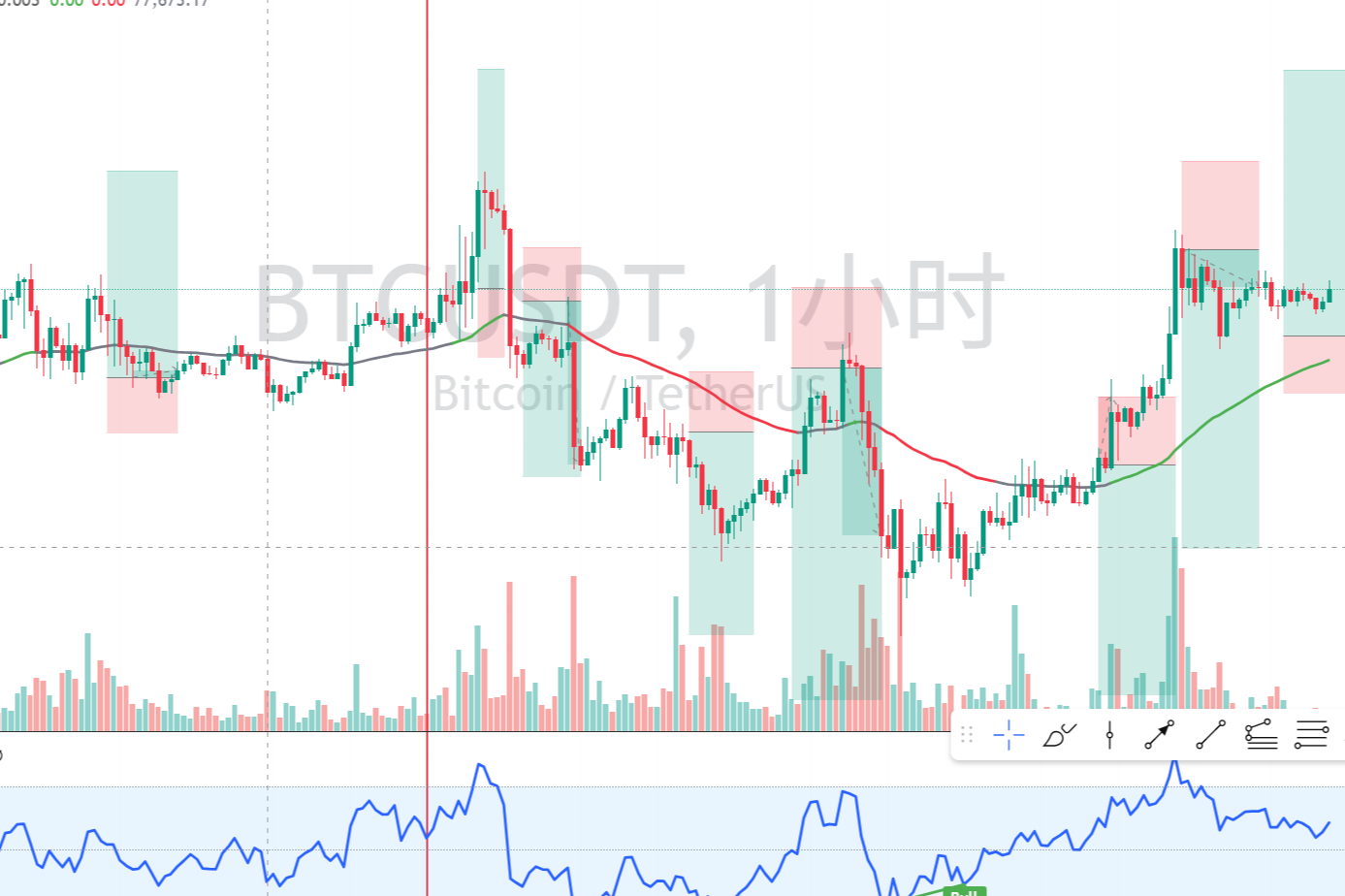
On the defensive cushion built by institutional funds, the competition in the existing market has evolved into an extremely tight leverage tug-of-war. According to AiCoin market data, Bitcoin is currently in a highly risky "liquidation squeeze zone": if the price breaks upward past $81,961, the cumulative short liquidation scale on mainstream centralized trading platforms is expected to reach approximately $1.07 billion; conversely, if the price drops below $74,752, the cumulative long liquidation intensity will also reach about $1.035 billion. This potential liquidation scale of over $1 billion in both directions reveals that high-leverage positions are densely packed in a price range of less than 10%, and the narrow fluctuations in the market hide a liquidity trap that could potentially be ignited at any moment.
This risk is particularly evident in the position structure of individual whales. On-chain monitoring shows that whale address 0x049b heavily opened long positions around May 2, 2026, holding 586.68 BTC (worth approximately $45.82 million) and 19,416 ETH long positions (worth about $44.67 million). Notably, the liquidation price for the BTC long positions held by this address is $75,564.02, which closely overlaps with the overall long liquidation zone of the market; its ETH long position has a liquidation price of $2,247.43. This multi-asset, high-leverage position structure means that once BTC reaches the liquidation zone triggering a chain liquidation, the resulting price impact will quickly spread to other assets like ETH, forming a cross-asset risk resonance.
Although these leveraged positions are primarily concentrated on centralized platforms, the severe volatility caused by passive liquidations poses a threat to the collateral safety margins of DeFi protocols through price transmission mechanisms. In a liquidity environment that is already tight, a rapid price decline can easily trigger the liquidation process of on-chain lending protocols. Without sufficient buyers to absorb the sell-off, the risk of liquidation in centralized markets will translate into selling pressure in on-chain liquidations, further squeezing the liquidity of DeFi protocols. For the DeFi market that experienced liquidity contraction in October 2025, this risk rearrangement driven by high-leverage whales remains the most significant systemic hidden danger.
Curve Bad Debt Recovery: How DeFi Handles Its Own Black Swans
This systemic risk driven by high leverage often manifests as difficult-to-digest bad debts on the balance sheets of DeFi protocols. According to AiCoin data, during the market crash in October 2025, the CRV-long Llamalend liquidity pool under Curve Finance suffered significant bad debt issues due to severe price volatility and rapidly shrinking liquidity. The speed of collateral liquidation failed to keep pace with the price decline, resulting in insufficient pool assets to support all user withdrawal requests, causing some depositors to face restricted withdrawals and substantial asset losses. Although this event was primarily concentrated in specific lending markets related to CRV longs, it did not affect all of Curve's liquidity pools, but it became a brutal example of risk control practices in the DeFi lending track.
To address this legacy issue, Curve Finance officially introduced a "bad debt recovery path" based on on-chain market mechanisms on May 1, 2026. The core of this mechanism is to make implicit bad debts explicit, split them into tradable debt shares, and grant impacted users three strategic options: to sell their debt shares directly in the secondary market for a quick exit, to hold onto their debt shares while waiting for potential recovery by the protocol, or to provide liquidity with the debt shares, thus earning trading fees and additional incentives provided by the protocol.
This approach provides a new risk control template for DeFi protocols to cope with extreme "black swan" events. By marketizing the pricing of bad debts, Curve effectively returns the decision-making power for risk management back to market participants, allowing funds with different risk appetites to reallocate risk on-chain. This practice not only alleviates the pressure for rigid repayment on the protocol but also demonstrates to the DeFi market in the age of institutional support how to achieve self-repair through transparent mathematical logic and incentive mechanisms without relying on centralized rescue.
Oracles and Prediction Markets: The Compliance and Security Race in Infrastructure
In the existing competition dominated by institutional funds, the accuracy of risk pricing directly determines the life and death of underlying protocols. Prediction markets are rapidly emerging as a new front in the competition for oracle data, as their high-frequency settlement needs for real-world events are reshaping the technical landscape of the track. According to relevant reports, leading prediction market platform Polymarket has adopted a dual redundancy strategy, introducing both Chainlink and Pyth as data sources. This shift aims to lower the event settlement discrepancies and technical risks that may arise from a single oracle through diversified data aggregation, ensuring the fairness of settlements under large fund competitions.
However, internal competition in the oracle track is intensifying due to the shift in application scenarios. Although Chainlink, as an industry leader, has a stable position, it is urgently seeking a second growth curve through emerging areas like prediction markets amid overall growth slowdown pressure. Meanwhile, Pyth continues to eat into the existing market share with its advantages in low-latency price data, becoming the preferred choice for many new projects outside Chainlink. In contrast, UMA, which was once highly anticipated, has seen its credibility eroded due to frequent governance disputes, affecting some parties' confidence in its decentralized arbitration mechanism. This differentiation reflects that as the weight of prediction markets and derivatives protocols increases in hedging risks on-chain, any data errors or governance flaws could be amplified into systemic settlement risks.
Beyond technical competition, the compliance path competition has also become a key factor affecting the liquidity of the track. According to publicly cited documents by Planet Daily, a16z explicitly stated in its comment letter to the CFTC that it supports the implementation of unified regulation by the federal CFTC on prediction markets. a16z warned that allowing states to conduct decentralized regulation would severely weaken the overall liquidity of prediction markets, leading to deep fragmentation in the market. This compliance demand from top venture capitalists reveals the core contradiction in the infrastructure track during institutional transformation: while pursuing on-chain transparency and security, regulatory uncertainties must be addressed to alleviate liquidity constraints, thereby accommodating larger institutional risk hedging demands.
From Leverage Liquidation to Protocol Bad Debt: The Next Round of Risks Lies on-Chain
With the significant retreat of retail investors and the establishment of institutional support, the risk structure of the cryptocurrency market is undergoing profound changes. According to AiCoin data, Bitcoin currently has approximately $1.07 billion in short liquidation amounts piling above $81,961, while below $74,752, there is $1.035 billion in long liquidation intensity. This extremely compressed leverage zone reflects the intense nature of existing market competition. Haseeb Qureshi pointed out that the strong "stickiness" exhibited by tracks such as DeFi, stablecoins, and RWA indicates that the market focus has shifted from short-term price speculation to the robustness of financial infrastructure. The decline of crypto financing to $659 million in April 2026, a two-year low, further confirms that funds are flowing back from high-risk early projects to leading protocols. Tether's Q1 financial report, showing a profit of $1.04 billion and excess reserves of $8.23 billion, not only endorses the safety of leading issuers but also signifies that liquidity is concentrating towards "certainty assets" with high compliance expectations and reserve support.
In this context, the future core of risk will lie within protocol governance and product design. The market-based recovery path introduced by Curve Finance for the bad debts in 2025, along with Bitwise's announcement to liquidate BTOP and BWEB crypto ETFs, jointly indicate that the compliance framework for financial products and the mechanisms for handling bad debts will replace single-price fluctuations as new sources of volatility. The competition for shares between Chainlink and Pyth in the oracle track, as well as Polymarket's compliance exploration in event settlement, unveil the vulnerabilities and resilience of the infrastructure layer when accommodating institutional demands. Looking ahead, as AI agents intervene as trading intermediaries and savings-type, passive on-chain assets become mainstream, the dimensions of risk monitoring must expand from mere price monitoring to encompass comprehensive tracking of protocol liquidation bands, bad debt ratios, and regulatory friction coefficients. The $90 million long position held by whale address 0x049b and its precise liquidation line setting epitomize this structural gaming era: under the narrative of institutional support, only funds capable of navigating the risk and compliance fog surrounding protocols will survive in the next wave of on-chain financial trends.
Join our community, let's discuss and grow stronger together!
Official Telegram community: https://t.me/aicoincn
AiCoin Chinese Twitter: https://x.com/AiCoinzh
AiCoin on-chain: https://aicoin.com/hyperliquid
Exclusive Hyperliquid benefits for AiCoin: https://app.hyperliquid.xyz/join/AICOIN88
Exclusive Aster benefits for AiCoin: https://www.asterdex.com/zh-CN/referral/9C50e2
免责声明:本文章仅代表作者个人观点,不代表本平台的立场和观点。本文章仅供信息分享,不构成对任何人的任何投资建议。用户与作者之间的任何争议,与本平台无关。如网页中刊载的文章或图片涉及侵权,请提供相关的权利证明和身份证明发送邮件到support@aicoin.com,本平台相关工作人员将会进行核查。