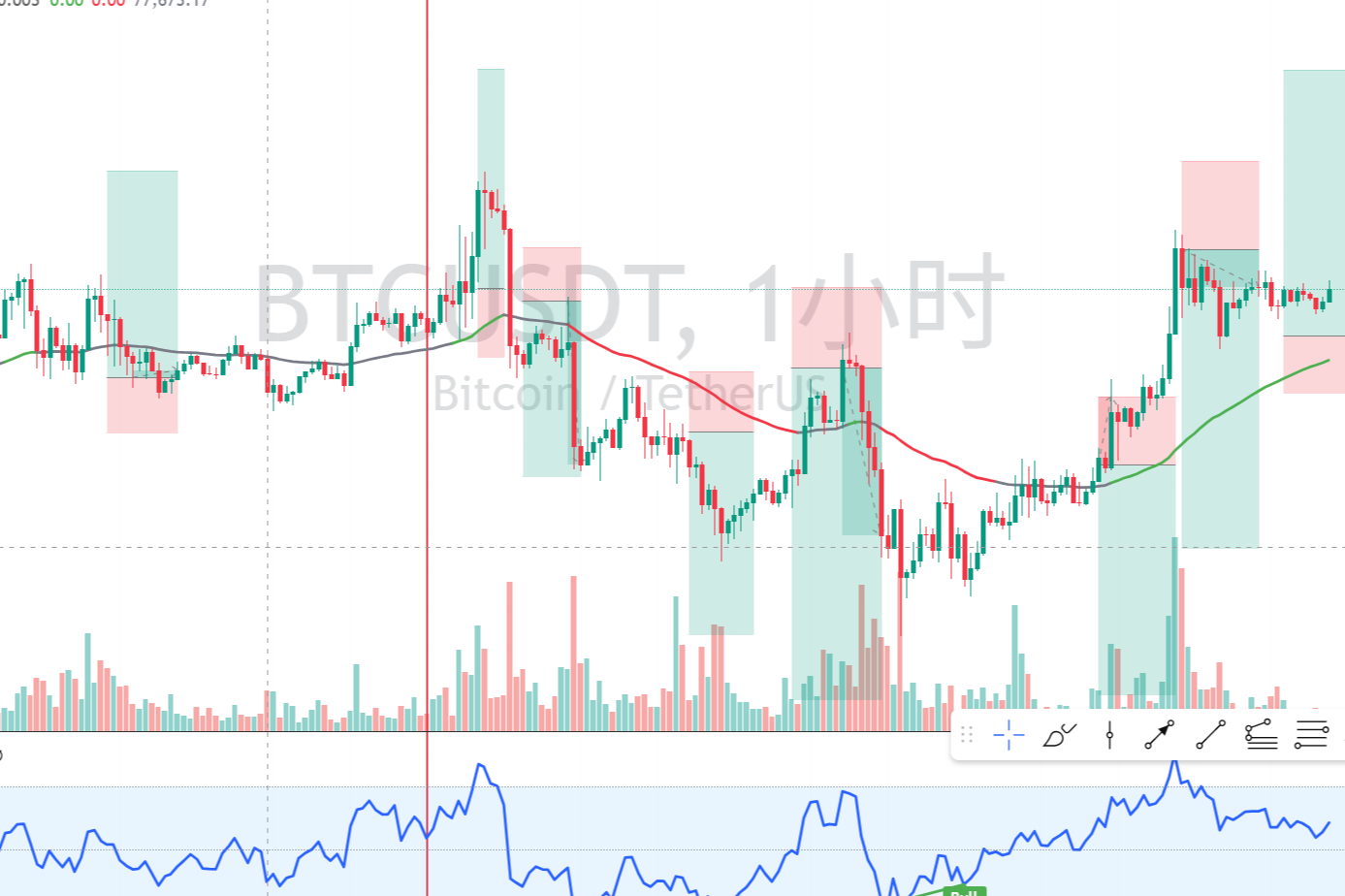
On May 2, 2026, according to data monitored by AiCoin in the derivatives market, BTC is entering a game zone characterized by extreme leverage concentration and highly symmetrical confrontations between bulls and bears. Based on the statistics for contract position liquidation intensity from major centralized exchanges, there are billions of dollars worth of potential forced liquidation positions on both the upper and lower sides of BTC at its current price, forming a rare "two-way liquidation wall" pattern. Specifically, data shows that if the BTC price breaks above $81,961, the cumulative liquidation intensity of short positions is expected to reach approximately $1.07 billion; conversely, if the price falls below $74,752, the cumulative liquidation intensity of long positions will also reach about $1.035 billion.
This data distribution reveals the two most critical liquidation concentrations in the current derivatives market, reflecting that the leverage concentration degree of both bulls and bears has fundamentally reached equilibrium in terms of magnitude. This high concentration of positions indicates that the market is in an extremely tense state, with bulls and bears repeatedly sawing back and forth in a narrow range, leading to a significant accumulation of leveraged funds. From the perspective of market structure logic, these levels are not only critical risk thresholds but also have a significant amplifying effect on short-term trends: once prices touch the critical point in either direction, large-scale forced liquidation chain reactions will provoke a surge of passive orders, drastically increasing volatility in a short time. In the current highly leveraged environment, this accumulation of liquidation density often signals that the market is building up momentum for a breakout, and any probing breakout in either direction could evolve into a deep liquidation of opposing positions.
Break above $81,961: $1.07 billion in short positions waiting
According to AiCoin data, as of May 2, 2026, the liquidation map in the BTC derivatives market shows a very high concentration of chips. If the BTC price rises further and exceeds $81,961, the cumulative liquidation intensity of short positions on major centralized exchanges is expected to reach approximately $1.07 billion. This data reveals the distribution center of leveraged short positions in the current derivatives market, where $81,961 has become the most critical liquidation concentration level above. It is essential to clarify that these pending liquidation amounts are primarily constituted by leverage positions in the contract market rather than selling pressure from the spot market, meaning that this level is not only a psychological resistance but is also the "red line" that determines the fate of a large amount of leveraged capital.
Once the price touches and stabilizes above $81,961, the market is likely to trigger a severe "short squeeze" scenario. When the concentrated short positions reach the strong liquidation threshold, the system will be forced to buy BTC at market prices to close positions, leading to a large influx of passive buying demand that rapidly drives the price up and hits higher liquidation lines, creating a chain reaction. This liquidation-driven acceleration often accompanies a surge in trading volume and an instantaneous explosion of volatility, but its essence is a liquidity shock triggered by leveraged unwinding. From a market logic perspective, such squeezes are more about reshaping market sentiment and capital structure in the short term rather than directly changing BTC's long-term value center. Under this extreme volatility, the release of liquidation forces often signifies a phase of reshuffling among short positions.
Fall below $74,752: $1.035 billion long positions in trouble
While the bulls attempt to push above the $81,000 mark, the defensive pressure below is equally significant. According to AiCoin data, the current market also has accumulated a very high leverage concentration in the downward range. If the BTC price falls below $74,752, major centralized exchanges are expected to trigger a cumulative liquidation intensity of approximately $1.035 billion in long positions. This price level is regarded as the most important liquidation concentration area for long positions below, with many high-leverage bulls choosing to set their margin defense lines near this position. Once this support level is breached, systemic forced liquidation orders will concentrate in the market in a short time, creating tremendous selling pressure.
This selling triggered by liquidation often has a domino effect, known as the "long-killing" logic. When the price touches the dense area at $74,752, automatic liquidation orders will further compress market liquidity and lower prices, leading to a deeper level of stop-loss triggers. Notably, the movements of whales detected on-chain have already indicated the proximity of this risk. For example, whale address 0x049b currently holds a long position of 586.68 BTC with an average opening price of $78,540, while the liquidation price is set at $75,564.02. This means that before reaching a liquidation zone of $1 billion, heavily weighted long positions at the market's top face the risk of being forced out, and the failure of the whales could likely become the spark that ignites a further round of massive liquidations below.
From the overall leverage structure perspective, the current BTC market presents a typical situation of being "sandwiched by high leverage at both ends." The $1.035 billion long position liquidation scale corresponding to the $74,752 level is closely matched in magnitude with the $1.07 billion short position liquidation intensity corresponding to the $81,961 level. This relatively symmetrical distribution of long and short leverage risks reflects that market sentiment is at a critical point of extreme combat. The current situation is extraordinarily sensitive to significant price fluctuations in either direction; any breakout will trigger liquidity shocks of at least $1 billion, and such leverage squeezes are often the root cause of non-linear explosions in market volatility.
$90 million whale high leverage long position risk
In the context of the overall market's fierce battles between bulls and bears, the direction of large single positions often serves as a "trigger" for chain reactions. According to media reports citing Lookonchain monitor data, on May 2, 2026, the on-chain address 0x049b showcased a high risk exposure, executing typical large single high-leverage operations. Specifically, this whale holds a long position of 586.68 BTC, equivalent to about $45.82 million based on the market price at the time; simultaneously, this address also holds 19,416 ETH long positions valued at roughly $44.67 million. This indicates that this single address's total exposure in BTC and ETH is approaching $90 million, representing a rare behavior of "heavy long positions" in the market.
This extremely concentrated position structure makes its net asset value very vulnerable to price pullbacks. According to monitoring data, the whale's BTC long position has an average opening price of $78,540, while its liquidation price is set at $75,564.02; the ETH long position opens at $2,317, with a liquidation price of $2,247.43. Comparing the opening prices with liquidation prices reveals an extremely tight margin for error; the BTC price only needs to decline by about 3.8% to trigger a forced liquidation. In a high-leverage environment, this lack of a buffer zone in position strategy means this whale is in a high-risk operational state, and any slight price movement could lead its nearly $100 million position to face liquidation pressure.
More importantly, the liquidation node of this whale overlaps significantly with the aforementioned market's overall liquidation concentration area. According to AICoin data, if the BTC price falls below $74,752, the major exchanges across the network will face approximately $1.035 billion in cumulative long position liquidation intensity. The whale's BTC liquidation line of about $75,564 lies precisely at the upper edge of this large-scale liquidation region. Once the price hits this whale's liquidation trigger point, its close to $90 million in selling pressure will flood the market, easily producing a negative feedback effect of "long-killing." The liquidity shock caused by a large individual forced liquidation could directly drag the prices into the $1 billion systemic liquidation range, thereby amplifying market downward pressure in a short time and causing a severe explosion in volatility.
Centralized liquidations vs. DeFi bad debt in the Curve case
Unlike centralized exchanges (CEX) that force liquidations instantaneously through liquidation engines, on-chain DeFi protocols often face more complex risks of liquidity run and bad debt evolution under extreme volatility. Reflecting on the market crash in October 2025, this risk evolution path was particularly evident in the Curve protocol. According to Curve's official disclosure, at that time, the CRV-long Llamalend lending market under its umbrella failed to clear debts through liquidation promptly due to severe price fluctuations and rapid tightening of on-chain liquidity, directly transforming leverage position "liquidation risk" into the protocol's "long-term bad debt." This lag caused some depositors to spiral into withdrawal restrictions, resulting in debt gaps within the liquidity pool that were not completely covered by collateral assets, leading to substantial asset losses.
In response to this historical legacy issue, the Curve team announced a "recovery path" based on an on-chain market mechanism officially around May 1, 2026. This mechanism starkly contrasts with the one-off liquidation clearance logic employed by CEX, aiming to slowly repair risks through market-oriented methods. According to the official explanation, affected users were granted three self-selection options: first, to sell their debts on-chain for quick exits; second, to choose to hold on while the protocol works on potential asset recovery later; third, to enter specific pools as liquidity providers to hedge losses by earning transaction fees and additional protocol incentives.
The proposal of such a recovery plan reveals the uniqueness of DeFi protocols in handling systemic leverage risks. As the $1 billion level liquidation zone approaches, contrasting with the immediate explosion pressure faced by whales like 0x049b on CEX, the Curve case reminds the market: the risk boundaries of on-chain leverage do not stop at the liquidation price; the depletion of liquidity could lead risks to spread to depositors. Centralized liquidations pursue immediate clearing efficiency, while DeFi protocols strive to exchange time dimensions for repair space through debt trading and incentive mechanisms, addressing the deep asset gaps caused by liquidity踩踏.
The next observations on the liquidation tightrope
From the current state of the derivatives market, BTC is on an extremely balanced and dangerous "liquidation tightrope." According to data monitored by AiCoin, looking upward, if the BTC price breaks above $81,961, major centralized exchanges will trigger about $1.07 billion in short position liquidations; looking downward, if it falls below $74,752, it will face approximately $1.035 billion in long position liquidations. The high proximity of these two liquidation intensities in magnitude indicates that the leverage chips from both sides have densely stacked. For ordinary traders, using leverage in the current volatile environment requires careful calibration of their liquidation prices with the relative positions of these two clusters of over $1 billion to avoid compounding position risks in the zone of high liquidity踩踏.
Future market observation points should focus on three main threads: first, the BTC price's testing of the critical levels of $81,961 and $74,752, which determines whether the market initiates a short squeeze or a series of long liquidations; second, changes in positions of typical high-leverage addresses such as 0x049b, whose current total long position of about $90 million has a highly overlapping liquidation price ($75,564.02) with the market's dense liquidation area, making their position adjustments indicative; finally, attention should be paid to the progress of Curve and other DeFi protocols in implementing recovery mechanisms after the bad debts resulting from the October 2025 crash. The debt trading and liquidity incentive strategies provided by Curve not only serve as a sample for observing the speed of on-chain leverage risk digestion but also offer important references for how the market can reconstruct liquidity confidence after extreme volatility.
Join our community, let's discuss and grow stronger together!
Official Telegram community: https://t.me/aicoincn
AiCoin Chinese Twitter: https://x.com/AiCoinzh
AiCoin on-chain: https://aicoin.com/hyperliquid
AiCoin exclusive Hyperliquid benefits: https://app.hyperliquid.xyz/join/AICOIN88
AiCoin exclusive Aster benefits: https://www.asterdex.com/zh-CN/referral/9C50e2
免责声明:本文章仅代表作者个人观点,不代表本平台的立场和观点。本文章仅供信息分享,不构成对任何人的任何投资建议。用户与作者之间的任何争议,与本平台无关。如网页中刊载的文章或图片涉及侵权,请提供相关的权利证明和身份证明发送邮件到support@aicoin.com,本平台相关工作人员将会进行核查。