TL;DR
Background: From DAI to USDS, from MKR to SKY, Sky's Endgame is forming a new on-chain financial infrastructure.
Core Architecture: The stablecoin layer forms the liability side | The yield layer products protocol earnings | The capital allocation layer seeks, filters, and manages sources of yield.
Stars / Agents: Spark liquidity and lending | Grove focusing on institutional credit | Keel for multi-chain expansion on Solana | Obex for new asset incubation.
Opportunities: Demand for yield-generating stablecoins | RWA introduces real cash flow yields | Multi-chain expansion enhances use cases | Stars/Agents drive network growth.
Challenges: More competitors in the stablecoin space | Sustainability of yields | RWA introduces off-chain credit and liquidity risks | Multiple entities lead to risk dispersion but lack of transparency.
Conclusion: Whether Sky can become the next generation of on-chain financial infrastructure depends on its ability to establish long-term balance among yield, liquidity, transparency, and risk management.
Once the DeFi OG MakerDAO, is now returning to the market center in its new identity as Sky. In late April 2026, the core Stars protocol Spark of the Sky ecosystem absorbed about $1.3 billion in funds in a single week, with TVL exceeding $5 billion, driving a significant increase in the SPK token; meanwhile, the circulation of the USDS stablecoin has approached $12 billion, and the TVL of the sUSDS yield products has stabilized at around $5.4 billion, making it one of the largest yield-generating stablecoins globally. From DAI to USDS, from MKR to SKY, from a single stablecoin protocol to a modular Agent Network driven by Stars like Spark, Grove, and Keel, Sky's Endgame has evolved from merely a governance blueprint to a new on-chain financial infrastructure.
1. The Glory and Bottlenecks of MakerDAO: The Origin of Endgame
In the history of DeFi development, DAI holds a pivotal position. After the mainnet launch in 2017, DAI became one of the first decentralized stablecoins to achieve mass adoption. Unlike stablecoins such as USDT and USDC, which rely on centralized issuers to hold dollar reserves, DAI's issuance depends on over-collateralization, on-chain liquidation, oracle pricing, and DAO governance: users can deposit ETH, wBTC, stETH, USDC, and other assets into Maker Vaults to mint DAI; when the collateral ratio falls below system requirements, the protocol recovers debt through a liquidation mechanism to maintain system solvency.
This design enabled DAI to play an extremely important foundational currency role in the early days of DeFi. Lending protocols, DEXs, yield aggregators, leveraged strategies, and DAO treasury management all extensively used DAI as a unit of account, settlement asset, and liquidity medium. It proved something groundbreaking at the time: that on-chain credit currencies priced in dollars could be generated without bank accounts, a single issuing company, or traditional financial intermediaries, simply through collateralized assets, automatic liquidation, and decentralized governance. In a sense, DAI was the key piece that enabled DeFi to transition from “asset trading” to “financial systems.” The success of DAI also gradually pushed MakerDAO toward more complex system boundaries. However, the issue is that the original MakerDAO governance framework was not designed to manage such a sprawling financial network.
Governance Complexity: The early governance focus of MakerDAO was primarily centered around adjusting collateral ratios, debt ceilings, stability fees, and liquidation parameters. However, with the increase in collateral types, governance issues began to expand into multiple dimensions, including oracle security, asset credit assessment, legal structures, PSM asset allocation, RWA custody arrangements, yield distribution, and protocol capital management. MKR holders now need to deal with not just single DeFi protocol parameters, but an ever-expanding financial balance sheet involving multiple assets, multiple durations, and multiple sources of risks.
Growth and User Experience: DAI has strong brand recognition among DeFi-native users, but for a wider audience, MakerDAO's product narrative has been complex. Users need to understand what a Vault, collateral ratio, liquidation line, and stability fee are, as well as the differences between DSR, PSM, MKR governance, risk parameters, and various collateral types. Compared to stablecoins like USDT and USDC, which can be used upon purchase, DAI's advantages lie in transparency, native on-chain characteristics, and control by multiple entities, but its disadvantages are also evident: the entry isn't intuitive enough, yield expression isn’t direct, and product branding isn’t consistent.
Transformation of Yield Sources: With fluctuations in on-chain collateral demand, MakerDAO has needed to seek more stable, sustainable income sources. In 2023, MakerDAO increased its allocation to real-world assets such as U.S. Treasuries, reaching about $1.2 billion. The introduction of RWA significantly improved MakerDAO’s revenue structure but also altered the risk nature of the protocol. Unlike on-chain assets like ETH and stETH, real-world assets such as U.S. Treasuries, institutional credit, CLOs, and mortgages involve legal entities, custodial arrangements, duration mismatches, credit risks, information disclosure, and regulatory frameworks. These risks cannot be resolved entirely through smart contract liquidation or simply rely on ordinary MKR governance voting to manage. MakerDAO began to face a problem more akin to traditional finance: how to establish a reliable risk control system between on-chain transparency and off-chain legal assets.
Stablecoin Competitive Landscape: DAI was once the representative of decentralized stablecoins, but the scaling of the stablecoin market is not solely determined by the degree of decentralization. USDT relies on exchange liquidity and a global payment network to establish a strong position, USDC attracts users through compliance, institutional channels, and transparency of dollar reserves, while Ethena stimulates demand for high-yield stablecoins through synthetic dollars. In this environment, if DAI remains at the status of "legacy DeFi stablecoin," it will struggle to shoulder MakerDAO’s next phase of growth targets alone. MakerDAO must answer a new question: as stablecoin competition expands from "who is more stable" to "who can provide better yields, stronger distribution, broader scenarios, and clearer compliance pathways," how does DAI need to evolve?
The core aim of Endgame is to establish new organizational and growth methods among these bottlenecks. It is not merely a renaming of the brand; it is not simply launching a new token, but a structured response to MakerDAO's complexity: reducing the burden of single governance through a modular architecture, specializing business development and capital allocation through Stars/Agents, mitigating single business line contagion through risk isolation, improving user experience and yield expression through USDS, Sky Savings Rate, and sUSDS, and extending income sources through RWA, DeFi lending, and multi-chain layouts.
2. From MakerDAO to Sky: Upgrading Stablecoin Paradigms and Systematic Reconstruction
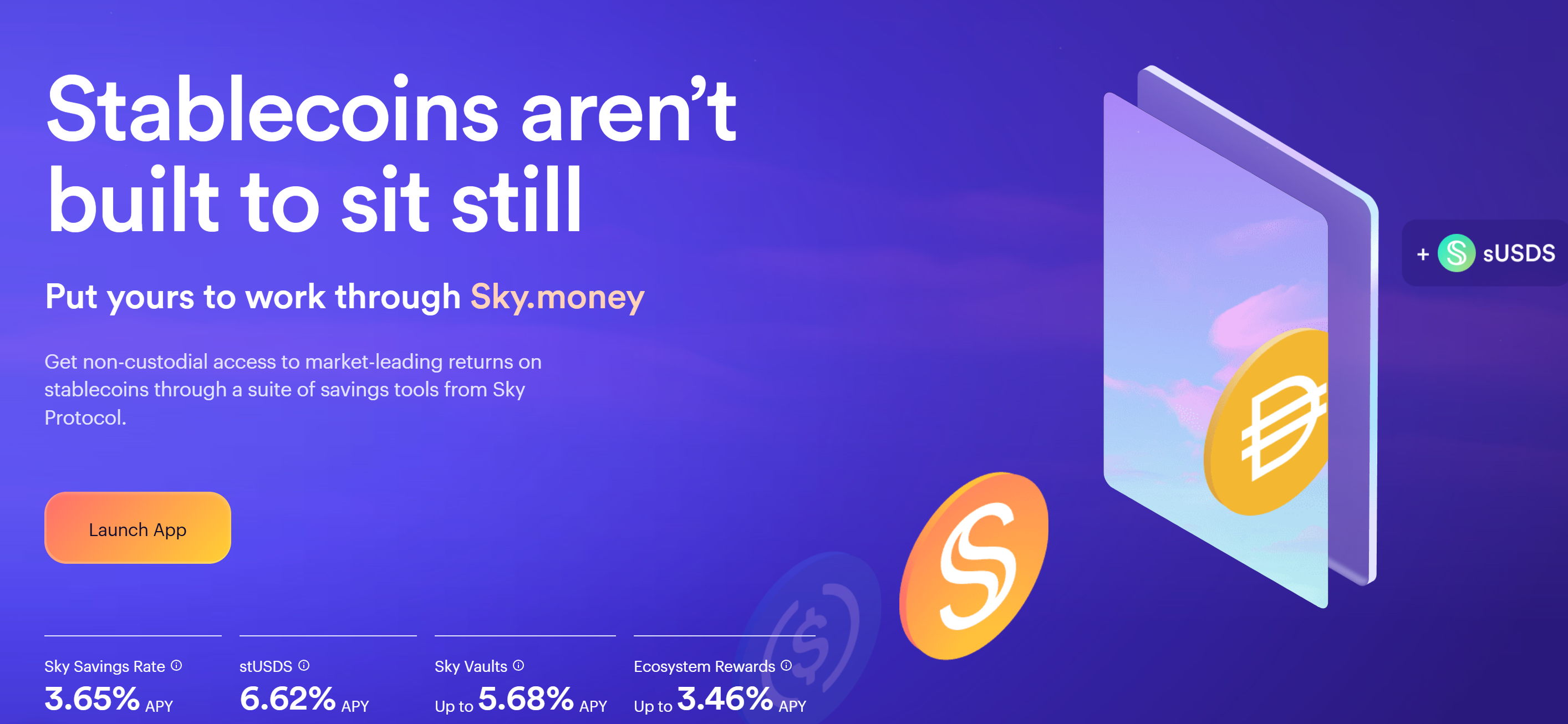
Source: https://sky.money/
Sky is not just a brand upgrade of MakerDAO's history, but a result of the accumulated stablecoin credit, RWA experience, and DAO governance contradictions of the DAI era. MakerDAO proved that decentralized dollars can be created on-chain, while the question Sky must answer is whether an on-chain financial infrastructure network can be formed that is scalable, manageable in risk, and can continuously generate real yields.
1. From Maker to Sky: Reconstructing the Stablecoin Entry
In August 2024, MakerDAO publicly announced its renaming to Sky and introduced the upgraded stablecoin USDS and governance token SKY. DAI can be exchanged for USDS at a 1:1 ratio via the official converter, and the exchange ratio of MKR to SKY is 1:24,000; meanwhile, DAI and MKR do not immediately disappear, but will coexist with USDS and SKY for an extended period, providing a migration buffer for existing users, DeFi integrators, and governance participants.
(1) DAI → USDS
The core difference between DAI and USDS first lies in the product positioning. DAI is the crypto-native stablecoin of the MakerDAO era, historically emphasizing decentralized collateralization, on-chain liquidation, and DeFi composability; USDS, on the other hand, is the flagship stablecoin of the Sky era, focusing more on user growth, yield entry points, reward mechanisms, and cross-scenario distribution, shifting the user experience from “using a stablecoin” to “entering a stablecoin yield and capital allocation ecosystem.”
Compared to the decentralized stablecoin brand of DAI, USDS is viewed by the market as a product form better suited for exchanges, institutions, real-world assets, and compliant scenarios. Some community members express concerns that the potential freezing function and compliance interface of USDS might undermine the long-term established identity of DAI as a decentralized asset; supporters argue that if Sky wishes to access wider liquidity, institutional credit, RWA assets, and multi-chain applications, adjustments must be made at the compliance boundary, risk disposal, and user entry points.
(2) MKR → SKY Upgrade
The MKR → SKY upgrade represents a transformation of governance tokens from “high-barrier governance assets” to “ecosystem participation governance assets.” MKR was previously the core governance and value capture token of MakerDAO, with a small supply, high unit price, and strong financial attributes, making it more suitable for deep governance participants and long-term capital holders; SKY, being more accessible in terms of unit price, distribution efficiency, and ecosystem incentives, is designed for use in governance on key protocol parameters such as Sky Savings Rate, and can participate in staking, rewards, and lending functions in the Sky ecosystem.
However, this brings new issues: as governance tokens become easier to distribute and participate in, how the protocol avoids short-term governance, incentive arbitrage, and coordination costs from voting power dispersion will become an important test of Sky's long-term governance quality.
2. The Three-Tier Architecture of Sky: Stablecoin, Yield Layer, and Capital Allocation Network
To understand Sky, one must break it down into three layers: the stablecoin layer is responsible for forming the liability side, the yield layer is responsible for converting asset yields into user-perceivable products, and the capital allocation layer is responsible for seeking, filtering, and managing sources of yield.
Layer | Core Components | User Experience | Main Functions | Key Questions |
Stablecoin Layer | DAI, USDS | Users can hold, convert, transfer, trade, and lend stablecoins. | Forms dollar-denominated liabilities, catering to DeFi and multi-chain payment, trading, and lending demands. | How DAI and USDS coexist; can USDS gain broader circulation scenarios? |
Yield Layer | Sky Savings Rate, sUSDS, stUSDS, Vaults | Users can deposit USDS into yield products to earn automatic compounding or higher-risk yield exposure. | Presents protocol yields to users in the form of savings, tokenized yield vouchers, or higher-risk yield products. | Are yields generated from real asset sources, and can they be maintained in a declining rate environment and under market pressure? |
Capital Allocation Layer | Spark, Grove, Keel, Obex, etc. Stars / Agents | Users may not directly access underlying assets, but yields come from these asset allocation activities. | Expands Sky's asset side to DeFi, RWA, Solana, multi-type credit assets, and institutional-grade projects. | Are multi-entity governance, risk isolation, information disclosure, and execution capabilities sufficiently mature? |
Stablecoin Layer: The coexistence of DAI and USDS allows Sky to serve two types of users simultaneously: DAI is more focused on DeFi-native integration, historical credit, and decentralized branding; USDS serves as a base stablecoin used mainly for holding, transferring, trading, lending, and entering various Sky products, acting as a unified entry point into Sky's yields, rewards, and ecosystem applications. Users can perform 1:1 zero-fee, no slippage exchanges between USDC and USDS and further enter sUSDS, stUSDS, or ecosystem reward modules.
Yield Layer: sUSDS tokenizes and standardizes stablecoin yields, enabling users to receive protocol-distributed yields through holding yield vouchers without needing to directly understand the complexities of the asset side. The yield certificate obtained after users deposit USDS into the savings module is sUSDS, and the yield accumulates automatically, suitable for users looking for relatively passive stablecoin yields; stUSDS introduces higher risks, deeper governance participation, and risk capital design, used to accept independent risk exposures related to SKY-backed lending.
Capital Allocation Layer: Stars/Agents like Spark, Grove, Keel, and Obex essentially undertake specialized management functions for the asset side. Spark is responsible for DeFi lending and liquidity, Grove focuses on RWA and institutional credit, Keel allocates capital to the Solana ecosystem, and Obex acts more like a new asset and stablecoin project incubation and capital deployment entry. They can enter different markets, undertake different risks, and form different sources of yield, while via Sky's stablecoin system, bringing yields and liquidity back to the core protocol. Thus, Sky is no longer just a stablecoin issuer but is building an on-chain asset-liability management system: who can generate yields, who bears the risk, how yields are distributed, and how losses are isolated become core questions of protocol value.
Therefore, the transition from Maker to Sky is not a simple brand upgrade but a paradigm migration for stablecoins: stablecoins are no longer mere passive mappings of on-chain dollars but have become financial entry points connecting user funds, protocol revenues, RWA assets, multi-chain liquidity, and governance incentives.
3. Stars / Agents: Transitioning Sky from Single Protocol Growth to Networked Growth
If USDS, sUSDS, and Sky Savings Rate form the front-end products oriented towards users in Sky, then Stars/Agents are the true execution layer for Sky's asset side expansion, responsible for finding yields, managing risks in different markets, and routing liquidity and revenues back to Sky's stablecoin system. In classification, Spark, Grove, and Keel are considered Stars within the Sky ecosystem, as relatively autonomous business units; Obex leans more towards being an Agent, taking on the functions of selection and incubation for new assets, projects, and sources of yield.
1. Spark: The Execution Layer for DeFi Users
Spark is positioned as a product entryway for stablecoin savings, lending, and liquidity management. Spark’s core is not merely to provide a lending market, but to connect Sky's stablecoin capital to different chains and various DeFi protocols through SparkLend, Spark Savings, and Spark Liquidity Layer. The Spark Liquidity Layer automates the provision of liquidity from Sky in USDS, sUSDS, and USDC and supports users acquiring Sky Savings Rate through sUSDS across different networks while also allowing Spark to automatically deploy liquidity to DeFi markets to optimize yields. According to public data from the Spark website, as of April 29, 2026, SparkLend's TVL is approximately $3.5 billion, Spark Liquidity Layer around $2.68 billion, and Savings TVL is about $5.6 billion.
Spark's role within the Sky system is akin to an "on-chain capital dispatcher": one end receives the stablecoin liabilities of USDS/sUSDS, while the other enters lending, liquidity, and yield markets. Compared to other DeFi protocols, Spark’s advantage lies in its natural integration with Sky's balance sheet, governance parameters, and stablecoin liquidity; however, risks are also apparent: if issues arise with collateral quality, interest rate models, liquidation efficiency, or external integrations, risks will directly impact user trust in the USDS yield layer.
2. Grove: Moving Towards Institutional Credit and RWA Allocation
Grove functions as the institutional credit allocation layer, guiding USDS liquidity towards diversified credit strategies through non-custodial, vault-based infrastructure. In June 2025, Grove announced the launch of institutional-grade credit infrastructure protocols and secured $1 billion for investments in tokenized Janus Henderson Anemoy AAA CLO strategies, which was considered one of the largest allocations toward tokenized strategy at the time. In January 2026, Galaxy announced that its first tokenized CLO completed approximately $75 million in initial fundraising, of which Grove provided around $50 million as the anchor allocation.
Grove advances Sky's RWA narrative from "allocating short-duration U.S. Treasuries" to "institutional credit assets on-chain." If short-term U.S. Treasuries are closer to low-risk interest rate assets, then CLOs, structured credit, and institutional loans test credit analyses, legal structures, duration management, and default handling capabilities. Grove may bring richer sources of yield to Sky but also expose it to more traditional financial risks: underlying borrower credit quality, asset transparency, market liquidity discounts, and off-chain legal execution efficiency. For Sky, the core value of Grove is not merely to "increase yields," but whether it can establish a framework for institutional credit allocations that can be understood, supervised, and constrained by on-chain governance.
3. Keel: Sky's Multi-Chain Attempt
Keel was launched in 2025 as Sky's Star aimed at Solana, planning to direct up to $2.5 billion in capital to the DeFi and tokenized asset market within the Solana ecosystem. Its strategic significance lies in the understanding that if USDS remains confined to Ethereum DeFi for the long term, its growth potential will be significantly limited by on-chain transaction costs, user demographics, and liquidity layers; the Solana ecosystem, however, boasts higher transaction frequency, stronger retail engagement, and faster application iteration. Keel's role is to leverage Sky’s capital allocation capabilities to transition USDS from a stablecoin asset on Ethereum to a multi-chain financial asset.
However, the risks of Keel should not be overlooked. The higher frequency and application-oriented nature of the Solana ecosystem also means that capital flows faster, and strategies can be more easily influenced by market sentiment and liquidity cycles. Additionally, cross-chain USDS distribution involves bridging, security, liquidation, and governance response issues. Whether Keel can become a successful case of USDS multi-chain expansion hinges on its ability to maintain stable, transparent, and recoverable capital allocations in Solana's high-growth environment, rather than simply chasing short-term TVL.
4. Obex: Asset Incubator and New Sources of Yield
The Defiant reports that Obex has begun deploying $1 billion USDS into directions such as mortgages, AI hardware, and solar energy; at the same time, the Sky community has voted to provide deployment quotas of up to $2.5 billion USDS for incubated and approved projects. According to Stabledash, Obex's initial projects include Maple, Securitize, Centrifuge, Daylight, USDai, Better, River, and TVL Capital, all of which will launch tokenized products aligned with USDS around the Sky ecosystem and allow other Sky Agents like Spark and Grove to further deploy capital to these protocols.
Obex has expanded the imaginative potential of Sky’s asset side: stablecoin yields are no longer solely derived from DeFi lending or U.S. Treasury securities but may also come from mortgages, AI computing power, energy assets, fintech credit, and other real cash flows. However, this also means that risks extend from "on-chain liquidatable assets" to "off-chain verifiable cash flows." If the underlying projects exhibit poor cash flow quality, significant duration mismatches, inflated valuations, or unclear legal structures, Sky risks not just singular project losses, but potential damage to the trust around the USDS yield narrative.
In summary, the real value of Stars/Agents lies not in making Sky appear to have more ecosystem projects but in institutionalizing the specialization, competition, and risk isolation of its asset side. Spark manages DeFi liquidity and lending, Grove handles institutional credit, Keel oversees multi-chain expansion on Solana, and Obex incubates new asset projects, together propelling Sky from a stablecoin issuing protocol to an on-chain capital allocation network. However, fragmentation will not eliminate risks; instead, it will transfer risks from the core governance layer to multiple executing entities. What Sky truly needs to demonstrate next is that it can not only empower Stars to pursue yields but also effectively limit risk spillover when a Star exhibits strategy deviations, asset losses, or liquidity pressures, thereby protecting USDS and sUSDS, the two core products most directly perceived by users.
4. Opportunities and Challenges: Rebalancing Yields, RWA, and Governance Complexity
After completing the structural upgrade from MakerDAO to Sky, the market's renewed focus is not only on the growth of USDS supply or the TVL increase of a particular Star, but whether Sky has genuinely discovered a growth path distinct from traditional DeFi protocols. Thus, the opportunities and challenges for Sky are two sides of the same coin: yield-generating stablecoins, RWA, and modular capital allocation provide greater imaginative space, but also bring more complex risk management pressures.
1. Sky’s Opportunities: Transitioning from Stablecoin Protocol to On-Chain Financial Network
First, the demand for yield-generating stablecoins is becoming a new competitive dimension.
The previous round of DeFi yields relied more on token incentives, liquidity mining, and cyclical borrowing, which often proves unsustainable when subsidies decrease, leveraging contracts tighten, or market sentiment reverses. Stablecoin users' needs are shifting from "Can it be reliably redeemed for $1?" to "Can it generate yield within understandable and verifiable risk boundaries?" When users deposit USDS into the Sky Savings Rate, they receive sUSDS, and the yields accumulate automatically, with no lock-up period or fees, meaning that USDS is no longer merely a payment or settlement medium but is packaged into an entry point that can be held, composed, and generate yield.
Second, RWA provides stablecoins with yields closer to real cash flows.
Stablecoin protocols previously relied primarily on demand for crypto-collateral, stability fees, lending differentials, and liquidity scenes to generate income, but this revenue is highly influenced by cryptocurrency market cycles. As on-chain leveraging needs decline, the protocol’s earnings diminish in tandem. Sky’s yields cover directions such as fixed returns, structured credit, on-chain capital markets, and infrastructure financing, addressing how to match sustainable, reportable, and risk-controllable yields for the stablecoin liability side.
Third, multi-chain expansion helps USDS enter broader circulation scenarios.
Stablecoin competition occurs not just on the issuance side, but also in exchanges, wallets, payments, lending, perpetual contract margins, RWA settlements, and cross-chain liquidity layers. If USDS remains confined to a few Ethereum DeFi scenarios, its growth ceiling will be significantly limited. The positioning of the Spark Liquidity Layer is to automate the provision of liquidity from Sky in USDS, sUSDS, and USDC and deploy it across different blockchain networks and DeFi protocols, enabling users to obtain the Sky Savings Rate via sUSDS on their preferred networks.
Fourth, the Stars/Agents model allows Sky to transition from single-protocol growth to networked growth.
Traditional DeFi protocols usually grow based on the TVL, transaction fees, or number of users of a single product, while Sky's growth may be driven by multiple executing entities together: Spark handles DeFi lending, savings, and liquidity; Grove focuses on RWA and institutional credit; Keel explores capital allocation in the Solana ecosystem; Obex takes on the incubation of new real-yield assets and stablecoin projects. The Spark Liquidity Layer serves not only a single lending market but also automatically deploys USDS, sUSDS, and USDC across multiple chains and protocols into liquidity scenarios. If these Stars/Agents can continue to contribute real yields in their respective fields and avoid single-point risk spillover through risk isolation mechanisms, Sky will no longer be just a stablecoin issuing protocol but will move closer to an on-chain capital allocation network.
2. Sky’s Challenges: Complexity is Also the Price of Growth
First, the competitive landscape of stablecoins will not become easier because of Sky’s transformation.
USDT still boasts the strongest exchange liquidity and network effects, USDC has advantages in institutional, compliance, and payment scenarios, while Ethena USDe attracts high-risk funds through synthetic dollars and basis yield narratives. The differentiation of USDS lies in its decentralized governance tradition, yield layer design, and RWA allocation capabilities, but it must demonstrate that it can maintain sufficient liquidity while achieving sustained advantages in yield transparency and risk disclosure.
Second, the sustainability of yields will directly affect user retention for sUSDS.
The appeal of Sky Savings Rate and sUSDS largely comes from users' expectations for stable yields, but yields do not appear from thin air. They may derive from protocol revenues, RWA revenue, DeFi lending, liquidity deployments, results from Stars/Agents' capital allocation, and governance distribution decisions. Should macro interest rates decline, RWA revenues shrink, on-chain lending demand decrease, or governance choices raise capital buffers and reduce yield distribution ratios, the appeal of sUSDS to users could change.
Third, RWA brings real yields but also introduces off-chain credit and liquidity risks.
RWA, institutional credit, and structured products indeed provide richer yield sources than on-chain native borrowing, but they also bring issues of off-chain defaults, legal enforcement, custodial arrangements, valuation lags, duration mismatches, and redemption delays. Unlike on-chain assets like ETH and USDC, institutional credit, structured products, or real asset cash flows cannot completely rely on smart contracts for liquidation within minutes. If Sky configures more complex credit assets through Grove, Obex, or other Agents, it must establish due diligence, disclosure, and risk limit mechanisms closer to traditional lending institutions. Otherwise, RWA not only becomes a source of yield but also potentially an implicit risk in the stablecoin trust framework.
Fourth, multi-entity governance may transition from "efficiency enhancement" to "risk dispersion but lack of transparency."
The modular design of Stars/Agents can elevate specialization levels, but it may also incur new coordination costs. Each Star may have its own team, risk preferences, growth targets, incentive mechanisms, and asset allocation strategies. If boundaries for yield attribution, loss-bearing, risk limits, governance authorities, and information disclosure aren't sufficiently clear, Sky could shift from "single governance overload" to "multi-entity governance opacity." Especially with multi-chain, multi-protocol deployment mechanisms like the Spark Liquidity Layer, ongoing management of capital dispatching, liquidity withdrawal, cross-protocol risk, and on-chain asset allocation needs to be maintained. Whether these mechanisms can remain robust during extreme market conditions, cross-chain risks, or external protocol risk exposures remains to be validated over time.
Thus, the opportunities for Sky should not be simply understood as the growth of USDS supply or the rise in TVL of a particular Star. What truly determines Sky's long-term value is whether it can establish a sustainable balance between yield, liquidity, transparency, and risk management. Narrative heat can attract attention; only verifiable income, clear asset disclosures, executable risk control frameworks, and stable user retention can lead Sky from a brand upgrade of MakerDAO to becoming a true on-chain financial infrastructure.
5. Outlook and Conclusion: Can Sky Become the Next Generation of On-Chain Financial Infrastructure?
According to the Sky Frontier Foundation's 2026 Outlook, Sky's narrative regarding its next growth phase has shifted from "stablecoin protocol upgrade" to more explicit financial metrics: USDS supply, Gross Protocol Revenue, Protocol Profits, contributions from the Sky Agent Network, and RWA yield sources. Looking forward, Sky's primary focus areas are roughly concentrated on four main lines:
First is the supply expansion and real circulation scenarios of USDS. Whether USDS can continue to grow depends not only on yield rates but also on whether exchanges, wallets, DeFi protocols, RWA projects, and multi-chain applications are willing to adopt it as one of their default stablecoins. If USDS can only remain within the Sky ecosystem, its growth potential is limited; only by entering broader payment, trading, lending, and settlement scenarios can it truly enhance the stablecoin network effect.
Second is the stability of the yield layer. The core attraction of sUSDS/Sky Savings Rate lies in providing stablecoin users with relatively intuitive on-chain yields, yet whether this capital has long-term stickiness remains to be observed. The critical issue is not whether a specific APY is high enough at any given moment, but whether yields come from sustainable income and whether capital retention arises from genuine demand rather than short-term incentives or interest rate arbitrage. If macro interest rates decline in the future, RWA yields compress, or the protocol opts to increase capital buffers, then the yields of sUSDS may subsequently adjust, making user retention an important test.
Third is the execution capability of Stars/Agents. Entities such as Spark, Grove, Keel, and Obex represent Sky's transition from single-protocol growth to network maturity, but they must contribute not only narratives and TVL but verifiable income, clear asset disclosures, and controllable risk boundaries. Spark needs to demonstrate its DeFi lending and liquidity dispatching capabilities; Grove needs to validate the transparency and risk control of its institutional credit assets; Keel must prove that its Solana multi-chain expansion can generate genuine demand; Obex has to demonstrate that its incubation of innovative RWA projects is not merely the pursuit of high yield. Sky's core competitive strength will increasingly depend on whether these executing entities can balance expansion and risk isolation.
Fourth is the sustainability of RWA and institutional applications. RWA can provide Sky with yield sources relatively independent of crypto leverage cycles but will also introduce credit risks, duration mismatches, legal enforcement, and liquidity discounts into the protocol system. If Sky wants to support a larger scale of stablecoin liabilities, it must establish more mature asset disclosure, risk limits, capital buffers, and loss absorption mechanisms. Especially during shifts in interest rate cycles, the protocol cannot merely pursue higher yields but must demonstrate that its asset side can navigate through different market environments.
Evaluating Sky cannot solely focus on short-term supply levels or individual Star TVLs, but must continuously observe several key indicators: whether USDS continues to enter external real scenarios; whether sUSDS/SSR TVL remains stable; whether Stars/Agents contribute real revenues; whether RWA disclosures are sufficiently transparent; and whether Sky is willing to maintain restraint in yield distribution and capital buffers. If governance choices sacrifice some short-term yields to enhance protocol resilience, it may reduce APY attractiveness in the short term, yet foster long-term trust; conversely, overly pursuing growth and yields may amplify risks from RWA, multi-chain, and governance complexities.
Conclusion
The essence of Sky is not merely a renaming of MakerDAO, but rather MakerDAO's attempt to complete a systematic reconstruction of its organization, assets, governance, and revenue structure through Endgame. USDS serves as the entry for stablecoin issuance and growth, while Sky Savings Rate/sUSDS undertake yield distribution and user entry, and Stars/Agents like Spark, Grove, Keel, and Obex handle capital allocation and ecosystem expansion. All of them point toward a greater goal: upgrading from a singular stablecoin protocol to an on-chain financial infrastructure.
This transformation is a direct response to the core contradictions of DeFi's maturation stage: users desire stable yields, protocols require real asset sides, governance must manage more complex risks, and the market demands a better product experience and broader liquidity. Endgame did not eliminate these contradictions but rather attempts to address them through modular organizational and asset-liability management approaches. Cautiously speaking, Sky remains in a validation stage. Whether it can become the next generation of on-chain financial infrastructure does not depend on having the most aggressive yields, but on its ability to establish long-term equilibrium among yield, liquidity, transparency, and risk management. For the market, the true focus should not be on whether Sky becomes a hot topic in the short term but whether it can transition from the historical credit of DeFi OG to a verifiable, scalable, and risk-manageable on-chain financial system.
About Us
Hotcoin Research, as the core research and analysis institution of Hotcoin Exchange, is committed to transforming professional analysis into your practical tool. We analyze market contexts through “Weekly Insights” and “Deep Research Reports”; and with our exclusive column “Hotcoin Selection” (AI + expert dual screenings), we pinpoint potential assets, reducing trial and error costs. Every week, our researchers also meet with you through live streams to interpret hotspots and predict trends. We believe that warm companionship and professional guidance can help more investors navigate through cycles and seize the value opportunities in Web3.
Risk Warning
The volatility in the cryptocurrency market is significant, and investment itself carries risks. We strongly recommend that investors make sure they fully understand these risks and invest under a stringent risk management framework to ensure fund safety.
Website: https://www.hotcoin.com/zh_CN/learn/index/
免责声明:本文章仅代表作者个人观点,不代表本平台的立场和观点。本文章仅供信息分享,不构成对任何人的任何投资建议。用户与作者之间的任何争议,与本平台无关。如网页中刊载的文章或图片涉及侵权,请提供相关的权利证明和身份证明发送邮件到support@aicoin.com,本平台相关工作人员将会进行核查。