Author: Liu Honglin
The United States has taken action against Iran again.
According to reports from media outlets like CCTV News, on April 24 local time, the U.S. Department of the Treasury's Office of Foreign Assets Control, commonly referred to as OFAC in news about international financial sanctions, announced a new round of sanctions against Iran, synchronously updating the "Specially Designated Nationals List." Notably, this time the U.S. is targeting not only institutions, accounts, and transaction networks within the traditional financial system but has also included multiple cryptocurrency wallet addresses related to Iran in the sanctions, involving approximately $344 million in frozen cryptocurrency assets.
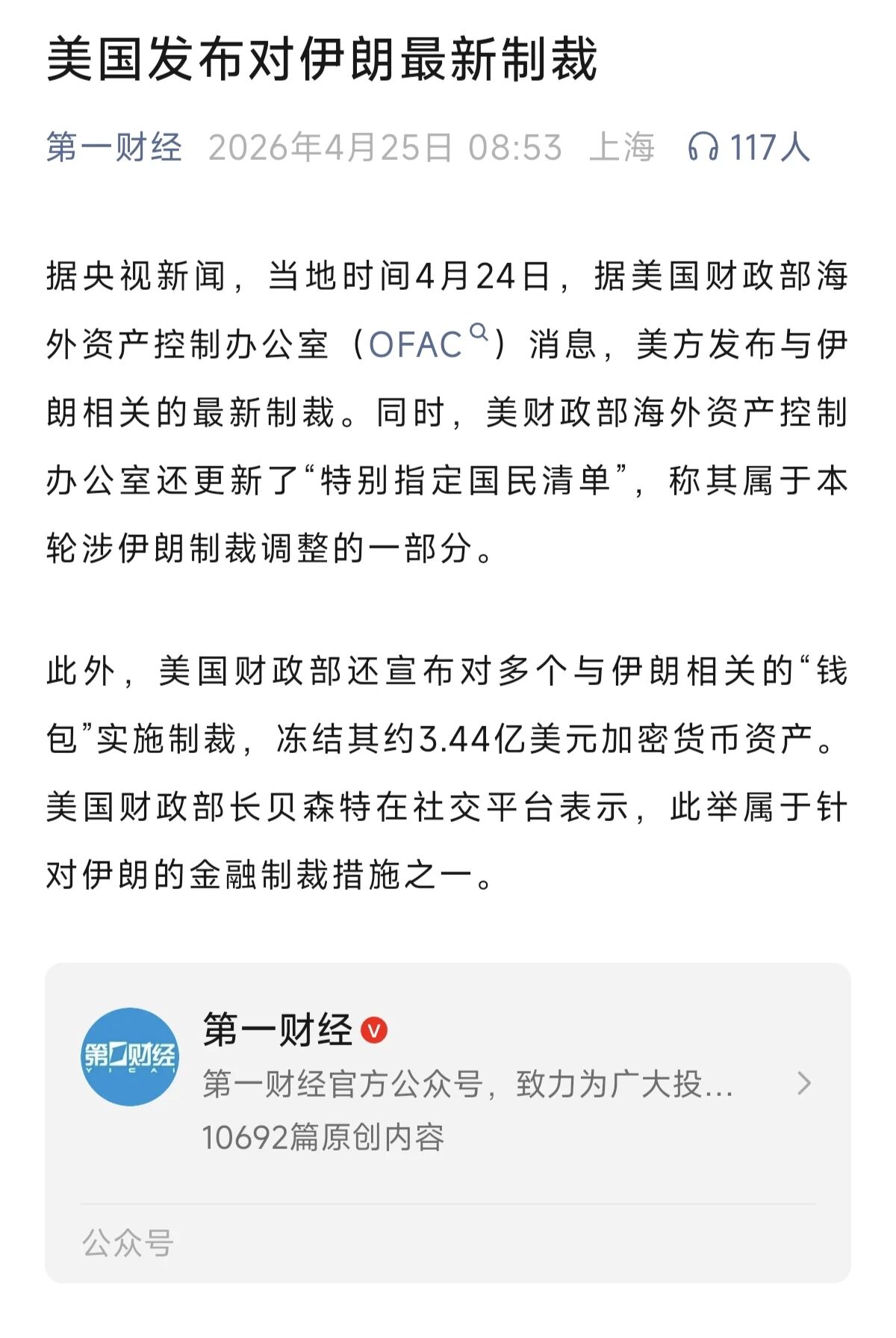
The more critical information comes from Tether's own announcement. According to Tether, it has cooperated with OFAC and U.S. law enforcement agencies to freeze over $344 million in USDT across two addresses. The announcement also mentioned that these addresses were identified after U.S. law enforcement provided relevant information, and the freezing action was taken to prevent the associated funds from continuing to transfer.
Therefore, if we simply stop at the news of "the U.S. freezing Iranian cryptocurrency assets," it is not enough.
A deeper understanding should be that this is the U.S. migrating its well-established sanctioning capabilities from the traditional financial system into the blockchain world.
In the past, the U.S. froze bank accounts; now it is starting to freeze on-chain addresses; previously, the U.S. cut off dollar settlements, and now it is also cutting off the liquidity of stablecoins.
An invisible financial control power
When we talk about the global financial influence of the U.S., it is often not about how many warships the U.S. has deployed or how many statements it has issued, but rather about the strong financial tools it holds.
The U.S. dollar clearing system, international banking networks, SWIFT communication system, OFAC sanctions list, and compliance obligations of U.S. financial institutions combined create the formidable financial control of the U.S.
A country, a company, or even an individual, as long as your financial flows deeply rely on the dollar system, it is challenging to completely bypass these rules. Previously, this method of sanctions was more visually intuitive. Bank accounts were frozen, dollar settlements were cut off, companies were listed on sanctions lists, and financial institutions dared not provide services to you. Even if transactions occurred outside the U.S., as long as they involved dollars, involved U.S. financial institutions, or even as long as related institutions were concerned about being affected by U.S. secondary sanctions, the U.S. could make it very difficult for this money to move.
This is also why many countries, after being sanctioned by the U.S., would look for alternatives outside the U.S. dollar system.
Cryptocurrency is not the imagined safe haven
Cryptocurrency was once understood by many as a possible path; this logic is not hard to comprehend. On-chain transfers do not require banks, do not go through traditional clearing systems, do not involve SWIFT; as long as there is a wallet address and a private key, in theory, a transfer can be completed. Therefore, in the past few years, whether it was sanctioned countries or funds from gray and black markets, many have attempted to use crypto assets to transfer value.
But this incident illustrates that things are not that simple.
The blockchain is not a completely detached parallel universe from the real financial order. Especially with stablecoins, although they circulate on-chain, their issuance, reserves, redemption, compliance, and freezing mechanisms still highly depend on centralized institutions.
Many people often group cryptocurrencies like Bitcoin, Ethereum, USDT, and USDC together. It is fine to say this in casual conversation, but from a legal and power structure standpoint, there are very significant differences among them.
Bitcoin is something that is truly closer to a decentralized asset in the real sense. It is not issued by any company, does not have a single manager, and there is no entity that can press a "freeze button" upon receiving a notice from law enforcement. As long as users hold the private key, there is no centralized institution within the Bitcoin network that can directly freeze their accounts.
Of course, this does not mean that Bitcoin is completely immune to law enforcement in the real world. Law enforcement can still track and handle Bitcoin through exchanges, custodians, OTC merchants, on-chain analysis, judicial seizures, and other means. However, from a protocol perspective, Bitcoin itself does not have an issuer that can unilaterally freeze BTC from a specific address.
This is completely different from stablecoins.
Mainstream stablecoins like USDT and USDC are essentially on-chain dollar certificates issued by centralized institutions. They circulate on-chain, looking similar to other crypto assets, but behind them are issuing companies, reserve assets, bank accounts, compliance teams, and regulatory pressures that they must confront. Since their inception, stablecoins have never been purely decentralized assets.
The duality of stablecoins
Because of this, stablecoins have a very obvious duality.
On one hand, they are indeed faster, cheaper, and more suitable for cross-border flows than traditional bank transfers. Particularly in many regions where banking systems are underdeveloped, dollar accounts are difficult to open, and the cost of cross-border remittances is very high, stablecoins have essentially taken on part of the function of a "digital dollar." Many ordinary users use USDT not because they understand blockchain well, but because it is indeed convenient, highly liquid, settles quickly, and is applicable in various trading scenarios.
But on the other hand, stablecoins are not decentralized assets like Bitcoin that do not have an issuer. The issuer can cooperate with law enforcement, freeze addresses, and restrict the continued movement of funds. Tether has made it very clear in its recent announcement that once relevant wallets are identified as involved in evading sanctions, criminal networks, or other illegal activities, the issuer can take restrictive measures.
This is an aspect that many ordinary users have not truly realized.
You think you hold "on-chain money," but from the power structure perspective, what you actually hold is an on-chain liability issued by a centralized company. Whether this liability can circulate often depends not only on whether you have a private key but also on the relationship between the issuer, exchanges, custodians, law enforcement agencies, and regulators. The private key can control transfer signatures, but it may not be able to counteract the issuer's freezing capabilities at the contract level, nor may it be able to resist the overall blockage of this address by centralized exchanges and compliance service providers.
Why the U.S. encourages stablecoins
This is also why the U.S. attitude towards compliant stablecoins in recent years is worth observing.
The U.S. supports stablecoins, of course, considering financial innovation, payment efficiency, consolidating dollar demand, and promoting the development of the crypto industry. But from the perspective of international financial order, there is a more pragmatic aspect: stablecoins allow the dollar system to extend from bank accounts to on-chain addresses.
Previously, you used a dollar account, and the U.S. could influence you through the banking system; now, you use a dollar stablecoin, and the U.S. can still influence you through the stablecoin issuer, centralized exchanges, custodians, and compliance service providers. It appears that the technology has changed, account forms have changed, and wallet addresses have replaced bank account numbers, but the underlying logic of control has not completely changed.
The U.S. is not simply opposed to cryptocurrencies.
On the contrary, the U.S. is actually becoming increasingly clear that there are two types of things in the blockchain asset world:
One type is decentralized assets like Bitcoin that are genuinely difficult to be controlled at a single point, and the other type consists of stablecoins and centralized crypto services that can be integrated into compliance frameworks, cooperate with law enforcement, and be absorbed by the financial sanction system.
For the latter category, the U.S. is not necessarily opposed, and may even encourage their compliant development. The reason is quite pragmatic: as long as stablecoins still peg to the dollar, still issued by regulated centralized entities, and still need to cooperate with OFAC, FinCEN, the Department of Justice, and other law enforcement agencies, then they are not substitutes for the dollar system but rather new interfaces of the dollar system.
Previously, dollars circulated in the banking system, and now dollars can also circulate on public chains. Previously, the U.S. exerted influence through banks, clearing institutions, and SWIFT; now it can also exert influence through stablecoin issuers, centralized exchanges, on-chain analysis companies, and compliance service providers. On the surface, the financial system has become more open, but from the perspective of control, the core issues have not vanished; they have merely been expressed through a different technology.
A reminder for crypto industry practitioners
This incident serves a direct reminder for practitioners in the crypto industry.
If you are an exchange, wallet, payment company, custodian, market maker, or any Web3 financial service institution involved with the circulation of stablecoins, you can no longer simply explain your business with "I am just a technology platform" or "I am just an on-chain tool." As long as your business involves stablecoins, especially dollar stablecoins, you are within the radius of the global sanction compliance system. In the past, traditional financial institutions had to perform KYC, AML, and sanctions-list screening, and now many Web3 institutions cannot evade these matters either; it’s just that the subjects of screening have changed from bank accounts to wallet addresses and from remittance routes to on-chain fund flows.
For entrepreneurs, this matter is also very realistic.
Many projects enjoy discussing Web3, decentralization, and on-chain finance. However, if you look back at the business structure, you find that they use USDT for settling assets, rely on centralized exchanges for customer inflows and outflows, depend on centralized institutions for custody, and rely on third-party on-chain analysis companies for risk control. From a legal and regulatory standpoint, this project is not necessarily a purely decentralized project but more resembles traditional financial services with a new on-chain interface.
Regulators are not concerned with your slogans but rather with how your funds flow, who your clients are, who controls the assets, and who bears the risks. If you are doing payments, you have to face anti-money laundering and sanction screenings; if you are doing custody, you have to deal with asset freezes and law enforcement assistance; if you are trading, you have to confront KYC, KYT, and suspicious transaction identification; and if you are engaged in stablecoin-related business, you cannot avoid issues surrounding issuers, reserve assets, redemption mechanisms, blacklist mechanisms, and judicial assistance.
For ordinary users, this matter also offers a very basic reminder: USDT does not equal Bitcoin.
Many people buy USDT simply because they find it convenient, stable, and liquid. This judgment is correct, as USDT indeed performs a vital liquidity function in the global crypto market. However, if you understand USDT as an asset that is completely unfrozen, entirely unaffected by real-world regulations, and fully independent of the financial system, then you are mistaken.
The "stability" of stablecoins comes from the centralized arrangements behind them. Precisely because it has centralized arrangements, it can be stable, redeemable, widely circulated, and can be frozen in cooperation with law enforcement agencies.
This is not simply a matter of good or bad; it is rather a structural issue becoming increasingly realistic in the industry.
If you value efficiency, liquidity, and dollar pricing, stablecoins certainly have their value. But if what you seek is complete resistance to censorship, total immunity from freezing, and total detachment from the real financial order, then stablecoins may not have been the answer from the start. Many people enjoy the conveniences brought by stablecoins while simultaneously imagining them as decentralized assets like Bitcoin; there is actually a cognitive mismatch in between.
For some sovereign nations, especially those seeking financial security, the practical value of this news may be even greater.
In recent years, many countries have discussed how to reduce their reliance on the dollar system. Some countries wish to develop local currency settlements, others hope to promote central bank digital currencies, and some desire to bypass traditional financial sanctions using crypto assets. But if the eventual use is still dollar stablecoins, it is essentially just changing dollar accounts for dollar tokens. The form has changed, but the underlying power structure has not.
You no longer use U.S. bank accounts, but you use dollar stablecoins within the regulatory radius of the U.S. You don't use SWIFT anymore, but you are using stablecoin issuers that cooperate with OFAC. You think you have moved from off-chain to on-chain, but U.S. sanction tools have followed you on-chain.
For a nation genuinely pursuing financial security, this is not a minor technical route issue, but rather a significant question of who controls the underlying financial infrastructure.
Thus, true financial security does not merely involve asking, "Is it on-chain?" but should probe deeper questions: Who issued the assets? Where are the reserves? Who controls the redemption? Whose influence guides compliance obligations? Can addresses be frozen? Is critical infrastructure controlled by others? If these questions aren't clearly answered, merely discussing "on-chain finance," "digital currencies," and "stablecoin innovations" can easily remain superficial.
Of course, one cannot reverse and say that stablecoins have no value simply because they can be frozen. Such a judgment is overly simplistic.
The value of stablecoins is precisely derived from their contradictions. On one hand, they retain blockchain's transfer efficiency, and on the other hand, they preserve compliance interfaces of the real financial world. Precisely because they are not entirely decentralized assets, they are more readily accepted by institutions and more easily integrated into payment, settlement, cross-border trade, and financial service scenarios.
But because of this, they are destined not to be a purely "anti-sanction tool."
They are more akin to an upgrade of the dollar system under new technological conditions. In the past, dollars flowed through bank accounts and clearing systems; now, dollars can flow through stablecoins on public chains. Previously, the U.S. exerted influence through banks, clearing institutions, and SWIFT; now, it can also exert influence through stablecoin issuers, centralized exchanges, on-chain analytics companies, and compliance service providers. Technological advancements have allowed dollars to move faster, cover wider, and lower costs, but have not liberated the dollar from its original power structure.
This is not just any ordinary sanction news; it is a signal: global financial sanctions are entering the on-chain era.
Previously, the U.S. froze bank accounts; now, it freezes stablecoin addresses; previously, sanctioned parties were concerned about being unable to use dollar accounts, while in the future they will have to worry about not being able to use dollars on-chain either.
This is the most noteworthy aspect of the U.S. freezing $344 million in cryptocurrency assets of Iran.
免责声明:本文章仅代表作者个人观点,不代表本平台的立场和观点。本文章仅供信息分享,不构成对任何人的任何投资建议。用户与作者之间的任何争议,与本平台无关。如网页中刊载的文章或图片涉及侵权,请提供相关的权利证明和身份证明发送邮件到support@aicoin.com,本平台相关工作人员将会进行核查。


