

Author: Zen, PANews
In recent years, with the rapid advancement of the AI industry, its related infrastructure sector is entering an unprecedented cycle of capital expenditure. From NVIDIA GPUs to cabinets, power, and the entire data center industry are expanding.
Issues have arisen accordingly. Assets like GPUs naturally have a paradoxical nature; they generate cash flow quickly but also depreciate rapidly. Not to mention that today's most sought-after GPUs may lag behind substantially in three years. Moreover, traditional banking systems are often not friendly towards such high-depreciation, high-volatility assets that change with swift technological cycles.
It is against this backdrop that several projects aiming to establish an on-chain financing chain for AI infrastructure have begun to appear. USD.AI is one of the more unique ones. It does not create models or AI agents, but rather resembles an on-chain credit protocol built around GPU financing.
With its unique narrative and entry point, USD.AI's governance token CHIP has also gained support from all mainstream exchanges in the market, launching on Binance, Bybit, Coinbase, Upbit, etc. According to CoinGecko data, as of today, CHIP has a circulating market cap of approximately $215 million, an FDV of $1.08 billion, and has increased by about 57.7% since its launch.
How GPU Financing is Brought On-Chain
The USD.AI project is developed by Permian Labs and governed off-chain by the USD.AI Foundation, which handles governance and legal infrastructure. Its core logic can be understood as “off-chain organization, on-chain lending.” This means linking on-chain dollar liquidity to capital expenditure on GPU, cabinets, and data center expansion.
From the publicly available technical documentation, the entire process is not simple.
Borrowers must first place purchase orders with OEMs to secure data center positions and establish an SPV (Special Purpose Vehicle). Subsequently, the GPUs are sent to the data center for installation, where the data center issues electronic warehouse receipts. These receipts are then tokenized into ERC-721 NFTs, which ultimately serve as collateral in the protocol to obtain USDC loans.
Currently, the publicly verifiable cases are not numerous, but there has already been real disclosures of hardware-level loans. In April 2026, Crucible Capital extracted a loan of $26.82 million, secured by 72 units, totaling 576 NVIDIA B300 GPUs, with deployment in Washington State, USA.
However, the project has not fully disclosed the list of OEMs, data center operators, or complete lists of borrowers. The clearly confirmed entities include QumulusAI, Quantum Solutions, Sharon AI, and Crucible, among others.
These companies themselves represent USD.AI’s target market; they are not consumer AI product providers, but rather computational infrastructure providers. For example, QumulusAI's clients include machine learning teams, AI startups, and research institutions, while Sharon AI targets hyperscalers, enterprise customers, and government agencies.
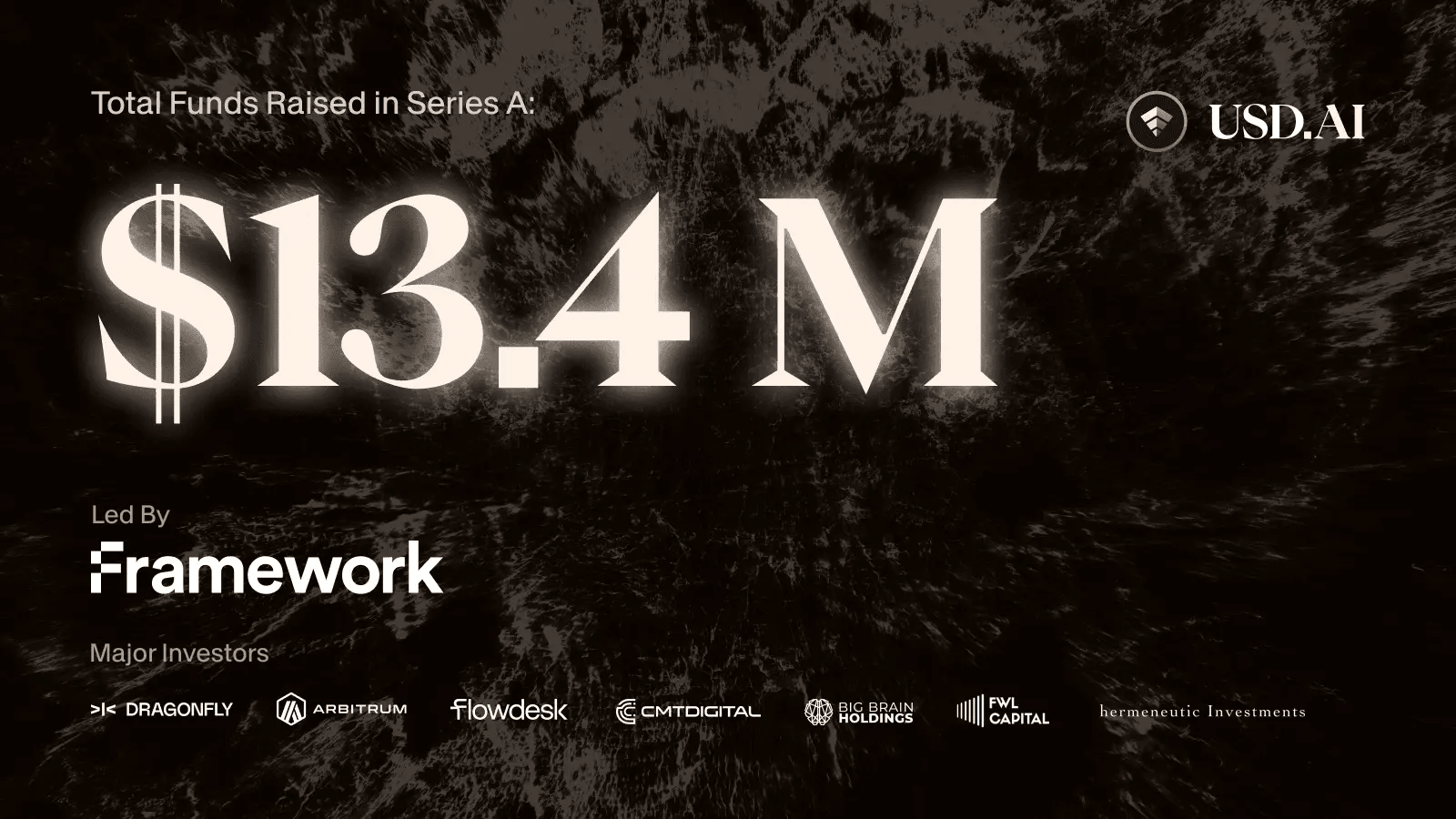
The innovative model of USD.AI's GPU-based stablecoin lending business has also received support from several institutions. In August last year, USD.AI announced the completion of $13 million in Series A funding, led by Framework Ventures, with Bullish, Dragonfly, Arbitrum, and others participating.
However, it is noteworthy that although the officials repeatedly emphasize that they will carefully review the quality of offtake agreements (computational power procurement agreements), they have not yet publicly disclosed the client list, number of contracts, or real leasing scale. In other words, the public still finds it very difficult to independently verify whether these GPUs can truly continue to generate stable cash flow.
Three-Layer Structure Operation: USDai, sUSDai, and CHIP
The structure of USD.AI is essentially layered. USDai is the liquidity layer, sUSDai is the revenue layer, and CHIP is the governance layer.
USDai: Basic Liquidity Layer
As the “basic layer” for on-chain financing in the USD.AI ecosystem, USDai is designed as a high-liquidity asset pegged 1:1 to the dollar, aiming for maximum compatibility with DeFi protocols to provide a stable medium of exchange, and it does not generate yield.Users can mint USDai by depositing PYUSD and can redeem back to PYUSD at any time.
From the protocol structure perspective, the core concept of this design is to separate “liquidity” and “credit risk.” USDai corresponds to foundational assets that are closer to immediate liquidity, while sUSDai corresponds to long-term GPU loan positions. The latter has asynchronous redemption, exit queues, and liquidity constraints, and the risks of the two are entirely different.
Moreover, sUSDai is also accounted around USDai. The protocol's share pricing and vault accounting are fundamentally based on the USDai layer. Even for end-users, USDai does not necessarily need to be a long-term holding asset, but for the protocol itself, it remains the fundamental accounting layer of the entire system.
sUSDai: Revenue Layer
The one really undertaking GPU financing revenue is sUSDai.
sUSDai can be understood as a yield-bearing share-type asset. The protocol will allocate funds through a dedicated position management module. A portion of the funds will be deployed into MetaStreet related pools, while another part will capture the yield brought by the underlying asset M itself. To put it simply, the yield of sUSDai does not come from a single source, but is composed of GPU mortgage loan revenue and underlying asset yield, with the most vital and recognizable part still being the GPU mortgage loans.
Its exit mechanism is also different from ordinary stablecoins. If a user wants to exit sUSDai, they need to go through an asynchronous redemption process. After the user applies to exit, they typically need to queue and wait for the protocol to release liquidity rather than receiving funds immediately.
On this basis, the project team has designed a mechanism called QEV (Queue Exit Vault). Its function is to price who can exit earlier. If someone is willing to pay extra, they can gain higher priority in the exit queue to get their funds back sooner; if no one pays for priority, then the queue will be arranged on a FIFO (First In, First Out) basis.
CHIP: Governance Layer
CHIP is the governance token in the USD.AI ecosystem and is currently the only governance token in the protocol. CHIP corresponds to a set of existing credit risk control parameters, and theoretically, its holders can participate in decisions on multiple core matters, including:
- Which assets can be accepted as collateral
- What underwriting standards need to be met for borrowing projects
- How to adjust loan interest rates and risk parameters
- How to allocate and circulate protocol fees
- How to use treasury funds
- Rules design for staking and insurance modules
In other words, the governance scope of CHIP is not merely “community operations” but directly involves how the protocol lends, how to control risks, and how funds flow within the system. However, CHIP does not grant holders the right to share in the protocol's revenue; holding CHIP does not equate to being able to directly divide protocol fees or loan yields.
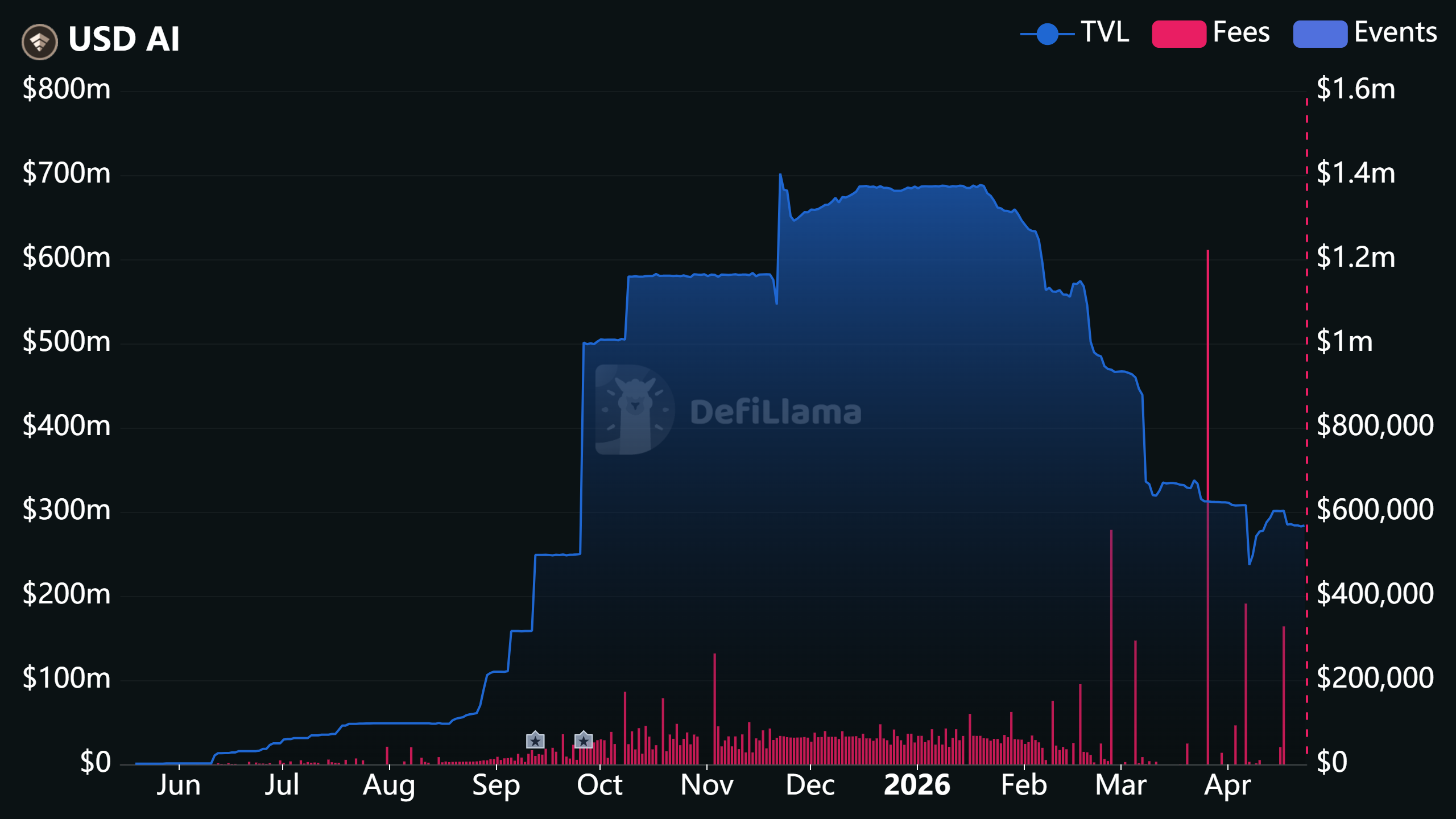
According to DeFiLlama data, as of April 23, USDai’s circulating market cap is approximately $280 million, with USD.AI’s total value locked (TVL) around $283 million, active loans of about $60 million, and revenue in the last 30 days approximately $850,000, with nearly $330,000 in revenue for the past week.
Is Risk Really Priced?
The most noteworthy aspect of USD.AI is not its use of the AI label, but that it is genuinely attempting to transform GPUs, a real-world asset, into an on-chain credit product. However, because of this, its risks are more complex than ordinary stablecoins.
First is the GPU collateral itself. The annual depreciation of a GPU can reach 15%-20%. The most popular cards today may not retain their value in the future. The project uses a lower LTV, three-year amortization, a Barker valuation system, and value warranty supported by reinsurance to buffer risks. But the issue is, once GPU market prices decline rapidly or new generation hardware replaces them faster than expected, it is difficult to predict whether these protective layers will be enough.
Secondly, there is the cash flow of the borrowers. The entire model is predicated on the premise that these GPUs can truly continue to be rented out. The officials repeatedly emphasize that they will audit offtake agreements, but the public currently lacks sufficient transparent data to verify the actual quality of these computational power contracts.
The third is liquidity risk. The protocol is based on longer-term GPU loans, but users holding sUSDai may want to redeem at any time. If everyone demands immediate exits, the protocol cannot instantly convert long-term loans into cash. Therefore, the significance of QEV is to mitigate liquidity pressure as much as possible through queuing and paid priority mechanisms. However, this mechanism can only buffer shocks and does not fundamentally eliminate the mismatch between long-term loans and short-term redemptions.
Returning to the CHIP token itself, the attractiveness of “governance tokens” has significantly declined in recent years. Many protocols grant voting rights to token holders, but the actual number of participants in governance is often low, and real decision-making often remains concentrated in the hands of core teams or a few large holders or institutions.
For USD.AI, this problem may become more pronounced. As it becomes increasingly institutionalized, the future key participants in the protocol may concentrate more on institutional market makers, compliant funding sources, and a few large players. In this structure, the extent to which the governance power of CHIP can truly influence the protocol's direction remains a question worth observing.
免责声明:本文章仅代表作者个人观点,不代表本平台的立场和观点。本文章仅供信息分享,不构成对任何人的任何投资建议。用户与作者之间的任何争议,与本平台无关。如网页中刊载的文章或图片涉及侵权,请提供相关的权利证明和身份证明发送邮件到support@aicoin.com,本平台相关工作人员将会进行核查。


