Author: Ada, Deep Tide TechFlow
Sun Yuchen invested $75 million, in exchange for a consultant title, a pile of frozen tokens, and a lawsuit from a federal court.
On April 22, this founder of TRON formally sued World Liberty Financial in the federal court in San Francisco, accusing it of making him "the primary target of its fraudulent scheme," resulting in "hundreds of millions of dollars in losses" for him and his company. At the same time, he accused WLF of being "on the verge of collapse" and "severely insolvent," planning to pay "95% of token sale proceeds to insiders of the company."
The person in the crypto circle who is the best at accounting has been calculated against this time.
$75 Million as a "Letter of Intent"
Back it up to the end of 2024.
World Liberty Financial had just launched the sale of WLFI tokens, and the scene was embarrassingly quiet, with sales of only $22 million in the first month.
Sun Yuchen took action. He initially invested $30 million, later increased it to $45 million, and added another 1 billion tokens as payment for consultant services, totaling approximately $75 million. He became the largest public investor in World Liberty.
After Sun Yuchen made his investment, other investors followed, and the project ultimately raised about $550 million. World Liberty Financial later publicly acknowledged that it was Sun Yuchen who helped "bring the project back to life."
At that time, the SEC was suing Sun Yuchen, accusing him of market manipulation, selling unregistered securities, and spending money to hire celebrities for promotion without disclosure. However, after Trump’s inauguration in January 2025, the SEC voluntarily suspended the lawsuit against Sun Yuchen. In March 2026, both parties settled for $10 million, with Sun Yuchen not admitting any wrongdoing.
A $30 million investment spared him from a lawsuit that could have bankrupted him. This calculation was quite clear to Sun Yuchen.
Refused to Provide Blood, Immediately Blacklisted
The honeymoon period was very short.
According to the lawsuit, World Liberty Financial continuously requested Sun Yuchen to increase his investment in 2025, including asking him to mint World Liberty Financial's USD1 stablecoin on the TRON network. Sun Yuchen refused.
By July 2025, the relationship had completely broken down.
What followed was less a business dispute and more a chain-based pursuit.
In August 2025, World Liberty Financial modified the smart contract for WLFI tokens, adding a "blacklist" function. The project team could unilaterally freeze any holder's tokens without notice, reason, or governance vote.
A month later, Sun Yuchen tried to transfer his WLFI tokens. But the wallet was blacklisted, approximately $107 million in governance tokens were frozen, and his voting rights were stripped.
Thereafter, World Liberty Financial threatened to "burn" his tokens. In the blockchain world, burning means permanently eliminating assets so that they no longer exist.
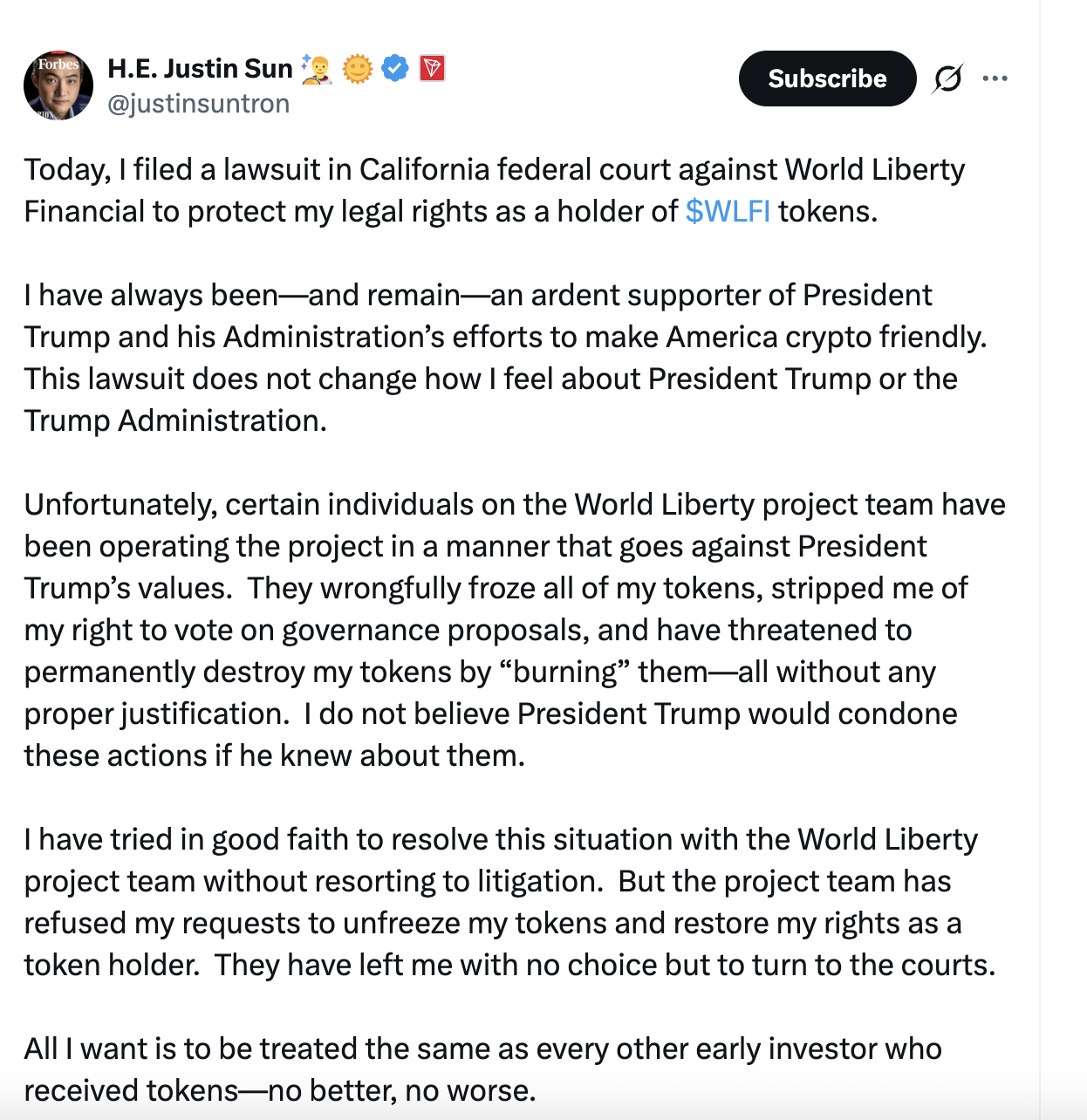
Sun Yuchen stated that he had tried to "resolve it amicably," but the other party refused to unfreeze the tokens and restore his rights.
"They left me no choice but to resort to the courts," he wrote on X.
Zach Witkoff, CEO of World Liberty Financial, responded that Sun Yuchen's allegations were "completely unfounded" and said that Sun Yuchen had engaged in "misconduct," forcing World Liberty Financial to take action "to protect itself and its users."
No one explained what this "misconduct" specifically was.
The President's ATM
To understand why Sun Yuchen was frozen, one must first clarify what World Liberty Financial truly is.
On the surface, it is a "decentralized finance" project, claiming to allow small investors to control their own funds. It has governance tokens WLFI, stablecoin USD1, and DeFi lending products.
But peeling back this layer reveals a profit pipeline at its core.
The Trump family receives 75% of the net income from WLFI token sales. By December 2025, the family had profited $1 billion from this, while holding unsold tokens worth $3 billion. The reserves for the USD1 stablecoin are invested in U.S. Treasury bonds, with the interest income also flowing to family entities. Based on a market value of $4.2 billion and current Treasury bond yields, just the stablecoin could generate around $160 million annually.
This does not even account for the largest transaction.
In January 2025, just four days before Trump's inauguration, Sheikh Tahnoon bin Zayed of the Abu Dhabi royal family acquired 49% of World Liberty Financial for $500 million. The agreement was signed by Eric Trump. Out of this, $187 million flowed directly into Trump family-controlled entities, with at least $31 million directed to entities associated with Witkoff's family.
Zach Witkoff is the CEO and co-founder of World Liberty Financial. His father, Steve Witkoff, serves as the U.S. Special Envoy to the Middle East.
Senator Elizabeth Warren referred to it as "blatant corruption." The House of Representatives subsequently initiated an investigation. Trump himself claimed he was "unaware" of the deal.
Dolomite: Lending Your Own Money to Yourself
At the beginning of 2026, on-chain data showed that World Liberty Financial deposited 5 billion of its own WLFI tokens into the DeFi lending platform Dolomite as collateral, borrowing about $75 million in stablecoins. Over $40 million of this was transferred to Coinbase Prime, which usually indicates that the tokens were exchanged for fiat currency.
Meanwhile, Corey Caplan, co-founder of Dolomite, is also a consultant for World Liberty Financial.
Using its own tokens, deposited in a platform opened by its own consultant, lending out the stablecoins it issued, and then exchanging for cash.
This operation pushed Dolomite's USD1 lending pool utilization rate to 100%. Ordinary depositors were locked out and unable to withdraw their own funds. World Liberty Financial's collateral accounted for 55% of Dolomite's total locked amount.
World Liberty Financial's response was: "We create attractive yields for the platform as an anchored borrower."
In other words, they used their own issued tokens to collateralize on their consultant's platform, lending out their own issued stablecoins. In traditional finance, this is called related-party transactions, requiring separate audits and disclosures. In DeFi, there wasn't even a notice.
Sun Yuchen publicly criticized on April 12, stating that the World Liberty Financial team treated users as "personal ATMs," and that he was "the first and largest victim." Three days later, World Liberty Financial launched a governance proposal.
Ultimatum
The governance proposal on April 15 was nominally a "governance restructuring." The actual content was: 6.228 billion WLFI tokens (62% of total supply) would be included in a new unlocking arrangement. The tokens held by founders, the team, and consultants, totaling 45.2 billion, would need to accept a 10% burn (about 4.5 billion) and then enter a 2-year lock-up period followed by 3 years of linear release.
Holders who do not accept the new terms will have their tokens indefinitely frozen.
Sun Yuchen called this proposal "one of the most absurd governance scams I have ever seen." But he could not vote against it because his tokens had already been frozen.
Looking at the distribution of voting rights, a USD1 governance proposal passed in January 2026 showed that the top nine wallets controlled nearly 60% of the voting rights.
The price trend of WLFI says it all. It reached a historic high of $0.46 in September 2025, and afterwards plummeted. On April 11, it hit a historical low of $0.0767, dropping 84% from its peak.
Early investors who bought at $0.015 still had profits. But if you are Sun Yuchen, the $75 million investment brought tokens that were once worth over $1 billion, but now they are frozen and may be permanently destroyed.
The Same Mirror
Sun Yuchen is not an innocent victim.
He was previously accused by the SEC of market manipulation and fraud, and his investment timing perfectly corresponds with his judicial troubles.
It is exactly because he is not innocent that this case is interesting.
A person who started from "cutting leeks" is treated in the same way by a larger power structure. The contrast here speaks more than any white paper.
World Liberty Financial promised "decentralized finance," where users control their assets, with no intermediaries and no scrutiny.
But in reality, the smart contracts contained backdoors, allowing the project team to freeze your tokens at any time, while governance votes are controlled by nine wallets, and founders used your deposits to lend to themselves.
Sun Yuchen's original words on X were: "Unfortunately, some people in the World Liberty Financial project team operate the project in a manner contrary to the values of President Trump."
Until the moment of the lawsuit, he was still trying to save face for Trump. A person who spent $75 million, after having all his assets frozen, still carefully distinguished between "President Trump" and "some people in the project team" in his complaint.
The most interesting aspect of this case is not whether Sun Yuchen can get back his tokens. It is how the court will classify WLFI. If it is deemed a security, then World Liberty Financial's unilateral modification of the contract and freezing of holder assets without a vote could constitute fraud under federal securities law.
WLFI is currently priced at $0.078, having dropped about 84% from its peak. The adequacy of the reserves for the USD1 stablecoin is being questioned. The risks of Dolomite's lending pool remain unresolved. The House investigation is still ongoing. But the Trump family has already cashed out over $1 billion.
Sun Yuchen's convertible bonds have their earliest expiration window in 2027. Court scheduling may take over a year. During this period, WLFI tokens will continue to unlock, and people will have to accept the choice of "either agree to the new terms or be frozen forever."
免责声明:本文章仅代表作者个人观点,不代表本平台的立场和观点。本文章仅供信息分享,不构成对任何人的任何投资建议。用户与作者之间的任何争议,与本平台无关。如网页中刊载的文章或图片涉及侵权,请提供相关的权利证明和身份证明发送邮件到support@aicoin.com,本平台相关工作人员将会进行核查。


