Author: Thursday, Deep Tide TechFlow
Deep Tide Briefing: Admiral Samuel Paparo, commander of the U.S. Indo-Pacific Command, testified this week before the military committees of both the House and Senate, confirming that the command is operating a Bitcoin network node and conducting cybersecurity "live tests."
He characterized Bitcoin as a "computer science tool" and a "means of power projection," rather than a financial asset. This is the first public confirmation by a U.S. military combat command of direct involvement in the Bitcoin peer-to-peer network, as the Pentagon's narrative on Bitcoin shifts from "combating illegal finance" to "defense-grade technical asset."
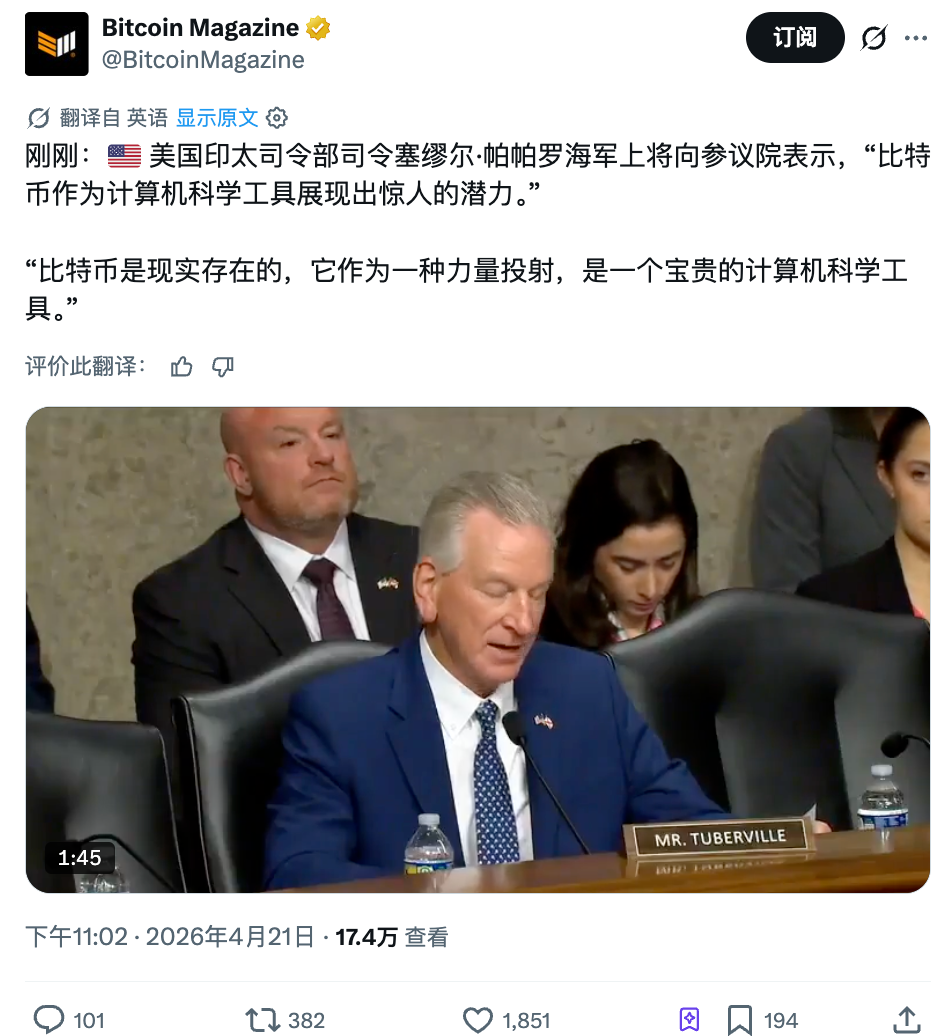
The U.S. military's characterization of Bitcoin is undergoing a fundamental shift.
According to Bitcoin Magazine, on April 22, Admiral Samuel Paparo, commander of the U.S. Indo-Pacific Command (INDOPACOM), testified this week before Congress’s military committees, confirming that the command is currently operating a full Bitcoin network node and conducting a series of military cybersecurity tests based on the Bitcoin protocol. Paparo is the highest commander of the largest of the six U.S. unified combatant commands, overseeing approximately 380,000 military personnel responsible for the Indo-Pacific theater covering half the Earth's surface.
In his testimony, Paparo explicitly defined Bitcoin as a "computer science tool" and "means of power projection," rather than a speculative financial asset. This is the first time a senior U.S. military leader has made such a characterization of Bitcoin in a public congressional setting, and it is the first known instance of a U.S. combat command confirming direct participation in the Bitcoin peer-to-peer network.
SENATE TESTIMONY: BITCOIN IS A "TOOL OF NATIONAL POWER"
On April 21, Paparo responded to Senator Tommy Tuberville (Republican, Alabama) during the Senate Armed Services Committee's hearing on the fiscal year 2027 defense authorization concerning the strategic value of Bitcoin.
Tuberville asked directly: Can the U.S. leading position in Bitcoin enhance deterrence against China? Paparo did not avoid the question, informing the committee that INDOPACOM's research focuses on the underlying computer science architecture of Bitcoin, including the integration of three major technological components: cryptography, blockchain, and proof of work.
Paparo stated, "Bitcoin is a reality. It is a peer-to-peer, zero-trust value transfer system. Anything that supports all national power tools of the United States is beneficial." He further added, "Beyond its economic attributes, Bitcoin has very important computer science applications in cybersecurity."
Paparo elaborated on the military potential of the proof of work protocol, indicating that the cost imposed by Bitcoin's proof of work mechanism "far exceeds simple algorithmic network protection," with applications extending to offensive and defensive cyber operations.
In other words, the Pentagon is interested not in Bitcoin's price movements, but in its role as a "computer security architecture that imposes physical costs on attacks."
HOUSE HEARING CONFIRMATION: "WE HAVE A NODE ON THE BITCOIN NETWORK"
On April 22, Paparo answered further inquiries from Congressman Lance Gooden (Republican, Texas) at the House Armed Services Committee, revealing more details.
According to the official press release and verbatim transcript from Gooden's office that day, Paparo clearly stated, "We are currently in the experimental stage. We have a node on the Bitcoin network. We are not mining. We use it to monitor and conduct a series of operational tests leveraging the Bitcoin protocol for cybersecurity purposes."
Gooden also cited data from the Bitcoin Policy Institute during the hearing, pointing out that China currently holds approximately 194,000 Bitcoins, while the U.S. holds about 328,000. He pressed Paparo:
In the era of digital competition, should the U.S. maintain its leading position in Bitcoin holdings like it does for strategic resources such as gold and oil?
Paparo responded that people are currently using Bitcoin to protect their digital property, which is exactly the function resulting from the combination of the proof of work protocol with blockchain and cryptography. He also expressed support for the GENIUS Act (stablecoin legislative framework) in maintaining the dollar's global dominance, but refrained from commenting on "strategic Bitcoin reserves" in public settings, preferring to discuss the matter in classified environments.
PENTAGON NARRATIVE SHIFT
A notable feature of Paparo's testimony is what he "did not say." He did not describe Bitcoin as a reserve asset, payment system, or speculative tool but consistently positioned it as a computer science system with direct military relevance.
According to Bitcoin Magazine, prior public statements from the U.S. military regarding cryptocurrencies were almost entirely focused on combatting illegal finance and enforcing sanctions. Paparo's testimony marks a significant shift in this narrative framework, as the protocol layer architecture of Bitcoin is first characterized by a serving combat command's highest military commander as a technology of national security value.
Sam Lyman, research director at the Bitcoin Policy Institute, stated in a statement that Paparo's testimony confirms that Bitcoin "is an undeniably geopolitically significant asset."
As of early 2026, there are approximately 15,000 to 20,000 publicly reachable full nodes on the Bitcoin network, with the actual number likely higher as many nodes operate behind firewalls. The addition of INDOPACOM's node means the U.S. military is no longer an observer of the Bitcoin network but a direct participant.
免责声明:本文章仅代表作者个人观点,不代表本平台的立场和观点。本文章仅供信息分享,不构成对任何人的任何投资建议。用户与作者之间的任何争议,与本平台无关。如网页中刊载的文章或图片涉及侵权,请提供相关的权利证明和身份证明发送邮件到support@aicoin.com,本平台相关工作人员将会进行核查。


