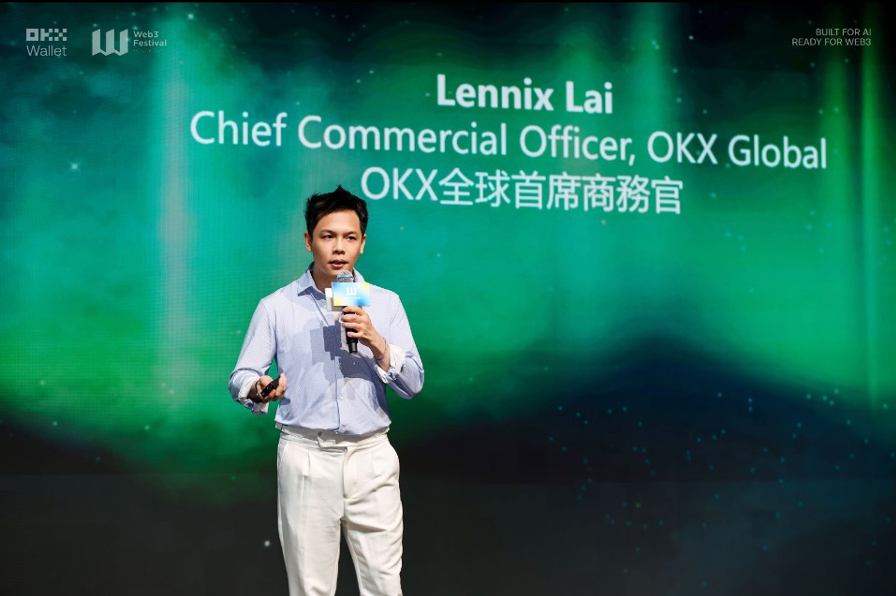
The annual Hong Kong Web3 Carnival has opened once again, gathering global crypto practitioners at the summit.
As one of the largest and most influential Web3 events in the industry, the "2026 Hong Kong Web3 Carnival" brings together several heavyweight speakers and over a hundred exhibition projects, attracting extensive attention and participation from developers, institutions, and industry participants worldwide.
On the first day of the summit, OKX Global Business Officer Lennix was invited to attend and delivered a keynote speech titled "Start building on Onchain OS" at the main forum. The following is the content of the speech (organized):
Today, I would like to talk about the future and the role of AI in our entire financial system, especially in our industry.
AI is not just a tool upgrade but the beginning of a trend
In the past year to year and a half, changes have occurred very rapidly. Everyone is talking about AI and also using Agents. With the development of large models, we are starting to see that Agents are not just a concept but are really beginning to enter our business. We see users creating various Agents to achieve different goals. Some people will use OKX Wallet data, combined with AI models, to monitor the market, generate signals, and then deploy different strategies.
These applications make us begin to realize one thing: this is not just a tool upgrade, but an important trend that is forming. And this trend could be very significant because it will change trading behavior itself and the way we interact with on-chain.
In the past, OKX Wallet spent a lot of time optimizing user experience, from Web2 to Web3, from interface to transaction process. But if Agents become a part of users in the future, even the main users, the entire logic of interaction needs to be redesigned.
The current issue is very clear. You can use Agents for in-depth data analysis, and use AI to generate many trading signals, but the most critical step, or what Agents currently lack, is how to execute and how to execute securely? How to ensure that users maintain control while not sacrificing the freedom of Agents? These are the real challenges.
We are currently seeing some Agents can already perform certain tasks, such as managing accounts, initiating payments, and executing simple operations, but these capabilities are decentralized. The issue is not whether there are capabilities, but that these capabilities have not been integrated together and run in a secure, controllable execution environment. So we began to think: if Agents are users, shouldn’t we build an operating system for Agents? This is our starting point.
Onchain OS: An operating system born for Agents
We do not just regard users as human users; we believe that Agents themselves are also users. Therefore, we need a system that can serve different types of Agents, allowing them to call capabilities, execute operations, and cooperate with each other.
Onchain OS is not something that starts from scratch; it is built on the existing capabilities of OKX Wallet. The OKX Wallet system itself is API-first, handling over 1.2 billion API calls daily, with about 300 million dollars in transaction volume, and currently supports over 60 chains, aggregating over 500 DEXs, maintaining a system stability of 99.9%. Because everything is API-ready, we can continue to build MCP on this foundation, allowing future Agents to directly call these capabilities to accomplish what they want to do.
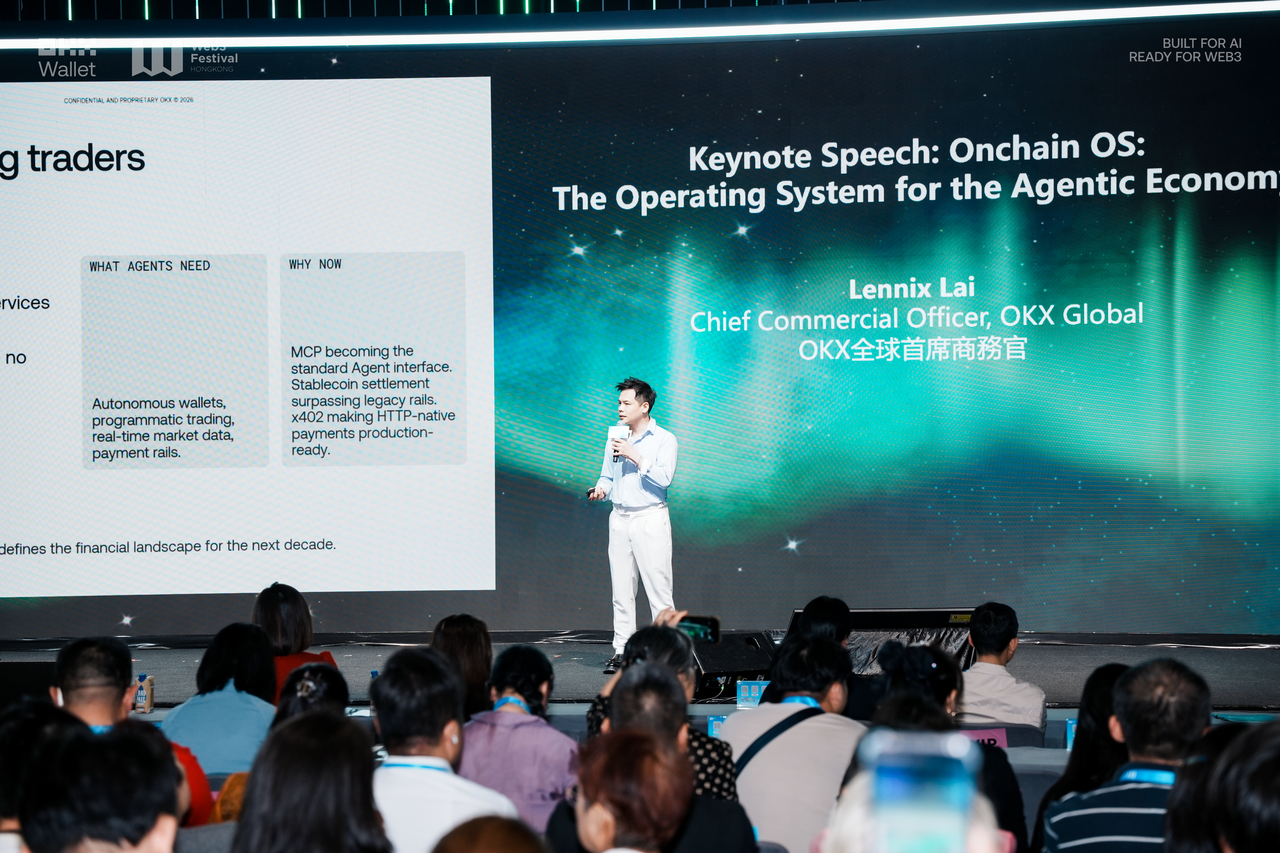
In this system, we have also introduced payment capabilities, allowing Agents to complete payments and transactions; using X Layer as the execution layer, with extremely low costs, even free; and have introduced a Plugin mechanism, allowing the community and developers to build more capabilities. We hope users can perform actions using natural language directly, instead of clicking through layers of interfaces.
For example, if you say: "When ETH drops to 2000 USD, help me exchange it for USDC," the Agent will continuously track market prices using OKX Wallet data to make judgments and then automatically complete price comparisons, adjust liquidity, validate, and execute the transaction when conditions are met. Therefore, future crypto users may no longer focus on specific interface experiences like today because all operations will be distilled into a common language for expression. The underlying security, liquidity, asset management, and various complex processes will be managed uniformly by the native underlying system of OKX Wallet.
But more interestingly, this will not be a world with only one Agent. In the future, there will be many Agents. Your Agent will interact with others' Agents, collaborate with third-party Agents, and even generate payments and settlements among themselves. We will enter an environment of Agent-to-Agent and Agent-to-human interactions. In such an environment, we need infrastructure to support these payment scenarios, which is the role of X Layer. It is a Layer 2 based on Enhanced OP Stack, supporting fast, low-cost settlements and also supporting payments and interactions between Agents.
We believe that in the future, on-chain interactions will involve more and more Agents participating in transactions and interactions, even forming an ecosystem that far exceeds that led by humans. Therefore, to achieve this, a truly efficient settlement layer is needed. This is also why we want to build an open ecosystem; this is just the beginning, and we need eco-partners to participate together, such as continuously expanding different types of Skills.
At the same time, we are continuously opening the ecosystem, allowing the community to submit Skills, which will be reviewed and listed by AI Agents and security teams, and users can install them with one click. We also provide tools like SDK, CLI, etc., to help developers build Agents, bringing them closer to application forms. In Onchain OS and the Plugin Store, we hope to see more real use cases, ultimately achieving a situation where one person can manage a project or even an entire investment system.
Conclusion
Over the years, financial infrastructure has been highly dependent on top professionals, requiring the formation of complete teams, including analysts, traders, risk control, developers, and establishing a complete set of standardized investment processes, while also needing to comply with anti-money laundering (AML) and other regulatory requirements, and operating in coordination with such systems. But the future may be different. One person, along with multiple different types of Agents, will have the opportunity to accomplish similar work, even with higher efficiency.
When we interact with on-chain ecosystems, we no longer need to rely entirely on teams to build everything. Every user has the potential to gain capabilities and competitiveness akin to large institutions. This means that ordinary users can also possess advantages that were previously only available to professional institutions. I believe this is a very critical issue. This is not only a change happening in our ecosystem but also explains why AI is playing an increasingly important role in this industry.
We can even imagine that future transactions and interactions driven by Agents might surpass the markets dominated by humans.
Thank you all. If you are interested in Onchain OS and want to do something together, feel free to contact us.
免责声明:本文章仅代表作者个人观点,不代表本平台的立场和观点。本文章仅供信息分享,不构成对任何人的任何投资建议。用户与作者之间的任何争议,与本平台无关。如网页中刊载的文章或图片涉及侵权,请提供相关的权利证明和身份证明发送邮件到support@aicoin.com,本平台相关工作人员将会进行核查。


