Original Title: ZachXBT vs. RAVE: Is a Clean Market What Degens Want?
Original Author: Tiger Research
Translator: Peggy, BlockBeats
Editor's Note: In the past few days, RAVE completed an extreme market event, with the price skyrocketing 4500% in a matter of hours. Subsequently, on-chain investigator ZachXBT pointed out that approximately 90% of the tokens were concentrated in team-related wallets, and the price surge was triggered after chips flowed into trading platforms. Following the investigation's initiation, its price rapidly dropped from $26 to $1, evaporating approximately $5.7 billion in market value within a single day. This incident once again brought the structural contradictions of the crypto market to the forefront in the familiar path of "surge—reveal—collapse."
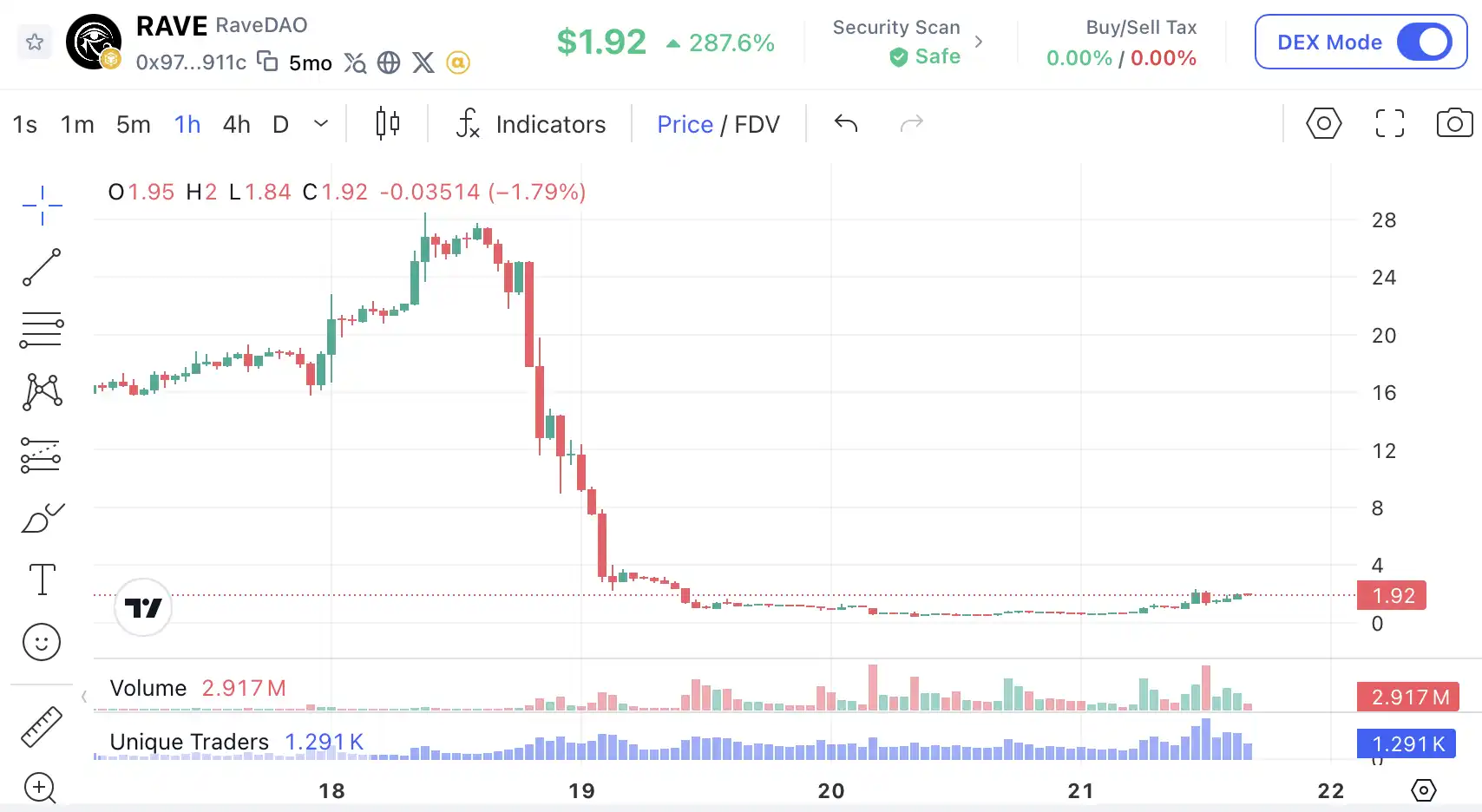
It is noteworthy that this correction did not come from regulators but was driven by an anonymous on-chain investigator. Individual action prompted trading platforms to respond in one day and triggered a re-evaluation of value in the tens of billions of dollars — this reflects the power of on-chain transparency but also exposes the lack of institutional constraints.
However, the question is not just about "whether manipulation exists." More critically: If the structure similar to RAVE is systematically cleaned up, what will be left in this market?
Against the backdrop of institutional funds accelerating their entry and the gradual formation of compliant frameworks, the crypto market is evolving towards a "stock market-like" model: information disclosure is more comprehensive, trading is more monitorable, and price fluctuations tend to converge. However, this process also undermines its original appeal of extreme volatility and asymmetric returns.
Thus, a more difficult question arises: When the "45 times in an hour" opportunities disappear, will liquidity also exit? When the market becomes safer, will it also become more boring? And will the remaining participants still be willing to engage in a system closer to traditional finance?
What RAVE provides is not just a sample of a manipulation event, but more like a mirror — reflecting the trade-offs that the crypto market must face on its path to maturity: transparency versus efficiency, regulation versus vitality, order versus speculation, which have always been difficult to achieve simultaneously.
This might be the real question at hand.
Below is the original text:
Key Takeaways
Just after RAVE skyrocketed by 4500%, on-chain investigator ZachXBT revealed that about 90% of its token supply was concentrated in team wallets, and there was an organized transfer to trading platforms. Subsequently, Binance and Bitget launched investigations, and the token plummeted by more than 90% within a day.
But a more uncomfortable question followed: If the market were "cleaned up" overnight, would the extreme volatility that attracts retail investors also disappear?
Many investors come here not for the annual 10% return of the S&P index, but for the opportunity of "4500% in one night." The work of ZachXBT is undoubtedly commendable, but the question is—do those "degens" really want a clean, rational market? This question deserves an honest answer.
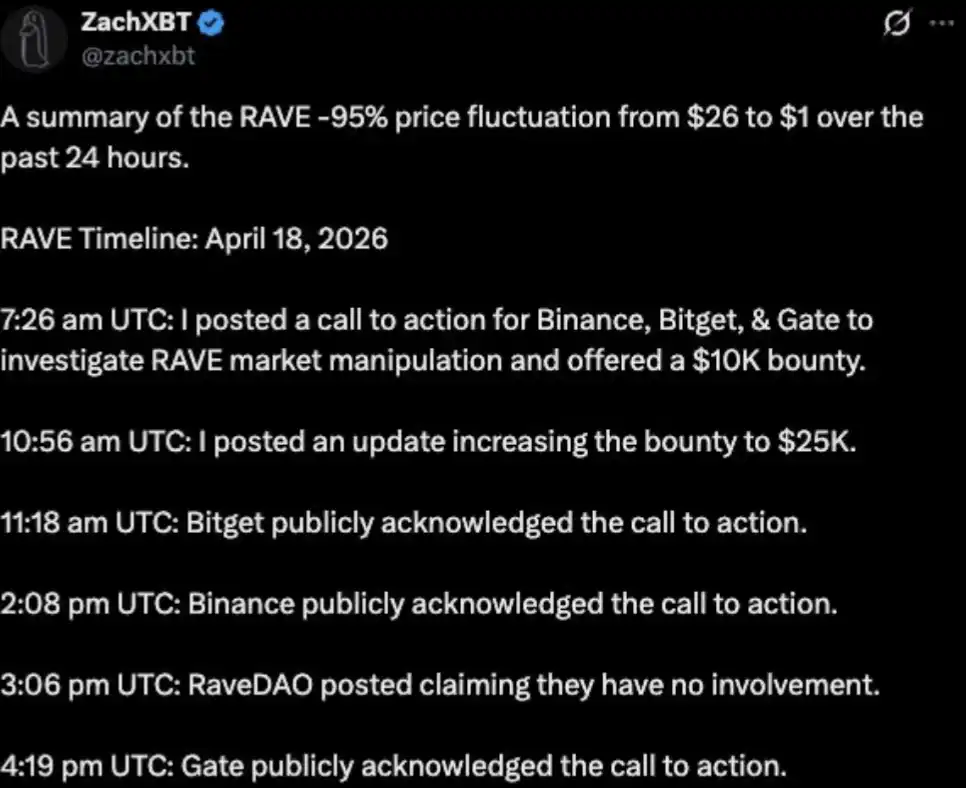
In April 2026, shortly after the RAVE token skyrocketed by 4500%, on-chain investigator ZachXBT publicly accused it of manipulation.
He pointed out that three wallets associated with the project team controlled approximately 90% of the supply out of a total of 1 billion tokens, and the price surge occurred rapidly after these wallets transferred holdings to mainstream trading platforms. Meanwhile, the market's liquidations reached $44 million. ZachXBT subsequently called for Binance, Bitget, and Gate.io to investigate, offering a reward of $25,000 for related information.
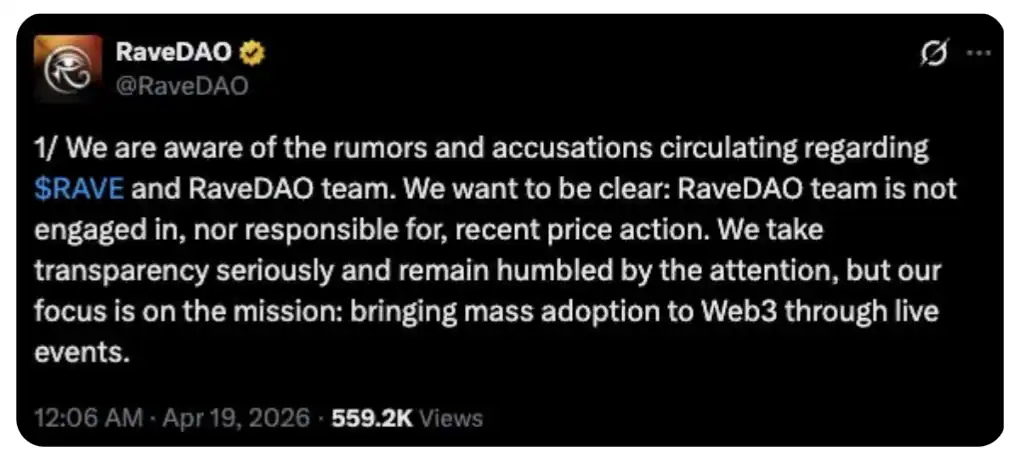
This is a statement from RaveDAO. The project team stated they have noticed various rumors and accusations surrounding $RAVE and the team and explicitly denied involvement or responsibility for the recent price fluctuations. They also emphasized their commitment to transparency and humility towards concerns, but the current focus remains on advancing their mission — promoting the mass adoption of Web3 through offline activities.
Subsequently, Binance and Bitget launched investigations, and the price of $RAVE dropped from $26 to $1, a decrease of 90%, evaporating about $5.7 billion in market value in a single day. RaveDAO later responded, denying the team's involvement.
Why Now
Institutional funds are beginning to flow into the crypto market on a large scale, but hacking incidents have not decreased, and price manipulation is repeatedly occurring. The question "Is this market trustworthy?" has been brought to the forefront once again.
More importantly, this event's "correction" did not come from the U.S. Securities and Exchange Commission or any financial regulatory agency but was propelled by an anonymous on-chain investigator—who prompted action from two trading platforms within a day and indirectly wiped out about $6 billion in market value. The response speed of individual action even surpassed that of regulation.
But this structure is difficult to sustain. The integrity of the market cannot be built on individual goodwill. And the more unsettling question is: Is the so-called "self-correction" really what these high-risk speculators (degens) want?
A Simple Analogy
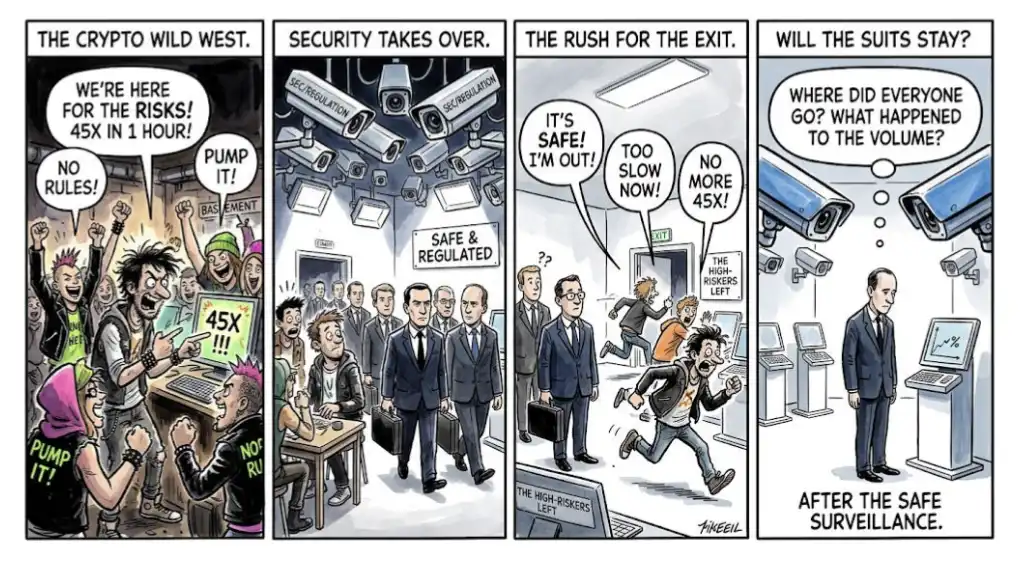
This series of images expresses a paradox; the "chaos and risk" of the crypto market is precisely its core mechanism for attracting liquidity and participants; once cleaned up, the market may also "lose vitality."
First Panel: Crypto "Wild West" phase, no rules, no regulation, everyone shouts "45 times in one hour," "pump it," meaning high risk + high volatility = attracts numerous speculators (degens) to enter.
Second Panel: Regulation/Security Takes Over, large numbers of cameras (symbolizing regulation and compliance) appear; "safety and regulation" take over the market, meaning the market begins to normalize, similar compliance requirements for institutional fund entry.
Third Panel: Speculators Rush for the Exit, those who were originally shouting "45x" begin to run out: "Too slow," "There is no 45 times anymore." This means when the opportunity for huge profits disappears, the initial batch of high-risk players quickly exits.
Fourth Panel: Institutions Remain, but the Market is Quiet (Will the suits stay?), well-dressed people (institutions) stand in a "safe but quiet" market asking: "Where did everyone go? What about the trading volume?" This means the market has become safer, but liquidity and activity have actually decreased.
The crypto market is starting to resemble a strictly regulated stock trading platform.
Surveillance "cameras" are being set up, and well-dressed institutional clients are gradually entering. But the original people filling these seats came not for "safety," but because there was once the possibility of "45 times in one hour."
When every table is covered by monitoring, that kind of 45 times opportunity also disappears, and the original group exits.
So the question arises—when everything becomes safe, will these institutional clients stay?
Uncomfortable Truth
Identifying and curbing manipulation like that of $RAVE is necessary. When team wallets control 90% of the supply and the price surges at the moment these chips flow into trading platforms, this is very close to manipulation. Illegal manipulation should be removed from the market.
But the question is, why do most retail investors choose the crypto market instead of the stock market? Not for the annual 10% return of the S&P index, but for the possibility of "4500% in one day." There are indeed many quality projects in the market, but extreme volatility often stems from information asymmetry, liquidity manipulation, and supply concentration.
Imagine a crypto market where regulations similar to those of the U.S. Securities and Exchange Commission are fully involved — team wallets are fully disclosed, projects with highly concentrated supplies are filtered out before listing, and liquidity manipulation is monitored in real-time. In such a market, which project could still ignite retail investors’ "adrenaline"? It would no longer be a crypto market but more like a slowly operating stock market.
ZachXBT's work is commendable, and we acknowledge that. A safer market is necessary.
But the current reality remains uncomfortable: many people claim they want a "clean" crypto market, but in practice, many high-risk speculators (degens) are attracted to this volatility. By the time regulations are truly complete, the crypto market is more likely to become "boring" than "pure." Projects that can survive will also be validated against standards close to those of listed companies.
We recognize ZachXBT's efforts. But at the same time, there are still many speculators looking for the next "RAVE-like" trend.
Today, there remains a significant gap between the ideal future and the reality of the market. If more projects can rely on their fundamentals to prove their value, this reliance on extreme volatility should not exist.
This is the uncomfortable truth.
免责声明:本文章仅代表作者个人观点,不代表本平台的立场和观点。本文章仅供信息分享,不构成对任何人的任何投资建议。用户与作者之间的任何争议,与本平台无关。如网页中刊载的文章或图片涉及侵权,请提供相关的权利证明和身份证明发送邮件到support@aicoin.com,本平台相关工作人员将会进行核查。


