
Author: Changan I Biteye Content Team
Do you know why you cannot outperform the front in Polymarket? Because they stick to the rules, analyzing them word by word like lawyers reviewing contracts.
In April 2026, a controversy about the leadership in Venezuela exploded in the Polymarket community.
There was a market on Polymarket asking "Who is the leader of Venezuela at the end of 2026?", and many traders' intuition was: Maduro is in a U.S. prison, Delcy is presiding over the cabinet in Caracas, and the actual power holder is clearly Delcy, so they placed their bets on Delcy.
However, the rules and supplementary explanations are very clear: "officially holds" refers to a formally appointed and sworn-in person. The UN-recognized Venezuelan government has not officially dismissed or replaced Maduro, and the official government information still identifies him as President. The rules specifically add: "temporary authorization to exercise presidential powers does not equate to a transfer of the presidential position."
According to this set of rules, even if Maduro is still in a U.S. prison, he is still the legitimate President of Venezuela.
There are many similar examples:
After Polymarket issued stablecoins, a market about "What is the FDV of Polymarket tokens?" sparked debate: Do stablecoins count as tokens, a matter of a word
Iran Uranium: The standard for "agreeing" conditional statements vs formal signing of agreements
The same logic lies behind these cases: in Polymarket, the rules are at the core. However, when rules become controversial, Polymarket has a complete adjudication process to resolve them: this article will introduce how this mechanism operates, and how it is similar to and fundamentally different from traditional courts.
1. The Adjudication Mechanism of Polymarket
The ambiguity of the rule text not only causes pricing discrepancies but can also turn into formal disputes during settlement.
Every day, Polymarket has a large number of market settlements, especially markets involving political statements, diplomatic expressions, and military actions that easily spark controversy.
Controversial events are actually the norm for prediction markets. Ambiguity creates pricing discrepancies during the trading phase, which turn into disputes during the settlement phase, representing the same issue at two different points in time.
To resolve these disputes, Polymarket has established a complete adjudication process, which consists of two paths: normal settlement and dispute adjudication.
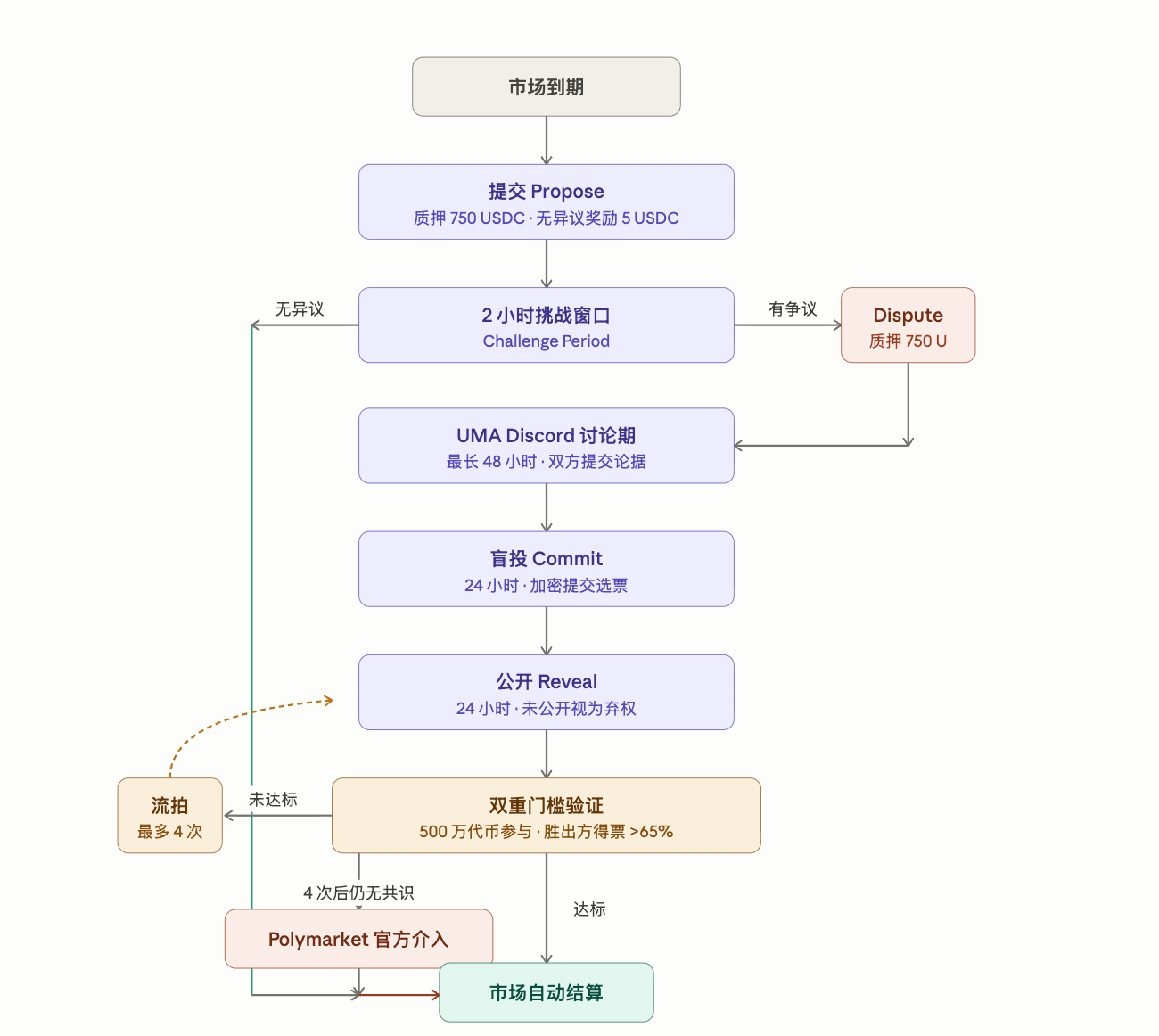
Step One: Submit Propose
When a market meets the settlement conditions, anyone can submit a proposed ruling, declaring whether this market should be judged as YES or NO. When submitting a proposal, a deposit of 750 USDC is required as collateral, which serves as an endorsement of the submitter's judgment; when there are no objections to the market, the user who submitted the Propose can receive a reward of 5 USDC.
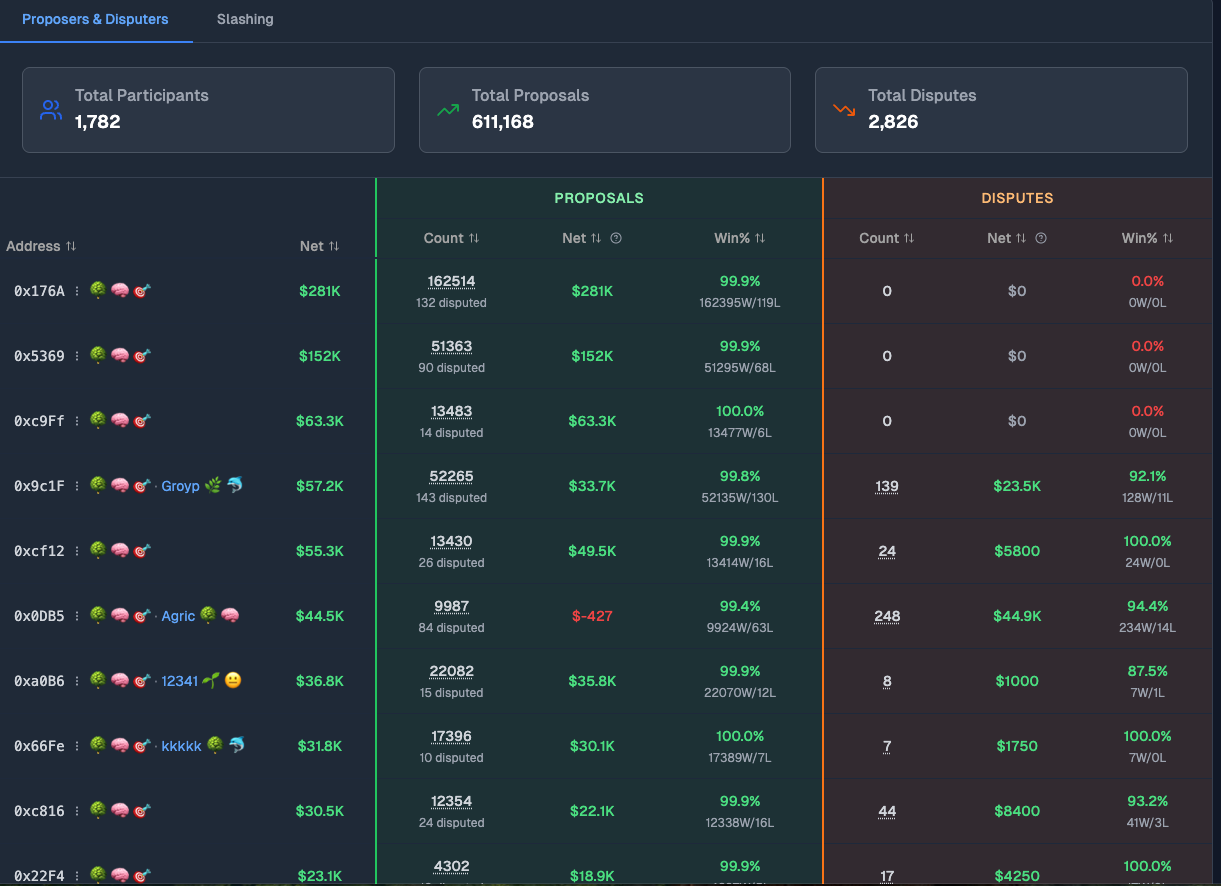
Currently, there are only 1,782 users submitting Propose in the market, with the highest-earning user having accumulated $281K.
Step Two: 2-Hour Challenge Window (Dispute)
After the proposal is submitted, it enters a 2-hour challenge period. This is the first fork in the process.
If no one raises an objection within 2 hours, the system defaults to the proposal being correct, and the market settles directly, ending the process. The vast majority of markets follow this path.
If someone believes the proposed outcome is incorrect, they can raise a challenge within these 2 hours, which also requires a deposit of 750 USDC. A successful challenge can earn a bonus of 250 USDC.
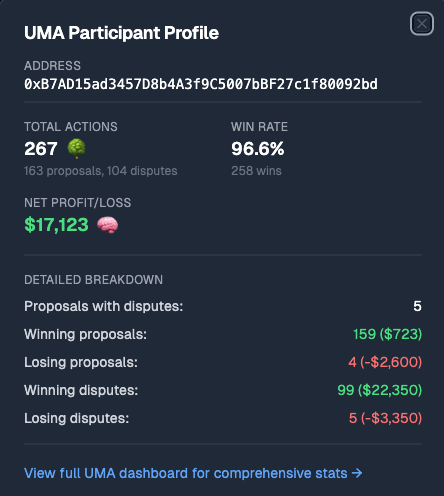
Few users specialize in Dispute, with the highest-earning user in the Dispute phase being 0xB7A, with earnings of $17,123.
Step Three: Up to 48-Hour Discussion Period
Once in the dispute track, both sides enter the UMA Discord discussion phase. The purpose of this phase is to allow parties to submit arguments and evidence: interpretations of the rule text, relevant news reports, historical precedents, official statements—any materials that can support one's position can be presented during this phase.
The discussion period lasts up to 48 hours and is the only phase where reasons can be fully articulated; the quality of this stage largely determines the direction of subsequent voting.
Step Four: 48-Hour Voting
After the discussion ends, it enters the voting phase for UMA token holders, which is divided into two stages of 24 hours each.
The first stage is a blind vote. This ensures each voter must make an independent judgment based on their understanding of the rules, rather than following the big players.
The second stage is public. Votes not disclosed during this stage are considered abstentions and are directly invalidated.
After voting concludes, UMA has set two settlement thresholds that must both be met to complete the adjudication:
Participatory scale: At least 5 million tokens must participate in the vote to ensure the adjudication has sufficient representativeness.
Absolute consensus: The winning side's vote percentage must exceed 65%, rather than a simple majority of 51%.
If the two thresholds are not simultaneously met, the vote fails, leading to a re-vote in the next round, with a maximum of 4 re-votes allowed. If no consensus is reached after 4 rounds, Polymarket has the right to intervene directly for adjudication.
Step Five: Automatic Settlement
Once the voting results are confirmed, the market automatically settles, and funds are allocated according to the outcome. There are no appeals, no retrials, and no remedial opportunities.
The entire dispute process, from the submission of challenges to final settlement, typically completes within a week.
2. Polymarket vs. Traditional Courts: Same Logic, Different Design
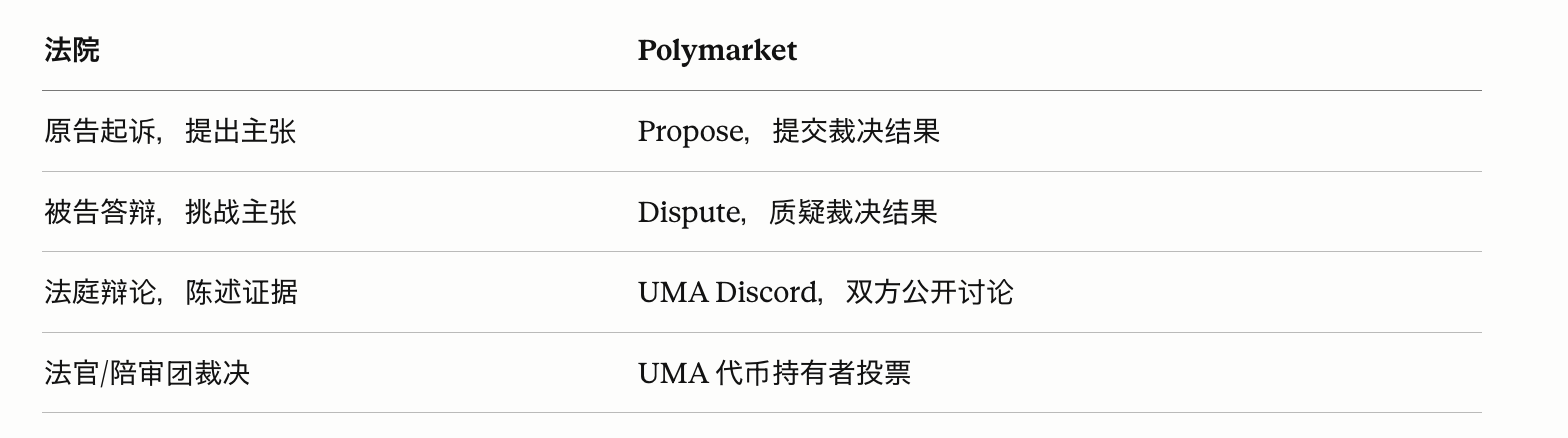
On the surface, the adjudication process of Polymarket is highly similar to traditional courts: there is a party that puts forward claims, a party that challenges those claims, a discussion and presentation phase, and finally, a adjudicator gives a result.
However, the two systems are fundamentally different in one design aspect: the separation of powers.
The power of the courts is isolated
In traditional courts, the plaintiff and defendant only have the right to state their cases and do not have the right to adjudicate. Judges only have the power of adjudication and have no vested interests. More importantly, judges must maintain independence from the cases. Once a judge has any interest connection with a case, they must withdraw and allow another to handle it.
The adjudicator and the interested parties are never the same person.
Polymarket does not have this separation
UMA token holders are the adjudicators, but they can simultaneously hold positions in the dispute markets. The direction they adjudicate can directly affect their profits and losses. The adjudicators and interested parties are the same person; this is known as a conflict of interest in traditional courts and is required to withdraw, but in Polymarket, it is legal and normal.
This design flaw is the root of the following two issues.
1️⃣ Why the discussion phase may fail
In courts, the positions of the plaintiff and defendant are fixed from the moment of filing. Lawyers will not suddenly switch sides during trial nor will they withdraw their statements due to pressure from the other party. Clear positions and defined roles stabilize the whole debate process.
The discussions in UMA Discord simultaneously face two issues.
Herd Effect: Discussions are conducted publicly and under real names; once an influential KOL expresses a view, it easily leads to following the trend. Many participants only post "P1" or "P2," without any reasoning.
Position Shifts: Those participating in the discussion may simultaneously hold positions in the dispute market; once their positions change, their stances naturally follow. This is why opinions are often posted and then deleted in UMA Discord.
The root of both issues is the same: there is no separation between adjudicators and interested parties. Courts use a forced withdrawal system to separate these two roles, ensuring stability in positions during discussions, while Polymarket lacks this separation.
2️⃣ Why the adjudication results are not transparent
In court, judges make decisions based on complete presentations from both sides, and judgments specify which arguments were adopted, the basis for them, and the reasons for the ruling. The losing side may be dissatisfied, but at least they know where they lost, allowing for targeted reinforcement of arguments in the next instance.
These judgments create a system of precedents that can be studied and referenced by future judges, lawyers, and parties, thus making adjudicative standards verifiable, learnable, and predictable.
After UMA voting ends, there is only one result: YES or NO. The parties involved in the discussion do not know what the voters saw, believed, or why they leaned towards one side. The winning side does not know which argument was effective, and the losing side does not know where the persuasiveness fell short. Because the adjudicative logic is never made public, the outcomes of disputes are difficult to learn from and accumulate.
Court judgments comprise a system of precedents, while Polymarket's adjudications leave only one outcome.
3. Final Thoughts
Thus, Polymarket is never just a market for "correctly guessing events"; it is more like a system that translates real events into legal texts and then translates those legal texts into settlement outcomes.
Understanding the rules is as important as conducting research. The advantage of the front often comes from a deep understanding of the rules and knowing what this system recognizes and how adjudication will be viewed.
Whoever realizes the gap between "reality" and "rules" earliest has a better chance to profit from the price discrepancies created by misreading, controversy, and emotion.
免责声明:本文章仅代表作者个人观点,不代表本平台的立场和观点。本文章仅供信息分享,不构成对任何人的任何投资建议。用户与作者之间的任何争议,与本平台无关。如网页中刊载的文章或图片涉及侵权,请提供相关的权利证明和身份证明发送邮件到support@aicoin.com,本平台相关工作人员将会进行核查。


