Author| Moonshot
Editor| Jingyu
In the past two years of the generative AI explosion, people naturally assume that young people, as digital natives, are the most fervent believers in this technology.
On the surface, this seems to be true. Data from the Pew Research Center shows that 54% of American teenagers have started using tools like ChatGPT to complete their studies. The latest Gallup report titled "The Voice of Generation Z: The AI Paradox" also shows that more than half (51%) of Americans aged 14 to 29 maintain a high frequency of daily or weekly AI use.
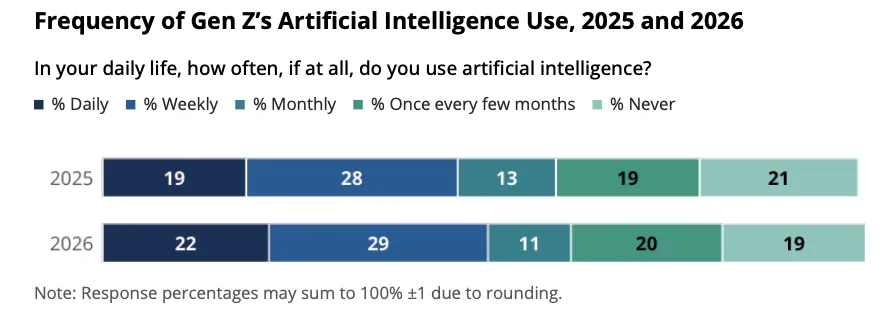
But behavior does not equal willingness. Gallup further found that, in just one short year, the proportion of 14 to 29-year-olds feeling "hopeful" about AI dropped from 27% to 18%. Nearly one-third (31%) of respondents felt "angry," and as many as 42% fell into persistent anxiety.
High-frequency use coincides with a collapse of trust; the contradictory feelings of both love and dependence on AI are spreading among Generation Z in the United States (those born between 1996 and 2012).
Why is it that the generation that uses AI most frequently trusts it the least?
01 Anxiety: Keeping Enemies Close
The group that harbors the most hostility toward AI is those who have just entered the workforce or are looking for a starting point.
Gallup data shows that among employed Generation Z, as many as 48% believe that the risks of AI in the workplace far outweigh the benefits, an increase of 11 percentage points within a year. Only 15% think the benefits outweigh the risks.
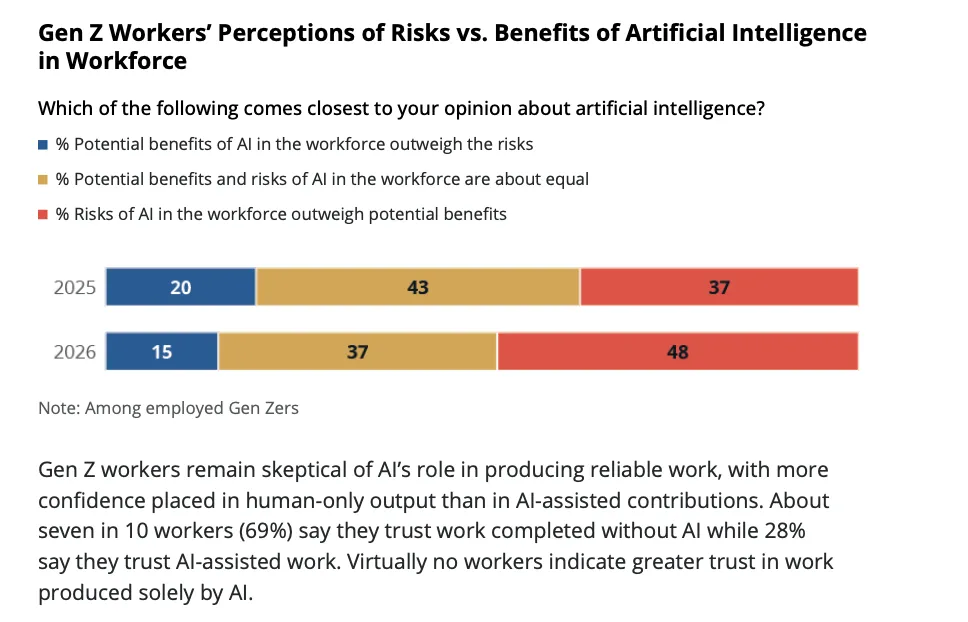
The reasons are easy to understand; the economic climate is poor, and it is hard for American graduates to find jobs.
Data from the New York Federal Reserve shows that by the end of last year, the unemployment rate for college graduates aged 22 to 27 soared to 5.6%, far exceeding the overall unemployment rate.
In this broader environment, AI is portrayed as a tool to "improve efficiency," capable of becoming a "digital employee" for businesses. Some executives from AI companies frequently express to the media that "a large number of entry-level white-collar jobs may be automated in the coming years."
These are often the "junior white-collar jobs" exclusive to young people. Without these entry-level positions for experience, young people have no qualifications to build their career moats.
So, although this replacement has not fully occurred in reality, expectations have already changed emotions beforehand; for young people, AI feels like a potential competitor.
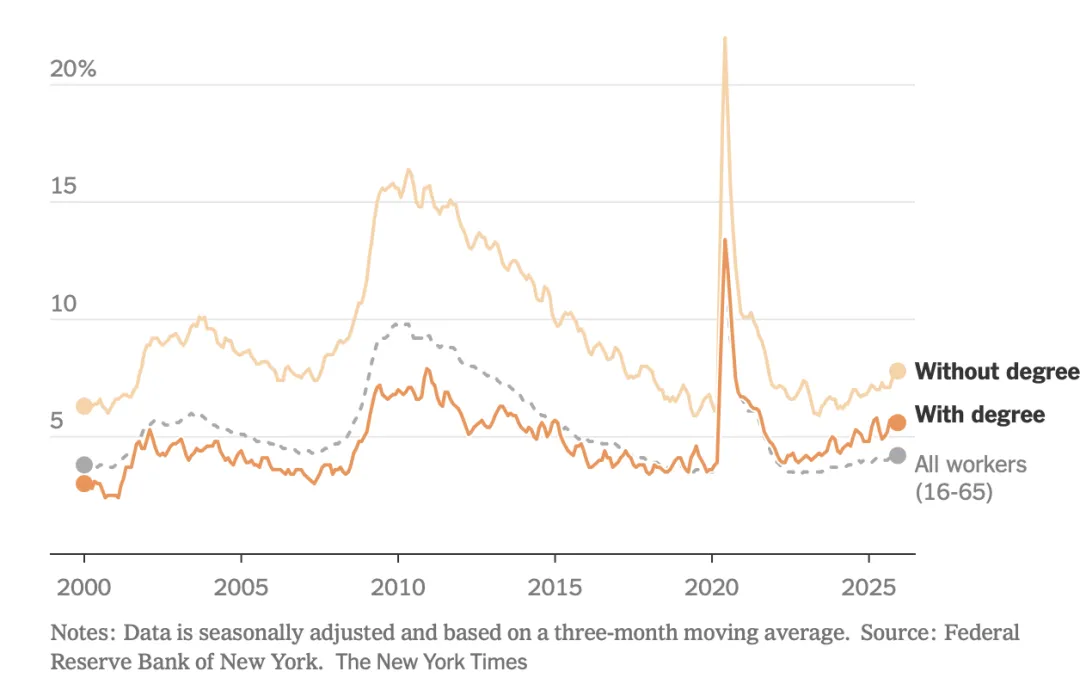
The cycle of "unemployment wave" coincides with the rise of AI|Image source: The New York Times
The report by The New York Times mentioned many specific dilemmas faced by Generation Z.
For example, 22-year-old psychology graduate Erin sent out nearly 200 resumes in hopes of landing even a basic business analysis job but only received four interview invitations, ultimately having to take a job as a waitress in a restaurant on Long Island as a stopgap. The job search experience has left her physically and mentally exhausted, and she has started seeking therapy.
Meanwhile, freshman Sydney does not know how to choose a major, saying, "I feel like any field I am interested in could be replaced in the coming years." Her confusion represents the overwhelming majority of current college students.
On the other hand, tech giants are continuously laying off employees under the pretext of deploying AI. This is the starkly divided reality today. Silicon Valley elites can make companies "reduce costs and increase efficiency," but for young people, it means losing the stepping stones to enter the workforce.
Ironically, to avoid being eliminated, they must daily open ChatGPT to polish their resumes and ask the large models which universities are easier to get into.
This psychological and behavioral inconsistency regarding AI is the core reason for Generation Z's anxiety about it.
02 Fear: The AI That Must Be Used
Given their hostility and distrust, why are as many as 51% of young people still using it daily or weekly?
New York Times reporter Callie Holtermann captured the answer during lengthy interviews, finding that the young people she spoke to did not think using AI was that great. The driving force that prompts them to open the dialogue box is the fear that "if they do not become familiar with this technology, they will fall behind in their studies or careers."
The rules of the workplace have already been reshaped by AI. While browsing job postings for entry-level positions, young people often see requirements like "applicants must be proficient in using ChatGPT or Gemini."
A recent report from the AI agency company Writer paints a harsher picture, revealing that 77% of executives explicitly state that employees who do not master AI will not get promotions. Even 60% of management is considering directly laying off this group of people.
This means that within the existing workplace and evaluation systems, not understanding AI equates to being immediately eliminated.
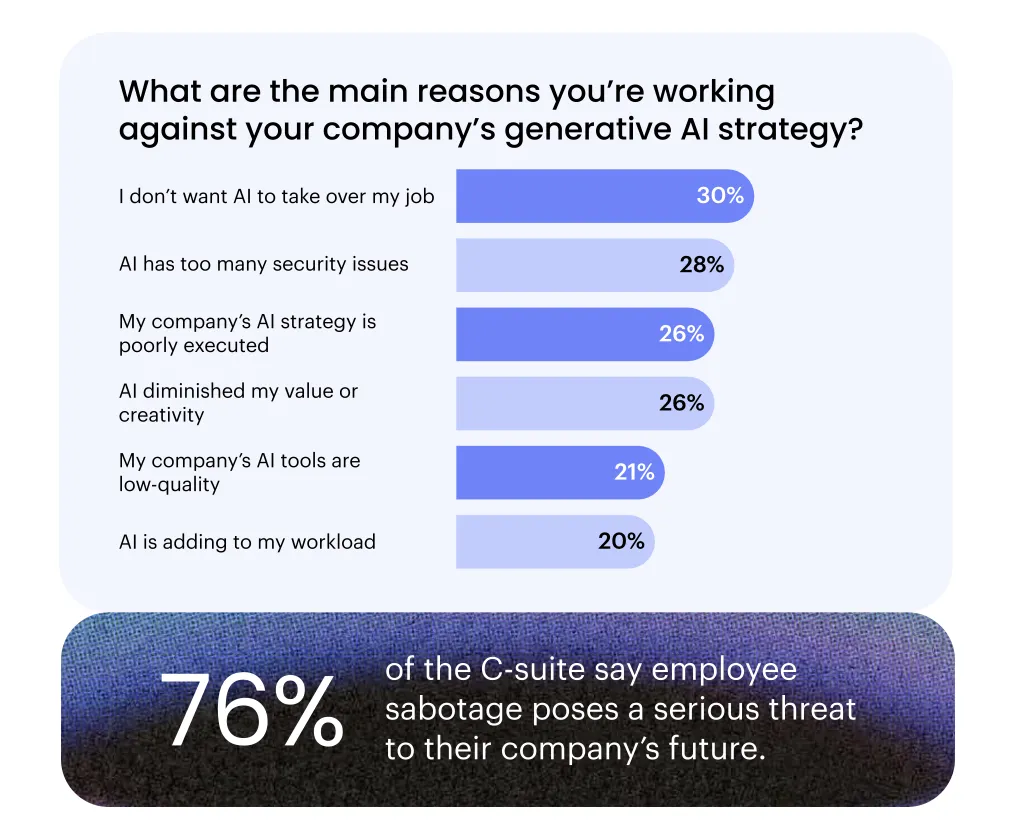
The most important reason employees resist AI is: they do not want AI to replace their jobs|Image source: WRITER
Even if they reluctantly gain a position, this fear does not dissipate.
These workers also face the impact of "FOBO" (Fear of becoming obsolete), with reports indicating that 26% of workers believe that AI is directly undermining their creativity and core value in the company.
This represents a profound professional deprivation; all the coding, law, or finance knowledge they have painstakingly learned is rapidly losing its market value. Accompanying this loss of value is a deep self-doubt regarding their own abilities. In Gallup's survey, many young people worry that AI will weaken their critical thinking and creativity.
Moreover, this "FOBO" extends not only to workers, but also to management that forces employees to embrace AI. According to the Writer report, 69% of companies are laying off employees because of AI, yet 39% of those businesses have not clearly figured out how to profit from AI. Even 73% of CEOs are feeling anxious about their AI strategies.
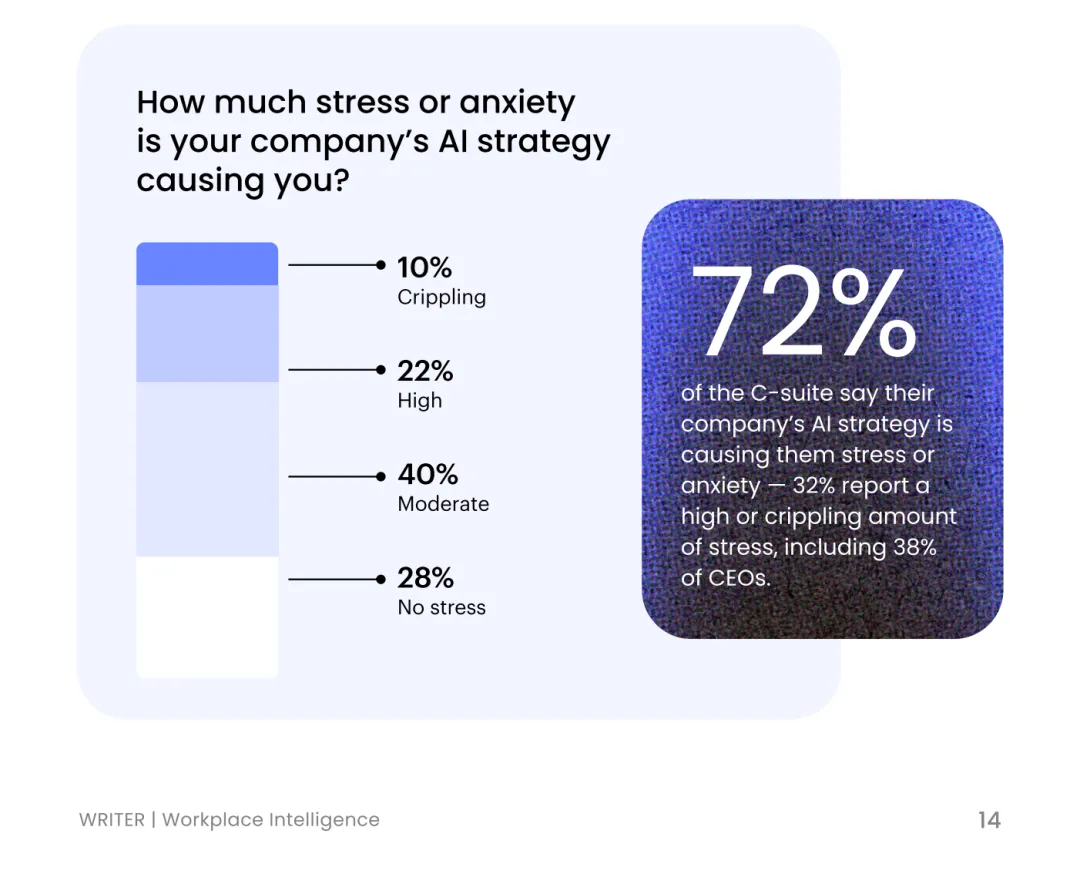
72% of employees feel some level of pressure from AI|Image source: WRITER
As fear reaches its peak, young people begin to throw sand in the gears of the system.
Nearly half (44%) of Gen Z employees admit to consciously obstructing their companies' AI adoption, including refusing to use or misusing tools, and even intentionally lowering their efficiency.
The methods of sabotage are varied. Some deliberately input company secrets into public AI tools to trigger security alerts, while others refuse to use approved software. In more extreme cases, some manipulate performance evaluations or intentionally submit low-quality work generated by AI to prove to management that "AI is simply no good."
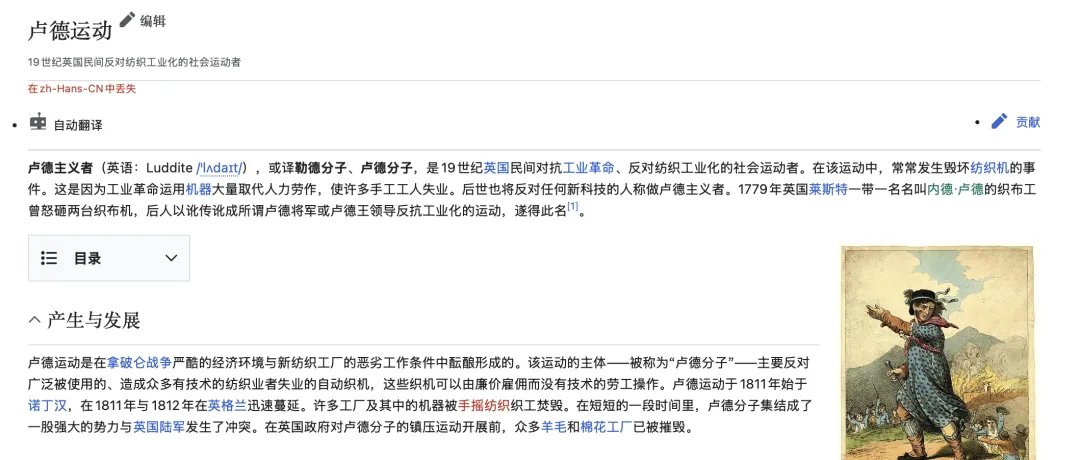
The Luddites aimed to resist unemployment and worsening working conditions caused by technological changes|Image source: Wikipedia
This situation is akin to the Luddites' movement, where workers took the lead in smashing machines after the advent of industrial revolution textile machines.
Even if it poses a high risk of termination, they resort to this passive resistance to combat their inner fears.
03 Caution: The More You Use, The Less You Trust
In the face of anxiety and fear, many young people are starting to remain cautious about AI.
This sense of caution is reflected in a series of specific behaviors; the most direct change is that they begin to set boundaries for AI. They are now very clear about what AI can do and what things should not be entrusted to it.
The first boundary is drawn in interpersonal communication.
For instance, 27-year-old tourism industry employee Abigail Hackett shared with The New York Times that she frequently uses AI to handle complex copy in her work, saving a lot of time. However, in her personal life, she never uses AI to draft any private information. The reason is simple: she does not want her "social muscles to atrophy."
This is a type of "cautionary trade-off" many users exhibit; AI can enter the workflow, but should not intrude into social relationships.
Even regarding those AI designed for companionship, young people's attitudes have shifted.
In the past two years, role-playing chat tools like Character.AI have rapidly gained popularity among young people. They can simulate friends, lovers, and even fictional characters, offering an always-available sense of "companionship." Meanwhile, the debates surrounding these products are also increasing, including issues of youth addiction, emotional dependency, and even isolated incidents of self-harm and suicide.
Many discussions thus conclude that AI is weakening minors' social skills.
However, long-term observations by researchers at the University of Sydney have overturned this hypothesis, showing that the vast majority of young people are very clear-headed and do not see AI as real human substitutes; they prefer to treat these chats as a form of "play" or entertainment.

Quentin significantly reduced his use of AI chat apps after starting a relationship with his girlfriend|Image source: The New York Times
For example, 15-year-old respondent Quentin was once a heavy user of Character.AI, but he clearly stated that it was just a game and essentially made up of a bunch of 1s and 0s.
Once there are changes in real life, such as making new friends at school or starting a romantic relationship, the time he spends on chatbots drops sharply. Chatbots, at best, serve as mere electronic distractions when boredom strikes; as soon as real life begins to operate, AI can be discarded without hesitation.
Establishing boundaries in life, when it comes to critical decision points, young people also do not trust AI.
According to a 2024 survey by consulting firm Ruffalo Noel Levitz, one-third of high school students use AI to plan their college applications. They will allow AI to pull up a long list of schools, organize tuition, scholarships, and acceptance rates into tables for quick preliminary screening, but they will not let AI make judgments.
This caution has been built through multiple missteps.
In the report by The New York Times, a senior from Wisconsin, Brandon, has developed a strict habit of verifying AI information because a large model once definitively recommended several nonexistent university scholarships, wasting his time on verification.
A student from San Francisco, Tanay, saw through the false emotional value provided by AI; when his AI told him, "You can 100% get into Princeton," he immediately realized that AI was catering to him with excessive affirmation and was of no help to his school selection decisions.
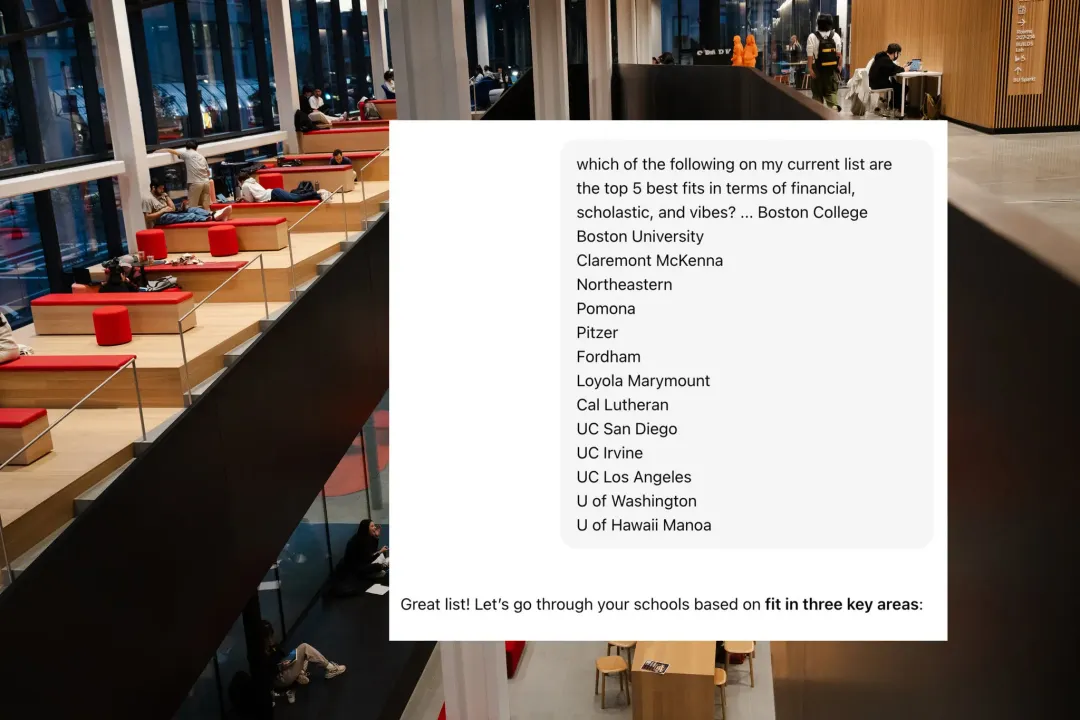
On average, 376 students in public high schools across the U.S. are assigned one counselor, so many students will use AI to assist in applications|Image source: The New York Times
Who hasn’t been "amused" by AI at some point? Once such moments appear a few times, attitudes toward AI are hard to return to initial trust.
At this point, looking back at the Gallup and Pew survey data, the "AI paradox" becomes understandable.
More than half of young people use AI daily, driven by the survival instinct prompted by the pressures of employment and academic advancement. The drastic drop in their trust in AI from 27% to 18% reflects that the more they use it, the more problems they encounter, leading them to see the limitations of the technology.
Anxiety, fear, caution, and to some extent misuse—all these seemingly conflicting states coexist in young people's attitudes toward AI.
Because in this unavoidable technological cycle, Generation Z has figured it out.
A tool is just a tool; one should extract its value thoroughly, but one should not truly revere it as a deity, nor let it make decisions on their behalf.
Rather than saying they distrust technology, it is more accurate to say they are acutely aware that the benefits and costs of this technology may fall on them simultaneously.
免责声明:本文章仅代表作者个人观点,不代表本平台的立场和观点。本文章仅供信息分享,不构成对任何人的任何投资建议。用户与作者之间的任何争议,与本平台无关。如网页中刊载的文章或图片涉及侵权,请提供相关的权利证明和身份证明发送邮件到support@aicoin.com,本平台相关工作人员将会进行核查。


