On April 18, the cross-chain bridge of Kelp DAO was attacked, with the attacker minting 116,500 rsETH without real asset backing, which was then deposited into Aave and borrowed out as WETH. Aave Guardian initiated an emergency freeze within hours. According to on-chain estimates from Lookonchain, the potential bad debt faced by Aave V3 and V4 is approximately $195 million.
In contrast, the lending protocol SparkLend under the MakerDAO (Sky) ecosystem suffered no losses.
This is not because Spark's team is smarter than Aave’s, nor is it because they foresaw the vulnerability of the cross-chain bridge in advance. The reason for Spark’s exit from rsETH is documented in a governance forum post from three months ago and is unrelated to the security of the bridge contract.
The core date of this article is January 29, 2026. On this day, Spark executed a governance operation called Spell, which stopped the new supply of rsETH. On the same day, Aave's rsETH E-Mode officially launched, allowing users to borrow WETH using rsETH as collateral, with a maximum loan-to-value (LTV) ratio of 93%.
One exited, one expanded, all on the same day.
Spark’s exit decision was initiated by a governance post submitted on January 16, 2026, by PhoenixLabs (Spark’s ecosystem execution entity). The reason for the exit was straightforward: low utilization of rsETH, with almost all usage coming from the same wallet (on-chain address 0xb99a), and the owner of this wallet has indicated a willingness to use alternative collateral such as wstETH or weETH. The original governance post stated, "Exiting rsETH can improve SparkLend's safety margin and enhance risk-adjusted returns." This was a periodic asset cleanup, with the same batch exiting including tBTC, ezETH, and the entire Gnosis Chain market, with the unified reason being "low utilization."
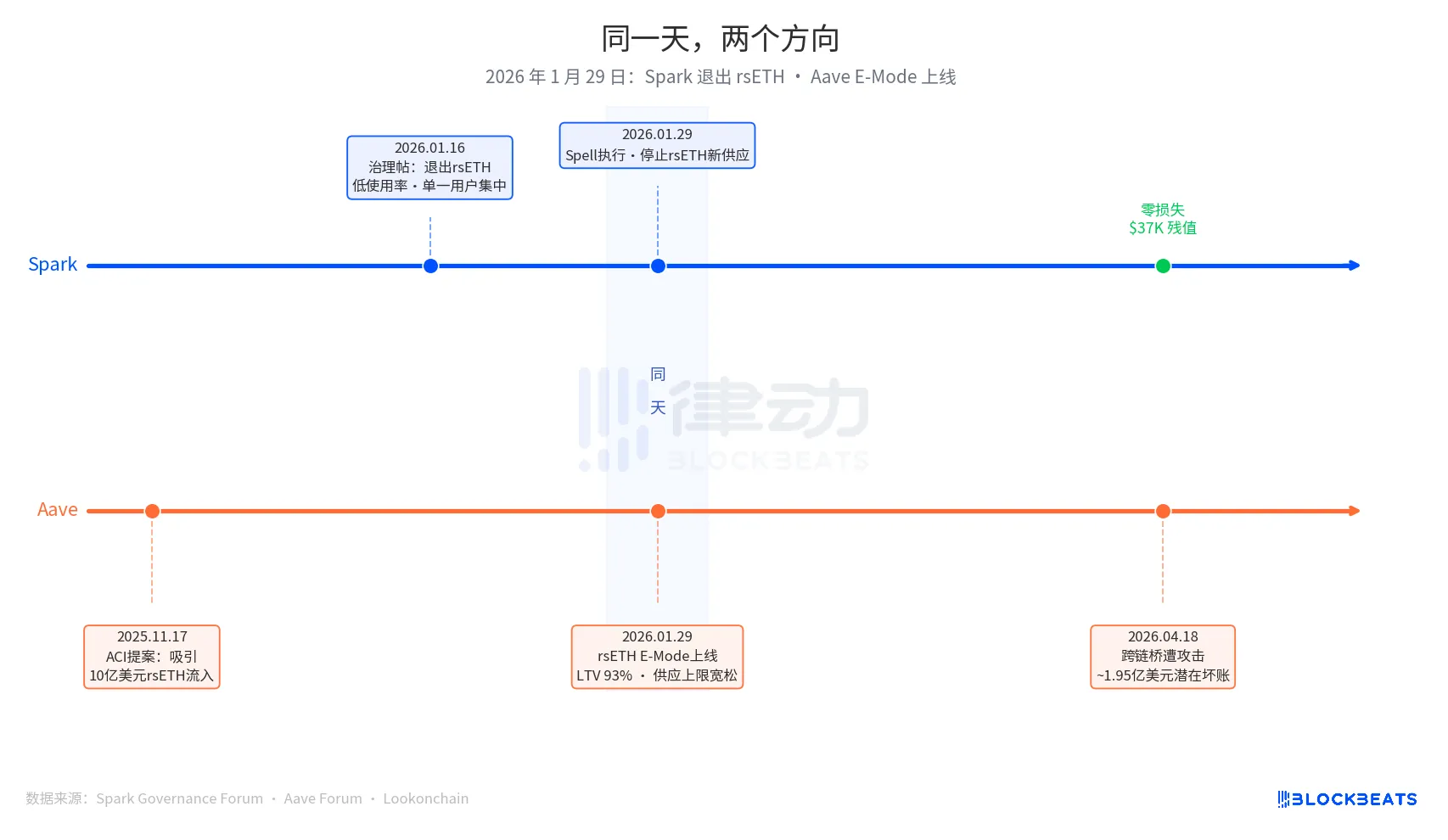
Aave's expansion decision started earlier, stemming from a proposal initiated by ACI (Aave Chan Initiative, a governance proposal organization led by Marc Zeller) on November 17, 2025. The motivation for the proposal was clear: "To restore WETH utilization rates, expecting to attract $1 billion in rsETH inflow." Chaos Labs confirmed the risk parameters in January, determining E-Mode LTV at 93% and a liquidation threshold at 95%. The participating decision-making entities included ACI, Chaos Labs, LlamaRisk, and the Aave community voters. This was an expansion decision driven by multiple parties rather than a mistake by a single entity.
Three months later, the market provided results.
Currently, Aave’s Umbrella insurance mechanism has approximately $50 million in available funds, covering only 25% of the potential bad debt of about $195 million. The order of loss absorption is: aWETH stakers bear the first loss, followed by WETH depositors proportionally sharing the next, and then stkAAVE and the DAO treasury. Aave's total value locked (TVL) dropped from $26.4 billion to $19.8 billion, including panic withdrawals. USDT market utilization reached 100% within hours, with new lending volume around $300 million.
Spark's current frozen residual value in the rsETH market of SparkLend is $37,300, equivalent to 15.32 rsETH. The wallet 0xb99a, after the prohibition on new supplies on January 29, has almost entirely migrated to wstETH and weETH, fully aligning with the predictions in the governance post.
On April 19, Spark co-founder Sam MacPherson (@hexonaut) pointed out that protocols claiming no risk exposure to rsETH do not equal zero risk exposure. If users have collateral in the affected lending market, indirect exposure still exists. Spark did not incur direct losses, but indirect risks are still being assessed.
The fact that both protocols made opposite decisions on the same day does not indicate who made the right decision; the starting issues of the two systems are entirely different.
Spark’s risk control logic has the trigger of "whether marginal costs exceed marginal benefits." If utilization falls below a threshold, single user concentration exceeds limits, or risk-adjusted returns do not meet standards, any one of these criteria hitting means the asset enters the exit candidate list. This is a proactive, efficiency-oriented tightening mechanism, unrelated to whether this asset has security risks.
Aave's logical trigger is "market growth opportunity." With low WETH utilization and a sufficiently large rsETH market, E-Mode can attract incremental funds. From this entry point, the parameters are oriented towards expansion: LTV at 93%, relaxed supply limits, and multiple governance entities driving the initiative.
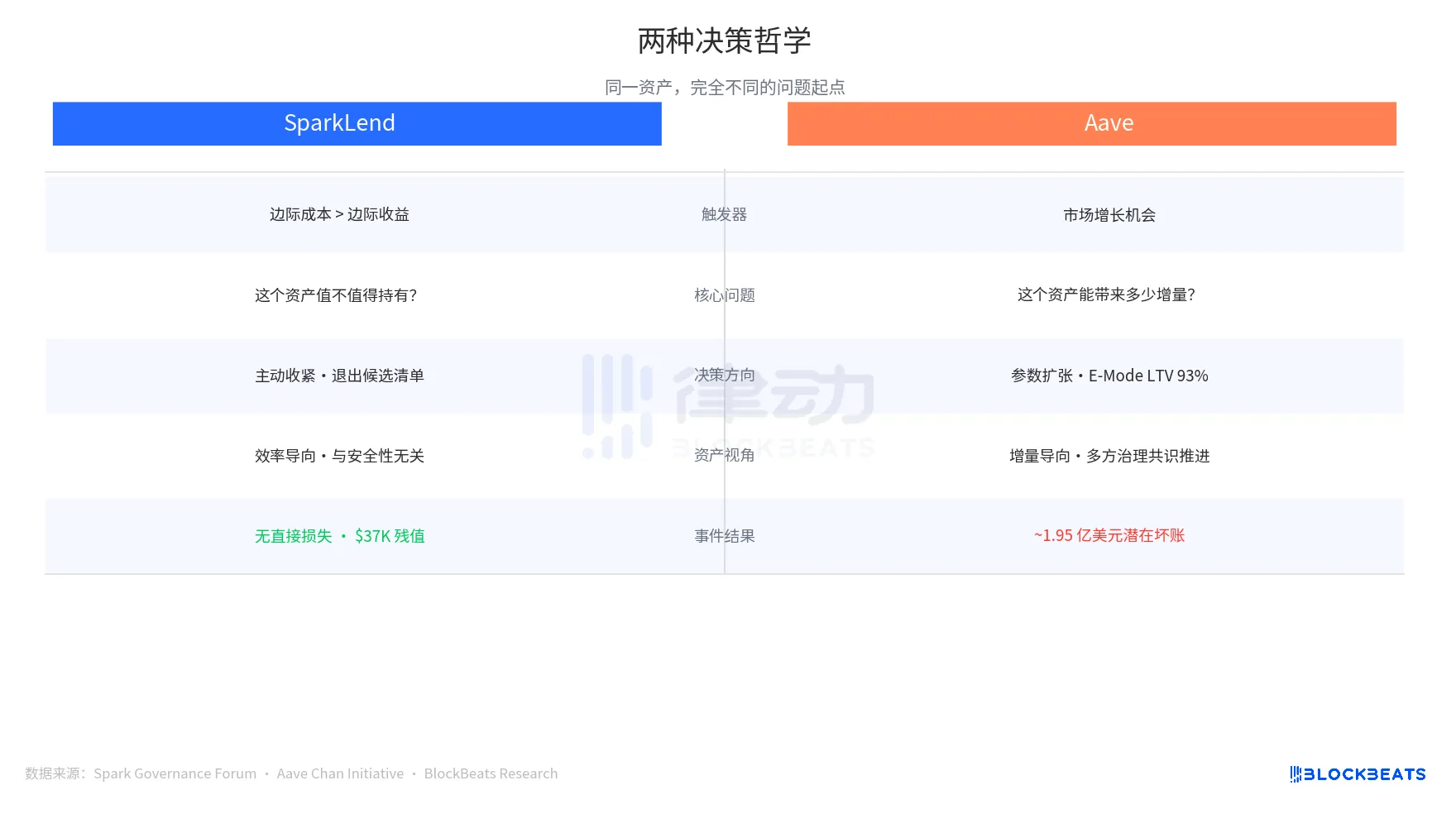
These two protocols answer fundamentally different questions: "Is this asset worth holding onto?" versus "How much incremental value can this asset generate?" Both approaches, before a risk event is triggered, represent reasonable business logic; it is only after triggering that arbiters emerge.
The safety result for Spark has another layer of support.
In a post on April 19 announcing "the exit from rsETH," Sam MacPherson mentioned that "SparkLend has rate-limited deposit and borrowing caps. Its oracle mechanism also uses a three-way median." This points to another two lines of defense in Spark's risk control system.
One is the physical constraints during operation. The Rate-Limited Supply Cap restricts the maximum supply within a unit time, while the Borrow Cap limits the maximum borrowing scale. The implication of these designs is that even if Spark had not exited rsETH, an attacker would not have been able to deposit $292 million worth of rsETH at once, and the loss scale would have been capped severely.
The other line of defense is at the price information level, the three-way median oracle takes the median of three independent price sources: Chronicle, Chainlink, and RedStone, and in extreme cases downgrades to Uniswap TWAP as a fallback. Manipulation of a single price source does not affect the triggering of liquidations. In contrast, Aave faced exposure windows caused by oracle price lags in this event, which is a design-level difference rather than an execution-level mistake.
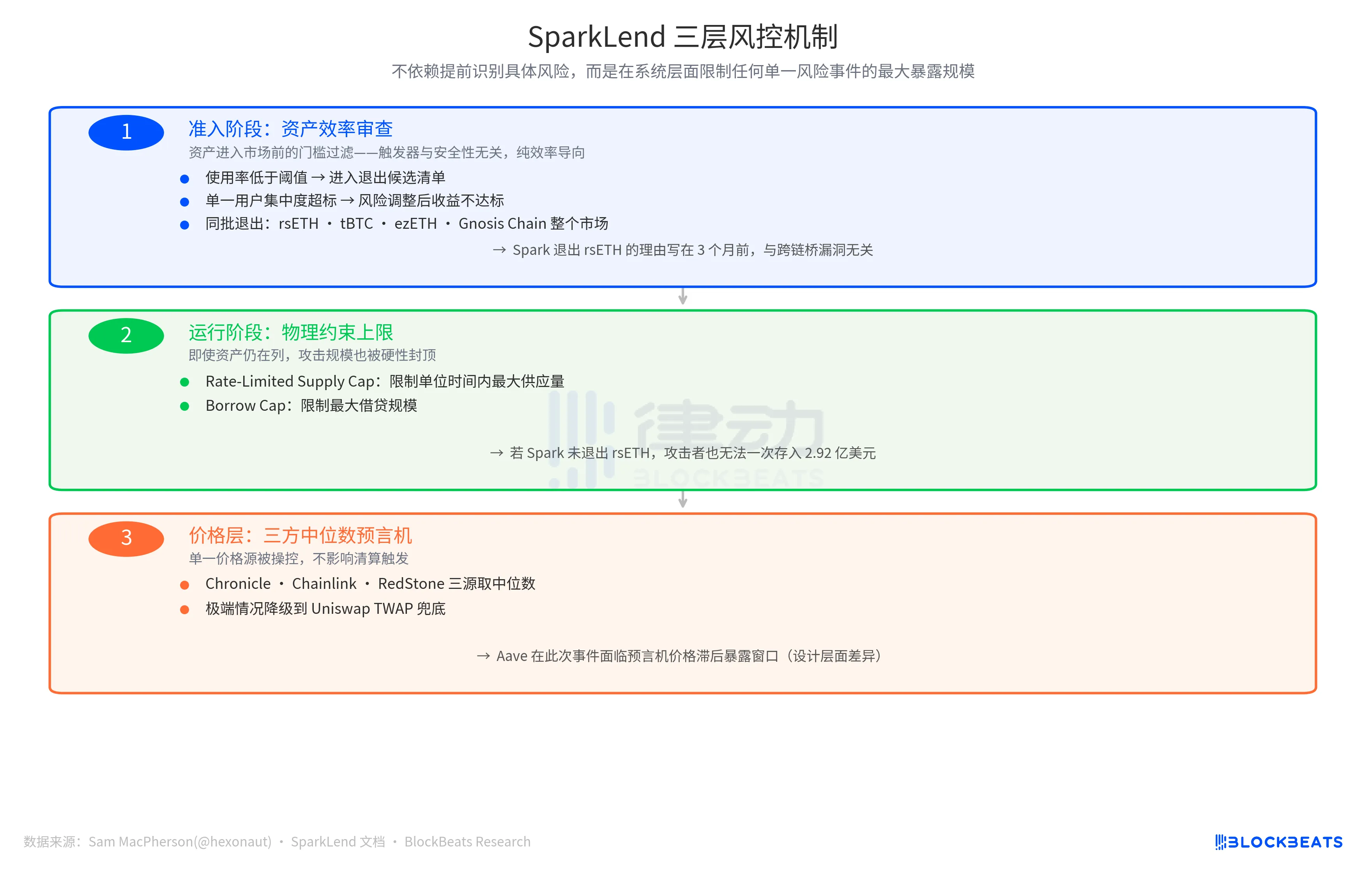
The design logic of these three lines of defense is consistent: not relying on the early identification of specific risks but instead limiting the maximum exposure scale of any single risk event at the system level.
The final loss figures depend on the loss allocation plan of Kelp DAO. Currently, there are three coexisting options: socialized losses for all chain rsETH holders (reduced bad debt size), L2 rsETH holders bear it alone (mainnet Aave bad debt remains unchanged), or snapshot rollback (operational difficulty extremely high). This figure will have an answer in the next few weeks.
But the results of the two decision-making philosophies can already be quantified, with a gap of approximately $195 million, triggered on the same date, recorded in the governance operations of the same day.
免责声明:本文章仅代表作者个人观点,不代表本平台的立场和观点。本文章仅供信息分享,不构成对任何人的任何投资建议。用户与作者之间的任何争议,与本平台无关。如网页中刊载的文章或图片涉及侵权,请提供相关的权利证明和身份证明发送邮件到support@aicoin.com,本平台相关工作人员将会进行核查。


