Author: Yanfei
Another celebrity company has been ruthlessly "slaughtered" by Anthropic.
On April 18, Anthropic launched a new product called Claude Design. Users can create website or app design plans with it, including interactive prototypes, product feature diagrams, etc. They can also create presentation PPTs, online event landing pages, marketing materials, and more, making it very feature-rich.
All of this can be completed through conversation, rather than by rigidly searching for materials or building pages. Additionally, users can package the generated content into code with one click using Claude Code.
As soon as the new product was released, the first to be affected were the design software companies still following traditional routes. On the day of trading, the stock price of Figma, the largest design software company in the U.S., plummeted nearly 7%.
Figma was founded in 2012 and has grown into a mainstream tool for global UI design over the past decade. In 2022, Adobe planned to acquire Figma for $20 billion, shocking the global software industry. However, due to interventions by regulatory agencies in various countries, this monumental acquisition ultimately fell through.
In July 2025, Figma went public on the New York Stock Exchange, reaching a market value of $68 billion on its first day. However, under the influence of the AI wave and other factors, Figma's stock price has been on a downward trend.
The emergence of Claude Design has dealt a heavy blow to Figma, which is already at a low point. Today, Figma's market value is less than $10 billion, and its stock price has dropped by nearly 90% compared to its 52-week high.
Figma is not the first company to be "slaughtered" by Anthropic.
Since January this year, Anthropic has launched a series of new products and features aimed at multiple traditional tracks, leading to significant declines in the stock prices of related companies and casting a shadow over their development prospects. Legal, financial, marketing, design, security, automation... wherever Anthropic's influence reaches, those prominent players seem to have little resistance.
Sometimes, the "new dishes" served up by Anthropic are far from perfect, and commercialization is still out of the question, showing no potential to replace existing products. Even so, the capital market will still vote with its feet, and the entire industry will fall into widespread anxiety due to Anthropic's entry.
Behind Figma's "sudden attack" by Anthropic, a clear "AI slaughter line" is emerging: those seemingly indestructible companies and tracks are surprisingly shattered under the AI wave, falling apart in an instant.
Slaughtering Figma in the software design field is a microcosm of Anthropic's sweeping of traditional industries over the past four months.
At the end of January, Anthropic released the Claude Cowork plugin package, which includes 11 plugins in fields such as law, sales, finance, marketing, and data analysis. These plugins integrate workflows from different fields into the Agent, allowing users to issue commands in natural language to quickly complete a whole set of operations.
Previously, users needed to call different third-party software and master the corresponding software usage specifications to achieve results through a complex process. Now, with the help of the plugins, all these tasks are handled by AI.
For example, with the legal plugin, Claude Cowork can automatically complete tasks such as contract reviews, compliance checks, and legal briefings, greatly reducing the workload of in-house legal personnel. With fewer legal needs, the demand for third-party legal software has also decreased.
As the ripples spread to more fields, the official start of the "Anthropic slaughter" has begun.
At the end of January and early February, a storm swept through the U.S. stock market, with software stocks becoming a particularly hard-hit area.
According to statistics from "Quantum Bit," on February 3 alone, Thomson Reuters, which provides legal research services, saw its stock plummet 16%, setting a record for the largest single-day drop in company history; legal tech company CS Disco fell 12%; standardized legal service provider LegalZoom dropped 20%.
As panic continued to spread, more and more software stocks were caught up, with Adobe, Salesforce, Atlassian, and others all experiencing declines. Within a single day, a basket of American software stocks compiled by Goldman Sachs fell 6%, with the financial services sector index dropping nearly 7%.
Within hours, these stocks collectively lost a market value of $285 billion. According to a Reuters report, in less than a week, the market value of American software and service stocks evaporated by nearly $830 billion, almost equivalent to the valuation of OpenAI.
Some commented on social media: "Anthropic released 11 plugins, and Nasdaq panicked. Why? Because for the first time, a foundational model company ignored the API layer and directly consumed the application layer... If the model can work directly, software is worthless."
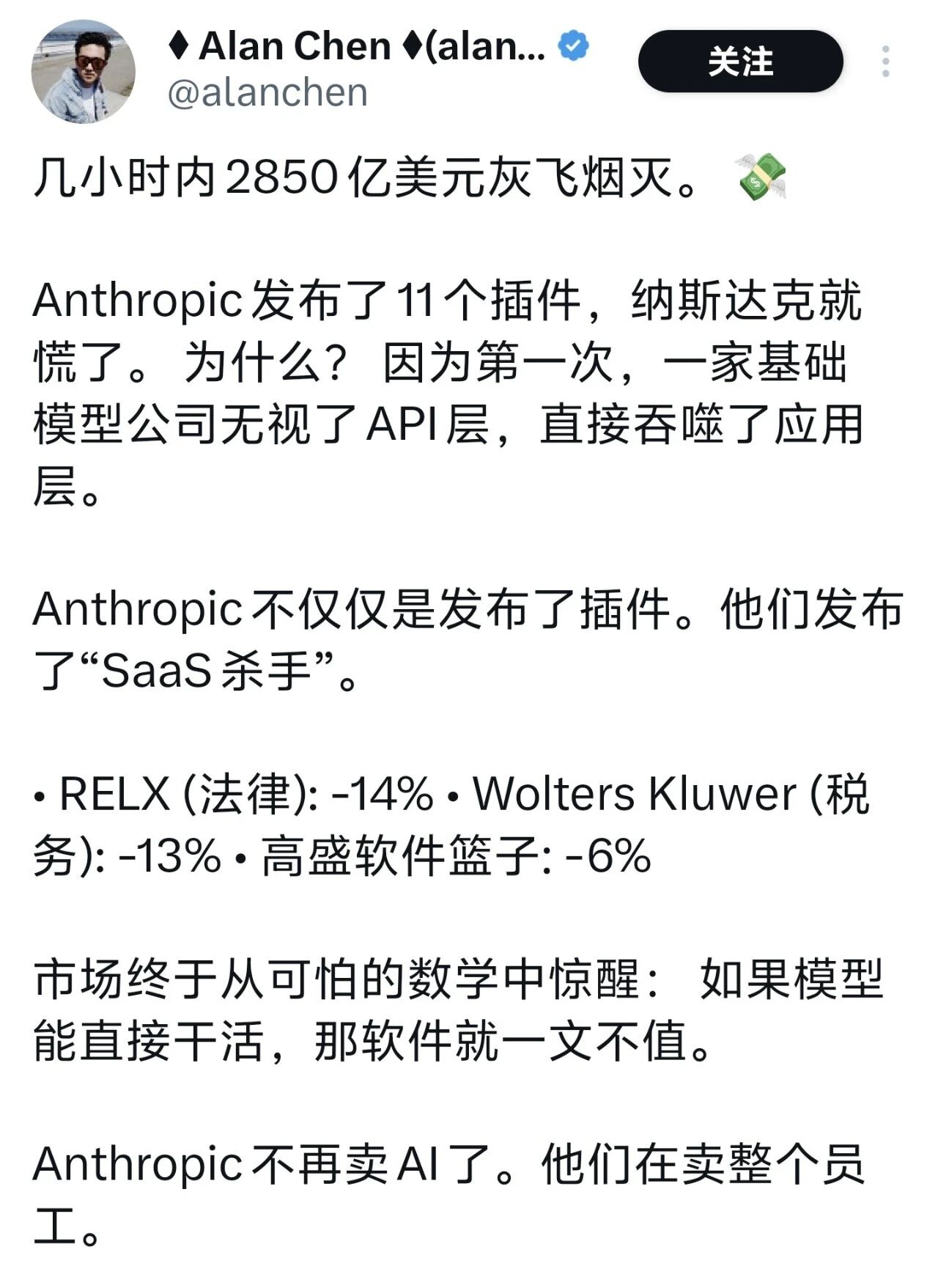
Even more shocking is that Claude Cowork was launched on January 12, and just over half a month later, these plugins were introduced. The hastily thrown together, somewhat rough plugins were enough to sweep across the software industry, while Anthropic's exploration and promotion of the plugin ecosystem is far from 1% done.
The sharp decline in software stocks quickly attracted short sellers. By mid-February, various hedge funds had made $24 billion by shorting software stocks.
Later in the month, another "Anthropic slaughter" struck, this time targeting security software.
On the 20th, Anthropic released the code security tool Claude Code Security. This tool is integrated into Claude Code and is capable of actively understanding, identifying, and locating vulnerabilities like human security researchers, rather than merely matching vulnerabilities according to a rulebase. On the same day, network security stocks such as CrowdStrike and Cloudflare collectively plummeted.
But this "slaughter" is far from over.
In early April, Claude Mythos Preview made its official debut. Anthropic claimed that although the new model was not designed for security, its efficiency in uncovering and exploiting vulnerabilities is about ten times that of previous models. To avoid abuse and impacts on cybersecurity, the company decided not to publicly release it for now, instead providing it to dozens of key infrastructure and leading tech companies for use.
It’s not hard to imagine that if Claude Mythos Preview were fully opened, traditional security companies’ business models would face collapse, facing unprecedented survival pressure.
More "weapons" have already emerged or will soon appear: Cowork scheduled tasks, Claude Code Channels, Claude Managed Agents, and so on. Every move made by Anthropic sends waves of anxiety through a batch of companies, industries, and investors.
This is also the terrifying aspect of "Anthropic slaughter":
Anthropic has never pointed its blade at a specific vertical industry or singled out any software company as an adversary; yet its casual swings of the club can easily topple a whole swath of players. Others not only have no way to defend against "Anthropic slaughter," but also find it difficult to determine when and where the next slaughter will occur.
Why is Anthropic able to continue creating "slaughter lines"?
The key reason is that AI one is worth ten, providing extreme cost efficiency.
One of the main cost items for large companies is purchasing software, more specifically, accounts for third-party SaaS services. The larger the scale and the more employees a company has, the more accounts it needs to purchase.
For example, in legal services, WestLaw, owned by Thomson Reuters, is one of the world's largest databases of case law and statutes, and is almost an essential tool for legal practitioners in the U.S. Its pricing is tiered, with the mainstream level being $300-$400 per person per month. For many small and medium-sized law firms, this is quite a heavy burden.
Now, with the legal plugin of Claude Cowork, law firms can save a lot of costs, and even cut some junior positions specifically responsible for researching information from WestLaw, further reducing expenses.
As for work capabilities, AI is equally commendable. Supported by the Claude Opus 4.6 model, the aforementioned plugin scored 90.2% in the BigLaw Bench legal reasoning benchmark test, which is sufficient to meet daily work requirements.
For instance, in the security field, Claude Code Security discovered over 500 previously undetected vulnerabilities in production-level open-source codebases. Some of these vulnerabilities had existed for decades without being discovered by experts during reviews.
The effectiveness of Claude Code Security is rooted in its simulation of the work methods of real human security testers: understanding codebases, tracking data flows, analyzing component interaction logic, and ultimately uncovering complex vulnerabilities that rulebases struggle to cover.
Subsequently, the AI attempts to confirm or refute each detection result, filter out false positives, assign severity ratings and confidence scores for each vulnerability, and present all findings and repair suggestions in a dashboard for the security team to review.

In contrast, most security software is still trapped in the basic framework of rulebase matching. If maintenance is not timely, and rulebases cannot cover all vulnerabilities, the performance of security software will suffer significantly.
Recently impacted Figma is facing an internal and external product capability surpassing it.
According to Anthropic, Claude Design can read users' codebases and design files in advance to maintain the same specifications and standards when making new designs. Users can design and fine-tune using natural language, and package the final results with one click to pass to Claude Code for the next steps, completely bridging design and development.
In contrast, Figma's native AI capabilities are much weaker, and various operations are far less convenient than those in Claude Design. Additionally, users need to invest time and effort to learn in order to use Figma; anyone can design products with Claude Design, and it integrates seamlessly with programming, whereas Figma finds it difficult to achieve that.
Thus, Anthropic's "slaughter" is not simply about replacing traditional software with AI tools, but rather a "combination punch" that integrates technology, products, ecosystems, and cost advantages.
Anthropic does not shy away from this increasingly fierce "slaughter."
While Figma was being heavily hit by Claude Design, Anthropic CEO Dario Amodei publicly stated that AI could replace up to 50% of junior white-collar jobs in the next five years. He believes that the industry cannot downplay this impact and must allow AI to bring greater positive value.
Additionally, in a report released in early March, Anthropic stated that in the daily work of programmers, about 75% of tasks can be covered by Claude. Similarly, jobs like customer service representatives (70%) and data entry clerks (67%) also face similar situations.
If mass replacement truly occurs, it’s clear that it will not only be humans who are replaced, but also the companies engaged in these businesses. The collective "slaughter" of American software companies is just one external manifestation of this great replacement.
It’s not only Anthropic playing the "killer" role.
Whenever large companies release groundbreaking AI products, the survival foundations of traditional companies are always threatened, even severely shaken.
For example, in the film and television industry, ByteDance launched the Seedance 2.0 video generation model at the end of last year, producing results that almost match "handcrafted" videos, with production cycles taking only a few days and costs compressed from hundreds of thousands to thousands or even hundreds. The century-old industrial processes of the traditional film and television industry face reshaping, leading to the death of a large number of production companies.
Even more frightening is that ByteDance and other companies are still rapidly iterating new models; for example, Alibaba's recent release of Happy Horse has already surpassed Seedance 2.0 in some metrics. AI video overtaking "handcrafted" video is just a matter of time.
Moreover, in early February, Google released the world model Genie, which can quickly construct interactive, navigable virtual worlds with just a sentence and an image. The external world quickly recognized Genie’s impact on game development, leading to stock price declines for companies like Unity, Roblox, and Apploving.
Having "slaughter" capabilities is one of the methods for an AI company to raise its valuation. It means that the AI company possesses the astonishing ability to destroy an old industry and shape a new market, taking the largest slice of the cake in the process.
To date, Anthropic, which has been "slaughtering" everywhere, has seen its valuation approach $800 billion, more than doubling from $380 billion just two months ago. The ability to "absorb" the value of old industries through AI technology innovation is a significant pillar of this valuation.
However, despite Anthropic's fierce "slaughter," it is still very challenging to instantly destroy an entire industry.
From a cost perspective, while using AI to replace traditional workflows can save a significant amount on SaaS subscription fees, it also incurs substantial token costs. After offsetting the two, it might not lead to significant savings for companies.
This is especially the case in application scenarios that require frequent calls to the Agent, where token consumption can be very quick. According to "Geek Park," after experiencing Claude Design, some users found that just constructing a design system, building a prototype website, and making a few adjustments consumed over 50% of their weekly quota, requiring additional payment.

On the other hand, companies that have been "slaughtered" by Anthropic also have long-term advantages that are not easily replicable.
The high charges for SaaS are not merely about how useful the software is. In contrast, the UI and interaction of most SaaS software are stuck in frameworks from ten or even twenty years ago, leading to very poor experiences.
Nevertheless, a large number of companies are willing to pay for it, primarily due to the comprehensive capabilities of SaaS providers, such as refined data, rules, paradigms, and workflows. Companies like Figma have undergone over a decade of product iterations, with every feature improvement grounded in the experiences and needs of thousands of users, which AI cannot completely replicate.
Furthermore, the true strong suit of traditional SaaS companies is solutions, while AI large models excel at single-point breakthroughs, and the two are not entirely overlapping.
For instance, in the security software field, Claude Code Security performs exceptionally well, but the requirements for network security by companies are evidently far more complex than merely "scanning for vulnerabilities." Third-party security firms often provide customized solutions rather than a single product; their capabilities are more comprehensive and systematic, not comparable to a single AI model.
Some investment institutions also hold this view. A report from Barclays previously pointed out that Claude Code Security is essentially a security tool for developers, and does not constitute direct competition to network security companies. The latter's core businesses, such as endpoint protection, identity management, network security, and threat intelligence, have clear functional differences from code vulnerability scanning.
AI and traditional software are not necessarily in competition; more likely, they will integrate. Traditional SaaS providers are actively embracing AI, while AI tools, besides showcasing their capabilities, also need to collaborate with SaaS platforms to reach more precise user groups.
This also means that the various companies "slaughtered" by Anthropic will have the opportunity for market value and confidence recovery after initially emerging from panic. Especially those leading enterprises have a great chance to profit from AI.
However, in the long run, as AI tools are implemented in more and more scenarios and user cognition strengthens, the industries that have been "slaughtered" will never return to the past. Companies within will not only compete for customers, but also fiercely compete for the favor of AI large models—whoever integrates better with AI large models will continue to survive, rather than being gradually eliminated by AI companies.
The new era's "slaughter" of the old era has already occurred in fields such as smartphones vs. feature phones, electric vehicles vs. fuel vehicles, and short videos vs. mid-to-long videos. Now, it is the turn of AI and SaaS.
References:
DeepTech, "Claude Resparks Panic in American Software Stocks! New Code Tool Makes Traditional Security Measures Ineffective?"
New Intelligence, "Anthropic Layoff Report Blows Up! Young People Aged 22-25 Are Slaughtered, AI Replaces 75% of Programming Jobs"
Geek Park, "Is Anthropic Planning to Kill Figma?"
Silicon Star Pro, "Anthropic's 'Death Update': 7 Releases Erase Trillions in Market Value, Next Target Lovable"
World Model Workshop, "With Such Strength, Do Security Vendors Still Have a Way Out?"
免责声明:本文章仅代表作者个人观点,不代表本平台的立场和观点。本文章仅供信息分享,不构成对任何人的任何投资建议。用户与作者之间的任何争议,与本平台无关。如网页中刊载的文章或图片涉及侵权,请提供相关的权利证明和身份证明发送邮件到support@aicoin.com,本平台相关工作人员将会进行核查。


