TL;DR
Background: The deep driving force behind the independent market of the TRON ecosystem comes from TRON's unique energy system.
Resource System: Bandwidth + Energy, "staking priority, insufficient burning of TRX," achieving a "zero Gas fee" experience.
Energy Leasing: Lessors stake TRX to lease idle energy | Lessees rent energy directly without locking TRX.
Deflationary Linkage: The TRON energy system transforms on-chain usage into the burning of TRX, and the buyback and destruction of JST and SUN.
Risks: Centralized control | Single ecological structure | Complex resource model | Stablecoin dependency risk.
Opportunities: Financialization of resources | Stablecoin network effects | Layered yield stacking | Low-cost driven scale expansion.
Conclusion: The TRON energy system forms a closed loop: user transactions → resource consumption → revenue distribution → token deflation.
Since 2026, the overall cryptocurrency market has been sluggish and fluctuating, but the TRON ecosystem has progressed into an independent market: TRX maintains a strong position, while JST has risen against the trend. This is not merely driven by sentiment but reflects structural changes in the token economic model: TRX has entered a continuous deflationary phase, while JST continuously engages in buybacks and destruction based on the real income from the JustLend protocol. The deeper driving force comes from TRON's unique energy system, which means that each transaction on-chain translates into TRX burning and JST buybacks. While the industry remains immersed in discussions about performance and scalability, TRON is presenting another answer—perhaps the long-term value of blockchain does not depend on technological imagination, but rather on real demand and sustainable cash flow.
1. TRON Resource System: Bandwidth + Energy
On Ethereum, users have to pay Gas fees directly in ETH tokens for each transaction initiated; whereas on TRON, the TRON resource system consists of two core resources: bandwidth + energy, adopting a closed-loop design of "staking priority, insufficient burning of TRX," allowing for a "zero Gas fee" experience.
1.1 Understanding the TRON Resource System: Bandwidth + Energy
The resource system of TRON is primarily composed of two parts: Bandwidth and Energy.
(1) Bandwidth: Writing transaction data on-chain
Bandwidth corresponds mainly to the storage and transmission cost of transaction data on the chain. Simply put, putting a transaction on-chain occupies space, and occupying space consumes bandwidth. As long as you initiate a transaction, whether it is a regular transfer or invoking a contract, bandwidth will be consumed first.
1 byte of transaction ≈ 1 unit of bandwidth. Regular transfers mainly consume bandwidth. The entire network offers a fixed 43.2 billion bandwidth units daily, and each account receives 600 free bandwidth daily (sufficient for 2-5 small transfers). If bandwidth is insufficient, the system will burn a small amount of TRX to make up the difference.
For ordinary users, the most common use cases for bandwidth include: transferring TRX, initiating basic account operations, completing some not too complex on-chain transactions, etc. Since TRON accounts receive a certain amount of free bandwidth daily, many simple transactions appear to have almost no cost.
(2) Energy: Executing smart contracts
Energy corresponds to the computational resources consumed during the execution of smart contracts. As long as a transaction involves contract invocation, energy will be consumed. If bandwidth solves the issue of "whether a transaction can be written into a block," then energy addresses "whether a smart contract can be executed smoothly."
The official definition states 1 Energy = 1 microsecond of execution time. Currently, the entire network provides a fixed 18 billion energy units daily, and this total can be adjusted through governance votes by super representatives. The energy system is not isolated but is deeply integrated with ecological products such as JustLend energy leasing, SunSwap trading, and SunPump meme issuance.
Typical scenarios include: transferring TRC-20 USDT, exchanging on DEX, operating in lending protocols (depositing, borrowing, repayment), participating in other DeFi or on-chain application interactions, etc.
1.2 Operation Mechanism of the TRON Resource System
The core logic of TRON is not that every transaction directly pays Gas but first uses resources, burning TRX to make up for costs when resources are insufficient. This is also why TRON is often seen as having "very low transaction fees" or even approaching a "zero Gas experience."
After users stake TRX, they can choose to gain bandwidth or energy while receiving corresponding TRON Power, which is used to participate in super representative voting. The network distributes a fixed 4.32 billion bandwidth and 18 billion energy daily, and how much users can obtain depends on the proportion of their staked TRX relative to the total staked TRX in the network.
When a transaction occurs, the system deducts resources in a fixed order:
Bandwidth: Prioritize deducting staked bandwidth (including delegation) → 600 free bandwidth → Burn TRX when insufficient (rate of 0.001 TRX/unit).
Energy: Prioritize deducting staked/delegated energy → Burn TRX when insufficient (rate of 0.0001 TRX/Energy).
After consumption, bandwidth and energy will be linearly replenished within 24 hours according to usage, and the used bandwidth will gradually return to zero, forming a cycle of resource quota system.
Project | Bandwidth | Energy |
Use | Storage of all transaction bytes | Only for executing smart contracts |
Daily Free | 600 bandwidth per account | No free, must be staked or delegated |
Total Network Amount | 43.2 billion units/day | 18 billion units/day |
Acquisition | Staking TRX + daily free | Stake 2.0 staking/delegation |
Burn Rate | 0.001 TRX/unit | 0.0001 TRX/Energy |
Typical Scenario | Normal TRX transfers are almost free | USDT transfers, DeFi must have energy |
2. TRON Energy Leasing: Resource Marketization
In the TRON network, executing smart contracts, such as USDT transfers, DeFi operations, etc. requires consuming energy, with only two sources for energy: staking TRX or directly burning TRX. In other words, users need to either lock up assets long-term or bear uncertain burning costs to obtain sufficient energy. The emergence of energy leasing establishes a layer of market between the two, enabling resources to flow freely between users, thereby significantly enhancing network usability and capital efficiency.
2.1 JustLend Energy Leasing Mechanism
JustLend DAO is the core platform for the energy leasing market. JustLend wraps up the complex Stake 2.0 + resource delegation mechanism into a standardized product, allowing ordinary users to participate with one click.
JustLend energy leasing transforms the previously lower-layer resource delegation mechanism into a one-stop service better suited for ordinary users.
Lessor: Users can delegate idle resources to others by staking TRX with JustLend. JustLend's backend automatically completes: Stake 2.0 staking + automatic voting + automatic leasing of energy, issuing sTRX to users as proof. sTRX can be used for DEX trading, lending, collateral, and even stacked with USDD minting for more returns. TRX that has been staked must wait 14 days for withdrawal after unstaking.
Lessee: If users do not want to stake TRX for the long term themselves, they can directly rent energy on JustLend, select quantity and rental period, and pay rent, with energy arriving in real-time. Thus, ordinary users can complete USDT transfers or on-chain interactions at low costs without locking assets for extended periods.
Source: https://app.justlend.org/
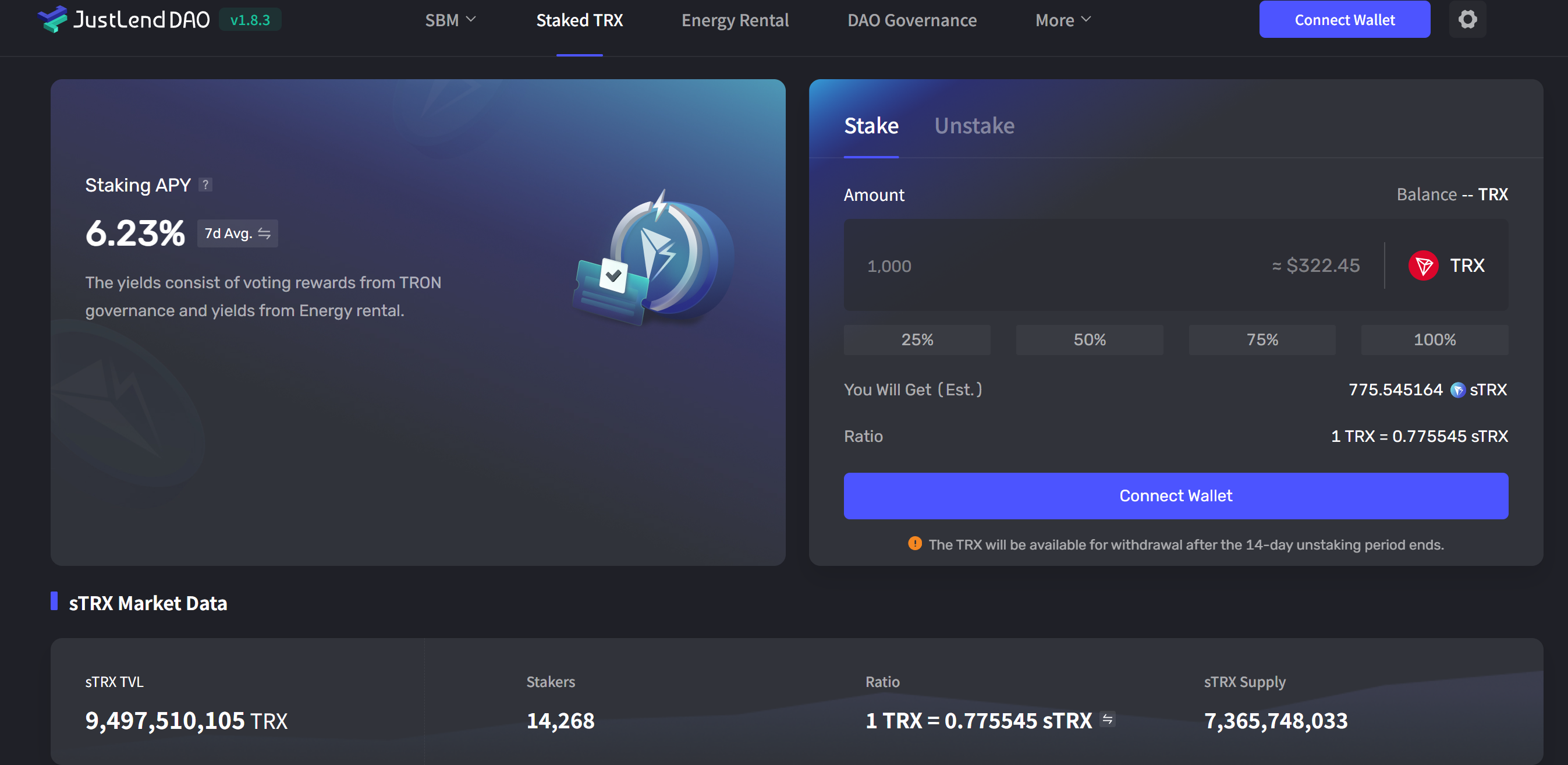
Ninety percent of energy leasing rent goes to lessors, and 10% is counted as the platform service fee into JustLend DAO's income, becoming a significant funding source for JST deflation. According to data from JustLend DAO's official website, the current annualized yield of staking TRX over 7 days is approximately 6.23% (with income from voting rewards and energy leasing), and the total locked amount in the market is approximately 9.498 billion TRX, with around 14,268 addresses participating in staking.
2.2 Core Advantages of Energy Leasing
The greatest value of TRON's energy leasing mechanism lies in its transformation of the "resource acquisition problem" into a user-friendly "cost optimization tool" and "revenue tool" for ordinary users.
Significantly reduces on-chain usage costs: In traditional models, if users do not have energy, they can only complete transactions by burning TRX, which is costly in high-frequency operation scenarios. However, through energy leasing, users can obtain the required resources at a lower price, and overall costs are significantly lower than directly burning TRX.
Lowers entry barriers and increases flexibility: Users do not need to stake TRX long-term or face a 14-day unlocking cycle; they can simply rent energy as needed to complete operations, supporting "pay-per-use" or "short-term use." This model is particularly suitable for small to medium users, arbitrage traders, and high-frequency strategy users, making on-chain operations more flexible and efficient.
Enhances capital efficiency of TRX: Through JustLend's sTRX mechanism, users who stake TRX can not only earn voting rewards but also obtain extra earnings through leasing energy, achieving "dual yields." At the same time, sTRX, as an interest-bearing asset, can still participate in DeFi (such as collateralization, trading, etc.), breaking the limitation of traditional staking where "locking loses liquidity."
Increases ecological activity, forming a positive cycle: Energy leasing reduces usage costs → Users engage in transactions and interactions more frequently → Energy demand rises → Leasing income increases → More users stake TRX to provide resources. This structure of "usage drives revenue, and revenue feeds back to supply" creates a continuous growth flywheel effect for TRON in stablecoin and DeFi scenarios.
3. How the Energy System Drives TRON Ecosystem Token Deflation
The TRON energy system is fundamentally a mechanism that transforms "on-chain usage" into "token consumption and value return," becoming the "engine" for TRX, JST, and SUN deflation. The more users frequently transfer, invoke contracts, borrow, and trade, the more pronounced this system's impact on the token economy.
3.1 For TRX: Insufficient Resources Directly Translates Usage into Burning Pressure
In the TRON network, whenever an account's resources are insufficient, whether bandwidth or energy, the system automatically burns TRX to cover costs. In other words, the more on-chain activities there are, the greater the resource consumption, and the higher the probability that TRX will be consumed.
Stake 2.0 makes this mechanism smoother. Users can not only earn energy through staking TRX but also delegate resources for others' use. As a result, more users are willing to lock their TRX within the resource system. Consequently, two layers of effects occur simultaneously:
Part of the TRX is staked, reducing the available tokens in circulation;
Another group of users continues to burn TRX when resources are insufficient, resulting in continuous consumption.
From the issuance perspective, approximately 336 million TRX are newly minted each year, with stable monthly burns of 1-1.2 billion TRX expected in 2026. The amount of TRX destroyed has already surpassed new issuance, placing it in a deflationary state, with an annualized inflation rate of -3.44%, effectively enhancing the token's scarcity and supporting price performance.
3.2 For JST: Energy Leasing and Protocol Income Begin to Form a Buyback and Destruction Closed Loop
JustLend passed the JST buyback and destruction mechanism proposal in October 2025, with funds mainly sourced from net protocol income and revenue exceeding $10 million in the USDD multi-chain ecosystem. Stake 2.0 has made "resource delegation" more flexible, which is a fundamental condition for the establishment of JustLend's energy leasing market. The more active resource transactions are, the more prosperous the JustLend ecosystem becomes, and the easier it is for protocol income to grow; and the growth of protocol income will, in turn, flow back into the JST buyback and destruction mechanism.
Thus, the logic of the energy system driving JST deflation can be summarized as: the resource system first activates on-chain demand, which then translates into protocol income, and finally, protocol income flows back into JST destruction.
According to JustLend's official data, approximately 1.085 billion JST has been destroyed cumulatively, accounting for about 10.96% of the total supply, entering a clearly quarterly deflation mechanism.
3.3 For SUN: The More Active Transactions, the Easier it is for Platform Revenue to Convert into Destruction
Since the end of 2021, part of SunSwap's transaction volume revenue has continuously been used for the buyback and destruction of SUN; by 2024 and 2025, SunPump's revenue has also been included in the buyback and destruction scope. Official announcements indicate that the SUN token has completed 49 buyback and destruction rounds, accumulating a total buyback and destruction of approximately 651 million tokens, accounting for 3.38% of the current circulation.
The energy system's role in driving SUN deflation is reflected in the fact that TRON's resource system lowers on-chain interaction costs, making it easier for users to engage in transactions, issue tokens, exchange, and participate in platform activities. The trading volume and revenue within the SUN.io ecosystem can easily amplify; and a portion of this revenue will continue flowing toward SUN buyback and destruction. In other words, the energy system lowers the entry barrier for usage, but the ultimate beneficiaries are the platform's activity and the token buyback capability.
In summary, the relationship between the TRON energy system and ecological tokens can be summarized into three lines:
TRX: Direct burning when resources are insufficient, acting as the most direct deflationary bearer;
JST: The resource system drives lending, leasing, and protocol income, which in turn enters buyback and destruction;
SUN: Low-cost on-chain transactions drive platform activity, and platform revenue feeds back into token destruction.
Therefore, the significance of the TRON energy system is not just "saving transaction fees." Its more important value lies in the gradual translation of real on-chain usage into TRX burning, JST buybacks, and SUN destruction. From this perspective, the energy system is indeed not just a technical infrastructure, but more like the underlying engine of the TRON ecosystem's token economy.
4. Risks and Opportunities of the TRON Energy System
4.1 Structural Risks: Hidden Constraints Behind Efficiency Advantages
Despite the significant advantages of the TRON energy system in cost and efficiency, its underlying design also carries some non-negligible risks.
High risk of centralized control: TRON adopts a DPoS mechanism, with a few super representatives responsible for block production, centralizing governance. Meanwhile, ecological development and resource scheduling are largely influenced by Justin Sun's personal impact. This "strongly dominant ecology" aids rapid decision-making and execution in the early stages but poses issues like relatively weak governance transparency and decentralization in the long run, dependency on core individual judgment for ecological direction, and doubts from external institutions about its censorship resistance and neutrality.
Relatively single DeFi ecological structure: Current on-chain activity on TRON heavily relies on: USDT transfers, JustLend borrowing, and SUN ecological transactions. Compared to Ethereum's rich DeFi ecosystem, TRON's protocol diversity and innovation density remain insufficient. The ecological risk resistance is weak; if growth of core protocols slows, overall activity may decline in tandem.
Complexity of the resource model: TRON introduces a three-layer structure of bandwidth + energy + leasing, which enhances efficiency but poses a high understanding cost for new users. Particularly in high-frequency usage scenarios, users need to manage resource balances, leasing costs, and burning logic, increasing operational complexity compared to the "direct Gas payment" model.
Ecological dependence risk: Current on-chain demand for TRON heavily depends on stablecoin (especially USDT) transfers. Should there be a structural change in the stablecoin market (such as regulation or migration to other chains), TRON's resource demand and burning logic may face direct impact.
4.2 Core Opportunities: Resource Financialization and Stablecoin Network Effects
Despite structural risks, the TRON energy system still possesses a clear and sustainable growth logic, with core advantages evident in the dual drivers of "resource financialization" and "stablecoin network effects."
Resource financialization builds a differentiated moat: TRON disassembles on-chain resources into: stakeable assets (TRX), tradable resources (Energy), and profit-generating financial products (sTRX), essentially constructing an on-chain resource market. Compared to Ethereum's single fee model centered on Gas, TRON achieves a leap from "consumption of fees" to "financialization of resources," allowing resources not only to be used but also held and invested, thereby forming a long-term value accumulation mechanism.
Network effects brought by stablecoin infrastructure: TRON has become one of the most important stablecoin circulation networks globally, with its low-cost, high-throughput features, providing sustained demand support in scenarios like cross-border payments and fund settlements, OTC and off-exchange trading, and high-frequency small transfers. The energy system serves as the underlying mechanism accommodating these demands: the more frequently usage occurs on-chain, the more stable resource consumption is, and the more active the TRX burning and resource leasing market becomes, which forms "usage-driven" endogenous growth.
Layered yield structure and capital efficiency enhancement: Based on protocols like JustLend and USDD, TRON is gradually constructing a multi-layer yield system: staking yield + energy leasing yield + DeFi strategy yield, enabling the same asset to generate income at multiple levels. Compared to the single staking yield model in traditional PoS chains, this is closer to a "on-chain yield aggregator," making it more attractive to specialized funds and institutions.
Low-cost model driving user scale expansion: The essence of TRON's resource mechanism positions the user's usage cost upfront and shares it, reducing the cost of single transactions to nearly zero. Essentially, low costs are not just a technical advantage but also a user growth strategy. Compared to high Gas chains, TRON is better suited to accommodate the real transaction needs of emerging market users, small high-frequency users, and Web2 to Web3 users, rather than just relying on capital-driven short-term liquidity.
5. Outlook and Conclusion
From a more macro perspective, TRON, Ethereum, and Solana are not merely in simple competition but represent three different public chain development paradigms.
Ethereum chooses a "security and decentralization first" path, lowering costs while ensuring security through its Gas mechanism and Layer 2 expansions, suitable for carrying high-value assets and complex DeFi structures.
Solana opts for a "performance first" path, adapting to high-frequency trading, chain gaming, and other scenarios through extremely high throughput and low fees but requires higher system stability and hardware dependencies.
TRON has carved out a unique path— the "resource optimization and cost control" route, achieving a near "zero Gas" user experience through its energy system and leasing market, transforming on-chain resources into tradable and revenue-generating assets.
In the long-term evolution view, these three paths are likely to form structural divisions of labor:
Ethereum will continue to carry high-value assets and complex financial activities, becoming the "value settlement layer";
Solana will leverage performance advantages to serve high-frequency interaction scenarios, becoming the "application execution layer";
TRON is expected to solidify its position in stablecoins and payment networks, becoming the "on-chain fund circulation infrastructure."
Conclusion
The core value of the TRON energy system is not merely to reduce transaction fees, but in establishing a more direct mapping relationship between on-chain behavior and token economics, ultimately forming a complete closed-loop: user transactions → resource consumption → revenue distribution → token deflation. This mechanism of translating real demand into value capture is what distinguishes it from other public chains.
However, the future ceiling for TRON still hinges on its ability to break through current structural constraints: on one hand, it needs to enhance ecological diversity and innovation capabilities while maintaining its low-cost advantage; on the other hand, it also needs to further weaken centralized dependency at the governance and infrastructural levels. Only by finding a balance between "efficiency advantages" and "ecological depth" can the energy system evolve from an efficient resource model into a fundamentally competitive underlying economic system.
About Us
Hotcoin Research, as the core investment research institution of Hotcoin Exchange, is committed to transforming professional analysis into your practical tool. We analyze market trends for you through "Weekly Insights" and "In-depth Research Reports"; utilizing the exclusive column "Hotcoin Selection" (AI + expert dual filtering), we identify potential assets to reduce trial and error costs. Each week, our researchers will also engage in face-to-face discussions through live broadcasts, interpreting hot topics and predicting trends. We believe that warm companionship and professional guidance can help more investors navigate through cycles and seize value opportunities in Web3.
Risk Warning
The cryptocurrency market is highly volatile, and investment itself carries risks. We strongly recommend that investors conduct investments under a strict risk management framework based on a complete understanding of these risks, ensuring the security of funds.
Website: https://www.hotcoin.com/zh_CN/learn/index/
免责声明:本文章仅代表作者个人观点,不代表本平台的立场和观点。本文章仅供信息分享,不构成对任何人的任何投资建议。用户与作者之间的任何争议,与本平台无关。如网页中刊载的文章或图片涉及侵权,请提供相关的权利证明和身份证明发送邮件到support@aicoin.com,本平台相关工作人员将会进行核查。