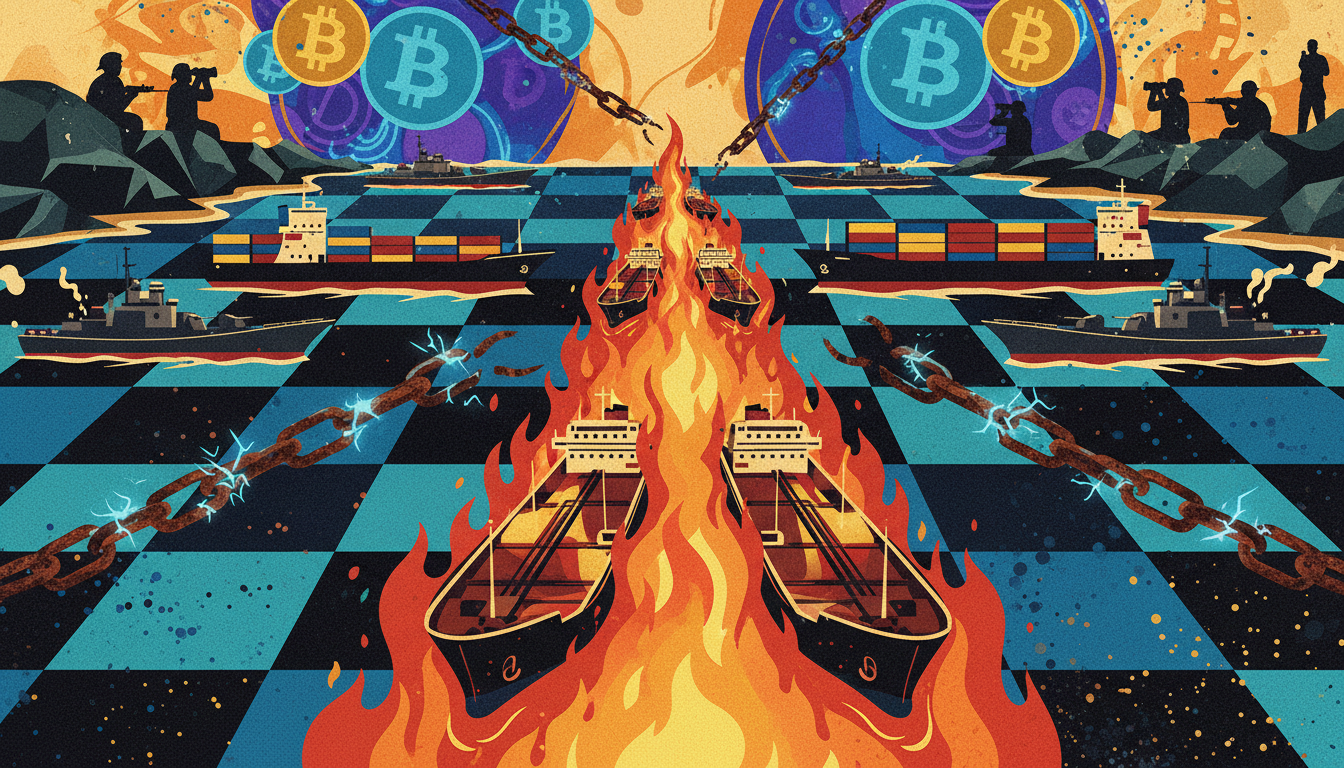
This week, Iranian Foreign Minister Zarif publicly announced that the Strait of Hormuz will be "fully open" to commercial vessels, a statement that quickly spread across global media and social platforms. After the news broke, major U.S. stock indices opened higher collectively, with the Dow Jones, S&P 500, and Nasdaq strengthening simultaneously, igniting clear enthusiasm for stocks related to crude oil, shipping, and energy chains, among which the crypto-related CEA Industries surged about 2.66% in a single day, becoming a symbol in this narrative. However, while the financial markets delivered an optimistic vote through price movements, key details such as toll fees and timelines were not disclosed, exposing the growing gap between sentiment trading and real constraints in the shipping industry and analysts' cautious statements.
A Simple Open Statement Ignites Global Market Sentiment
The Strait of Hormuz connects the Persian Gulf and the Gulf of Oman and is a critical point for global energy transport, as well as a high-risk area for long-term geopolitical games. Although specific historical shipping volumes and the share data of various countries are limited in public documents, the prevailing consensus in the market is that: once this channel is blocked, the global crude and refined oil trade chains will face systemic disruptions, and both oil prices and transportation costs may be forced to reprice. In such a long-term tense context, any remarks about "blockades" or "openings" will be amplified in financial markets.
Zarif's recent statement regarding "full openness" was initially released by local media, subsequently quickly reprinted by international news agencies and financial terminals, and further propagated by social media, forming a cross-market information diffusion chain within hours. For quantitative funds and macro trading desks, such high-sensitivity geopolitical information is often viewed as a tradable event, with algorithms immediately triggering orders once headlines and keywords are identified, intensifying short-term fluctuations in risk assets.
During this time window, the three major U.S. indices opened collectively higher: according to a single source, the Dow rose about 1.07%, the S&P 500 rose about 0.66%, and the Nasdaq rose about 0.87%, demonstrating a rapid response from capital to the "phased easing of geopolitical risks." At the same time, CEA Industries rose 2.66%, becoming one of the representative samples of the warming sentiment related to energy and crypto infrastructure. Investors directly equated "opening Hormuz" with a "decrease in the risk of oil and shipping disruptions," which further extrapolated into reduced inflationary pressures and improved stability in global trade chains; while this logical chain is simplified, it was sufficient to create a wave of collective relief in price movements on the market.
Within this framework, the market saw the Iranian foreign minister's statement as an important signal of easing geopolitical risks, expecting that the originally tense supply chains would have some room for repair, reducing marginal demand for safe havens and allowing risk appetite to recover. However, this reaction is based on the premise that "the opening will be smoothly implemented," and for the shipping participants that truly need to transit the strait, this premise has yet to be proven.
Toll Fees Become a Black Box: The Shipping Industry Dares Not...
Compared to the immediate cheers from the capital market, the shipping industry, directly exposed to the risks of the Strait of Hormuz, is much more cautious. Multiple shipping analysts have cautioned in professional media that a single statement is insufficient to support decisions to change existing shipping routes and insurance arrangements. Richard Meade, editor of Lloyd's List, frankly stated that the prospects of this statement are "generally positive," but the current information is "far from enough to support shipowners and operators in making substantial adjustments," especially in the present environment where maritime safety and cost structures are highly sensitive.
The key bottleneck lies in the fact that Iran has not simultaneously disclosed the toll fee arrangements and specific opening timelines. Whether shipowners will replan routes through Hormuz depends not just on "whether passage is allowed," but more critically on whether costs are manageable, rules are stable, and whether insurance companies and military escort arrangements can be quickly adjusted. Currently, how toll fees are set, whether there are differentiated charges or other conditional arrangements, remains unknown to the outside world, making it difficult for the practical operations to undergo significant route restructuring based solely on a statement in a short time.
In contrast, financial asset prices can quickly "price in" new narratives within minutes, but the decision-making cycle of shipping companies often requires navigating multiple negotiations and assessments through board actions, compliance, insurance, and charterers. In the absence of execution details, the capital market has already provided positive feedback through rising indices and stocks, while the vast majority of shipowners and cargo owners still choose to wait and see, making only marginal adjustments in a few short-term contracts and small-scale trial voyages. This information asymmetry and the misalignment of decision-making rhythms mean that short-term funds are more like trading "declaration sentiment" rather than trading real, executable route restorations.
Because of this, the "toll fee black box" and the "lack of timelines" have become the key variables overlooked in this round of narratives. For professional shipping players, the absence of quantifiable charges and safety expectations means they cannot provide risk-controlled explanations to shareholders, clients, and insurers; while for short-term funds, such complexities are often compressed into a single statement: "First rise, then discuss." The time mismatch between capital and the real economy is particularly amplified across the strait at Hormuz.
Trump's Hard Statement: Blockade and Resolutio...
While Iran released a signal of "full openness," the hard political confrontations on the U.S. side have not retreated. U.S. President Trump emphasized publicly that the blockade measures against Iran will continue to be enforced until the U.S.-Iran transaction is "100% completed", with terminology deliberately highlighting its thoroughness and conditionality. This statement constitutes a direct check on Iran's declaration and reminds the market that even if one side announces an opening, the other still holds the key to sanctions and military presence control.
In the current U.S.-Iran negotiation framework, several media outlets have mentioned a combination arrangement involving $20 billion in unfrozen funds and exchanges of enriched uranium stocks, although the details and terms structure in publicly available information are far from complete and are clearly marked as sensitive areas in research briefings. This backdrop implies that any seemingly "technical" opening of the channel is unlikely to completely detach from the great power games regarding fund releases, safety commitments, and constraints related to nuclear programs.
In this context, the Iranian foreign minister's opening statement is more easily understood as a release of bargaining chips at the negotiation table rather than a fait accompli that has completed all procedures. On one hand, by sending "positive signals" to the global market, they can seek the support of international opinion and pressure from energy-importing countries; on the other hand, under Trump's hardline stance of "not loosening grip until the deal is fully implemented," related sanctions and military coordination will not be immediately altered due to a diplomatic statement.
What truly influences when shipping routes will return to "normal" is still the substantive progress of U.S.-Iran negotiations—including the pace of unfrozen funds, how enriched uranium is exchanged and regulated, and the subsequent constraints on nuclear and missile projects. However, as these key terms remain in a state of confidentiality and dynamic negotiation, the outside world cannot verify their progression speed nor can it reasonably predict their specific paths. This high level of uncertainty directly slows down shipping companies' re-pricing of strait risks but has not prevented short-term funds from betting on the "opening narrative" in advance.
Israel Downgrades Alert: Regional Tensions...
Alongside the verbal opening of Hormuz, another important regional security signal emerged—the Israel Defense Forces announced a nationwide return to normal activity. For a considerable time prior to this, Israeli society remained in a state of heightened alert, with domestic and foreign investors vigilant about the potential for further escalation of military conflict in the region. This decision to "return to normal" coincided roughly with the Iranian statement, symbolically indicating that some key participants in the Middle East are attempting to shift from a posture of complete confrontation to a relatively controllable regional tension.
For global markets, the easing of Israel's security posture alongside Iran's declaration of "full openness" in Hormuz forms a set of seemingly coordinated "cooling signals." Macro traders are likely to interpret these two pieces of news within the same narrative framework: the probability of a complete loss of control in the Middle East is decreasing, and the extreme risks of skyrocketing oil prices and shipping interruptions are being repriced, directly supporting the return of risk appetite in the stock market and some crypto-related assets.
However, the stabilization of geopolitical military signals does not mean that shipping operations can immediately return to normal. From escort arrangements, insurance rates, crew safety assessments, to the actual implementation by port and strait management, each segment requires time to digest emotions and new information. Israel's adjustment of its alert level reflects more of a risk assessment within its own territory and surrounding environment rather than a direct endorsement of maritime safety along the Hormuz route, a contrast that is very clear in the eyes of professional participants.
Under multiple optimistic signals, the capital market tends to experience short-term over-adjustments: funds preemptively "consume" future benefits that may not be realized for some time, and if the actual execution rhythm lags behind expectations, prices need to recalibrate through corrections. For high-beta risk targets like crypto assets, this narrative-driven over-adjustment and retraction are especially common, and the misalignment between the Hormuz and Israel narratives is setting the stage for the next round of volatility.
The Crypto Market Stands at the Gap Between Emotion and Reality
Overall, Iran's statement regarding the "full opening" of the Strait of Hormuz was rapidly amplified by the financial market as a signal of "the retreat of geopolitical risks" under conditions of incomplete information, driving short-term strengths in the U.S. stock market and certain assets related to energy and crypto infrastructure. Risk appetite was reignited within hours, but its foundation stemmed more from expectations for future peace and supply stability rather than a solid understanding of established rules and execution paths.
For investors, it is essential to deliberately differentiate between two rhythm lines: one is the emotional trading at the price level, reflecting funds' rapid bets on news headlines; the other is the actual recovery rhythm of physical shipping and energy flows, depending on the toll fee policy, specific opening timelines, the progress of U.S.-Iran negotiations, and the comprehensive evolution of the regional military situation. Currently, the toll fees and potential future pricing models, as well as the existence of discounts or differentiated arrangements, have not been disclosed in public information; the specific terms and execution details regarding the unfrozen $20 billion and exchanges of enriched uranium between the U.S. and Iran are similarly off-limits, and external analyses cannot make imaginative fillings in these gaps.
Under these constraints, assessments of the Hormuz narrative must acknowledge the existence of analytical boundaries: we can discuss the signals released by the statement itself, the market's immediate response, and the discrepancies in the shipping industry's cautious attitude, but we cannot make any concrete assumptions about toll fees or negotiation texts. If in the future Iran and related parties disclose clearer passage rules, fee frameworks, and formal opening timelines, combined with verifiable progress on fund releases and nuclear issues in U.S.-Iran negotiations, it could form a new round of directional volatility for oil prices, shipping stocks, and crypto assets highly correlated with energy and macro liquidity.
Until then, the crypto market is often layering one layer of emotion on top of another: using high leverage to gamble on whether the "peace dividend" can be realized. At a geopolitically sensitive node like Hormuz, the real advantage lies not in jumping ahead to follow headlines but in accurately understanding what expectations have already been priced in and which realities have yet to be accounted for amidst the gaps in information and execution.
Join our community, let's discuss and become stronger together!
Official Telegram community: https://t.me/aicoincn
AiCoin Chinese Twitter: https://x.com/AiCoinzh
OKX Benefits Group: https://aicoin.com/link/chat?cid=l61eM4owQ
Binance Benefits Group: https://aicoin.com/link/chat?cid=ynr7d1P6Z
免责声明:本文章仅代表作者个人观点,不代表本平台的立场和观点。本文章仅供信息分享,不构成对任何人的任何投资建议。用户与作者之间的任何争议,与本平台无关。如网页中刊载的文章或图片涉及侵权,请提供相关的权利证明和身份证明发送邮件到support@aicoin.com,本平台相关工作人员将会进行核查。