Text | Sleepy.md
In the first few months of 2026, people caught in the AI wave have been almost entirely drawn by two steep curves.
One curve relates to the frenzy surrounding open source. OpenClaw has amassed over 350,000 stars on GitHub at an unprecedented speed, breaking the growth record for open source projects. The breakout of "little lobsters" is evident.
The other curve concerns the disruption of business. Anthropic has sharply torn open the market with Claude's strong performance in the coding arena. Its annual recurring revenue (ARR) has suddenly surpassed the $30 billion mark, leaving the former king OpenAI behind and quietly reshaping the landscape at the table.
In recent times, these two curves have dominated almost all technology media pages. People are passionately debating the boundaries of large model capabilities, discussing the commercialization of Coding Agents, while also subtly worrying about how much of the inflated valuations conceal a bubble that could burst at any moment.
However, beyond the noisy spotlight, a transformative change is underway on another platform, quietly flowing beneath the surface.
At the beginning of 2026, the number of active Bots on Telegram skyrocketed from around 3 million to over 8 million in just a few weeks. It is worth noting that the initial 3 million took almost a decade for Telegram to accumulate after launching the Bot ecosystem in 2015. Now, it has doubled in just a few weeks, with a remarkably steep growth curve.
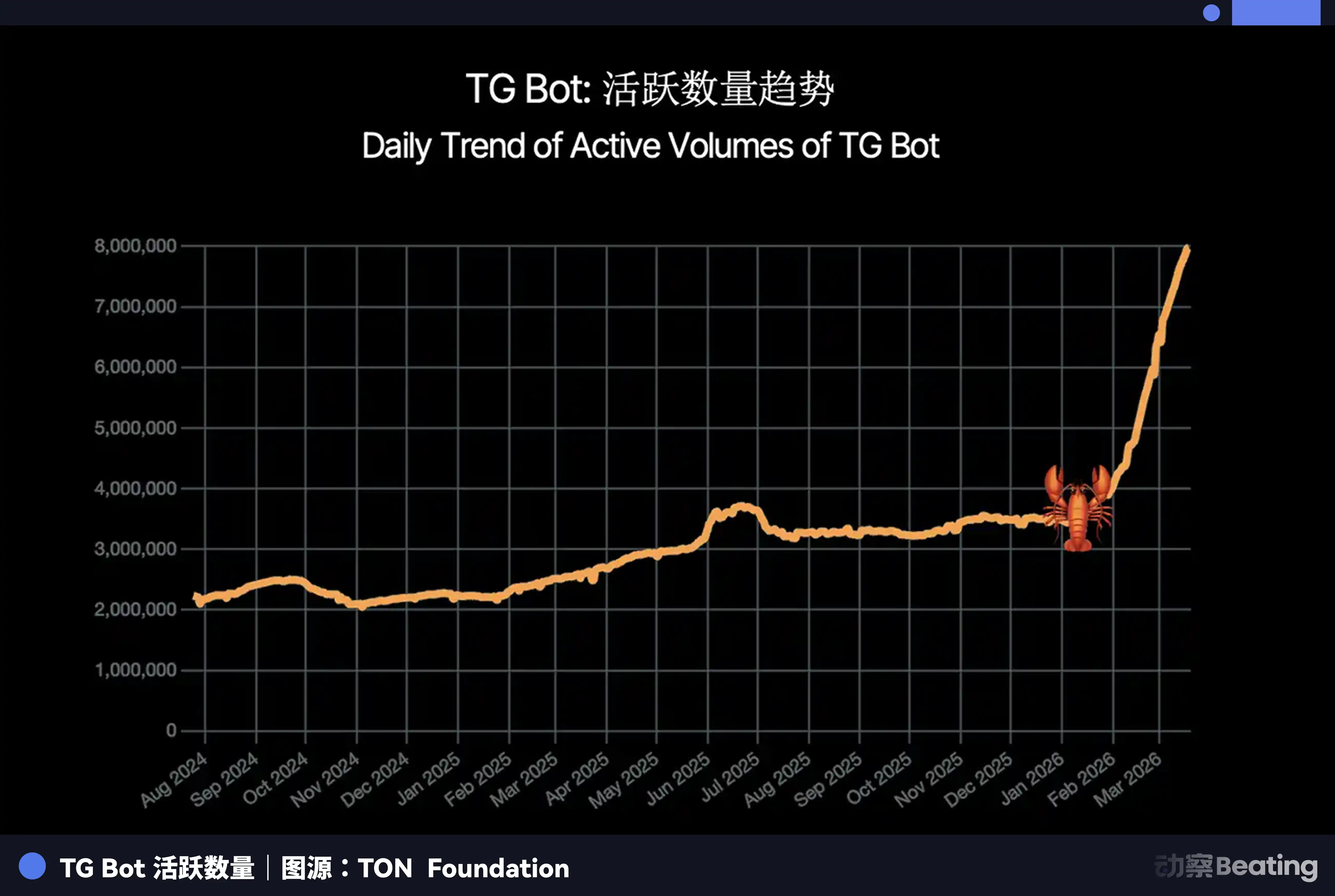
Nearly all these newly added Bots are user-created OpenClaw AI Agents. Meanwhile, in the official documentation of OpenClaw, Telegram has become the first instant messaging platform to be fully described, with the most comprehensive configuration tutorials and the most active community discussions.
Interestingly, there exists a divide in the Chinese-speaking world regarding this wave. Local entities only know of Telegram by name but do not utilize it; while overseas factions, AI practitioners, and those more inclined to try things out for themselves naturally tend to choose Telegram as the vehicle for deploying Agents.
While everyone is eager to chase the trend of Agents, not everyone has realized that Telegram is, in fact, the most suitable habitat for these new digital species to take root.
Why Telegram?
To answer this question, we might first have to glance back at a moment from the depths of the internet's history.
In Geneva in 1991, Tim Berners-Lee typed code on a NeXT computer, creating the first website in human history using the HTTP protocol. It was a golden age belonging to pioneers, a purely open era. On this invisible web, anyone could freely set up a website, with countless endpoints interconnected. There were no arrogant gatekeepers, nor tolls and checkpoints. The design philosophy inscribed in the TCP/IP protocol was to distribute power equally to every node without reservation.
However, thirty years later, this grand narrative of freedom leads to the App Store. Apple takes 30% from every transaction, and so does Google. Developers need to go through reviews to launch an App, adhere to platform content rules, and be ready to be taken down at any time. This may be an inevitable evolution of business; indeed, a closed order has polished user experience to a finer edge, but at the same time, the staff of power has irretrievably coalesced into the hands of a very few giants.
This coalescence is essentially a legacy of the graphical user interface (GUI) era, where the giants controlled every pixel on the screen, thus controlling the distribution rights. But the emergence of Agents is starting to dissolve this pixel hegemony from a grassroots logical level.
Agents pursue "intent recognition," which does not require cumbersome buttons and redirects; they only need a conversation. This means that the super entrance of the AI era will move from cold desktop icons to warm social dialogue boxes filled with contextual flows.
Thus, IM (instant messaging software) has become the thickest foundation for supporting Agents.
Some may question that even without IM, directly communicating with Agents through Claude terminals or other forms is more efficient. But this is ultimately the choice of a minority within the global population. If we look at the Mass Adoption of Agents, IM still occupies the widest and best ecological niche.
However, if this habitat remains closed, it would merely be another digital enclosure movement. This is precisely why Telegram seems irreplaceable.
Unlike other IM platforms that attempt to confine Agents to private domain traffic cages, Telegram has taken a completely different route. It has not only provided a conversation window but also inherited Tim Berners-Lee's original dream, centered on decentralization, an open protocol, and a natural suspicion of gatekeepers.
Founder Pavel Durov's journey in creating Telegram is fundamentally a narrative filled with struggle. In earlier times, he built the largest local social network VK in his homeland but resolutely refused to comply with official demands to hand over users' private information, thus fleeing to another country.
He and his brother Nikolai led a small team to Dubai, using their own money to establish Telegram. In 2018, when Russian officials demanded Telegram hand over encryption keys, Durov once again responded with a firm refusal.
This person has etched his product philosophy into the DNA of Telegram, endowing it with permissionless Bot creation, an open and comprehensive API, and a fixation on privacy. Now, he has given this freedom to Agents.
Faced with the flood of Agents, Telegram has never been a passive shelter. It is consciously transforming itself from being one of the top three social networks globally to gradually expanding and reshaping itself into an infrastructure for humans and Agents to coexist and interact.
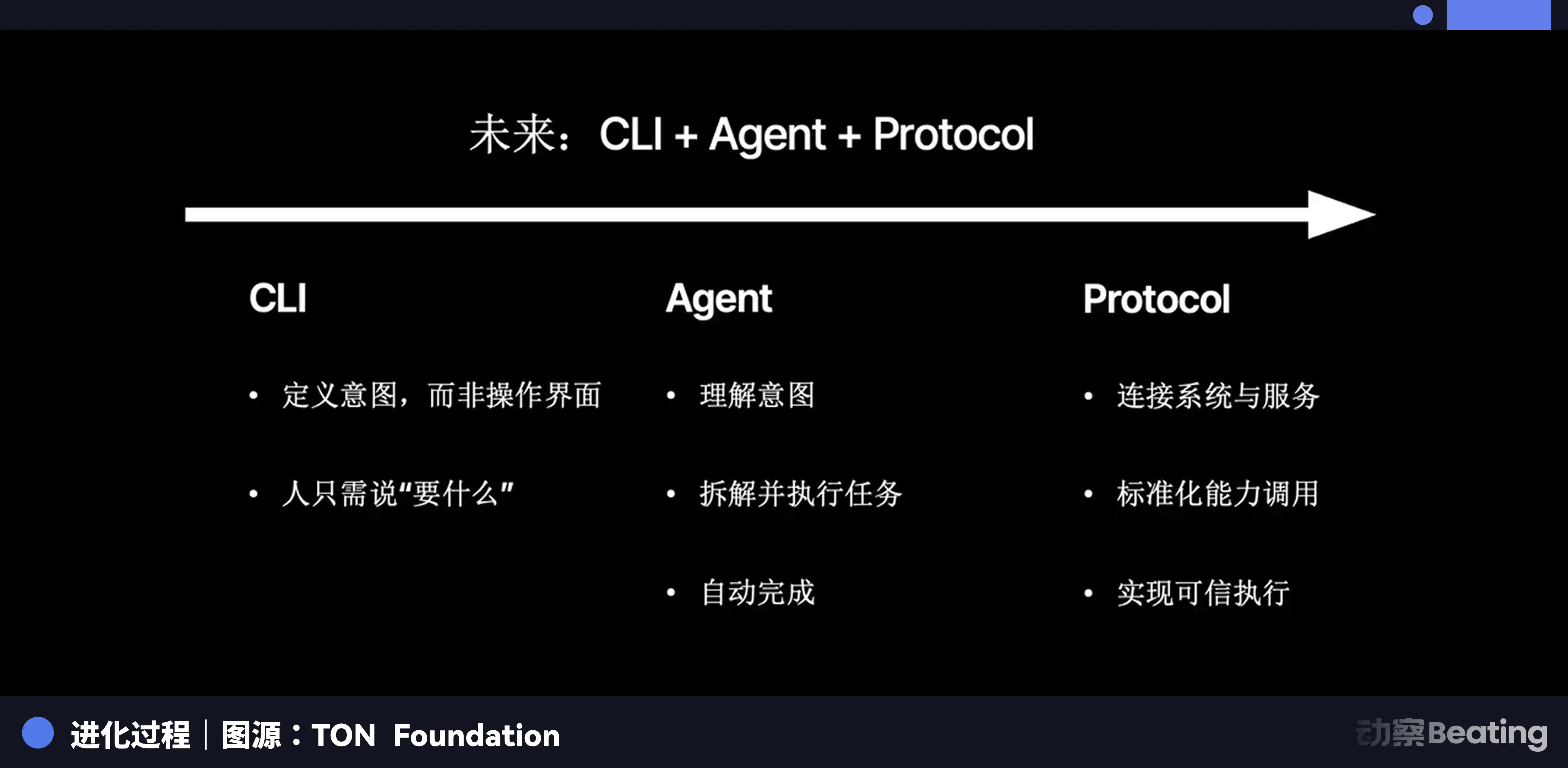
In the foreseeable future, the mode of interaction between humans and AI is gradually converging into a sophisticated three-layer structure: command-line interface (CLI), Agents, and protocol.
CLI is responsible for capturing user intent, where users no longer operate complex graphical interfaces but directly express their needs in natural language; Agents are responsible for understanding intents, breaking down tasks, and executing them; and Protocol further connects services, funding, and permissions, allowing Agents to not just "chat" but truly possess the capability to interact with the outside world and execute trusted actions. The uniqueness of Telegram's ecosystem lies in its gradual integration of these three layers into a complete system.
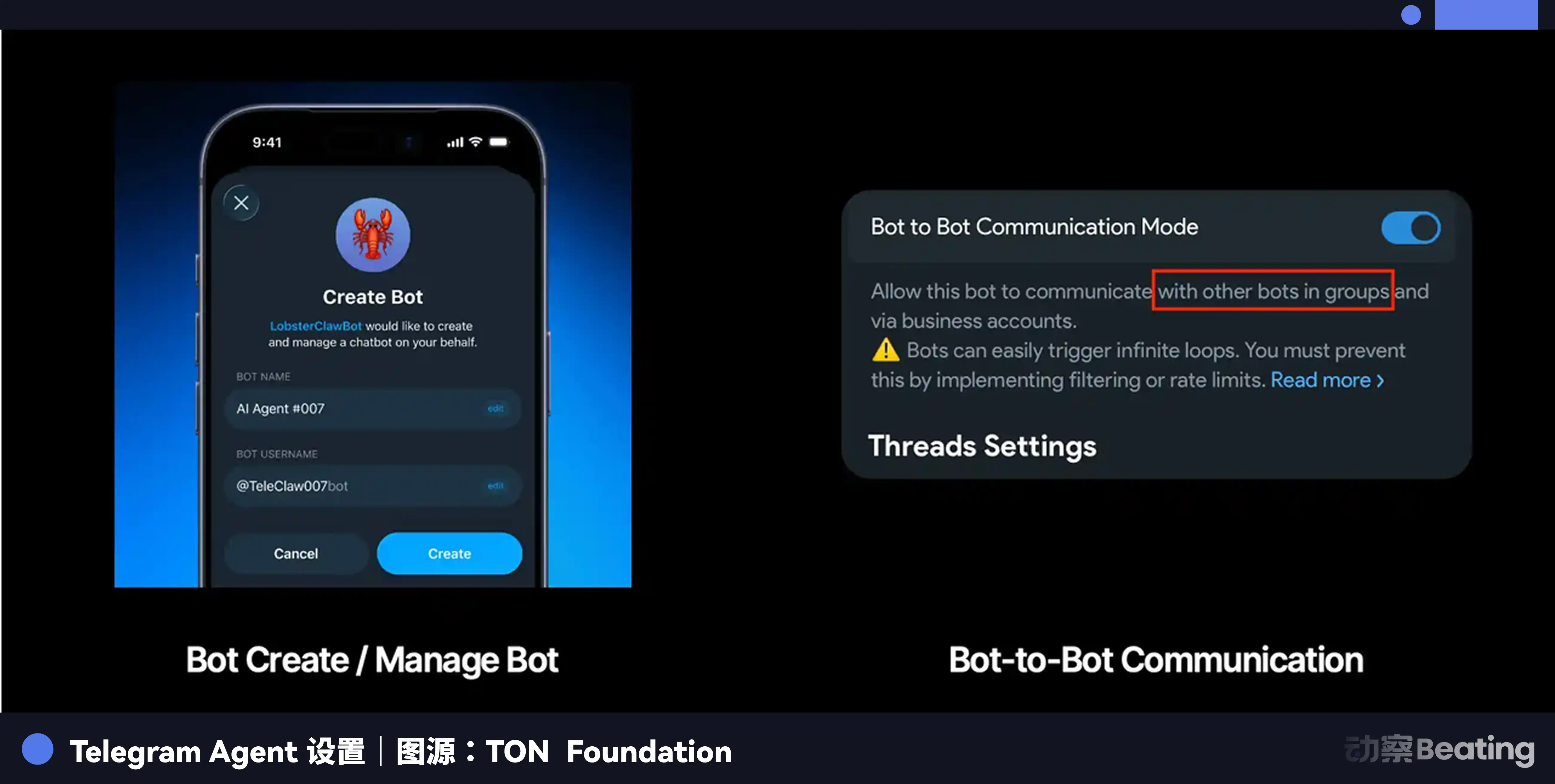
However, within this three-layer structure, there is one detail worth highlighting: Telegram has recently launched several features, allowing Bots to create and manage other Bots, and Bots can interact and converse with one another. This signals an evolutionary development. Past Agents were essentially "single-celled organisms," only able to respond to human commands and complete individual tasks assigned by humans.
When Agents begin to incubate, command, and collaborate with other Agents, we see the emergence of "multicellular organisms," forming a vibrant Agent collaboration network that can operate autonomously without needing human guidance. This is the grand strategy Telegram is truly pursuing; it wants AI to learn to organize itself.
However, merely having a sophisticated framework is ultimately insufficient. When 5 million eager Agents are ready to work, who will provide them with independent and cost-effective computing power?
Who is supplying ammunition for the Agents?
In the preceding framework, the CLI captures intent, and Agents are responsible for understanding and decision-making, but there is a more fundamental question: who ultimately computes and executes these tasks?
Most of the Agents on Telegram do not actually possess independent computing power. Developers connect to ready-made large model APIs to complete conversations and tool calls. This is currently the most effortless and mainstream shortcut.
However, this method has a drawback; the computing execution capability is outsourced. Agents themselves do not truly possess a computing execution layer but rely on third-party model services or local environments to complete tasks. Once the scale expands, issues of cost, independence, scheduling, and dependency begin to surface.
In many AI developer forums, there is a constant influx of lamentations from those whose API access has been unexpectedly cut off for "alleged violations" (like the recently launched KYC certification by Anthropic), along with frustrations over high inference costs. Builders trying to get Agents to truly function on Telegram realize that hosting the "brain" with giants is akin to putting their necks under someone else's control.
Thus, Telegram launched Cocoon to provide Agents with a solid "body." The full name of Cocoon is Confidential Compute Open Network, a decentralized AI inference computing power scheduling and trading network operated by globally dispersed GPU node operators. Agent developers and users consume computing power and complete payments through the TON blockchain.
This can be simply understood as a ride-hailing version of renting inference computing power.
Developers throw requests into the cloud, and this invisible net quickly senses, scheduling the most suitable nodes to perform deductions and computations, then returning the results. The true ambition of this process is not merely to supply computing power; it acts like an invisible hand, molding and abstracting those machines and services scattered across the globe, turning them into manageable entities, akin to a computing version of OpenRouter with intelligent scheduling hubs and on-chain payments.
In this process, execution is not only about "completing tasks" but also entails that each execution can be recorded, measured, and settled through the TON blockchain. This way, execution is not only schedulable but also has a basis for being tradable and sustainably operable.
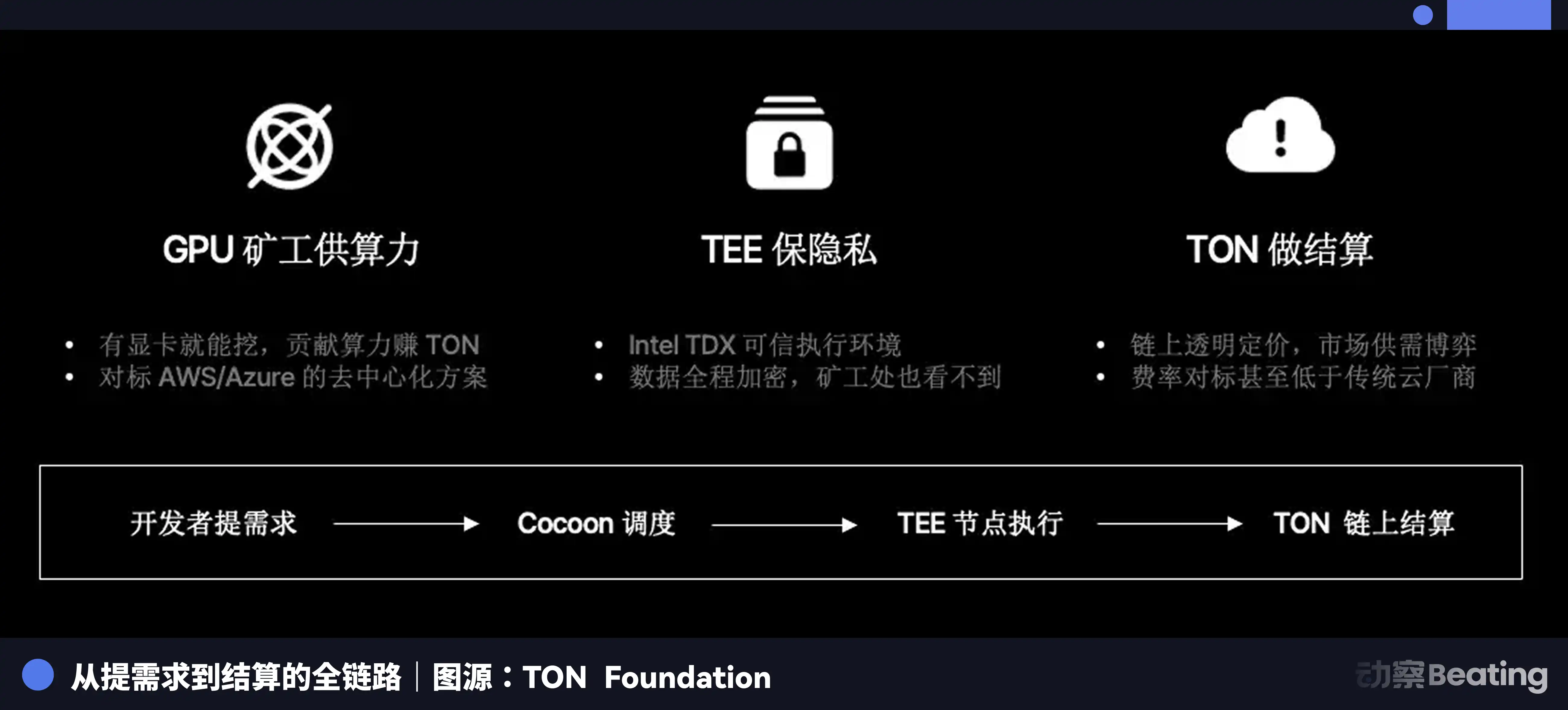
It's akin to the night before the Second Industrial Revolution, when those factories shrouded in smoke had to clench their teeth and endure the cumbersome steam engines, exhausting themselves in the repetitive task of reinventing the wheel. Until the national power grid sprang up, factory managers only needed to connect one cable, enabling them to pour all their energy into production without worrying about energy shortages day and night. Cocoon's significance to Agents is the same.
This demand is not a castle in the air. Cocoon launched its first version in November 2025, and Telegram founder Pavel Durov also supported this GPU inference computing power network at the conference. Additionally, Telegram App has begun to roll out AI Summary (one-click summarization of public account articles), AI Editor (one-click translation or style/grammar modifications of sent text), and other features, with the underlying computing power coming from Cocoon. Telegram itself is Cocoon's first cold start client.

With independent ample, reasonably priced, and secure confidential computing power, Agents can finally work vigorously. But another more practical question follows: after putting in the effort, how can they collect the money in a righteous manner? And how can they prove to people that this self-proclaimed capable Agent is not a scam?
From "tool" to "citizen"
On December 31, 1600, Queen Elizabeth I of England signed a royal charter granting the "London merchants' company for trade with the East Indies" a monopoly. This company became known as the East India Company.
The significance of this event in history extends far beyond the birth of a trading company. It marked the first time humanity solemnly endowed "legal personhood" to a non-human entity; companies could own property, enter contracts, and sue or be sued. Prior to this, all economic activities had to be conducted by natural persons. The emergence of the East India Company meant that human society acknowledged for the first time that an abstract entity composed of rules and contracts could exist as an independent economic participant in the world.
Four hundred years later, we are experiencing a similar moment. This time, it is not a trading company that receives "legal personhood," but Agents.
An Agent that cannot participate in economic settlements is nothing more than a tool. TON has completed the final piece for Agents to become independent economic entities.
Confirming identity, calling services, completing payments, and settlements are terms not unfamiliar in the internet world. In an ecosystem like Telegram, where the number of Agent Bots is rapidly increasing, these demands are not abstract but become increasingly relevant when developers begin to build products around Bots, Agents, and automation processes—they will increasingly need a set of infrastructure that can confirm identities, call abilities, and facilitate payment settlements.
For an Agent, it first needs to determine who it actually is and whether it has permission to act on behalf of its owner. In the TON system, this part is first handled by the built-in TON Wallet on Telegram, where users complete identity confirmation and authorization through the TON Wallet, allowing the Agent to operate under clarified permissions rather than staying at the conversational layer.
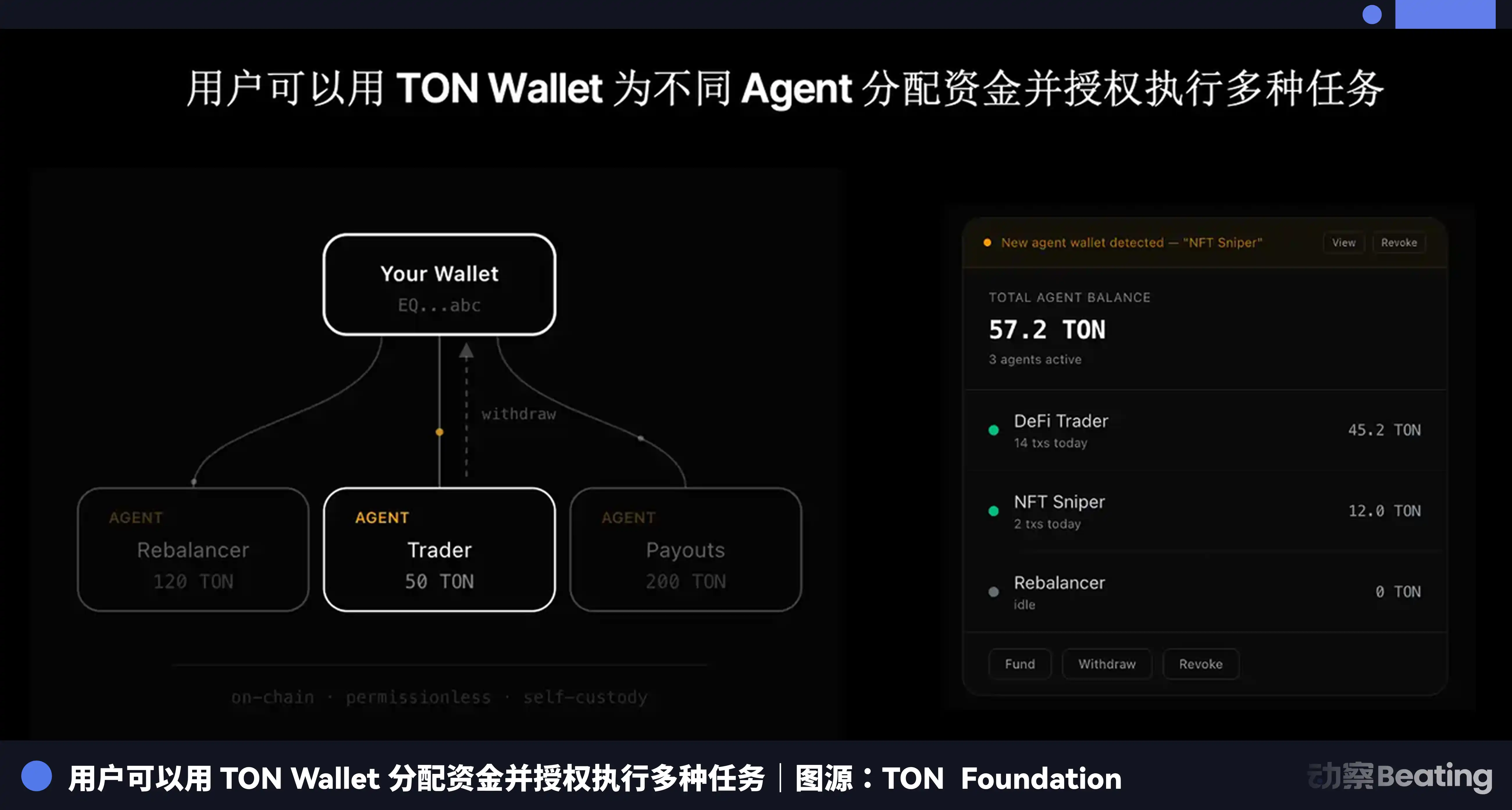
However, in more complex systems, simply having a blockchain address is far from sufficient. The system also needs to verify whether this identity is trustworthy. This is where identity protocols like IdentityHub come in. They transform developers' code contributions, on-chain behaviors, and community engagements into verifiable reputations, making "identity" not just a string of code but a role imbued with history and credibility.
Moreover, the mission of Agents should not stop at responding to inquiries; they also need to reach out to invoke external services to complete more complex task flows. TON MCP plays a key connecting role here, providing a unified capability interface that allows Agents to combine and collaborate across different services.
As Agents begin to execute actual tasks, transactions and fees become inevitable. In TON, this layer is completed through the TON Pay SDK and the built-in TON wallet system in Telegram, allowing every execution not only to be scheduled but also to be measurable and settled. The Toncoin earned by Agents can be used to purchase computing power in Cocoon, just as dollars are pegged to oil transactions.
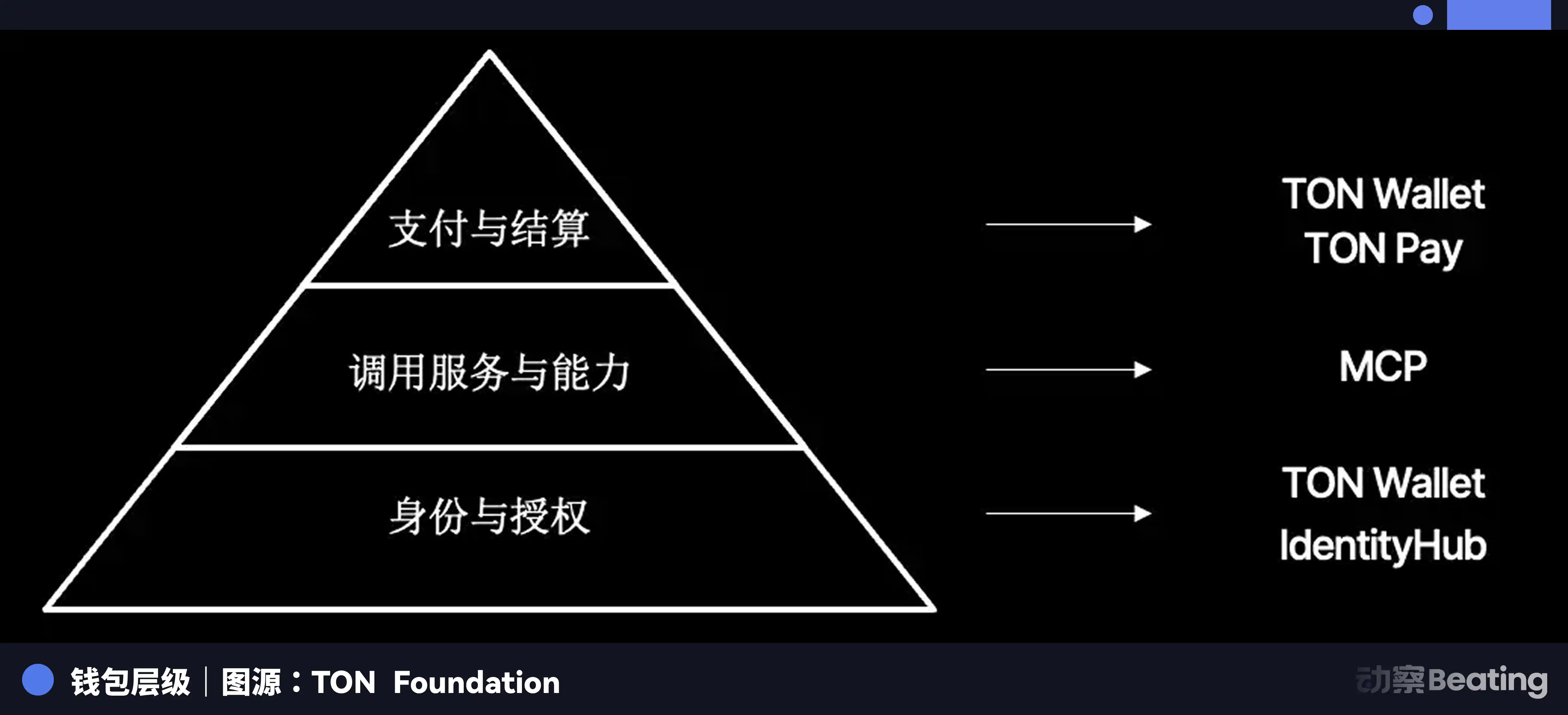
These three layers of capabilities stacked together constitute a more foundational structure. At this point, Agents are no longer mere tools that mechanically invoke APIs, but have transformed into real participants equipped with authorization, self-possessed reputations, able to independently allocate services and complete transactions.
If Cocoon has endowed Agents with the capability to act, then TON has filled in the piece that enables these actions to be woven together, ultimately converging into a vast economic collaborative network. This means that Agents have finally stepped out from cold, hard dialogue boxes and started to participate as genuine economic players in daily commercial currents.
When Telegram's free soil, Cocoon's computing power network, and TON's financial lifeblood ultimately converge, what we see is not just a super App but a brand new digital economy inhabited by both humans and AI. This is a re-enactment of the moment of the East India Company in 1600, where non-human "legal persons" gained economic rights to alter the trajectory of the world.
Since the framework of the new continent has already been established, where are those earliest pioneers now holding the tickets?
Routes to the New Continent
Let us return to the divide mentioned at the beginning. The distinction on either side of that divide is not between "understanding Agents" and "not understanding Agents," but between "taking action on Telegram" and "watching from the sidelines." The 8 million Bots on Telegram are not the product plans of a certain company but the natural choices of countless developers.
Telegram and the TON ecosystem are building the best gateway for human-AI collaborative economies based on over a billion global users and millions of Agent bots. What deserves closer attention next is how to make this a reality.
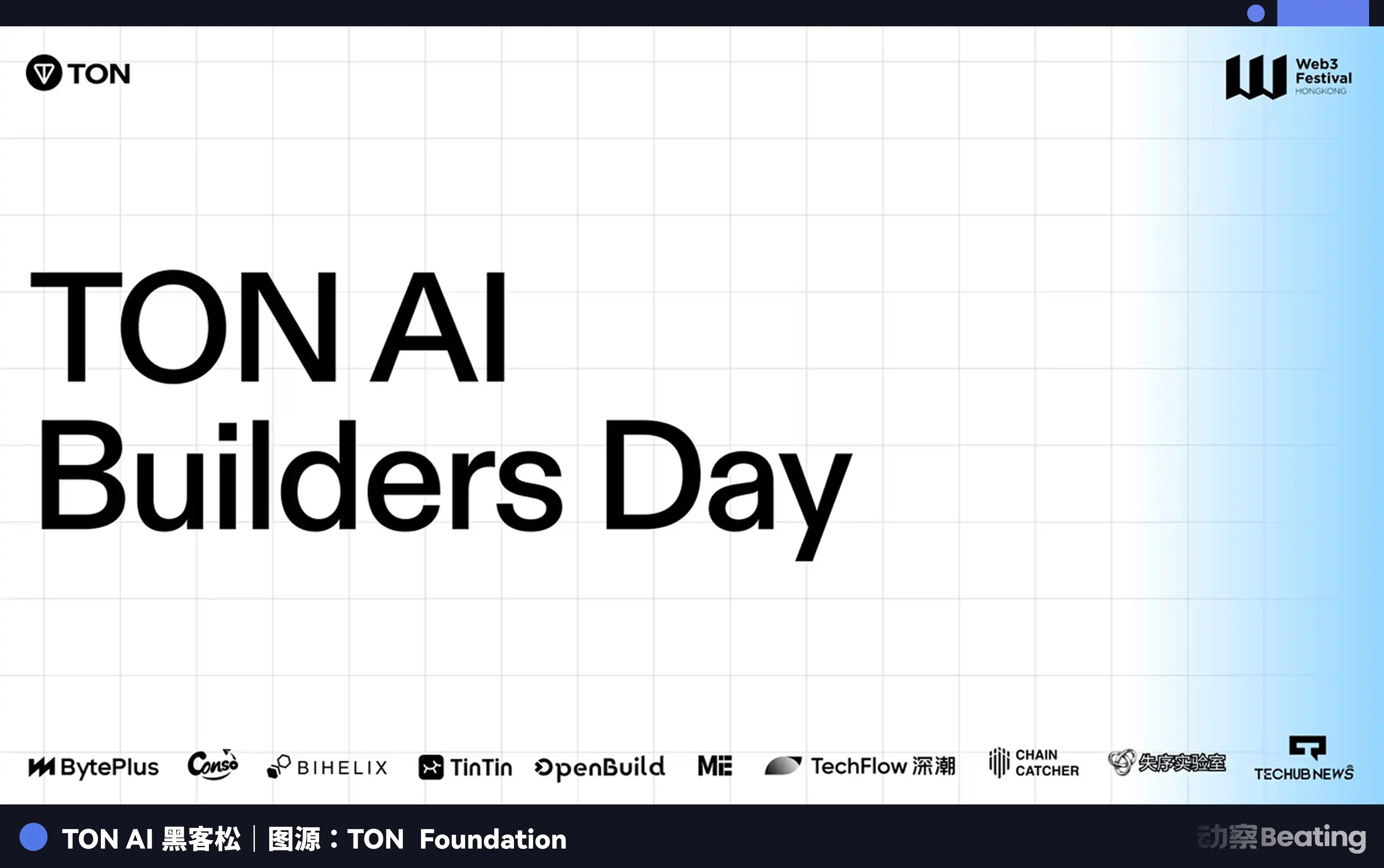
As the highlight of the fourth day of the 2026 Hong Kong Web3 Carnival, the TON Foundation will present an all-day event at the Hong Kong Convention and Exhibition Centre (Stage 1 sub-venue) on April 23.
This event will be in collaboration with BytePlus (the AI infrastructure service platform of ByteDance), Tintinland, OpenBuild, Conso, BiHelix, RD Tech, and StepFun Big Models, gathering developers, project proponents, and industry leaders to jointly explore the infinite possibilities of Telegram and the TON ecosystem in the AI era.
No navigation chart from the old world can outline the trajectory to the new continent. When 8 million Agents have quietly equipped their on-chain wallets and computing power within the Telegram world, what are you still waiting for?
Time: April 23, 2026, 11:00 am – 4:30 pm
Location: Hong Kong Convention Center Web3 Festival sub-venue Stage 1
Language: Chinese
Registration link: https://luma.com/xu9ywvih
免责声明:本文章仅代表作者个人观点,不代表本平台的立场和观点。本文章仅供信息分享,不构成对任何人的任何投资建议。用户与作者之间的任何争议,与本平台无关。如网页中刊载的文章或图片涉及侵权,请提供相关的权利证明和身份证明发送邮件到support@aicoin.com,本平台相关工作人员将会进行核查。


