Author: Claude, Deep Tide TechFlow
Deep Tide Guide: On April 14, World Quantum Day, Nvidia released the world's first open-source quantum AI model family, Ising, with error correction decoding speed increased by 2.5 times compared to industry standards and accuracy improved by 3 times.
Quantum concept stocks collectively surged on that day, with IonQ rising 18% and D-Wave rising 15%. On the same day, Chief Scientist William Dally revealed at GTC 2026 that AI has compressed the porting of chip standard cell libraries from 8 people over 10 months to one GPU completed overnight, and the design results are better than human work.
Nvidia is using AI to accelerate two of the most difficult engineering problems: making quantum computers truly usable and making GPU design itself faster and better.
On April 14, World Quantum Day, Nvidia released the world's first open-source AI model family aimed at quantum computing, NVIDIA Ising, causing quantum concept stocks to rise significantly. At the same time, the company's Chief Scientist William Dally disclosed the latest progress of AI in Nvidia's internal chip design process at GTC 2026, where the efficiency improvement of one task reached several hundred times.
Two clues point to the same conclusion: AI is transforming from an "application layer tool" to "the infrastructure of infrastructure," accelerating both downstream industries (quantum computing) and the hardware iteration of AI itself.
The World's First Open-Source Quantum AI Model Targets Two Major Bottlenecks in Quantum Computing
According to Nvidia's press release on April 14, the first batch of the Ising model family includes two model domains: Ising Calibration and Ising Decoding, targeting the two core bottlenecks in the application of quantum computing.
The quantum bits (qubits) of quantum processors inherently come with noise, and currently the best quantum processors experience an error approximately once in every thousand operations. To make quantum computers practically valuable, the error rate needs to be reduced to less than one trillionth.
Ising Calibration is a visual language model with 35 billion parameters that can automatically interpret measurement data from quantum processors and make calibration decisions, shortening the calibration process from several days to a few hours. Ising Decoding consists of a pair of 3D convolutional neural network models (optimized for speed and accuracy, respectively) for real-time decoding of quantum error correction, being 2.5 times faster than the current open-source industry standard pyMatching and achieving 3 times higher accuracy.
Nvidia's Quantum Product Director Sam Stanwyck explained the logic behind the open-source strategy at the launch event: since the noise characteristics of quantum hardware vendors are different, the open-source model allows them to fine-tune locally with their proprietary data, enhancing performance while protecting their proprietary data.
Nvidia CEO Jensen Huang's statement was even more direct. He said in a statement that AI is becoming the control plane of quantum machines, transforming fragile qubits into scalable and reliable quantum GPU systems.
According to Nvidia, several institutions have already adopted the Ising model, including Harvard University's School of Engineering and Applied Sciences, Fermi National Accelerator Laboratory, IQM Quantum Computers, Lawrence Berkeley National Laboratory, and the National Physical Laboratory of the United Kingdom.
Quantum Concept Stocks Surge Collectively, IonQ Rises 18% in a Single Day
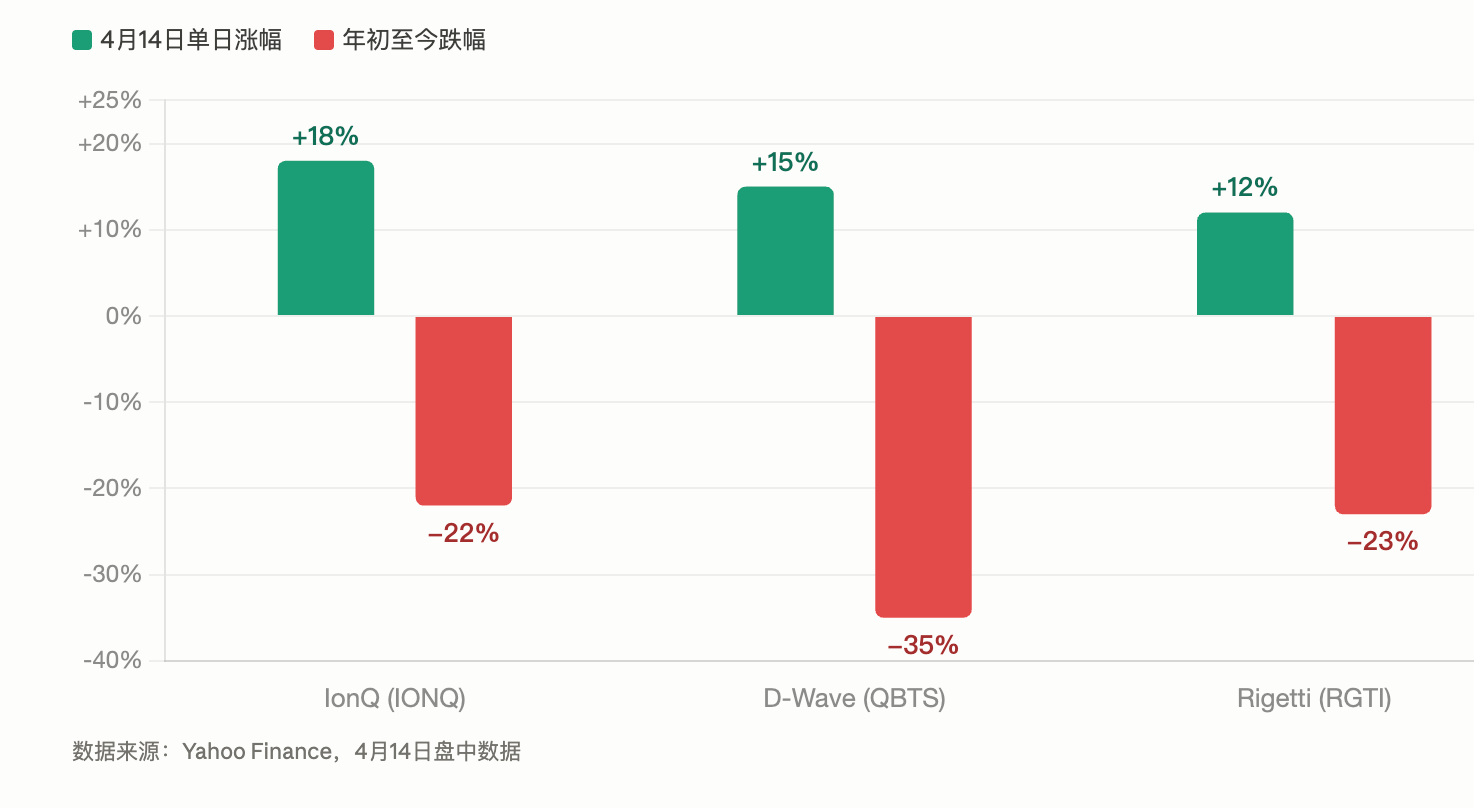
On the day of the Ising release, U.S. quantum concept stocks saw a round of collective surges. According to Yahoo Finance data, IonQ rose about 18%, D-Wave Quantum rose about 15%, and Rigetti Computing rose about 12%.
This wave of increase came against the backdrop of quantum concept stocks being generally in deep corrections since the beginning of the year. As of April 14, IonQ had fallen about 22% this year, D-Wave about 35%, and Rigetti about 23%. The double-digit rebound on that day did not change the downward trend for the year, but the magnitude of collective movement was still noteworthy.
It should be noted that the driving factors for this wave are not solely due to the Ising release. IonQ announced significant progress in quantum networking and a DARPA contract on the same day, and Rigetti also received an $8.4 million order from the Center for Development of Advanced Computing (C-DAC) in India. Multiple catalysts compounded to amplify the sector effect.
Research agency Resonance predicts that the global quantum computing market will exceed $11 billion by 2030. A report released by the Quantum Economic Development Consortium (QED-C) on the same day stated that the global quantum market reached $1.9 billion by 2025, with pure quantum company employment growing by 14%.
80 Person-Months Compressed to One Night: AI Reshaping Nvidia's Chip Design Process
The Ising model points towards external industry acceleration, while Nvidia is reshaping its chip design process internally using AI.
Nvidia Chief Scientist William Dally disclosed several specific cases during a discussion with Google's Chief Scientist Jeff Dean at GTC 2026. The most striking data comes from the porting of the standard cell library: Whenever Nvidia shifts to a new semiconductor process (for instance, from 7nm to 5nm), it needs to redesign and adapt about 2500 to 3000 standard cells to the new process, which previously required 8 engineers around 10 months. Nvidia has developed a reinforcement learning tool called NVCell, which can now complete this task overnight on a single GPU, and the output cells match or even surpass human-designed cells in terms of area, power consumption, and latency.
According to Tom's Hardware, Dally described this process as a "video game for fixing design rule errors," which is exactly the style of trial-and-error optimization that reinforcement learning excels at.
At a higher level of abstraction, Nvidia has developed internal dedicated large language models Chip Nemo and Bug Nemo. These models are fine-tuned based on Nvidia's 30 years of accumulated proprietary data, covering RTL codes, hardware design documents, and architectural specifications of all GPUs in the company's history. According to Dally, junior engineers can directly ask Chip Nemo questions, saving them from repeatedly bothering senior designers. He described Chip Nemo as "a very patient mentor."
In terms of circuit optimization, Nvidia has also applied reinforcement learning to classic circuit design issues like carry lookahead chains. Dally stated that the designs produced by AI are "completely unconventional solutions that humans would not think of, but with actual performance better by 20% to 30% than human designs."
There Is Still a Long Way to Go for AI to Independently Design Chips
However, Dally also clearly defined the expected boundaries. He stated that he is very eager to achieve end-to-end capabilities, but the goal is still far away.
Nvidia's current AI chip design is still assistive rather than a replacement. AI is taking action in tasks such as standard cell porting, bug classification and summarization, layout prediction, and architectural space exploration, but a complete end-to-end automated process has yet to form. Dally envisages a long-term direction of multi-agent models, where different AI systems are responsible for different aspects of the design, similar to the division of labor in human engineering teams.
According to Computer Weekly, Dally and Dean also discussed the impact of AI agents on traditional software tools during their conversation: when the operating speed of AI agents far exceeds that of humans, traditional software tools designed for human users will become performance bottlenecks, requiring a redesign of everything from programming tools to business applications.
免责声明:本文章仅代表作者个人观点,不代表本平台的立场和观点。本文章仅供信息分享,不构成对任何人的任何投资建议。用户与作者之间的任何争议,与本平台无关。如网页中刊载的文章或图片涉及侵权,请提供相关的权利证明和身份证明发送邮件到support@aicoin.com,本平台相关工作人员将会进行核查。


