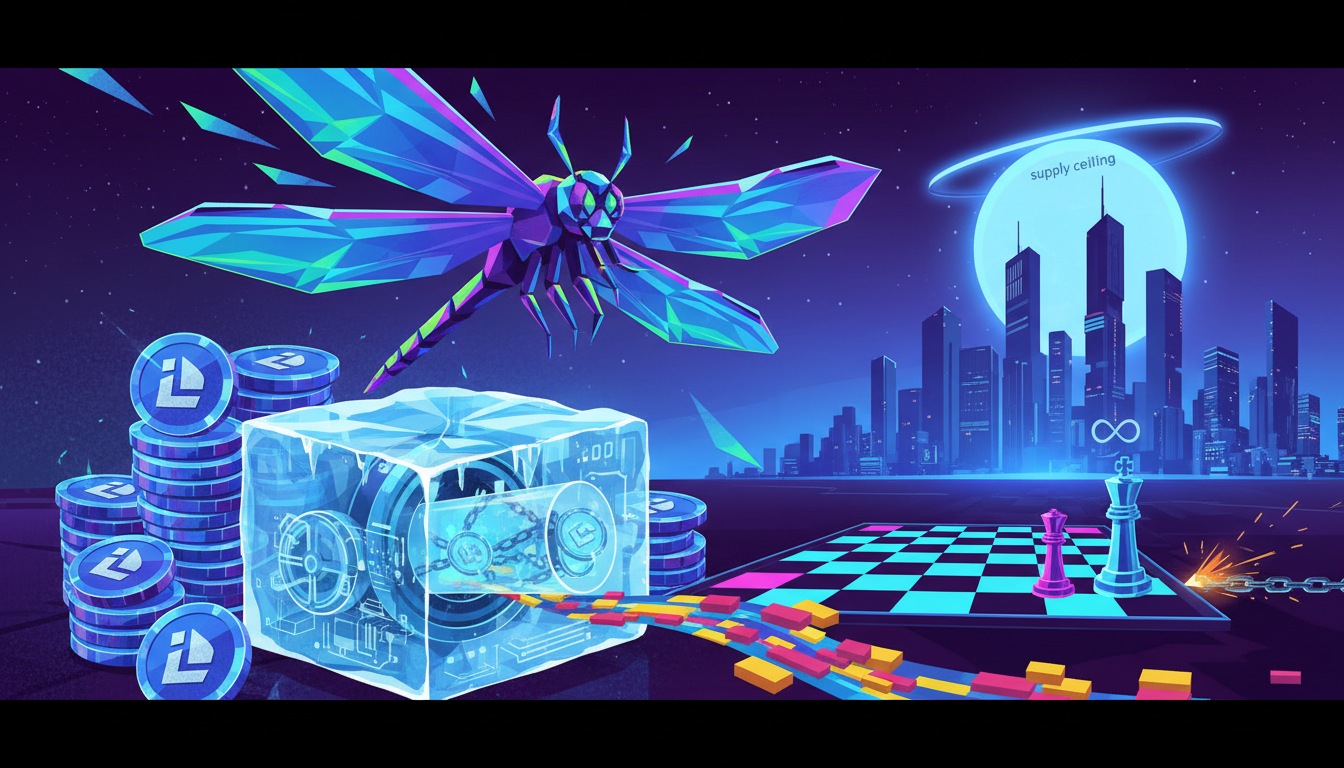
On the morning of May 16, 2026, Beijing time, the developer community was inundated by the same message: after operating for about five years, the blockchain game infrastructure team Lattice announced the formal shutdown of its business. The Redstone network it built will also press the "shutdown button" at 23:59 (UTC) on May 15, 2026. The official and multiple Chinese media reports pointed to a cruel fact—after ceasing operations, Redstone will only retain a withdrawal channel facing L1, and it will be open solely to EOA accounts. Any assets still left in contracts that are not migrated actively before the deadline will be permanently locked on-chain. When time is compressed into a clear countdown progress bar, the reality that "the decentralized network will also be shut down" sharply contrasts with Lattice's technical system built over the past five years around MUD, Redstone, Quarry, and Dozer. Why did a blockchain game infrastructure team that seemed to possess a long-term vision ultimately choose to shut down completely instead of transitioning or selling? When such a team decides to stop, what is left for developers, asset holders, and the blockchain gaming sector—a technical legacy, or a collective lesson on risk and exit mechanisms?
Shutdown Countdown: The Freezing of Redstone on the Timeline
According to Lattice's announcement and the information from multiple news platforms, the key timeline for Redstone is written exceptionally clearly—May 15, 2026, 23:59 (UTC). This means that from the perspective of the Beijing time zone, after the morning of May 16, users will no longer be able to interact normally on Redstone as before, and the network will enter a substantive shutdown state. The official shutdown plan is to shrink Redstone into a one-way channel: the chain itself will no longer serve as an available execution environment but will only retain the capability to withdraw to Ethereum and other L1s, and this capability will only be available to accounts that meet certain conditions.
Specifically, after the shutdown, Redstone will no longer support regular application calls and contract-level interactions. The official statement indicates that the only retained function is to allow EOA (Externally Owned Account) to withdraw assets via L1 withdrawal contracts. This means that previously built contract accounts, protocol vaults, and complex asset management schemes on Redstone will be unable to withdraw funds using the same contract logic after the shutdown if the migration is not completed before the shutdown occurs. More harshly, multiple media outlets quoting team statements indicate that assets remaining in contracts after the deadline will be considered permanently locked with no subsequent technical or operational options for "manual unlocking."
For ordinary users and integrators, this combines time and rules into a practical choice: on one hand, it requires asset inventory, on-chain signing, and cross-chain withdrawals to be completed within a limited time to avoid asset stagnation due to negligence; on the other hand, protocols relying on contract accounts must design transitional paths in advance, such as upgrading contracts to transfer assets to an EOA-controlled address, and then using that address to access the L1 withdrawal channel. For new projects no longer being maintained or contracts that have long been "unclaimed," such demands are nearly impossible to fulfill. The shutdown countdown is not just a date; it is a forceful challenge forcing all participants to prove that they are "still present."
From Glory to Shutdown: The Narrative Trajectory of Lattice's Five Years
When Lattice emerged, it labeled itself as a "blockchain game infrastructure team." It attempted to solve a class of long-standing yet consistently overlooked problems: if games are to run on-chain, then the development stack, state storage, composability, and upgrade mechanisms cannot simply follow traditional contract paradigms. Around this issue, Lattice built a relatively complete product matrix, from the underlying framework to the execution environment and supporting tools, attempting to provide a set of infrastructure closer to the habits of game developers for the "on-chain world."
On the specific timeline, the most representative achievements over the past five years have been the formation of the MUD framework and Redstone chain. MUD is positioned as a development framework for "autonomous worlds," introducing structures like ECS to manage on-chain states, hoping to allow developers to build contract logic in a manner closer to traditional game engines. In terms of security, the team revealed that MUD has passed OpenZeppelin audits, providing a professional endorsement for this framework to some extent. Meanwhile, Lattice was not satisfied with merely being a "library," but instead launched Redstone, a dedicated Layer 2 network, to provide a performance and cost-controlled operating environment for applications based on MUD.
Beyond the mainline products, tools like Quarry and Dozer played supporting roles: the former is more focused on resource and asset management development assistance, while the latter lowers the development threshold in data indexing, debugging, and other areas. These components formed a relatively complete "blockchain game development stack." From auditing to open-source, the reputation that Lattice accumulated within the technical community is not poor. However, when we compare technological achievements with operational results on the same coordinate system, a clear mismatch occurs: although the frameworks passed audits, tools are open-sourced, and networks are deployed, the overall business model did not succeed in establishing a sustainable cash flow or funding narrative for the team. Under the pressure of financial constraints, the cooling of narrative traction, and rising operational costs, Lattice ultimately chose a most resolute path—not a lightweight transition or seeking acquisition or custody, but directly announcing a complete business cessation, with the network shutting down as planned. In the absence of public financial data and details of internal negotiations, what we can confirm is only the outcome: five years of narrative is punctuated by a clear timestamp.
Technical Legacy Remains on the Chain: The Fate of MUD and Tools
Unlike Redstone, which was clearly written into the shutdown timetable, other products from Lattice will not disappear from the industry with the company's closure. The most typical example is the MUD framework. As the core development stack supporting "on-chain autonomous worlds," MUD has completed the OpenZeppelin audit on the security front, which has been mentioned in both official and third-party reports, becoming a key endorsement for its technical reliability. The framework itself exists as open-source and has not become invalidated due to the shutdown of Redstone; its code can still be referenced and expanded by developers, even evolving in other chains or execution environments.
Similarly, tools like Quarry and Dozer have already been open-sourced, meaning they have transitioned from a single team's asset to a public resource. Even if Lattice as a company exits the stage, the code repositories remain intact, and protocol licenses allow the community to continue using and forking. They are more likely to appear in the future in forms such as "community-maintained versions," "forked versions," or "new team reconstructions," and will no longer be tightly bound to Lattice’s brand.
Compared to these open-source components, the fate of the Redstone chain feels more terminal. As an operational Layer 2, it involves not only the operational maintenance costs of infrastructure but also carries complex variables like real user assets, security responsibilities, and regulatory environments. Once the decision to shut down is made, in order to avoid the latent risks of a long-term "zombie network," the team prefers to set a clear closure point and downgrade Redstone from an execution layer to a "liquidation layer" by retaining only the "L1 withdrawal contract," ultimately leading to total seclusion. This difference indicates that in a decentralized context, the chain itself and the open-source software built around the chain are two different entities: the former concerns real-time security and asset custody, while the latter is more like a technology legacy that can be infinitely replicated and reorganized.
In the foreseeable future, components such as MUD, Quarry, and Dozer will likely be "taken over" by other teams: either as the officially recommended development stack for a new chain, or integrated into more generic modular frameworks, or even find new applications in completely different narratives (like on-chain social or on-chain AI Agent worlds). The name Lattice will gradually fade, but the code it leaves behind will continue to survive on-chain and on GitHub in new combinations.
When Decentralized Networks Are Shut Down: The Imbalance of User Positions
From the users' perspective looking back at the Redstone shutdown plan, the rule that "contract assets must be actively withdrawn before shutdown or they will be permanently locked" places all participants in a rather passive position. In the past, when discussing on-chain assets, people tended to view "not relying on a single entity for existence" as a source of security, but in the case of Redstone, this sense of security is forced to yield to the reality of time pressure: only by completing operations within the pre-set time window can your decentralized assets truly belong to you.
More specific constraints come from the technical design of "only supporting EOA withdrawals". For ordinary users participating in the network directly with wallet addresses, as long as they remember to sign and withdraw before the deadline, the process is relatively controllable; however, for the many protocols and integrators that manage assets through contract accounts, this premise is exceptionally demanding. It requires:
● Before the shutdown, the contract itself must still be controlled by maintainers with upgradeable or operable permissions; otherwise, they cannot transfer the funds to an EOA-controlled address;
● The protocol needs to synchronize shutdown information to users within a limited time, designing a UI and interaction logic compatible with Redstone’s repayment path to ensure assets are not forgotten in old contracts due to information asymmetry.
Those projects that are no longer active, with developer teams dissolved or communities withered, are nearly destined to find it challenging to complete this series of complex operations. This makes the question of "what to do with assets when the chain shuts down" no longer an abstract inquiry, but a stark reality: while decentralized protocols may logically run for a long time, their usability and accessibility still deeply rely on the continuity of surrounding infrastructure and operational entities.
More broadly, the shutdown of Redstone has brought a long-avoided issue within the industry to the forefront: how should exit and aftermath mechanisms be designed when protocols or networks come to an end? Should it set clear time points and technical paths like this one, placing responsibility primarily on users; or should it introduce more "emergency modes," such as embedding more generic asset recovery logic within the contract layers or migrating assets to multi-party governance contracts? Those exit plans once viewed as "overly designed" now seem more like necessary contingencies for extreme scenarios.
Infrastructure Struggles to Survive: The Cooling Curve of the Blockchain Gaming Sector
Lattice's shutdown is not an isolated event but a microcosm of the collective pressure faced by the blockchain game infrastructure line amid a bear market and cooling narratives. As a team betting on "on-chain autonomous worlds," the business path chosen by Lattice inherently requires a long-term and stable developer ecosystem along with a continuous influx of new game projects to sustain itself through network effects and tool usage. However, with the market cooling down and investment and financing becoming cautious, the "blockchain gaming narrative" has notably cooled during the period of 2024-2026, making the underlying infrastructure the most challenging part to articulate a complete business loop.
Blockchain game development itself entails high risk and long lead times; many teams choose to build on more mature and general-purpose chains to enjoy existing users and liquidity, rather than staking everything on a dedicated Layer 2. This makes it difficult for networks like Redstone, which are customized for specific scenarios, to gather sufficient project volume and transaction activity in a short time to support operational and security costs. Meanwhile, tools like MUD, Quarry, and Dozer, while recognized in the technical community, do not have a clear path to monetization: technologically advanced, but demand and monetization lagging, become the key mismatch that crushes team cash flow and confidence.
In this context, the self-rescue paths available to infrastructure teams in a bear market are limited: some attempt to align themselves more closely with hotter narratives, packaging themselves as "general modular infrastructure" or "AI-native execution environments"; others proactively shrink their operations, cutting back on heavy asset network operations to retain only open-source components, extending life through a "technical IP + small team services" model; and some seek integration into large platforms or public chain ecosystems to exchange for longer funding and market runs. Lattice ultimately chose the most straightforward option—directly announcing a termination of business, leaving the open-source technological legacy to the community while orderly shutting down the network. This decision reflects a choice of "not further overspending the future" amidst a multifaceted balance of financing, team status, and sector prospects.
After Shutdown: Dust Scattered and New Beginnings
In the narrative closing of Redstone's shutdown and Lattice's disbandment, a few projects are still attempting to rescue themselves and restart. According to a single source of information, the DUST autonomous world project, which originally had a close relationship with the Lattice technology stack, is migrating to a new environment called DUST Chain. The details and ultimate effects of this action remain to be observed, but it at least demonstrates one point: when infrastructure undergoes fundamental changes, project parties do not have to passively wait for the outcome; migration, forking, and redeployment are still available options in the on-chain world.
From a broader perspective, Lattice's disbandment will prompt more developers and project parties to reassess their dependence on underlying infrastructure: Are they overly bound to a single network? Did they design multi-chain and transferable strategies early on? Did they reserve technical and governance emergency plans for extreme situations like "infrastructure shutting down"? Those multi-chain deployments, abstract settlement layers, and modular contracts that were once considered "unnecessary complexity" now appear to be essential buffer zones against single points of failure and narrative deterioration.
Looking to the future, the form of blockchain game infrastructure is likely to evolve along the lines of "lighter, more modular, and more resistant to single points of failure": the network layer no longer emphasizes a single dedicated chain but instead uses Rollup plug-and-play, sharing security and liquidity; the development stack no longer ties to a specific chain but exists in a combinable module format, allowing free migration between different execution environments; the custody of assets and states will increasingly rely on cross-chain proofs and general settlement layers, reducing dependence on any single operational entity.
The shutdown of Redstone is not an antithesis to the decentralized world but rather a stress test for insufficient institutional design. It reminds us that even if the technology stack can be open-sourced, audits can be professional, and narratives can be grand, systems without proper exit mechanisms often end up in passive liquidation under time pressure. If Lattice has left the industry with the most important lesson, it is probably this: a truly mature decentralized world must not only design how to initiate and grow but must also seriously address a seemingly pessimistic yet unavoidable question—when everything comes to an end, have we reserved a clear, executable, and sufficiently dignified exit path for all participants?
Join our community, let's discuss together and become stronger!
Official Telegram community: https://t.me/aicoincn
AiCoin Chinese Twitter: https://x.com/AiCoinzh
OKX Welfare Group: https://aicoin.com/link/chat?cid=l61eM4owQ
Binance Welfare Group: https://aicoin.com/link/chat?cid=ynr7d1P6Z
免责声明:本文章仅代表作者个人观点,不代表本平台的立场和观点。本文章仅供信息分享,不构成对任何人的任何投资建议。用户与作者之间的任何争议,与本平台无关。如网页中刊载的文章或图片涉及侵权,请提供相关的权利证明和身份证明发送邮件到support@aicoin.com,本平台相关工作人员将会进行核查。