Original Title: The Great Attrition of Crypto VCs
Original Author: Catrina
Translation: Peggy, BlockBeats
Editor's Note: When "issuing tokens to exit" is no longer valid, crypto venture capital begins to lose its once solid logic.
In the past three cycles, tokens have been the core path for capital recovery and profit amplification. With this premise, the industry has constructed a familiar rhythm: early financing, narrative expansion, launch circulation, price realization. However, as on-chain revenue becomes a new threshold, meme coins divert liquidity, and retail funds overflow into more risky assets, this mechanism is breaking down.
A more direct change is that the expected returns from token projects are compressed, while equity paths regain attractiveness. Early investors are becoming more cautious about projects that "exit through token issuance," while later-stage funds are shifting towards "web2.5" companies with genuine revenue and acquisition expectations. Crypto VCs are no longer in a relatively closed competitive environment but are forced to enter a realm where they compete directly with traditional fintech funds.
In this process, a deeper question gradually emerges: what can VCs provide when capital itself is no longer scarce?
In recent years, some of the most representative projects have almost bypassed institutional capital to directly establish network effects and revenue models. This means that funding is no longer the "pass" to enter quality projects. For founders, whether to bring in VCs depends on whether the latter can provide clear brand endorsement and real incremental value, rather than just book funds.
Under the new market structure, crypto VCs need to redefine their "product definition." Otherwise, they will become one of the eliminated entities in this cycle.
Below is the original text:
Crypto VCs are at a watershed moment. In the past three cycles, token exits have been the primary source of excess returns, but now this model is undergoing a substantial reset. What kind of tokens have value is being redefined in real time, while a unified evaluation framework at the industry level has yet to form.
So, what exactly has happened?
This round of changes in the crypto market structure is the result of various forces that have never appeared simultaneously in the same cycle:
1/ The emergence of HYPE has struck the entire token market from the side. It has proven one thing: token prices can be supported by real revenue, with over 97% of its nine- and ten-digit revenue coming from on-chain. This case quickly sparked a collective disillusionment in the market regarding "narrative-driven but fundamentally weak" governance tokens—such as the early L1s and governance tokens primarily used to evade securities regulation but struggling to directly distribute revenue. Almost overnight, HYPE reshaped market expectations: revenue capability is no longer a bonus but has become the minimum threshold.
2/ The ripple effects on other projects followed: before 2025, if a project has on-chain revenue, it is often classified as a security; but post-HYPE, if there is no on-chain revenue, for most hedge funds, the project's demise is merely a matter of time. This has put the vast majority of projects, especially non-DeFi ones, in a dilemma, forcing them to hurriedly adjust their paths.
3/ PUMP cast a severe "supply shock" on the system. The frenzy of meme coins has brought an explosive increase in token supply, fundamentally disrupting the market structure—attention and liquidity have been severely decentralized. Just on Solana, the number of newly issued tokens soared from about 2000–4000 per year to a peak of 40,000–50,000, essentially cutting the pie into about 20 slices with almost no increase in liquidity. The same batch of funds and attention that originally pursued high returns began to shift from holding altcoins to shorter-term meme coin trading.
4/ The alternative destinations for retail risk funds are also rapidly increasing. Products like prediction markets, perpetual stock contracts, and leveraged ETFs are directly competing for the portion of funds that originally flowed into crypto altcoins. Meanwhile, the maturation of asset tokenization technology allows investors to leverage blue-chip stocks, which do not face the zero-risk threat of most altcoins and are under stricter regulation, making information more transparent and reducing informational disadvantages.
These changes have collectively led to one outcome: the lifecycle of tokens has been significantly compressed. The cycle from peak to trough has shortened dramatically, and retail investors' willingness to "hold long term" has plummeted, replaced by faster capital rotations.
Core Issues
In this context, nearly all VCs are repeatedly pondering several core questions:
1/ Are we investing in equity, tokens, or a combination of both?
The biggest challenge is that there is currently no mature paradigm regarding "how token value accumulates." Even for leading projects like Aave, there remain ongoing disputes between DAO and equity structures.
2/ What are the best practices for accumulating on-chain value?
The most common practice today is token buybacks, but "common" does not mean "correct." We have long held an opposing view to mainstream buyback logic: this mechanism is "toxic," putting truly revenue-generating projects in a dilemma.
The problem is that its motivation has been wrong from the start.
Traditional companies typically repurchase stocks when growth investment opportunities diminish or when stock prices are undervalued; however, crypto projects often perform buybacks under pressure from retail investors and market sentiment—this pressure is highly emotional and unstable. You might just put out $10 million for buybacks, which could have been reinvested, only to be completely swallowed by the market the next day due to a certain market maker being liquidated.
Public companies repurchase stocks when they are undervalued; yet, token buybacks are often front-run and executed at local peaks.
If your business is a B2B model primarily based on off-chain revenue, such buybacks are even more futile. In my personal view, during the phase when annual revenue is below $20 million, there is almost no justification for buybacks just to please retail investors—these funds should preferably be directed towards growth.
I strongly agree with a report/screenshot from fourpillars: even ten-digit scale buybacks are unlikely to have a substantive effect on establishing a long-term price floor for the project.
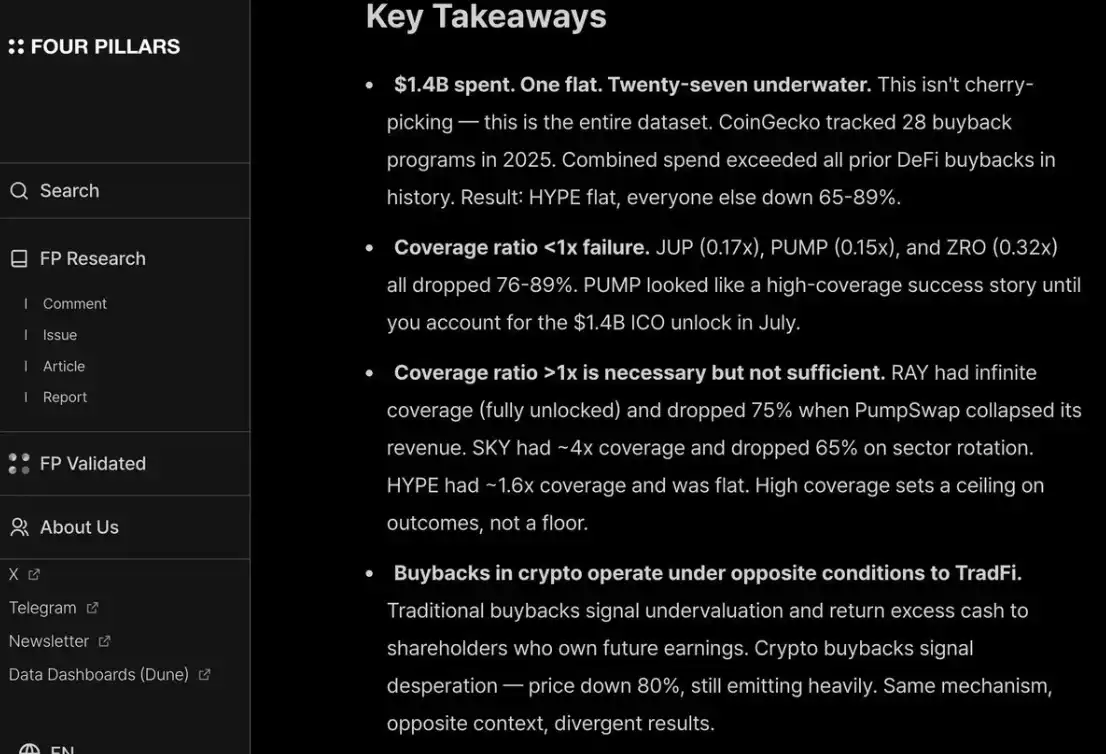
Moreover, to please both retail investors and hedge funds, you must, like HYPE, conduct buybacks continuously and transparently. If this cannot be achieved, you will be punished by the market like PUMP—its fully diluted valuation (P/F) is merely 6 times because the market "does not trust" it. Despite the fact that it has burned $1.4 billion that could have entered the national treasury as revenue.
3/ Will the "crypto premium" completely disappear?
This implies that, in the future, the valuations of all projects may revert to a range similar to traditional public companies—approximately between 2–30 times revenue.
This is worth serious consideration: if this judgment holds true, then from the current levels, most L1 prices may still need to drop over 95% to align with this valuation system. Only a few exceptions—such as TRON, HYPE, or other DeFi projects with real revenue—are able to relatively stand firm.
And this does not even take into account the additional selling pressure from token unlocking (vesting).
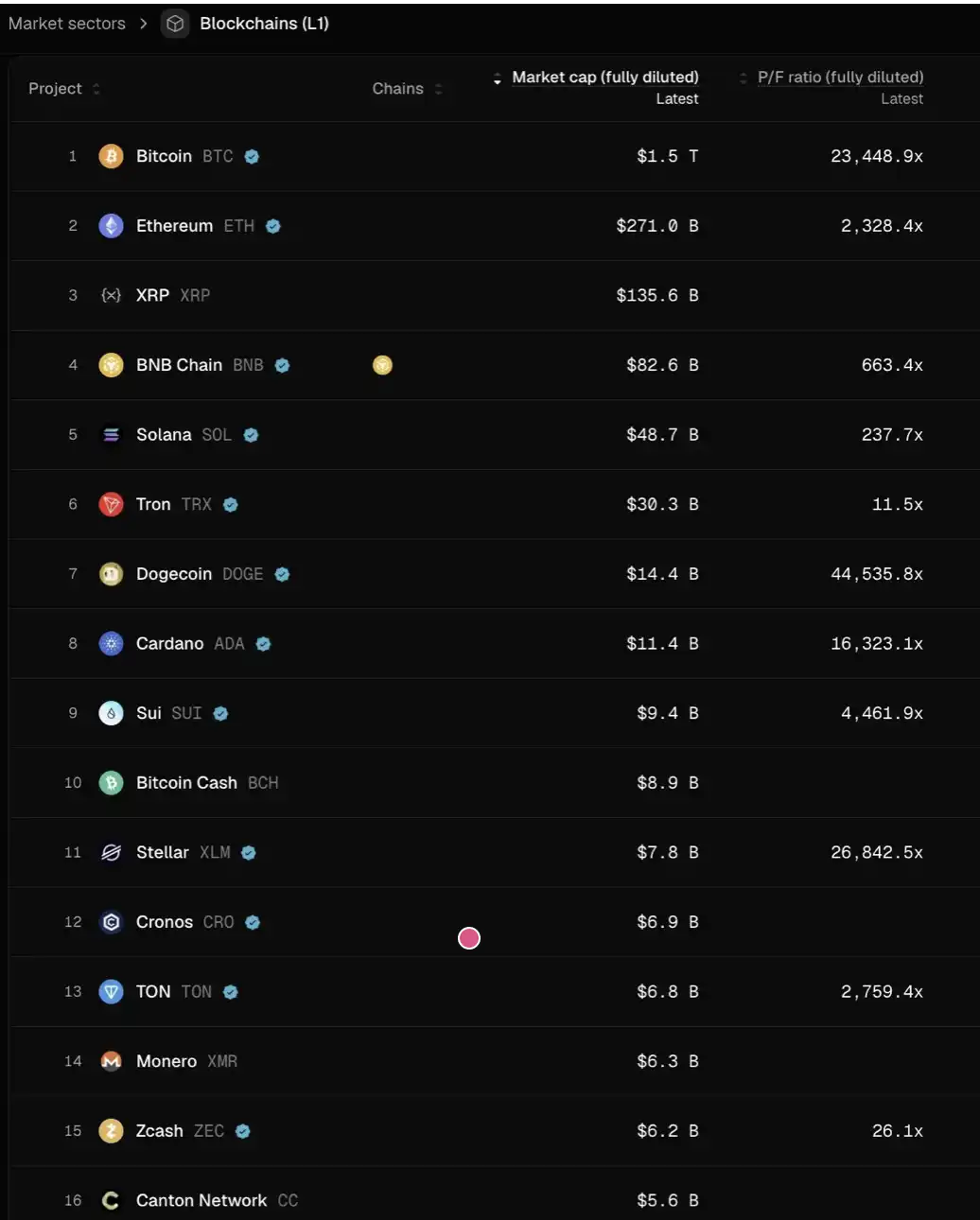
I personally do not believe the situation will reach that point. HYPE has indeed set an "outlier" market expectation, making investors unusually impatient about whether early projects possess "revenue/user growth from the launch." For payments, DeFi, and similar "sustaining innovations," such requirements are reasonable; but for "disruptive innovations," constructing, launching, growing, and eventually hitting a revenue explosion naturally takes time.
In the past two cycles, we swiftly swung from an overly tolerant approach towards "disruptive technologies," having experienced 8–9 rounds of financing amid the highly abstract narratives of new L1s, Flashbots/MEV, towards the opposite extreme—only willing to bet on DeFi projects. This is essentially an overcorrection.
But the pendulum will eventually swing back.
For DeFi projects, pricing based on "quantitative fundamentals" indeed reflects industry maturity; but for non-DeFi tracks, "qualitative fundamentals" also cannot be ignored: including culture, technological innovation, disruptive concepts, security, decentralization, brand value, and industry connectivity. These dimensions will not simply reflect in TVL or on-chain buyback data.
So, what will happen next?
The expected returns from token projects have been significantly compressed, while equity-related businesses have not experienced a similar degree of cooling. This divergence is particularly evident in early and growth-stage investments:
In the early stage, investors have become more price-sensitive towards projects "exiting via tokens"; meanwhile, interest in equity-related projects has significantly risen, especially in the current relatively friendly acquisition environment. This stands in stark contrast to the 2022–2024 period—during which token exits were the default pathway, underpinned by the assumption that "token valuation premiums would persist."
In the later stage, investors who possess brand advantages and resource capabilities in a crypto-native context are gradually distancing themselves from purely "crypto-native" projects in favor of more "web2.5" companies—whose valuation logic is more anchored in real revenue growth. This also leads them into a competitive arena that is unfamiliar: they need to compete directly with cross-border funds and traditional Web2 fintech funds (such as Ribbit Capital or Founders Fund), which have a deeper accumulation in traditional financial contexts, portfolio synergies, and early project acquisition capabilities.
The entire crypto VC industry is entering an "attribution period."
Who can stay depends on whether they can find their own "product-market fit" (PMF) in the minds of founders—and this "product" is not just capital but also a combination of brand identity and actual empowerment capability.
For quality projects, VCs need to "sell themselves" back to founders in order to compete for a spot on the cap table. Especially in recent years, some of the most successful projects have relied almost entirely on non-institutional capital (such as Axiom) or have not raised funds at all (such as HYPE). If a VC can only offer funds, it is almost destined to be marginalized.
Only VCs that genuinely qualify to remain at the table must clearly answer two questions:
First, what is its brand identity—why would the best founders actively seek them out;
Second, where is its value add—this ultimately decides whether it possesses the capability to win that deal.
免责声明:本文章仅代表作者个人观点,不代表本平台的立场和观点。本文章仅供信息分享,不构成对任何人的任何投资建议。用户与作者之间的任何争议,与本平台无关。如网页中刊载的文章或图片涉及侵权,请提供相关的权利证明和身份证明发送邮件到support@aicoin.com,本平台相关工作人员将会进行核查。


