Original author: Nic Carter
Original translation: Saoirse, Foresight News
Editor’s note:The mystery of Satoshi Nakamoto's identity remains unresolved. On April 8, The New York Times published another article accusing Adam Back of being the Bitcoin founder, sparking widespread discussion. Nic Carter wrote a rebuttal, arguing that the report lacks solid evidence and insufficient reasoning. He further introduced a viewpoint from the perspective of the quantum security crisis: If Satoshi Nakamoto were still alive, he should emerge to address the early high-risk Bitcoin to mitigate hazards; his prolonged silence may suggest he is no longer alive. This article presents strong and controversial opinions; the related technical judgments and inferences only represent the author's stance, for readers' contemplation and reference.
The New York Times believes Adam Back is Satoshi Nakamoto. Their analysis is based on the fact that Back is a member of the cypherpunk community, the inventor of Hashcash, and shares similarities in language habits with the Bitcoin founder. However, the article failed to present any substantively new evidence. For John Carreyrou, a seasoned journalist who exposed the Elizabeth Holmes and Theranos scandal, the quality of this report is indeed disappointing.
Back has been quite gracious, accumulating goodwill in the Bitcoin community while ambiguously denying any connection to Satoshi Nakamoto—this is a tactic almost all suspected individuals adopt.
This article has not shaken my view at all: Back is not Satoshi Nakamoto. The threshold for proving this identity is extremely high, and The New York Times basically provides no effective evidence. Stylistic analysis can easily be manipulated to yield false conclusions, and the paper has not conducted rigorous statistical research, merely scratching the surface with grammar and spelling patterns. I have my own speculation about Satoshi Nakamoto's identity and believe that artificial intelligence may soon unravel this mystery, but this report is clearly not the answer.
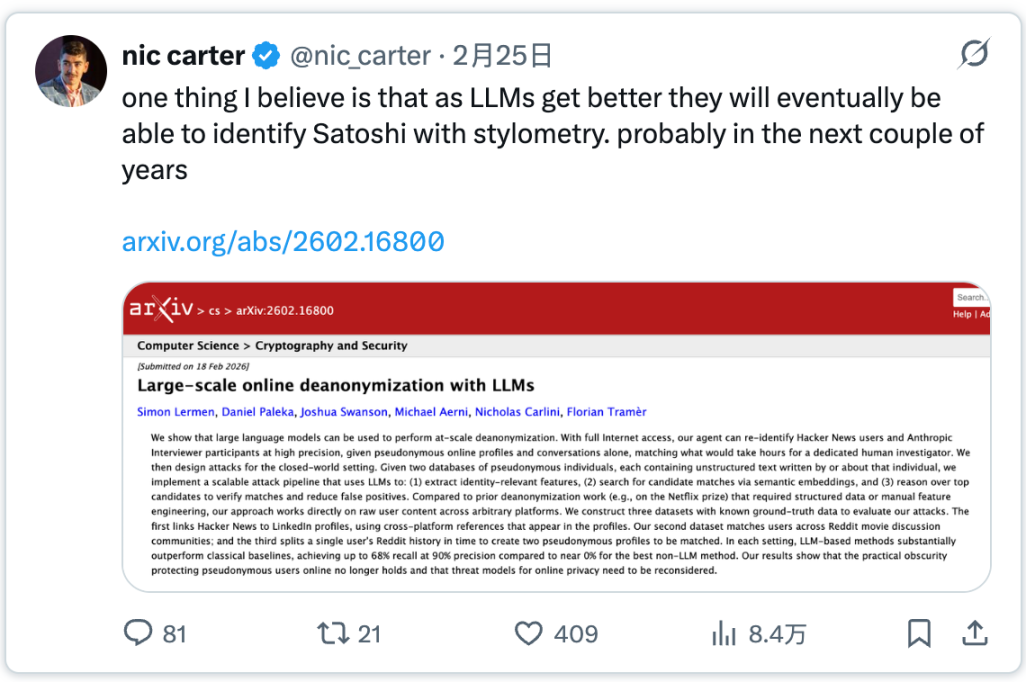
I believe that as large language models continue to advance, they will eventually identify Satoshi Nakamoto through stylometric analysis, likely achieving this in the coming years.
Why would someone deliberately cater to a New York Times journalist asserting they are Satoshi Nakamoto? This question is left for readers to ponder. Any rational person would not want the public to think they secretly hold a value of 12 billion dollars of unregistered digital assets.
Furthermore, I have a more critical questioning reason regarding the claim that "Back is Satoshi Nakamoto."
If Satoshi Nakamoto is still alive today, he bears a major responsibility—to address the largest risk that Bitcoin has faced to date: about 1.7 million Bitcoins, exposed in P2PK (Pay to Public Key) format, are vulnerable to potential theft by quantum computers.
It must be clarified that sufficiently powerful quantum computers can reverse-engineer the encryption relationship between public and private keys. A recent paper from Google and Caltech indicates that this difficulty is lower than previously thought; a quantum computer with only 26,000 qubits may complete the decryption in a matter of days. For this reason, both Google and Cloudflare have set 2029 as the deadline for the full upgrade of quantum cryptography, and the U.S. government has also mandated key institutions to prepare by 2030. Authoritative industry bodies generally believe that the quantum threat will become a real issue in the near future.
As the "Quantum Threat Day" approaches, I expect the Bitcoin community to advance cryptography upgrades, making addresses unreadable by quantum computers. In about the next decade, almost all Bitcoin holders will need to transfer their assets to secure addresses using new encryption schemes. But with that comes the problem:
Addresses held by Satoshi Nakamoto and early miners contain millions of Bitcoins, widely considered lost or abandoned. Of these, about 1.7 million, worth around 12 billion dollars, are stored in old P2PK addresses, exposing their public keys entirely. This means that anyone with a sufficiently powerful quantum computer can reverse-engineer the private keys and seize these assets. This would suddenly flood the market with 9% of the Bitcoin supply, previously seen as permanently lost, creating a devastating impact on prices.
Unfortunately, because Satoshi Nakamoto and some early participants either lost their keys, abandoned them, or have passed away, the Bitcoins in these old addresses cannot be migrated to a newer, safer format. Therefore, about 1.7 million Bitcoins will remain permanently exposed to quantum attack risks, allowing attackers nearly limitless time to compromise the addresses.
Of course, Bitcoin developers could propose a software upgrade to prohibit spending from such old addresses, thereby permanently freezing these assets. However, there has been no precedent for this in Bitcoin's history; in essence, it equates to confiscating user funds, a practice that Bitcoin's culture vehemently opposes. Thus, I believe this freezing plan is essentially impossible to implement. If carried out, the core characteristic of Bitcoin—upholding property rights and irrefutable currency issuance rules—would no longer exist.
This brings us back to Satoshi Nakamoto. Only he can truly resolve this dilemma. He can transfer the Bitcoins he holds to a safer new address, or without formally claiming them, transfer them to a burn address, rendering these assets utterly unusable and eliminating the market hazard while maintaining anonymity throughout.
This is the reason I conclude: Satoshi Nakamoto is most likely no longer with us. Unless developers take extreme measures to freeze nearly 10% of the Bitcoin supply, only Satoshi can address Bitcoin's quantum security risk. If he is still alive, he would certainly feel a strong sense of responsibility to handle the Bitcoins in these P2PK addresses, either by migrating or destroying them. Even if he could no longer access these assets, he could easily validate his identity through old documents, emails, and identity tokens.
As early as 2010, Satoshi participated in discussions regarding the quantum risk faced by Bitcoin's encryption system and was well aware of this issue. At that time, he took a relaxed attitude, casually stating that if necessary, Bitcoin could simply change its encryption algorithm.
Fifteen years later, quantum computing has developed rapidly and may pose a real threat to Bitcoin in the next decade.
This is also why the claim in The New York Times that Back is Nakamoto holds no water with me. It's not that Back lacks credentials or capability; if Satoshi were still alive and concerned about Bitcoin, he would undoubtedly be under immense pressure to resolve the increasingly serious issue of quantum vulnerability. It is hard to believe that Satoshi would passively watch Bitcoin fall into danger.
Thus, I ultimately conclude: Satoshi Nakamoto is no longer among us. As the Quantum Day approaches, we need him more than ever, yet he has always remained silent.
免责声明:本文章仅代表作者个人观点,不代表本平台的立场和观点。本文章仅供信息分享,不构成对任何人的任何投资建议。用户与作者之间的任何争议,与本平台无关。如网页中刊载的文章或图片涉及侵权,请提供相关的权利证明和身份证明发送邮件到support@aicoin.com,本平台相关工作人员将会进行核查。


