Original | Odaily Planet Daily (@OdailyChina)
Author | Asher (@Asher_0210)

Predictive markets are undoubtedly the hottest track in the current Web3 discussions.
Predictive trading surrounding macro events, the crypto industry, and even entertainment topics continues to heat up, with increasing discussion intensity and participation numbers. However, alongside the rapid development of the market, some discordant voices have gradually emerged - some events have shown disparities during settlement with users' expectations based on common sense or "real-world understanding," triggering controversies over rule design, fairness, and even platform credibility.
Recently, two highly controversial events have occurred in predictive markets. Below, Odaily Planet Daily will sort out and discuss them.
Polymarket: U.S. Rescue of American Pilots in Iran Deemed U.S. Invasion of Iran
On April 3, a U.S. F-15E Strike Eagle fighter jet was shot down by the Iranian air defense system in southwestern Iran. The two crew members onboard (one pilot and one weapons systems officer) parachuted out, with one being quickly rescued and the other missing for several days, hiding in the mountainous regions of Iran.
- The U.S. military then launched a search and rescue (SAR) operation involving armed aircraft, helicopters, etc., ultimately successfully rescuing the second severely injured crew member (Trump personally announced "WE GOT HIM").
- The rescue operation involved U.S. forces entering Iranian territory (mountainous search and rescue, possible ground or low-altitude actions), which has drawn attention in the context of the current sensitive geopolitical conflict.
As a result, the U.S. military's entry into Iranian territory could be considered a U.S. invasion of Iran to some extent and directly impacted the predictive event on Polymarket regarding when U.S. forces would invade Iran (US forces enter Iran by?)
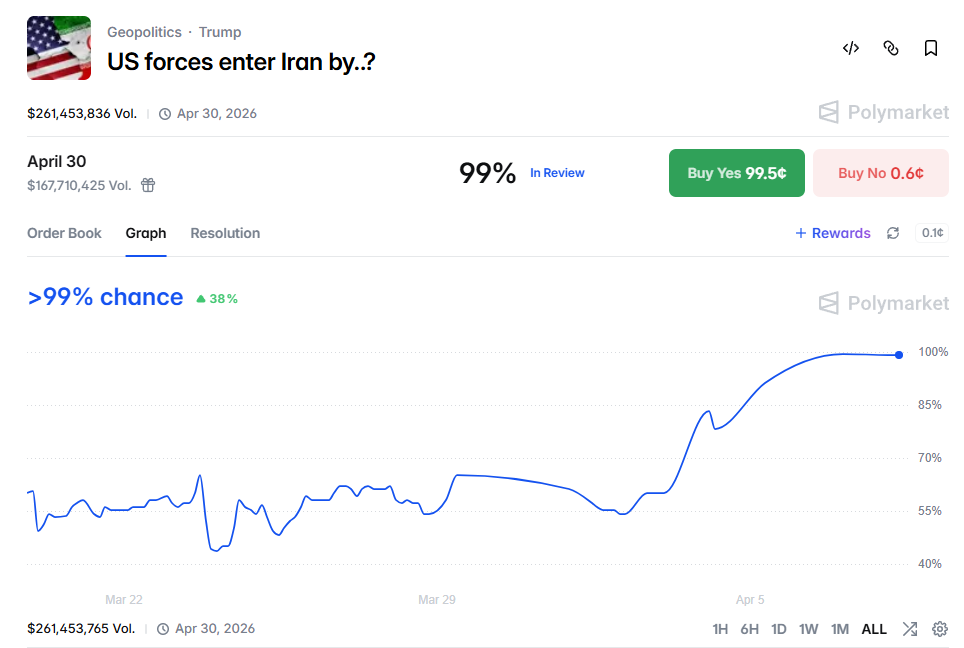
According to the settlement rules, active-duty U.S. military personnel (including special operations forces) entering Iranian land before the designated date counts as an invasion. The downed pilot does not count towards the invasion, but the special forces dispatched by the U.S. did enter Iran to rescue the pilot. Therefore, the special forces entering Iran to rescue the pilot meets the criteria for determining the U.S. invasion of Iran as Yes.
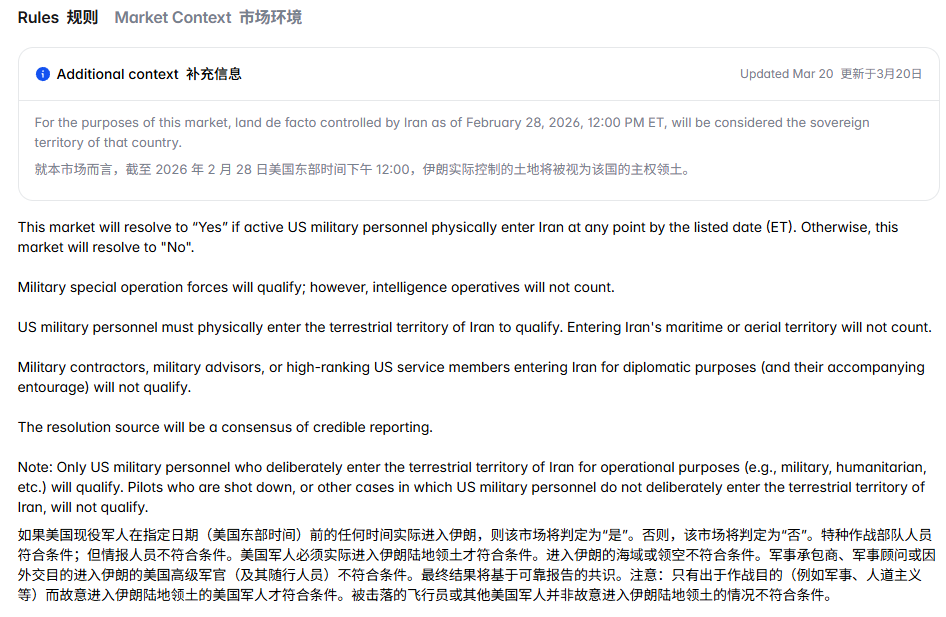
The "rescue of the pilot" event has been determined by Polymarket to be a U.S. invasion of Iran, provoking strong community controversy.
Those supporting "count as entry" (Yes side) believe that this action fits the definition of "entry" in the rules. The U.S. special forces deliberately entered Iranian territory to carry out the mission, and the rules clearly state that "special operation forces will qualify," which also includes "for operational purposes (including humanitarian)." From an objective standpoint, this is the first confirmed ground penetration behavior by U.S. forces in the current conflict context, as U.S. personnel did indeed set foot on Iranian soil, thus it should be regarded as "entry."
Opponents of "count as entry" (No side) argue that this definition is an overextension. This action is essentially a short-term, limited-scale humanitarian rescue, neither a military invasion nor having an intention to occupy, which does not align with the public's common understanding of "U.S. forces entering Iran." Furthermore, the rules explicitly exclude "pilots who are shot down... will not qualify," and this operation focused on the downed pilot, having the nature of "forced entry," logically should fall into a similar exceptional circumstance. Referring to past cases (such as similar regional actions not regarded as invasion), rescue actions should not be equated with military entry; if determined as Yes, it may encourage marginal interpretations of the rules, undermining the seriousness and consistency of the market. The Chinese community generally believes that "entering Iran" should refer to large-scale ground or amphibious operations rather than short-term actions of "rescue and leave."
Predict.fun: Polymarket Launching Stablecoin Deemed as Issuing a Token
On the evening of April 6, Polymarket officially announced on X that it would undergo a comprehensive exchange upgrade:
- Rebuilding the trading engine, upgrading smart contracts;
- Launching a new native collateral token Polymarket USD (1:1 pegged to USDC, to replace USDC.e and reduce bridging risks).
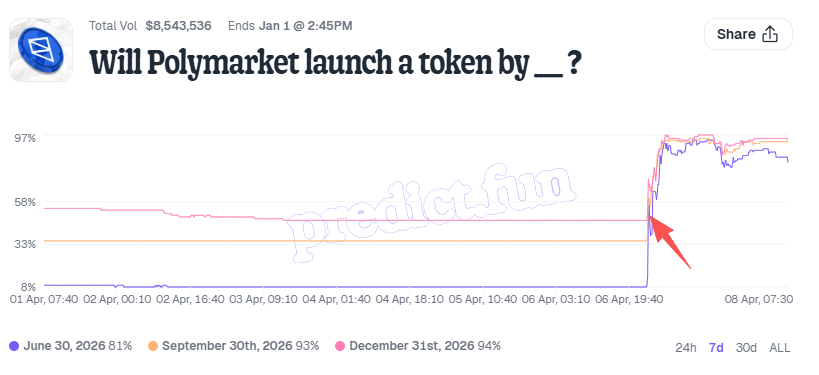
Among these, the second point mentioning the launch of the native collateral token Polymarket USD directly affected the probabilities of two related predictive events on the Predict.fun platform: one is issuing a token; the other is market cap after issuing a token:
1. When will Polymarket issue a token? (Will Polymarket launch a token by ___?)
2. One day after Polymarket's launch, FDV (Polymarket FDV above ___ one day after launch?);
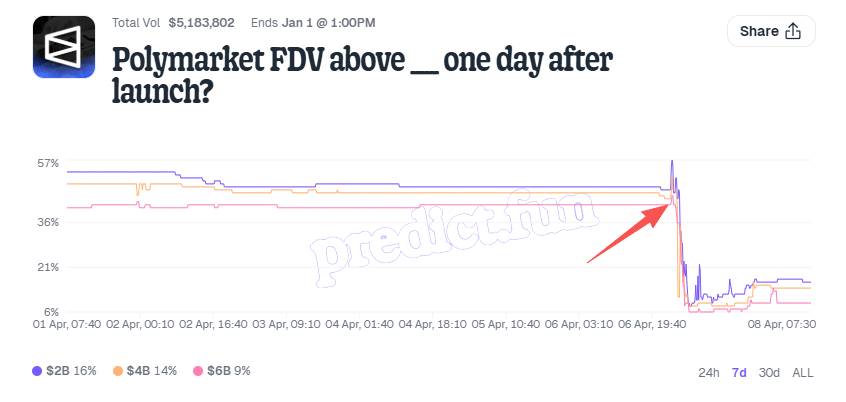
According to the settlement rules document, it clearly states that "any fungible tokens issued by Polymarket will count as 'issuing a token' in this event," and stablecoins are certainly no exception. Therefore, the Polymarket stablecoin meets the criteria for being deemed as Yes.
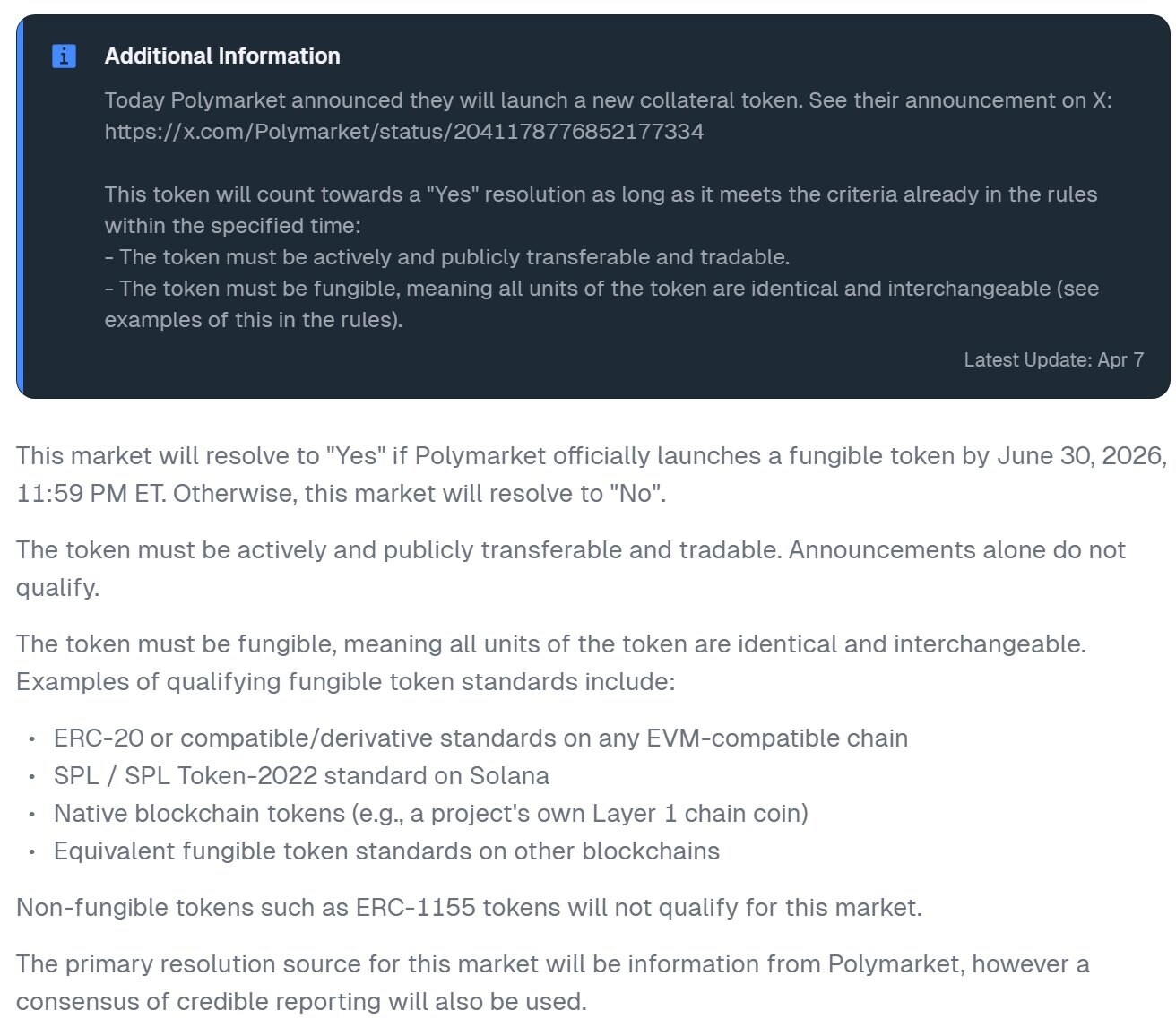
Explanation related to settlement rules
The community then began debating this issue.
Supporters argue that, based on the literal interpretation of the rules, "issuing a token" is not limited to being a "governance token," but is a general reference to all tokens. Under this premise, Polymarket USD, as a fungible token issued by Polymarket, essentially meets the definition of "issuing a token." Additionally, the official's later supplemental explanation is more of a reiteration of the original rules rather than a temporary alteration, thus possessing a degree of reasonableness in terms of compliance.
However, the questioning side does not accept this explanation. On one hand, they believe that including stablecoins in the "issuing a token" category is an overinterpretation of the rules and a typical case of wordplay; on the other hand, even if stablecoins are acknowledged as "issuing a token," the core of this predictive market is still "Polymarket FDV," not "Polymarket USD FDV." Stablecoins are more of a collateral or settlement tool, and their market cap structure differs fundamentally from the project's main token (such as POLY governance token), thus should not be equated or substituted for the overall valuation logic of the project.
Whose Side Are You On?
Looking at the overall situation, the controversial events in predictive markets essentially revolve around one core question: are you betting on "reality" or "rules." Often, these two do not completely overlap.
For us participating in predictive markets, understanding the rules themselves may be more important than predicting the event's direction. How information sources are defined, whether there are exception clauses, and whether there is room for interpretation, these details will directly determine wins and losses at critical moments.
Because of this, some high-probability events that appear to be "safe bets" may in fact carry risks and could potentially result in a "total loss." Many reversals happen precisely within these overlooked details. Rather than blindly betting, paying more attention to the rules is more useful than complaining after losing money.
免责声明:本文章仅代表作者个人观点,不代表本平台的立场和观点。本文章仅供信息分享,不构成对任何人的任何投资建议。用户与作者之间的任何争议,与本平台无关。如网页中刊载的文章或图片涉及侵权,请提供相关的权利证明和身份证明发送邮件到support@aicoin.com,本平台相关工作人员将会进行核查。


