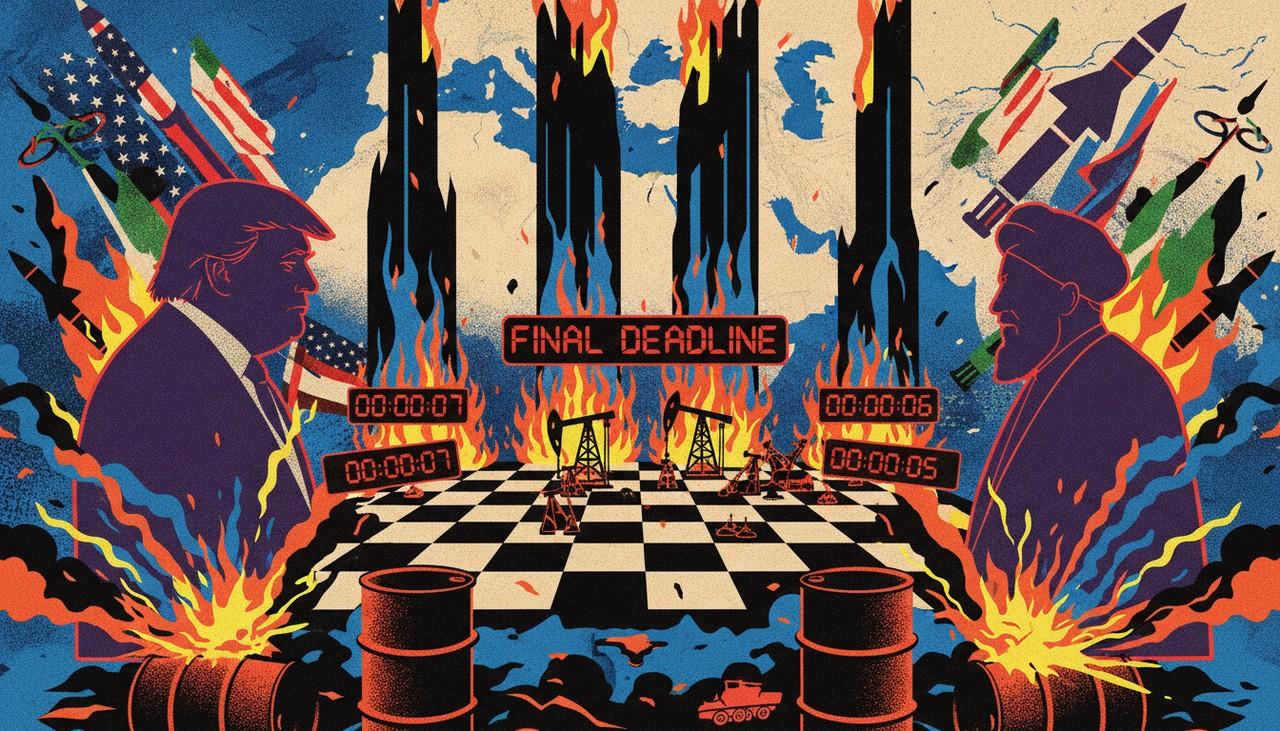
At 8:00 AM on April 7, 2026, Eastern Time, several media outlets cited reports claiming that the U.S. military struck military targets on Hark Island, near Iran, directly targeting this key offshore oil island. The first to reveal this information was a reporter from Axios, which was quickly picked up by Chinese cryptocurrency and financial media, forming a highly concentrated source chain of information. However, as of the time of this writing, neither the White House nor the Pentagon has made any official public confirmation regarding this action, and the incident remains in the sensitive stage of “reported by a single source.” Despite limited details, this attack, allegedly aimed at Iran's oil island, has been viewed by several market commentators as a significant trigger for the renewed escalation of tensions in the Middle East and global energy risks. Expectations surrounding the chain reactions of oil prices, stock indices, and cryptocurrency assets are quickly leaking from the geopolitical news between Washington and Tehran into the emotional pricing of global assets and cryptocurrency markets.
Who is firing and who is speaking: the narrative chain from Axios to social media
The current visible information chain is quite clear yet thin: the initial bombshell came from a reporter at Axios who disclosed the claim of “U.S. military strikes on military targets on Hark Island in Iran.” Following this, various Chinese cryptocurrency and financial media, such as Rhythm BlockBeats, Jinse Finance, and Deep Tide TechFlow, directly quoted the Axios report, making the narrative in the Chinese context heavily reliant on this single source, lacking diverse cross-confirmation.
In the English information sphere, accounts like Al Arabiya English and Iran International English also quickly shared and referenced the relevant reports, allowing the news to spread between Middle Eastern and Western audiences, but it still revolves around Axios’s original statement rather than independent on-site verification or official announcements. This means that, whether in the Chinese community or in international opinion, the current understanding of the “attack on Hark Island” heavily relies on the same source of information.
More critically, as of now, the U.S. White House and Pentagon have not provided any official public statement on the military operation, nor have they disclosed the operation’s goals, scale, or subsequent intentions. This state of “media has claims, officials remain silent” means that the event cannot currently be classified as a fully substantiated military fact and can only be cautiously labeled as “an action not yet confirmed by officials.”
Single-source military breaking news often has an amplifying effect in geopolitical and financial market narratives: on one hand, they touch on highly sensitive topics like interstate conflict and energy corridors; on the other hand, uncertainty itself is viewed by the market as risk, prompting capital and sentiment to preemptively discount for “worst-case scenarios.” It is within this typical pattern of “facts unverified, prices have reacted” that the current turmoil surrounding Hark Island has swiftly transcended news headlines and entered the asset pricing system.
Flashes of light above the oil island: Middle East tensions and energy nerves are once again stirred
In the traditional energy landscape, Hark Island is generally seen as an important oil export hub for Iran, long serving as a key node for crude oil transportation and storage. Regarding its share of Iran’s total export volume, current public data still shows significant discrepancies, with briefings having clearly stated that such specific proportions are pending verification. Thus, it can only emphasize the consensus that it is “of significant importance,” but cannot provide precise numbers.
It is precisely because of Hark Island's symbolic significance in Iran's oil and gas system that rumors of explosions and military strikes have immediately been interpreted by public opinion as a new node of escalating risk in the Middle East. From the Strait of Hormuz to the coast of the Persian Gulf, any attack news close to the “heart of oil and gas” will be highly sensitively categorized by the market as a “threat to energy security,” rather than merely a localized military friction.
In terms of pricing logic, once investors start to worry about the safety of key oil transport hubs, the first impact is on the expectations of future crude oil supply stability, along with the associated transport risk premium. Even if actual production is not materially affected, expectations for tanker insurance costs, route diversions, military escort demands, etc., are sufficient to elevate the “invisible cost curve,” thereby transmitting through futures prices and related asset valuations.
Against the backdrop of the ongoing Russia-Ukraine conflict, the global energy structure is already under strain. Any rumors of attacks directed at core oil and gas nodes in the Middle East will be seen as a potential trigger for breaking this balance. Once the name Hark Island is associated with “U.S. military strikes,” market fears about “multiple conflicts compressing the global energy buffer space” are naturally amplified quickly.
Wall Street gives a cold reaction first: the immediate reflection of stock index futures
From the price signals, Wall Street's first response has already emerged. According to single-source data, after news of the Hark Island strike spread, the S&P 500 index futures saw their decline extend to about 0.5%, and the NASDAQ index futures fell by about 0.6%. Such swings do not constitute a crash, but at this stage, where the news has not been officially confirmed, it already reflects a certain degree of rising risk aversion.
The futures market typically serves as a “preview theater”: when geopolitical and energy-related uncertainties suddenly rise, capital often first makes directional adjustments in the derivatives market, through slight position reductions or hedging to mitigate potential tail risks. The synchronous decline of the S&P and NASDAQ futures reflects that investors are re-pricing their exposure to the combination of “U.S.-Iran tensions plus oil price risks.”
Logically, short-term capital is most likely to withdraw from high-beta tech stocks and growth sectors and shift towards relatively defensive traditional industries or safe-haven assets. This is partly because growth stocks are more sensitive to interest rates and risk preferences, and also because they have accumulated a larger floating profit and valuation bubble during the prior increase, making them easier to be the first choice for “risk reduction.” The subtle pressure on tech giants and high-valuation sectors is a typical action of the market correcting optimistic pricing.
However, judging from the current futures decline of about 0.5%-0.6%, the overall pullback remains within a controllable range, not triggering systemic panic or liquidity crunch. A more accurate expression is that the market is reserving a buffer for potential risk escalation rather than being convinced that disaster is inevitable. This also means that the subsequent trends will largely depend on the “real signals” given by U.S. officials, Iranian sides, and the oil prices themselves.
Bitcoin oscillates in the cracks: the power map and regulatory shadows
In the cryptocurrency world, Bitcoin’s fundamentals also have a hidden relationship with geopolitics. The latest data shows that approximately 37.4% of Bitcoin’s hash power is distributed within the U.S. (according to a single source). The U.S.'s dominant position in mining and infrastructure means that any escalation of conflict between the U.S. and Iran is not only a military news far in the Middle East but might also indirectly influence mining companies’ expectations regarding regulatory outlook and operating environment.
From the price performance perspective, based on single-source information, Bitcoin has maintained a range-bound oscillation over the past two months, lacking decisive breakthrough momentum both upward and downward. This “has a story, lacks trends” sideways pattern makes any sudden geopolitical event more likely to amplify emotional fluctuations on a short-term basis rather than immediately reversing long-term trends.
Under the dominance of the U.S. power landscape, once U.S.-Iran relations further tense, the market inevitably conjures up potential scenarios involving tighter regulations, rising compliance costs, and intensified scrutiny on mining companies. Even if these changes are still at the “expectation” level in the short term, they are sufficient to become risk considerations for mining decision-makers and institutional investors, thereby transmitting to market sentiment through adjustments in positions and expansion plans.
More importantly, when sudden geopolitical events are layered on top of the already directionless oscillation pattern, crypto assets are more likely to display the characteristic of “amplified emotions, but unchanged trends.” Prices may experience rapid spikes or boosts under the stimulation of news, but in the absence of coordination between capital and fundamentals, such fluctuations often turn out to be merely concentrated releases of emotional leverage rather than the starting or ending point of a new bull-bear cycle.
Emotions are pulled between risk and good news: the internal contradictions of Bitcoin's narrative
In the narrative field of Chinese cryptocurrency media, Jinse Finance and Deep Tide TechFlow have clearly interpreted this Hark Island event as another example of “putting pressure on global asset and crypto market sentiment.” The rise of tensions in the Middle East and energy risks is seen as an important external variable that suppresses risk appetite and pulls down indices and cryptocurrency prices, where Bitcoin is more faced with “selling pressure expectations driven by rising risk.”
The contradiction lies in the fact that Bitcoin carries two coherent yet conflicting narratives: on one hand, it is seen by some supporters as “digital gold,” possessing safe-haven attributes during fiat currency depreciation and escalating geopolitical conflict; on the other hand, in actual trading behavior, Bitcoin is often categorized alongside high-risk tech stocks into the “growth and speculative assets” basket, and when the market de-risking occurs, it will be under pressure along with NASDAQ constituent stocks.
This means that if the situation in the Middle East continues to escalate, Bitcoin's trend is likely to oscillate between these two forces: in the short term, as indices and high-beta assets come under pressure, speculative and leveraged positions may choose to reduce holdings and exit first, forming noticeable selling pressure; while in the medium and long term, once the market starts worrying about inflation resurgence, excessive currency issuance, or financial sanction risks, coupled with high valuations of traditional safe-haven assets, Bitcoin’s “safe-haven imagination” may be reignited, attracting slow inflows from allocating funds.
Under this narrative tug-of-war, a more realistic coping thought for investors is to shift attention from momentary K-line fluctuations to two main lines: regulatory statements and the evolution of the energy market. The interactions between the U.S. and Iran moving forward in terms of policy and public opinion will directly influence compliance expectations and institutional participation willingness; while the trajectory of oil prices and expectations of transportation safety will indirectly shape the overall valuation space for crypto assets through macro liquidity and risk preferences.
Single message or starting point for a new cycle: maintaining flexibility in uncertainty
In summary, the incident of “U.S. military reportedly striking Hark Island” is more like another spark layered on the existing tensions in the Middle East and energy risks, rather than a standalone variable emerging out of nowhere. It ignites the already simmering tensions amid the Russia-Ukraine front lines, the Persian Gulf, and the Red Sea routes, rather than constructing an entirely new risk scenario from scratch.
At this current stage of high information asymmetry, obviously relying on a single media source, market participants first need to maintain flexibility and a skeptical attitude: not only must they not take unverified official claims as established facts, but they also cannot ignore the potentially far-reaching impacts on global assets and the crypto market once geopolitical and energy variables are substantiated. Managing positions and leverage levels should take precedence over bets on short-term directions.
Looking forward, three observation dimensions are particularly crucial: firstly, whether U.S. officials can provide clear statements regarding the nature of the action, targets, and subsequent intentions; secondly, whether Iran will choose to respond strongly or strategically restrain; and thirdly, whether the oil price and freight rate curves will indeed begin a new upward round. These three clues will together determine the extent and time span of pressure on risk assets and will directly reflect on the volatility intensity of stock indices and crypto assets.
It is foreseeable that in a cycle of rising geopolitical uncertainty, crypto assets will oscillate repeatedly between “the imagination of a safe-haven vehicle” and “the reality of high-risk assets.” For Bitcoin, each flash of tension in the Middle East and oil price fluctuations is a battle for narrative power: does it resemble gold more, or does it resemble the NASDAQ more? How to maintain independent judgment and disciplined execution amid this oscillation will be a common issue that all participants must face in the upcoming period.
Join our community to discuss and become stronger together!
Official Telegram group: https://t.me/aicoincn
AiCoin Chinese Twitter: https://x.com/AiCoinzh
OKX benefit group: https://aicoin.com/link/chat?cid=l61eM4owQ
Binance benefit group: https://aicoin.com/link/chat?cid=ynr7d1P6Z
免责声明:本文章仅代表作者个人观点,不代表本平台的立场和观点。本文章仅供信息分享,不构成对任何人的任何投资建议。用户与作者之间的任何争议,与本平台无关。如网页中刊载的文章或图片涉及侵权,请提供相关的权利证明和身份证明发送邮件到support@aicoin.com,本平台相关工作人员将会进行核查。