🚨 After BGD and ACI left, Chaos Labs also announced its exit from Aave DAO, citing fundamental differences in risk management priorities and methods.
It's unclear what the specific situation is, but there are said to be hidden circumstances;
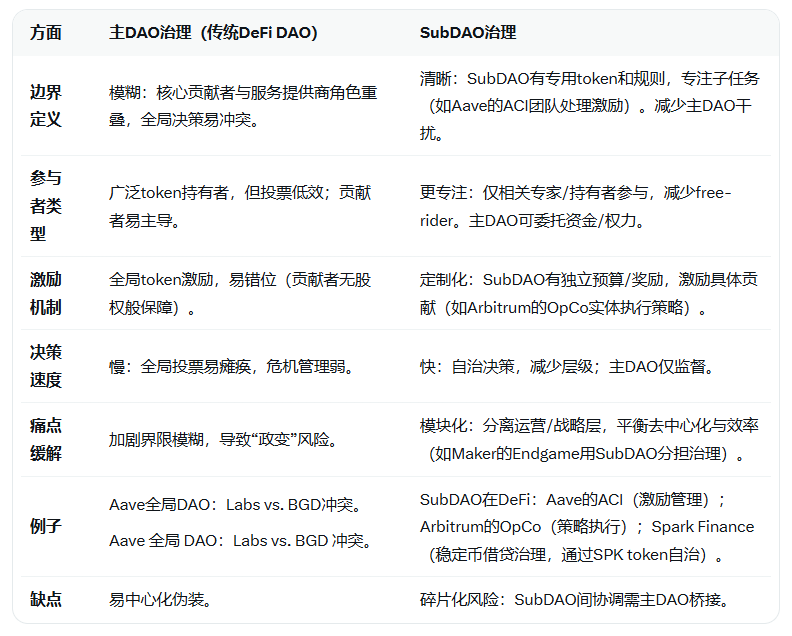
However, Aave has lost three key members in a row, which serves as a typical example of governance issues in traditional DeFi DAOs:
DAOs are very good at reaching consensus but not at managing operations, leading to an increasingly blurred line between service providers and core contributors.
▶️ Core contributors are usually the genesis team of the protocol, holding the brand, IP, and early code framework. In name, they are bound by the DAO, but in reality, they naturally have stronger discursive power.
▶️ Service providers are external executors hired by the DAO, responsible for code maintenance, protocol upgrades, risk support, and other specific tasks, mainly obtaining budgets through contracts or governance proposals.
In the early days, the protocols were small and did not pay much attention to this issue; the main governance tasks were simply adding assets, adjusting parameters, and making proposals. Many things could be advanced through forum discussions and community collaboration.
But as the protocols grew, maintaining this boundary became challenging:
Service providers could also be core contributors, shifting towards controlling or extracting value.
Then the contradictions arise——
For example, Aave Labs (core contributors) previously pushed the V4 framework, requesting 51M in funding, but BGD Labs (service providers) felt that Labs created dependencies, undermining decentralization.
You Labs control the brand/IP, I BGD provide the code, why don’t we have equal power?
One side does the work of core positions while receiving outsourced treatment;
One side is motivated by the thought of selling drugs, while the other side earns money from selling vegetables;
If this continues long-term, it will definitely undermine trust, which is the root of many issues in DeFi DAOs.
Relatively speaking, the subDAO governance model that Spark @sparkdotfi is currently adopting is a bit more advanced:
The main DAO is responsible for higher-level oversight and resource allocation, while SubDAOs handle ongoing governance and execution in specific tracks, with independent governance tokens and rules.
Subsequent developments of DeFi protocols should consider this governance template, ensuring the emergence of dedicated operational layers to avoid getting trapped in a tug-of-war over money, power, and responsibility;
It not only consumes team relationships but also harms the protocol itself.
If one or two more key teams leave, the hollowing out of the DAO will happen very quickly.
免责声明:本文章仅代表作者个人观点,不代表本平台的立场和观点。本文章仅供信息分享,不构成对任何人的任何投资建议。用户与作者之间的任何争议,与本平台无关。如网页中刊载的文章或图片涉及侵权,请提供相关的权利证明和身份证明发送邮件到support@aicoin.com,本平台相关工作人员将会进行核查。


