Written by: Bu Shuqing
Source: Wall Street View
As geopolitical conflicts in the Middle East continue to escalate, every increase in international oil prices tests the limits of the global market. In its latest research report, UBS sets a clear red line: $150 per barrel.
According to the Chase Trading Desk, a recent global macro research report released by UBS analysts points out that once international oil prices break $150 per barrel and sustain that level, the U.S. and global markets will face significant systemic risks, with the probability of recession and severe market corrections significantly increasing.
The bank emphasizes that the danger of this critical point lies in the fact that it will trigger a complete negative cycle of "high oil prices → inflation rebound → tightening monetary policy → deteriorating financial conditions → collapsing demand → market panic."
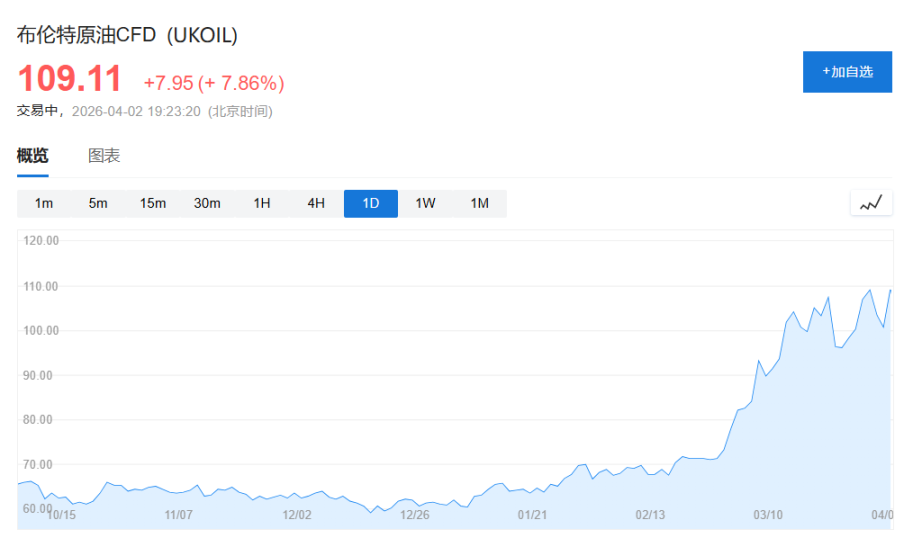
As of the time of writing, the international benchmark Brent crude oil has surged nearly 8%, once again challenging the $110 mark. UBS warns that the current market pricing of oil price risk still leans towards linear extrapolation, severely underestimating the cliff-like risks near $150 per barrel. Under the shadow of high oil prices, the market now has little safety margin, making it more important to safeguard the risk bottom line and avoid high-sensitivity assets than to seek profits.
Impact Depends on Initial Fragility
UBS's research report breaks the long-held market linear notion that "every $10 increase in oil prices contributes a fixed proportion to economic drag," pointing out that the destructive power of energy shocks highly depends on the initial economic state.
Currently, the global economy is in an environment of high interest rates, weak recovery, and tight credit conditions, and the initial probability of recession is already not low, which significantly amplifies the transmission effects of oil price shocks.
UBS has constructed a three-dimensional analytical framework, using the probability of a U.S. recession, the rise in oil prices, and the extent of economic cyclical decline as three dimensions. The calculated results clearly reveal the non-linear characteristics of risk:
- When the recession probability is 20% and oil prices are at $100 per barrel, the cyclical economic decline is only 0.28 standard deviations, leading to a mild impact;
- If the recession probability rises to 40% and oil prices remain at $100 per barrel, the decline expands to 0.81 standard deviations, nearly three times the baseline;
- When the recession probability is 40% and oil prices break $150 per barrel, the decline skyrockets to 1.4 standard deviations, with the impact intensity nearly five times the baseline.
This means that the weaker the economy, the more deadly the blow of high oil prices. In the current environment, an increase in oil prices from $100 to $150 does not result in a 50% increase in pressure, but rather a multiple accumulation of risk.
$150: Critical Distinction in Two Scenarios
Based on the approximately 30% probability of recession in the U.S. prior to the Middle East conflict, UBS presents critical values under two key scenarios; the difference between them reveals the core role of financial market reactions.
In an ideal steady-state scenario, if the financial market is stable and there is no additional risk fermentation, the U.S. economy can theoretically withstand oil prices rising to about $200 per barrel before entering recession. However, in a real risk scenario, once the stock market experiences a significant correction due to high oil prices, and risk appetite rapidly deteriorates, the recession tipping point will directly shift to $150 per barrel.
UBS points out that once $150 per barrel is reached, the world will face triple systemic pressures:
- On a macro level, inflation will surge again, forcing the central bank's interest rate-cutting cycle to be interrupted or even restarted, causing the economy to rapidly slide into stagflation;
- On a market level, stock market earnings expectations will be downgraded, valuations will shrink, high-yield debt credit spreads will widen, and tightened liquidity will trigger cross-asset sell-offs;
- On a real level, corporate costs will soar, profits will be squeezed, consumer purchasing power will decline, and consumption along with investment will cool down simultaneously, forming a resonant decline in the economy and markets.
The research report also cites historical comparisons noting that larger-scale oil price shocks prior to 2000 had smaller impacts due to stronger initial economic resilience than those during the Gulf War period in 1990. Today, with the global high-interest-rate environment persisting, the financial system is more sensitive to rising costs, and the intensity of shocks at $150 per barrel will only be more severe.
Non-linear Risks: Market Pricing Blind Spots
UBS's research report specifically warns that the current market pricing of oil price risks is systematically underestimated, particularly ignoring the threshold effect near $150 per barrel.
According to UBS's research, the $100 to $130 per barrel range typically affects specific industries such as aviation, logistics, and chemicals, but the overall market remains manageable; once oil prices stabilize above $150 per barrel, the risk will spread from local to global, upgrading from industry-level to systemic financial risk.
This non-linear risk manifests in three dimensions:
- First, risk transmission accelerates, with high oil prices quickly breaking through businesses' profitability, consumer spending, and government fiscal buffers;
- Second, policy space is compressed, as rising inflation places central banks in a dilemma of "fighting inflation vs. stabilizing growth," making it impossible to timely support the market;
- Third, confidence collapses rapidly, with a significant stock market correction and exposure to credit risk overlapping, forming a negative feedback cycle of "declines → deleveraging → further declines."
免责声明:本文章仅代表作者个人观点,不代表本平台的立场和观点。本文章仅供信息分享,不构成对任何人的任何投资建议。用户与作者之间的任何争议,与本平台无关。如网页中刊载的文章或图片涉及侵权,请提供相关的权利证明和身份证明发送邮件到support@aicoin.com,本平台相关工作人员将会进行核查。


