Written by: Zhang Qianwen
In traditional banks, interest rates are determined by people. The central bank sets the benchmark interest rate, and commercial banks, based on this, consider funding costs, risk pricing, and competitive strategies to eventually decide how much interest to give you.
But in DeFi, there is no interest rate committee, no risk control director, and no one has the power to announce this morning, "The loan interest rate of this protocol is adjusted to 5%."
So, is the interest rate random? Of course not.
The interest rates of DeFi lending protocols are calculated in real-time by algorithms based on the supply and demand of funds. When the supply-demand relationship changes, the interest rate changes immediately. The entire process is executed automatically without any human intervention.
Thus, in the logic of DeFi, the interest rate is a function that expresses whether there is enough "money to use" in the pool, with only one core variable: the utilization rate.
01 Reservoir Model: Utilization Rate is the Source of Everything
Imagine a reservoir.
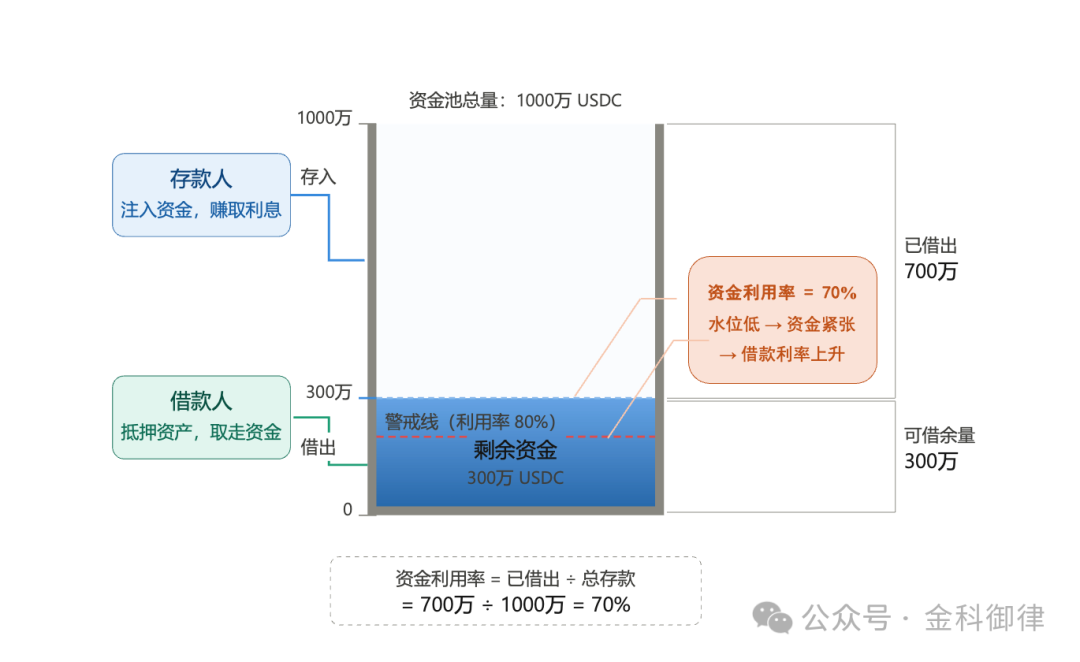
Depositors store water in the reservoir, and borrowers take water from it. The total storage capacity of the reservoir is all the assets deposited in the protocol.
Utilization Rate = Funds Borrowed / Total Deposits in the Fund Pool
Assuming there are 10 million USDC in the fund pool, of which 7 million have been borrowed, the utilization rate is 70%.
This number is the starting point for the entire interest rate mechanism.
The logic is simple: the lower the water level in the reservoir, the more precious the water and the higher the price. Conversely, if the reservoir is full and there are few users, the water price naturally decreases. Translating this logic into DeFi means that the higher the utilization rate, the less money is available to borrow, and therefore the higher the borrowing interest rate.
This is not a rule designed by humans, but the most basic supply-demand logic of the funding market, just written into code in DeFi and executed automatically in real-time.
02 Interest Rate Curve: Gentle Usually, Fierce at the Threshold
However, if the interest rate simply rises linearly with the utilization rate, there would be a problem: when the fund pool is about to be exhausted, the interest rate may not rise quickly enough, and new deposits may not be able to come in on time, causing the protocol to fall into a liquidity crisis of "no money to take".
To avoid this situation, mainstream DeFi lending protocols generally adopt a design called "segmented interest rate model", also known as the kink model.
The rules are simple:
- Before the utilization rate exceeds a certain threshold (usually 80%), the interest rate rises slowly with the utilization rate, with a gentle slope;
- Once the utilization rate exceeds this kink point, the interest rate will rise sharply, with the slope increasing several times or even ten times.
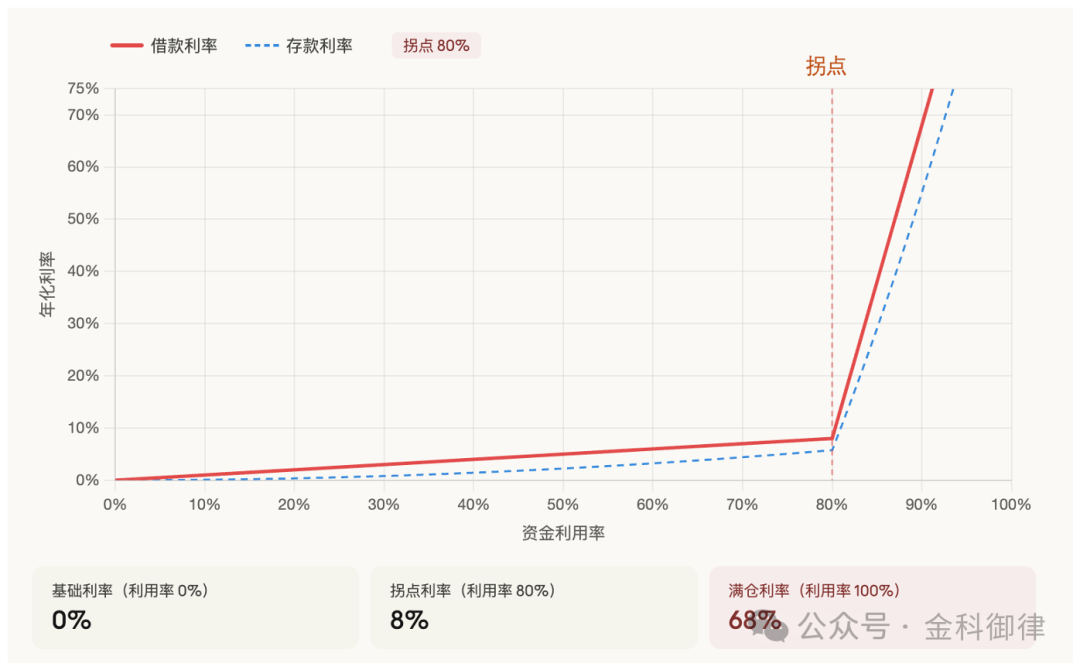
This design has a clear intention—high borrowing rates will generate two kinds of pressure: on one hand, borrowing costs suddenly become expensive, and some borrowers will choose to repay; on the other hand, deposit yields will increase, attracting new depositors to replenish funds. These two forces work together to pull the utilization rate back into a healthy range.
In other words, the interest rate curve not only "describes" the supply-demand relationship but also actively "regulates" it. This is the most ingenious part of the entire mechanism design.
03 Depositors Receive Less Interest Than You Think
Many people think that the deposit interest rate and the borrowing interest rate are the same number. In reality, they are not.
The calculation formula for deposit interest rate is:
Deposit Interest Rate = Borrowing Interest Rate × Utilization Rate × (1 - Protocol Fee Ratio)
For example: assume the current borrowing interest rate is 10%, the utilization rate is 80%, and the protocol fee is 10%.
Then the actual annual yield received by depositors is: 10% × 80% × 90% = 7.2%.
Why isn’t it 10%?
Because 20% of the money in the fund pool is idle and doesn’t generate interest income, depositors cannot be expected to pay for this "vacant" portion. The interest must be allocated based on the actual lending ratio.
So where does the remaining difference go? Part of it goes into the protocol's reserve to cover bad debt losses in extreme cases; another part is treated as protocol income, allocated to the "national treasury" or distributed to governance token holders.
This detail illustrates an important fact: DeFi lending protocols are not merely "peer-to-peer funding matching," but are also systems with income, reserves, and financial structures.
04 Algorithm Neutrality? There Are People Behind the Parameters Making Decisions
At this point, you might think: the interest rates in DeFi are determined by algorithms, which are fair, transparent, and without human intervention.
This judgment is only half right.
The algorithm itself is indeed neutral—given a utilization rate, the interest rate is automatically calculated by the code, and no one can modify it temporarily. But this algorithm contains several key parameters: where the kink is set (is it at 70% or 90%), how high the interest rate can go beyond the kink (50% or 200%), and what the protocol fee ratio is...
These parameters are decided by community governance votes.
In other words, holders of governance tokens can propose and vote to modify these parameters. Mainstream protocols like Aave and Compound have undergone multiple governance adjustments to interest rate parameters, and each adjustment directly affects the entire protocol's funding costs.
This brings a subtle reality: the interest rates in DeFi are not "without intervention," but rather are "rules transparent and parameters governable." While no one can interfere at the code execution level, the community still plays a role at the rule-making level.
This is not entirely the same as the central bank adjusting interest rates in traditional finance, but it is also not as "decentralized" as one might imagine.
免责声明:本文章仅代表作者个人观点,不代表本平台的立场和观点。本文章仅供信息分享,不构成对任何人的任何投资建议。用户与作者之间的任何争议,与本平台无关。如网页中刊载的文章或图片涉及侵权,请提供相关的权利证明和身份证明发送邮件到support@aicoin.com,本平台相关工作人员将会进行核查。


