The way most people discuss Web 4.0 is focused on the wrong question.
They are asking: Is this the next marketing cycle? Is Web 4.0 just another wave of concept creation? These questions are not important. The real question is: Whose underlying authority on the internet is being transferred to whom?
If we view this question on a historical scale, the answer has always been clear. Web 1.0 was read-only—users were consumers of content with no write permissions. Web 2.0 granted write permissions—you could post, upload, and comment, but the platform owned your data. Web 3.0 granted ownership—assets were placed on the blockchain, private keys were held by you, and the platform could not confiscate your wallet.
Each iteration is essentially a downward transfer of authority.
Web 4.0 continues along the same logical line, but the objects of the transfer have changed. It is not a transfer to users; it is a transfer to Agents.
An overlooked structural fact: For a long time, the entire architecture of the internet has been absolutely "human-centric."
The UI/UX of Web 2.0 was designed for the cognitive bandwidth of humans—information density, click paths, color contrasts, every parameter is an estimate of the limits of human attention. Web 3.0’s KYC verification, mnemonic phrase backup, multi-signature approvals are fundamentally addressing the physiological flaws of humans that make them prone to errors and attacks.
The entire system serves human limitations, not human capabilities.
But in the era of AI, this logic begins to fracture. When Agents obtain on-chain permissions, they face the same system designed for humans, but they do not need elegant UIs, password retrievals, SMS verification codes, nor do they need to sleep before confirming transactions.
This is the core contradiction of Web 4.0: an internet infrastructure designed for human cognitive limitations meets new participants without cognitive limitations. Reconstruction is inevitable.
The ongoing reconstruction can be observed from two dimensions.
The first dimension is the disintegration of the front end. In the traditional sense, a beautiful UI is designed for human visual processing capabilities. Agents mainly communicate through APIs and code logic; the interface is noise to them, not an entry point. Once Agents become the primary protocol interaction parties, the logic of the front end will shift from "how to help the user understand" to "how to make the machine read." This is a paradigm disruption that front-end development has never encountered in thirty years.
The second dimension is the replacement of the identity verification system. Account password-based systems assume that the login entity is a human with memory limitations—passwords need to be short enough to remember but long enough to be secure. This contradiction has spawned the entire password management industry. But Agents do not need to remember passwords. On-chain signatures can be granted and revoked in real time, with granular permissions precise to single operations. Account systems will gradually be replaced, not because of design failure but because their design premises are outdated.
The changes in these two dimensions can be summarized in one sentence: The gateway of the internet will shift from a revolving door designed for humans to an API interface designed for machines.
During this infrastructural reconstruction process, there is a specific closed loop worth examining separately.
AI possesses powerful decision-making abilities, but it inherently lacks two things: independent payment channels and asset sovereignty.
An Agent can analyze global gold market sentiment data within milliseconds and provide the optimal allocation decision—but if it does not have an independent funding account, this decision still requires human execution. Delays in the execution stage can consume all the advantages it gained during the analysis stage.
Crypto fills this gap.
Take Hyperliquid as an example: its perpetual contract market for commodities like gold, silver, and crude oil runs 24/7. This feature is optional for human traders—positions at three in the morning can wait until morning to be dealt with. But for Agents, this is a necessary infrastructural condition because Agents have no concept of sleep; their operation is around the clock.
When Agents take over wallets and private keys, they extend from the decision-making layer to the execution layer. AI provides analysis and judgment, Crypto offers settlement infrastructure, and the combination of the two forms a complete economic entity.
The marginal cost of running an Agent trends toward zero. Its output and trading execution occur around the clock. For DeFi protocols, this presents an unprecedented ideal interactive object—emotionless, cannot forget, and will not miss the optimal execution window because of daytime meetings.
This is the true narrative of Crypto × AI: it is not the accumulation of two trending terms; it is the complementary infrastructures connecting at the same time point.
There is perhaps an inappropriate example.
In 1908, the Ford Model T went into mass production. In the initial years, the mainstream judgment in the commentary circle was that cars were an upgrade of horse-drawn carriages, suitable only as toys for the wealthy. No one foresaw that cars would rewrite the entire spatial logic of cities, spawn gas station chains, destroy rail passenger transport, and turn Detroit into a global manufacturing center.
The overlooked key point was not the car itself but how the car changed the entire society's space-time cost function.
The structural significance of Web 4.0 is similar. The surface issues—what products will explode, which protocols will win—are akin to "which model will sell well" in the era of the Model T. The real proposition is: When Agents become the main on-chain participants, and their scale and concurrency exponentially surpass humans, in what dimensions will the rules of the economic system shift?
Based on this logic, Lidong BlockBeats has partnered with Zhihu to hold an event in Hong Kong on April 21 titled "Decoding Web 4.0: When AI Agents Take Over On-Chain Authority." In the face of this completely unknown proposition, we want to try to find some certainty.
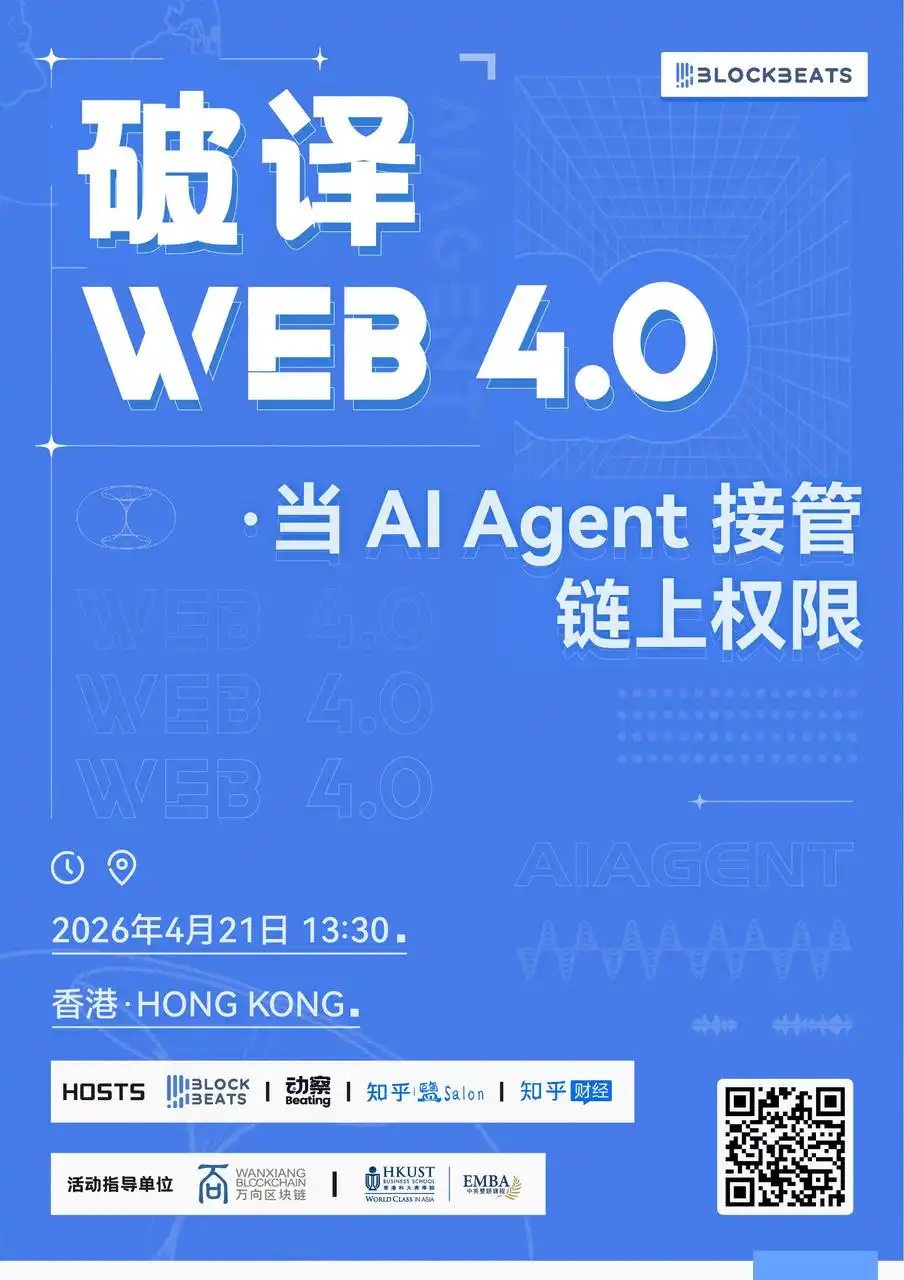
Everyone can scan the code to register
At this event supported by Wanxiang Blockchain and the Hong Kong University of Science and Technology Business School, top industry leaders will share their unique insights, and we will discuss the potential of "Agent Autonomous Economies," the necessity of on-chain automation, and new financial models brought by Agents.
At the same time, we also invited high-quality Skills teams in the fields of trading and changing payment habits; the flow of funds is the top priority, and everyone wants Agents to make money. These Skills demos will showcase the most cutting-edge financial transformations and see which ones can change our habits and perceptions.
Registration is now open, and everyone is welcome to scan the QR code on the poster to register and learn about the event details. We hope the insights from the leaders can inspire and provoke thought, providing us with a clear direction in this moment of online anxiety and offline turbulence.
免责声明:本文章仅代表作者个人观点,不代表本平台的立场和观点。本文章仅供信息分享,不构成对任何人的任何投资建议。用户与作者之间的任何争议,与本平台无关。如网页中刊载的文章或图片涉及侵权,请提供相关的权利证明和身份证明发送邮件到support@aicoin.com,本平台相关工作人员将会进行核查。


