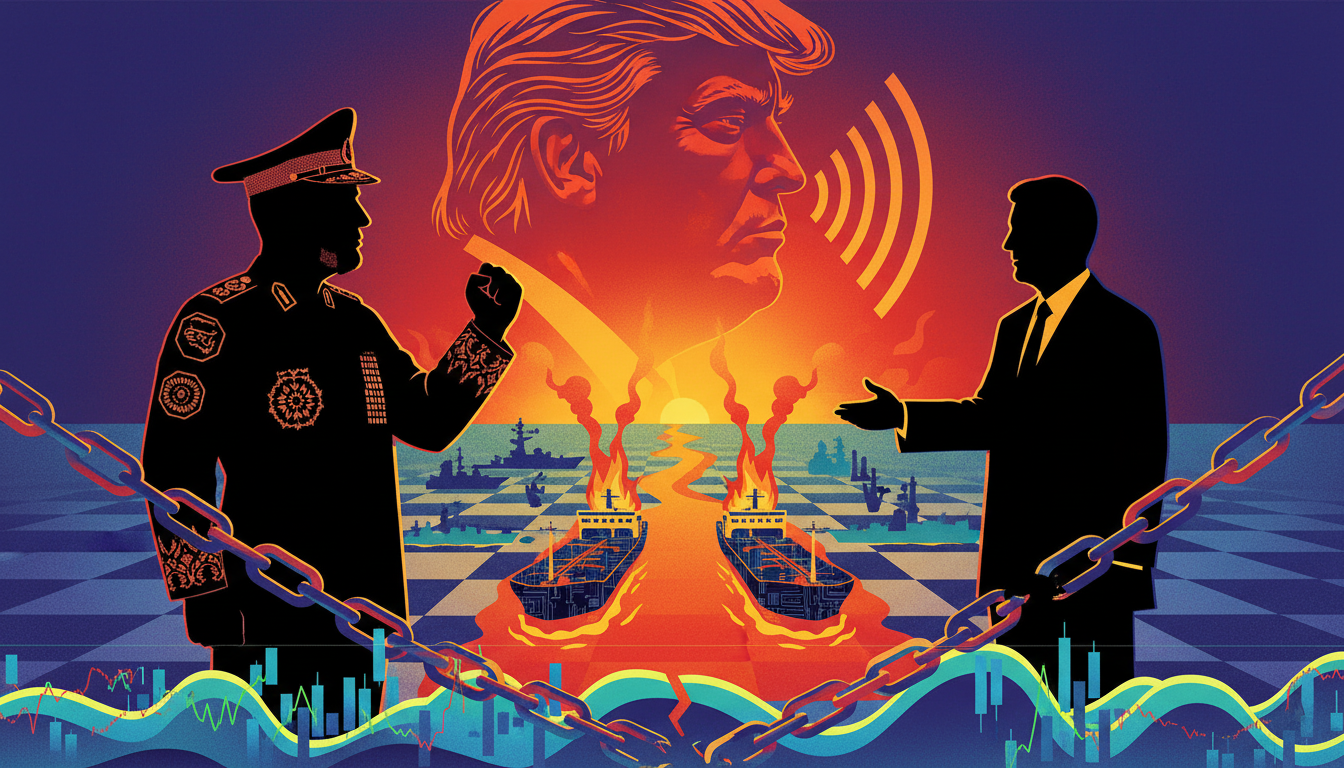
On April 1, 2026, Trump announced the withdrawal from Iran within 2-3 weeks, a statement that quickly rose from political news to the forefront of global asset pricing. On the same trading day, energy, stock markets, precious metals, and crypto assets exhibited a rare “dislocated resonance”: WTI crude oil briefly fell below $98/barrel, with a daily drop of approximately 3.78%, while Brent crude also fell about 3.3%; European stock markets took the opportunity to rally, with major indices generally rising 2-3%, while gold and silver increased by about 2.6% and 3% respectively, as traditional safe-haven sentiment did not completely dissipate. In stark contrast, the “main character” of the crypto market, Bitcoin, remained sluggish, with a cumulative decline over two consecutive quarters reaching approximately 41.6%, marking the worst Q1 performance since 2018; meanwhile, the TVL of USDD on the Tron ecosystem surpassed $2 billion, hitting a historical high, as funds opted for “fixed income” on-chain rather than betting on price rebounds. The geopolitical tension is expected to phase out, which should promote a recovery in risk appetite, but the current violent correlation among oil, gold, stocks, and on-chain funds raises a sharper question: has the global market already made an excessive and directionally divergent response before the expectations of troop withdrawal have been realized?
Oil prices fall below $98: War premium fast-forwarded
After Trump’s statement on withdrawing from Iran, the first market to respond with intense price feedback was the crude oil market. WTI crude oil dropped directly below $98/barrel, with a daily decline of approximately 3.78%; Brent crude also fell about 3.3%, as the “war premium” that had accumulated over previous weeks due to geopolitical tension seemed to be abruptly fast-forwarded within a single trading day. The steep decline in prices was not only a result of repricing future supply risks but also a concentrated liquidation of the bullish sentiment that had built up during the previous climbs.
The logic behind this sharp decline is relatively straightforward: the withdrawal signal diminished the market’s fears of disruptions in Middle Eastern supply, leading to a rapid compression of the geopolitical risk premium embedded in oil prices. Traders are no longer willing to pay such high insurance premiums for the “worst-case scenario,” and the retreat in risk premium manifests in the price decline. In the high-frequency fund-dominated crude oil futures market, once the narrative of “escalation of conflict” is shaken, algorithms and quantitative positions tend to move collectively toward the same exit.
In this suddenly changing environment, the fragility of individual leveraged positions was thoroughly exposed. Reports indicate that a newly created wallet holds a long position on the CL contract with a nominal size of up to $25.67 million, which is currently floating a loss of about $2.3 million. This typical “war trade” initially bet on the escalation of conflict to push up oil prices but encountered severe reverse volatility following the announcement of troop withdrawal. If oil prices continue to stay in the current range or even dip further, the proximity of this high-leverage position to forced liquidation or margin call is reduced only to a few gaps in risk control parameters.
What makes this situation even more uncertain is that Trump’s timeline is merely a political forecast, not a guarantee of immediate de-escalation of the geopolitical situation. If the situation reverses in the next 2-3 weeks or the troop withdrawal commitments are not fulfilled as expected, oil prices may quickly readjust geopolitical premiums again. For the aforementioned long positions in CL, this does not imply a unilateral disaster, but rather a “rollercoaster-style” risk of double liquidation: first enduring a heavy blow during expectations of de-escalation, and then being forced to chase higher prices to add positions or struggling to scale up during rebounds. The crude oil market reminds investors with a floating loss bill of millions of dollars: at geopolitical junctures, amplifying narratives with leverage often enhances one’s own vulnerability.
European stocks soar and precious metals warm up: Risk recovery and tail hedging intertwine
In contrast to the rapid decline in crude oil, European stock markets responded with an optimistic picture of “risk recovery” on the same trading day. Major stock indices generally rose 2-3%, with funds re-entering previously suppressed sectors due to geopolitical tension, as if the market was casting a vote of confidence on the “de-escalation of conflict” at first glance. This broad-based rally reflects, on one hand, investor optimism regarding the retreat in energy prices and easing cost pressures on businesses, and on the other hand, indicates a rush among previously accumulated cash positions to seek reallocation exits.
However, it was not only risk assets that flew alongside the stock market. Gold rose approximately 2.6% that day, and silver's increase approached 3%, indicating that precious metals, as traditional safe-haven assets, saw a synchronous uplift in price and sentiment, suggesting that funds did not merely view the troop withdrawal as a “risk endpoint.” On the contrary, while risk assets were being replenished, some funds continued to increase hedging instruments, reserving insurance for tail risks that had not yet been completely eliminated. Especially in the context where oil prices were highly correlated with geopolitical tensions, the continued strength of precious metals seemed more like a “defense against a downturn” asset allocation strategy.
Thomas Mathews of Capital Economics pointed out that even if the war quickly ends, its impacts will still persist in many cases. This viewpoint reveals a divergence in expectations: one group of investors bets that the marginal easing of short-term conflict will be sufficient to boost corporate earnings and risk appetite, while another is concerned about the long-term residue of geopolitical fractures in energy costs, supply chain security premiums, and risk premium structures. The coexistence of stock market optimism and the warming of precious metals is itself a price manifestation of this divergence.
In this oscillating state, the market displays a subtle structure: one hand is long European stocks, credit, and growth, while the other holds hedging assets like gold and silver. The hedge ratios may be rapidly adjusted with news flow, but there has yet to be a sign of “completely shedding armor” bullishness. This also means that as long as any uncertain signals emerge regarding the troop withdrawal timeline or execution details, the recovery in risk appetite could be instantly reversed, and the hedging function of precious metals would be amplified again.
Bitcoin declines for two consecutive quarters: The failure of the hedging narrative under macro pressure
Amid the dual noise of macro and geopolitical factors, Bitcoin’s performance seems particularly awkward. According to briefing data, Bitcoin has fallen for two consecutive quarters, with a cumulative decline of about 41.6%, marking the worst quarterly performance since 2018. This timing coincides with a macro environment where global interest rates remain high and risk assets are under overall pressure, making the hedging narrative of “digital gold” appear increasingly thin against real capital.
In a high-interest-rate cycle, capital generally discounts “no cash flow, high volatility” risk assets, including tech stocks and growth stocks, with Bitcoin being a typical representative. When genuine hedging demand is ignited by geopolitical risks, physical gold and precious metal derivatives often serve as the first anchor for immediate reactions, rather than crypto assets that exhibit price volatility exceeding several times that of stock indices. At this time, Bitcoin finds it more difficult to play the role of “instant hedging,” instead resembling a high Beta asset squeezed simultaneously by macro liquidity contraction and regulatory prudence.
Interestingly, the funding choices within the crypto trading ecosystem are indirectly corroborating this role misalignment. Briefings mention that on platforms like Gate, the trading volume of precious metal derivatives has significantly increased, indicating that a portion of participants already active in crypto platforms have not exited the system but have opted to hedge geopolitical and macro uncertainties through products like gold and silver contracts offered by the platforms. The logic behind this behavior is to remain within the infrastructure and account systems of the crypto market while choosing targets more closely aligned with traditional safe-haven attributes.
The expectation of geopolitical easing should theoretically provide some support for Bitcoin's sentiment, yet the actual prices have not shown synchronous recovery. The significant drawdown in Bitcoin continues, suggesting that the short-term “digital gold” narrative has limited traction over actual capital behavior. The image of Bitcoin as a macro hedging tool is increasingly misaligned with its actual performance under high interest rates, stringent regulations, and unstable liquidity environments, pushing some capital toward on-chain yield products that offer more visible returns and more manageable volatility.
USDD and Tron ecosystem active against the trend: Avoiding volatility but not crypto
In contrast to the continued weakening of Bitcoin, the funding data in the Tron ecosystem has shown an upward curve amid the intertwining of geopolitical noise and macro uncertainty. Reports show that the TVL of USDD has surpassed $2 billion, marking a historic high. This indicates that in an environment where Bitcoin has fallen for two consecutive quarters and overall sentiment is tepid, there remains a considerable amount of capital choosing to lock exposure in specific chain contracts and funding pools, rather than simply waiting on the sidelines.
Accompanying this data is a synchronous warming of partial asset prices and products within the Tron ecosystem. The price of JST has surpassed $0.061, and on-chain asset $U has landed on SunSwap V4, providing more tools and pathways for funds to flow and allocate within the Tron network. Whether through the launch of new trading pairs or the continuous rise in protocol TVL, these essentially point to the same phenomenon: amid weak prices of major cryptocurrencies, the ecosystem continues to attract and lock in funds willing to bear smart contract risks in exchange for relatively stable yields through product innovations and liquidity incentives.
From the perspective of funding motivation, some participants, amid macro uncertainties and severe price retreats, are more inclined to pursue high-yield or stable yield DeFi assets rather than continue to bet on directional price fluctuations. Behind the high TVL of products like USDD lies a structural shift of “avoiding volatility but not avoiding crypto”: investors have not completely exited the crypto world but have shifted from high-volatility spot and derivatives trading to on-chain “bond-like” positions and liquidity mining with more predictable returns.
The historical high of USDD TVL coexists with the continuous weakening of Bitcoin, actually reflecting a divergence between two narratives within crypto. One narrative is the price speculation mainstream, which has evidently cooled under high interest rates and regulatory pressures; the other narrative revolves around infrastructure designed around yield, liquidity, and on-chain collaboration, which has been strengthened due to the increased demand for “certain returns.” Geopolitical risks and macro fluctuations have not prevented funds from entering crypto but have reshaped their risk appetite curves within this system.
Crude oil longs on the brink of liquidation: Misalignment of new wallets and leveraged narratives
The aggressive layout of a newly created wallet in crude oil contracts is a microcosm of this geopolitical expectation repricing. Reports reveal that this wallet holds a nominal long position on the CL contract of up to $25.67 million, and after Trump signaled troop withdrawal and oil prices dipped by approximately 3.78% in a single day, the floating loss has reached $2.3 million. This is not a traditional “veteran oil trader” hedging, but rather a typical directional concentrated bet: gambling that escalation of conflict will push oil prices higher.
The trading path is roughly clear: during the previous phase of rising geopolitical tension, the market largely viewed disruption of Middle Eastern supply as one of the strongest catalysts for rising oil prices. This wallet chose to go long with high leverage during the most imagistic narrative peak, binding their single result to the “continuation of war escalation.” Trump’s withdrawal declaration broke this narrative loop, leading to a repricing of oil prices downward, while the high-leverage longs found themselves directly on the brink of liquidation. In this context, risk management did not align with the geopolitical game; the position design clearly overestimated the durability of the narrative and underestimated the severe reversal brought by political statements.
The greater risk is that the situation itself may not evolve along a “linear cooling” path. If there are fluctuations in the coming weeks—whether it be about modifications to the execution of statements or regional tensions reignited by other events—oil prices may experience a sharp upward correction. What appears to be a positive rebound for longs could actually induce a secondary liquidation: funds forced to reduce positions or add margin during the initial drop will find it difficult to keep pace with the rebound, resulting in being passively rounded out at the bottom and losing chips at the peak.
The fate of this wallet can be seen as a reflection of the games played by retail investors versus certain institutions at geopolitical nodes. On one end are speculators eager to amplify a single narrative using futures and leverage, while on the other are hedge funds and commodity traders engaging in risk hedging and position balancing over longer cycles. Differences in information asymmetry, capital scales, and risk tolerance set the former at a greater risk of being thrown out of the game during the violent swings of policy and military news. Trump’s statement of “withdrawal from Iran within 2-3 weeks” highlights not just the retreat of the oil price curve but also the inherent flaws of leveraged narratives in asymmetrical games.
From troop withdrawal statements to on-chain funds: How far has this round of connectivity gone?
Looking back at the price chain from this instance, Trump’s announcement on troop withdrawal quickly connected multiple asset clues: oil prices' decline squeezed out geopolitical premium, European stocks rallied amid expectations of cooling energy costs, gold and silver continued to rise, responding to tail risk hedging demand, and within the crypto world, there was a structural shift from directional speculation to competition for yield and liquidity. USDD TVL surpassed $2 billion, and assets like JST and $U actively performed within the Tron ecosystem, all illustrating the same picture through on-chain data—risk appetite has cooled, but the pursuit of “on-chain yield” has not ceased.
However, as Mathews emphasized, even if the war quickly de-escalates in form, its impact on economic structures and risk premiums will persist long-term. The uncertainty of energy costs, the restructuring of supply chains, and the anchoring of safe-haven asset pricing will continue to be shaped by this event over the next several quarters. In this context, the current market pricing of “peace dividends” as a sprint—whether it is forward-looking or overly anticipatory—will still need time to verify.
For the crypto market, this round of connectivity reveals not only the short-term failure of Bitcoin's hedging narrative but also the deep adjustment within its structure: shifting from chasing unilateral price increases to competing in yield, liquidity, and risk control designs across different public chains and protocols. The import of TVL data like that of USDD lies in its potential as a forward signal of the next stage of industry narrative migration—capital is no longer merely paying for stories but is focusing more on realizable cash flow and protocol security.
In the future 2-3 weeks, whether Trump’s troop withdrawal commitments can progress according to schedule will become a key window to test if this round of market pricing has gone too far. If the withdrawal proceeds smoothly, the drop in oil prices and optimism in the stock market may receive some confirmation, and the structural allocation of precious metals and on-chain hedging funds will rebalance accordingly; if the execution pace falls short of expectations, or the situation even heats up again, the current asset prices based on the premise of “rapid cooling” will have to reevaluate their premiums. Regardless of which path is taken, the intertwined trajectories left by oil, gold, stocks, and on-chain funds at this moment signal participants that in an era where geopolitics and macroeconomics intertwine, what truly needs to be priced may not solely be the events themselves but also the market’s memory and speed of forgetting uncertainty.
Join our community to discuss and become stronger together!
Official Telegram community: https://t.me/aicoincn
AiCoin Chinese Twitter: https://x.com/AiCoinzh
OKX Benefits Group: https://aicoin.com/link/chat?cid=l61eM4owQ
Binance Benefits Group: https://aicoin.com/link/chat?cid=ynr7d1P6Z
免责声明:本文章仅代表作者个人观点,不代表本平台的立场和观点。本文章仅供信息分享,不构成对任何人的任何投资建议。用户与作者之间的任何争议,与本平台无关。如网页中刊载的文章或图片涉及侵权,请提供相关的权利证明和身份证明发送邮件到support@aicoin.com,本平台相关工作人员将会进行核查。