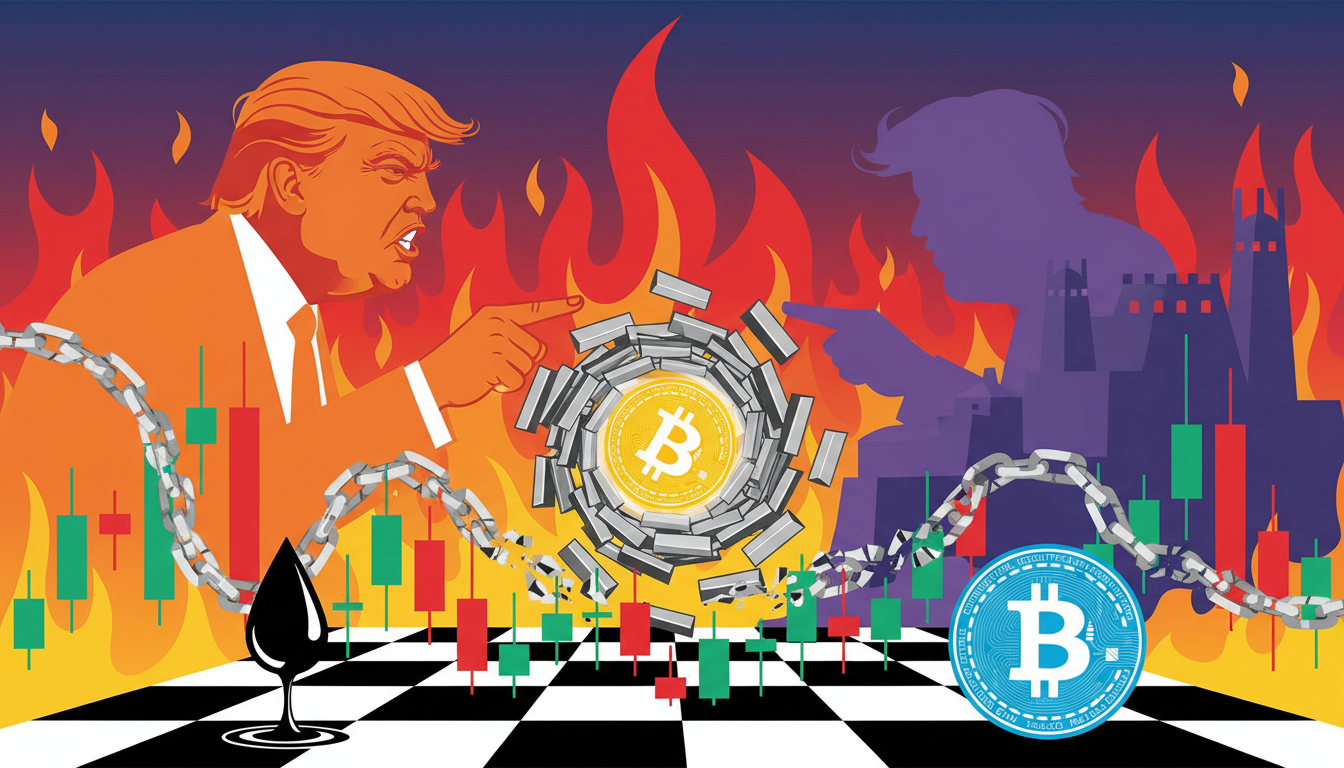
On March 31, 2026, Eastern Eight Time, the US military and Israel launched a joint operation, attacking Iranian targets and confirming the death of a senior Iranian military officer during the operation. Subsequently, US officials released a series of strong statements indicating that the war could escalate, rapidly intensifying the situation. After the news broke, the crude oil futures market's sentiment shifted immediately, with oil prices being substantially driven up during trading, and the risk-off versus sell-off game between stocks and bonds unfolding simultaneously. Cryptocurrency assets experienced high volatility, swaying between high beta risk assets and potential safe-haven tools. The truly concerning question is not just about a single spike in oil prices or a short-term surge in cryptocurrencies, but rather: how global funds will reshape new paths and priorities for safe-haven assets among US Treasuries, crude oil, and cryptocurrencies in the ongoing repricing of this round of geopolitical conflicts.
Death of Iranian Official: A Catalyst and Mixed Signals
The joint US-Israeli attack on March 31, 2026, has reignited US-Iran confrontations with a “targeted elimination” operation: focusing on high-ranking Iranian military personnel, confirming the death of a senior Iranian officer. At the same time, US defense and diplomatic officials publicly stressed the intention to “contain the Iranian threat,” with military escalation and diplomatic threats released in tandem, sharply raising concerns about whether the conflict might spill over from proxy battlefields to more direct confrontations.
This deceased officer—often identified in public reports as Ehaki—has multiple representations of identity and position across different channels: some versions emphasize his significant decision-making role within the military system, while others highlight his influence in the field of resources and logistics. The confusion over job descriptions is not simply an information error, but more akin to an information war surrounding “how important he truly is”: one side amplifies his status to emphasize the “decapitation” nature of the operation, while the other may attempt to downplay the loss to maintain stable expectations internally and among allies.
US Secretary of Defense Hegseth publicly stated after the attack, “The next few days will be a decisive moment in the war with Iran.” Such phrasing of a “decisive moment” is often interpreted in market contexts as suggesting the conflict may cross a threshold, either heading towards negotiations or further military escalation, potentially impacting regime stability expectations. The outside world swiftly began discussing possible paths to war escalation or even regime change; however, current public information does not provide sufficient evidence to support judgments of fundamental changes in Iran's power structure, and these interpretations remain more on the emotional amplification and public opinion projection level.
It is important to clarify that regarding Ehaki's specific position in the Iranian military, whether he also held certain financial or budgetary roles, and whether “regime change” is genuinely advancing along established paths are all part of the unverified or currently unsupported public evidence. Similarly, details such as the number of losses suffered by the Iranian Navy in this round of conflict and the operational division of labor between the US and Israel lack authoritative confirmation and exceed what is needed for short-term market pricing. This article will focus only on the key information that has been repeatedly mentioned by multiple reputable sources and can be confirmed, without extending into the unverified details of power structure to avoid losing the true anchor points of price and risk in emotional narratives.
Crude Oil Bullish Bets: $10.79 Million High-Leverage Wager
Following the US-Israeli attacks and the “decisive moment” statements, the oil market became the most immediate emotional outlet. In the crude oil futures market, short-term funds quickly flowed into the bullish side, with high-leverage bulls concentrating their positions, and prices experienced significant upward swings and intense back-and-forth within several trading sessions after the news. Rather than a stable layout, this scene resembles a high-stakes bet centered around “supply disruption expectations”: any signs of further escalation of hostilities could be amplified as justification for obstructed shipping and tightened supply.
A detail disclosed in a research brief reflects the radical degree of this emotional reaction: some traders established a nominal value of approximately $10.79 million in crude oil long positions via leveraged contracts. The scale of such positions combined with leverage ratios indicates that some funds have already adopted “oil price surges” as a tool to hedge against greater systemic uncertainties, rather than just betting on a few dollars' fluctuations. The market's pricing of “supply disruption” is concretely reflected in the stacking of bullish leverage.
Driving this premium is not just Iran's output but also its geopolitical position and mining capabilities in the Strait of Hormuz and surrounding waters. Briefing information shows that the US military intentionally targeted Iran's naval mining capabilities during the operation, which itself sends a clear signal to the market: if Iran chooses to deploy mines in key maritime passages, global crude and refined oil transportation will face actual disruption risks, causing shipping insurance, freight rates, and spot premiums to be forced upwards. Traders, therefore, view such military actions as core variables in the pricing of “maritime transport corridor safety.”
However, the other side of high-leverage speculation is the potential for liquidation and a run on the funds. If, in the next few days, both the US and Iran choose to de-escalate under pressure from regional allies or internal considerations, and military action remains at the level of limited retaliation and verbal threats, then crude oil supply and shipping will not face substantial obstruction, and the market will swiftly retract the “panic premium,” with $10.79 million long positions being the first to bear the brunt of correction pressure. Conversely, if the conflict escalates beyond expectations, with signs of tankers being attacked or key shipping lanes being blocked, the bullish side will experience a roller coaster in a short time: earlier participants may reap substantial profits, but latecomers chasing higher prices will face both liquidity withdrawal and slippage risks, potentially turning the oil market leverage chain into the starting point for the next round of risk diffusion.
Buffett Buys US Treasuries: A $17 Billion Safe Anchor
In contrast to the short-term bullish bets in the oil market is the quiet reallocation of traditional long-term funds. Briefings reveal that Berkshire Hathaway, amid heightened geopolitical tensions and macro uncertainties, increased its holdings of US Treasuries by approximately $17 billion. This scale, relative to Berkshire's asset size, is not an aggressive betting operation but enough to emit a clear signal: in an environment where expectations of war and recession intertwine, US Treasuries remain a “safe anchor” that large institutions are willing to increase exposure to.
Along with this increase, it is essential to consider Buffett's prior warning—“Problems may spread from one part of the banking system to another”. This statement points to concerns regarding systemic financial risks' chain reactions: against a backdrop of high interest rates, escalating geopolitical conflicts, and some asset valuations being too high, if a specific financial sub-system comes under pressure, panic may quickly transmit across different institutions and asset classes. For players like Berkshire, preemptively migrating part of their positions to the most liquid and credit-backed US Treasuries serves to create a buffer zone for potential “chain reactions.”
In an environment of war expectations and recession concerns, the logic behind long-term funds' attraction to US Treasuries primarily stems from several aspects: first, the dollar and US Treasuries remain the core of the current global financial system's settlements and collateral and are unlikely to be replaced in the short term; second, as equity and high-yield bond valuations come under pressure, US Treasuries typically have limited downside potential, and even if yields decrease, price increases can provide hedging benefits during risk events; third, for insurance, reinsurance, and large permanent capital, the regulatory-friendly attributes and liquidity depth of US Treasuries make them more like “cash equivalents that can be readily liquidated” during times of stress.
If the US-Iran conflict stretches into a long-term low-intensity consumption pattern, new balances may emerge between US Treasury yields, dollar trends, and the pricing of risk assets: on one hand, mid-to-long-term yields may decline due to safe-haven demand and recession expectations, raising US Treasury valuations; on the other hand, a too-strong dollar could squeeze the performance space of commodities and emerging market assets. For cryptocurrency assets, this environment may suppress liquidity and speculative risk preferences while also bringing structural increments when some funds seek “hedging channels outside the dollar system,” making this tension one of the main threads for the upcoming quarters.
Cryptocurrency Safe-Haven Narrative: From USDT and MiCA to New Asset Triangle
While traditional markets are seeking safe anchors, the cryptocurrency world’s safe-haven narrative is also quietly adjusting. The brief mentions that Tether has fired a gold trader, which on the surface seems like a personnel adjustment, but at this moment of geopolitical tension and asset reassessment, is interpreted by many market participants as a strategic signal: does this mean a shift from traditional precious metal safe havens to using US dollar-denominated cryptocurrency assets as core configurations? While there are currently no public details about Tether's internal asset segmentation and the scale of its gold business, the trend showing funds preferring “programmable, cross-border, and high liquidity” US dollar-denominated tokens over physical gold or its derivatives has been evident across multiple risk events.
Another clue related to the cryptocurrency safe-haven narrative comes from Europe. The brief points out that Tesseract has obtained a license under the MiCA framework, indicating that during periods of geopolitical tension, the EU prefers to filter survivors by constructing a “compliance moat”: only service providers meeting capital, compliance, and risk control requirements can operate within the regulatory framework. This approach contrasts with regions like the Middle East, which emphasize capital controls or direct blocking paths, and also signifies that, during future global capital rebalancing, compliant platforms and assets are more likely to take on cross-border safe-haven and asset transfer demands.
Compared to traditional safe-haven assets like US Treasuries, gold, and crude oil, mainstream cryptocurrency assets like Bitcoin and Ethereum must meet several conditions to truly gain the “digital safe-haven” label during this round of conflict: firstly, they must demonstrate a relatively independent performance from stock markets during high uncertainty events, rather than simply following risk asset declines; secondly, they must possess enough on-chain and off-chain liquidity to support large capital inflows and outflows within a short timeframe; thirdly, their underlying infrastructure and compliance channels must operate even amidst increased sanctions and capital flow restrictions. Currently, cryptocurrency assets still find themselves in the blurry middle ground between “high-volatility risk assets” and “potential safe-haven tools,” with the market yet to reach a unified pricing consensus.
Interpretations surrounding Tether's moves and the implementation of MiCA also exhibit significant disparities: some participants view this as a long-term tailwind for “crypto dollarization” and “compliant crypto finance,” believing it lays the groundwork for digital assets to become global safe-haven and settlement tools; others argue that these changes more immediately affect funding channels and compliance costs, exerting limited influence on prices. The key lies in distinguishing short-term emotional trading from long-term structural rebuilding: the former rapidly amplifies volatility after sudden news, while the latter only slowly solidifies into new asset and regulatory frameworks after multiple shocks and policy iterations.
Funding Reshaping Paths Between Warfire and Regulation
When placing the US-Iran conflict, concentrated crude oil bullish positions, Berkshire's increased US Treasuries holdings, and advancing cryptocurrency regulation into the same frame, a dynamic scene of multi-asset “risk repricing” emerges: warfare drives energy risk premiums up, with crude oil being the most direct volatility carrier; line-sensitive long-term institutions reinforce their defenses through increased US Treasuries holdings; meanwhile, the cryptocurrency industry is thrust into the “digital safe haven” narrative spotlight by geopolitical conflicts while simultaneously being pulled back by regulatory frameworks like MiCA into the trajectory of “institutional finance,” intertwining these two forces and forcing funds to constantly reassess between yield, liquidity, and compliance.
In this process, the correlation and funding rotation rhythm among the triangle of “dollar assets—commodities—cryptocurrency assets” are being rewritten. US Treasuries and the dollar remain the starting and ending points for global safe havens, while crude oil and commodities assume the immediate pricing functions for “inflation expectations” and “supply shocks,” with cryptocurrency assets reflecting amplifications, hedges, or decoupling from both ends at different intervals. During war escalation, funds might first flow into US Treasuries and the dollar, then some hedging demand may shift towards crude oil and gold, followed by a portion attempting to cross-border transfer and hedge sanctions through cryptocurrency assets; as tensions ease or liquidity tightens, funds may withdraw from high-volatility assets and commodities back into the dollar and short-term bonds, with the weights within the triangle shifting continually based on the context.
Traditional institutional investors and native cryptocurrency funds play fundamentally different roles and points of contention within this safe-haven narrative. The former, constrained by regulations, debt structures, and risk assessment frameworks, tend to seek “reportable safety assets” in US Treasuries, investment-grade bonds, and some commodities; the latter are more familiar with on-chain liquidity, leverage tools, and cross-chain channels, willing to switch positions quickly between Bitcoin, Ethereum, and various US dollar-denominated tokens to exchange high turnover and high leverage for potential excess returns. The differing pricing rhythms and volatility tolerances of these two types of funds in the same event also lead the market to exhibit a complex pattern of “sharp fluctuations + slow rebalancing” in the short term.
For all participants, the real risk lies in those variables that could suddenly interrupt existing funding paths: for instance, unexpected political shifts on the battlefield could trigger escalations in sanctions and capital controls; or, regulators could introduce major new rules affecting exchanges and US dollar-denominated tokens over a short period, altering funding ingress and egress; or global liquidity could abruptly tighten due to other financial events, causing even if there is safe-haven demand, there would be insufficient “firepower” for deploying configurations across multiple assets. These sudden variables often prove more lethal than price fluctuations themselves.
The War Script Is Not Finished: The Cryptocurrency Market Is Still in Examination
Considering the current visible information, the impact of the US-Iran conflict on crude oil, US Treasuries, and cryptocurrency assets remains in the expectation game phase: crude oil rapidly amplifies “supply disruption” sentiment through high-leverage bullish positions, US Treasuries enhance their image as “final safe-haven assets” under increasing holdings from institutions like Berkshire, while the cryptocurrency market, through fund movements and narrative oscillations, has yet to fully lock in its role. What truly determines the medium-to-long-term path is not the price fluctuations of one or two days, but rather whether the conflict becomes prolonged, whether sanctions escalate, and whether global liquidity continues to tighten.
For cryptocurrency assets to genuinely fulfill safe-haven functions, they must simultaneously navigate both geopolitical conflicts and regulatory cycles: on one hand, they must gradually evolve from “high beta speculative targets” into assets that “can provide independent hedges in specific scenarios” amidst multiple rounds of geopolitical risks and macro shocks; on the other hand, under the shaping of frameworks like MiCA, they must find a balance between compliance and decentralization, liquidity, and risk management. If they cannot firmly establish a foothold on both fronts, “digital safe haven” status may ultimately remain at the narrative level.
In the coming weeks, the market needs to closely monitor several observation points: firstly, whether the US-Iran conflict and regional situation signal escalation, such as more direct military confrontation or disruptions in key shipping lanes; secondly, the on-chain fund flows of exchanges and US dollar-denominated tokens to determine whether there is sustained net inflow or outflow, thereby reflecting what role cryptocurrency assets have played in this round of conflict; thirdly, the pace of further implementation of cryptocurrency regulations in Europe and America, especially regarding cross-border fund flows and compliance licensing enforcement, which will determine whether and how compliant funds can enter this market.
In an uncertain battlefield, emotional amplification and leverage stacking are often the real sources of risk control failures. Whether chasing panic premiums in the oil market or betting on “digital safe havens” in the cryptocurrency market, controlling exposure and position durations is more critical than attempting to capture every news-driven trend. When the war script remains unfinished, any extreme bets in a single direction risk handing fate over to unpredictable next headlines.
Join our community to discuss and become stronger together!
Official Telegram community: https://t.me/aicoincn
AiCoin Chinese Twitter: https://x.com/AiCoinzh
OKX Benefits Group: https://aicoin.com/link/chat?cid=l61eM4owQ
Binance Benefits Group: https://aicoin.com/link/chat?cid=ynr7d1P6Z
免责声明:本文章仅代表作者个人观点,不代表本平台的立场和观点。本文章仅供信息分享,不构成对任何人的任何投资建议。用户与作者之间的任何争议,与本平台无关。如网页中刊载的文章或图片涉及侵权,请提供相关的权利证明和身份证明发送邮件到support@aicoin.com,本平台相关工作人员将会进行核查。