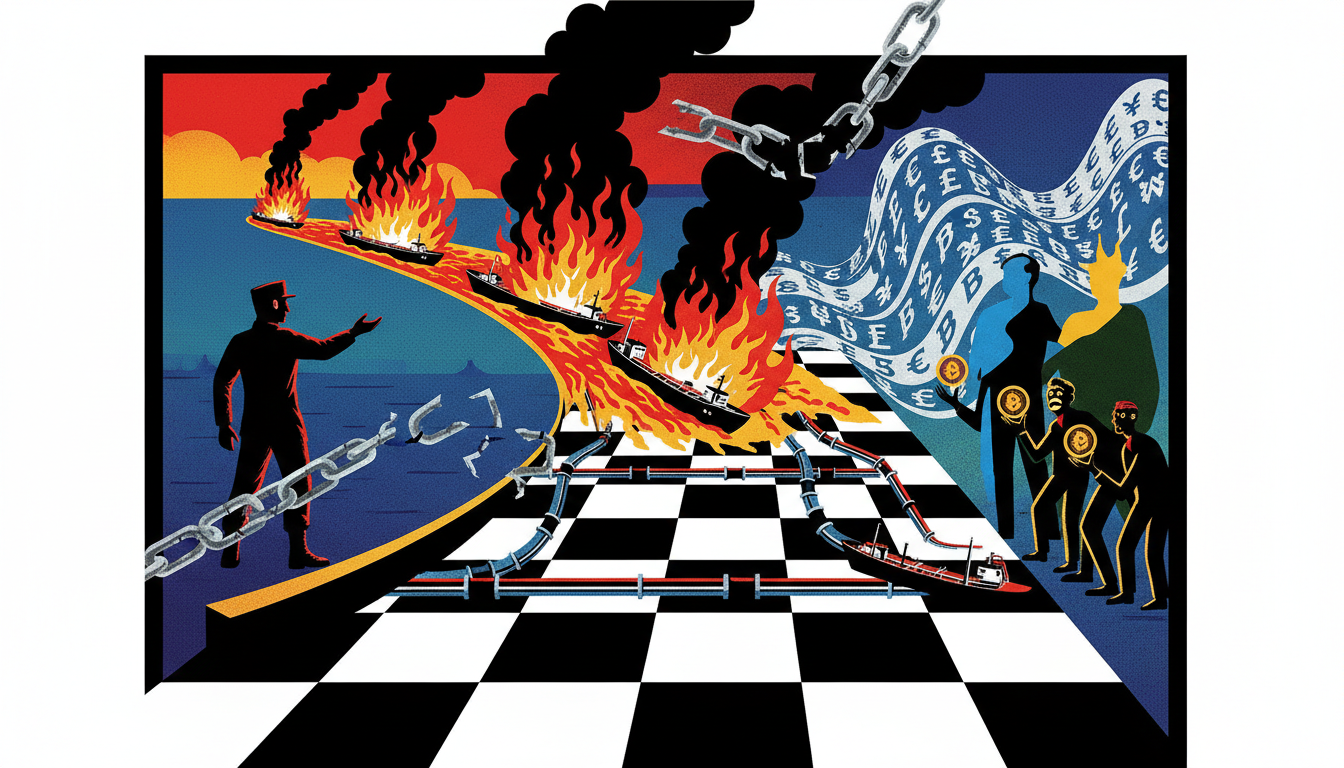
This week, the narrative focus of the Middle East situation has once again returned to the Strait of Hormuz: According to authoritative media reports, the UAE is pushing for the establishment of an international working group and is coordinating naval actions, aiming to reopen and ensure the safety of the Hormuz shipping lanes. This action occurs against the backdrop of threats to the safety of navigation in the strait and disruptions to shipping, leading to a rapid escalation of regional tensions. The Strait of Hormuz is regarded as the "throat" of global energy, with research briefs citing data that it handles approximately 30% of global oil shipping volume (data pending further verification), and is also an important natural gas export route. When this energy artery faces blockages, it not only indicates an increase in insurance costs and risk expectations for tankers and gas carriers but also means that a whole chain from oil prices, inflation, to the pricing of financial assets must be recalculated. This article will revolve around a main question: When energy routes turn into geopolitical powder kegs, how will their impact ripple into global risk assets, ultimately reflecting in the volatility of the cryptocurrency market and the reconstruction of narratives?
The UAE's Initiative: Multilateral Fleet Rushes to the Route
Current public information indicates that one of the leaders of this round of actions is the UAE. According to authoritative financial media in the UK, the UAE is advocating for the formation of a international working group to coordinate various parties through multilateral mechanisms, focusing on shipping channel security, intelligence sharing, and risk control. At the same time, the UAE is also cooperating in deploying naval forces to provide "underlying security guarantees" for the reopening and stabilization of navigation in the Strait of Hormuz. The motivation behind the UAE's actions is not difficult to understand: on the one hand, it is a key energy-exporting country, and continued tension in the strait directly harms its exports and finances; on the other hand, relying solely on individual major powers for escort would leave regional countries more passive in terms of discourse and security issues, and a multilateral working group would help enhance the UAE's standing in the regional security structure.
From a situational perspective, the current tension in the Strait of Hormuz is not an isolated incident but the result of overlapping factors within the broader context of Middle Eastern geopolitical games. The strait is narrow and the shipping lanes are concentrated. Once there are disturbances or "grey zone" actions targeting tankers and merchant ships, shipping companies and insurance institutions often respond with amplified risk-adjusted pricing—either rerouting with higher insurance premiums or delaying route adjustments, leading to significant declines in passage efficiency. In this environment, the maritime and aerial deployments, confrontations, and probes from various forces within the region have been escalating the strait's "uncertainty premium," adding heavier geopolitical risk labels to every vessel entering and exiting.
It is important to clarify that current public information is severely lacking regarding the member countries of this international working group, the scale of participation, the specific number of naval formations, weapon configurations, and tactical details such as the operational timetable. Likewise, there has been no authoritative and complete disclosure about whether there is formal UN authorization or specific discussions within the Security Council. Due to considerations of factual boundaries and risk control, this article does not attempt to list or speculate on the number of participating countries, nor will it elaborate on combat details and authorization mechanisms, staying within the framework of verifiable information.
The Imagination of 30% Global Oil Blocked
On the energy logistics map, the importance of the Strait of Hormuz is nearly irreplaceable. Research briefs cite data indicating that about 30% of global oil shipping volume must pass through this narrow waterway, and this ratio still needs to be verified against the latest statistics; moreover, many countries in the Middle East also heavily rely on this route for liquefied natural gas exports. Once this gateway is disrupted, the market will not only worry about "whether it can be exported," but also consider "how costs and rhythms will be repriced"—this implies broad re-evaluations across oil price futures curves, shipping indices, and downstream industrial and residential energy costs.
Historical experience provides a reference sample. In 2021, after UAE merchant ships were attacked in regional waters, international oil prices saw violent fluctuations in a short time. Although the event itself did not cause long-term supply interruptions, expectations about the "vulnerability of the transport chain" suddenly surged, with capital quickly responding through oil prices and options markets. The price trends at that time indicated that even sporadic events, if directed at key shipping lanes, could become catalysts for bullish and hedge funds to amplify narratives.
From this, one can deduce the chain reactions under two scenarios of "blockage" and "reopening" in the Strait of Hormuz: if strait risks continue to amplify and shipowners and insurance companies become collectively conservative, in the short term, oil prices are more likely to be pushed higher, with shipping costs rising in tandem, which in turn raises concerns for downstream countries about a renewed uptick in inflation. High inflation expectations usually trigger pricing for a tightening of monetary policy, thereby suppressing global liquidity and risk asset valuations. Conversely, if under UAE-led multilateral mechanisms and regional diplomatic mediation, the risks of navigation in the strait are pushed back into the "controllable range," and energy supply expectations stabilize, the market may reprice the risk premium for oil and freight, releasing part of the previously "overdrawn" panic in the opposite direction.
Chain Reactions in Risk Assets: Killing Estimates First
From the historical trajectory of asset prices, there is often a clear transmission chain between Middle Eastern geopolitical conflicts and the performance of global risk assets: Strait risks like those in Hormuz → Oil price shocks → Inflation and expected interest rate adjustments → Fluctuations in the dollar and U.S. Treasury yields → Stock market valuations and the repricing of risk premiums for crypto and other risk assets. When oil prices surge significantly within a short time, concerns about inflation rise, and the market begins to bet on the duration or intensity of tightening monetary policy by major central banks, which directly impacts global liquidity costs and the discount rates for risk assets. The stock and crypto markets often lead the way in "killing valuations" to adjust to the new risk environment.
Current market interpretations of the UAE's actions to ease risks in Hormuz show significant divergence. One view believes this is a typical short-term geopolitical shock: as long as there is no systemic interruption in the shipping lanes, the impact will primarily reflect transaction-level volatility rather than trend-based macro reassessment; another perspective emphasizes that any disruption in Hormuz will become a hallmark event for a "medium to long-term heightened risk premium"—even if there is no large-scale supply interruption in the short term, investors will incorporate concerns about Middle Eastern geopolitics into the tail of oil price and inflation distributions over the coming years, thereby driving up long-term risk premiums.
Amidst this divergence, the UAE-led multilateral working group and naval actions have become a key variable for market scenario shifts. If the actions are seen as substantial easing signals, risk appetite is expected to recover in stages: capital may flow back from high-safety assets (like certain sovereign debt) to stock and crypto markets, pushing for a narrative of a "soft landing + geopolitical control." Conversely, if the market interprets it as "preventive mobilization" before an escalation of the situation—believing that oil prices and inflation tail risks cannot significantly decrease until the conflict risk is definitively refuted—then the high-level consolidation of risk premiums could extend, with capital maintaining a cautious balance between defensive assets and economically sensitive assets.
Fear and Greed in the Crypto Sphere: Narratives Like Waves
In the cryptocurrency world, such geopolitical news is often quickly restructured into price narratives. Research briefs indicate that Chinese cryptocurrency media such as Rhythm and Jinse Finance have strongly linked Hormuz risks with cryptocurrency price fluctuations: some headlines directly juxtapose the Middle Eastern situation with cryptocurrency market cap fluctuations, while others package short-term market conditions with terms like "risk aversion" and "war premium." This approach is not surprising in terms of traffic logic—geopolitical events inherently possess emotional tension, and when combined with high-volatility assets, they are more likely to form compelling "stories" that spread.
However, within this narrative, there are actually two different logical threads. The first is the short-term emotional trading line: traders view news from Hormuz as "volatility fuel," amplifying price elasticity through perpetual contracts, options, and other tools, and taking advantage of market overreactions and lags to gain price differentials; in this thread, geopolitical events are often simplified to be just "reasons for green/red," essentially being liquidity games. The second is the medium to long-term macro capital flow line: longer-term funds focus on how variables like oil prices, dollar interest rate trajectories, and global risk premiums are reshaped by geopolitical events, subsequently determining allocation ratios for high-beta risk assets like cryptocurrencies. Along this line, a single news event by itself isn’t enough to change the framework, but it will be accumulated as part of "macroeconomic noise."
It is important to emphasize that geopolitical news in the cryptocurrency sphere can easily be amplified and utilized as tools for emotional marketing and market manipulation. Typical tactics include: using extreme language to exaggerate conflict risks in the early stages of news, inducing retail investors to chase and panic sell; after prices have already shown obvious fluctuations, retrospectively attributing everything to a certain "authoritative news source," creating a sense of "logical completeness"; even in the absence of conclusive data, using narratives like "insider information" and "big players pre-positioning" to amplify FOMO or FUD. On highly sensitive topics like Hormuz, investors should remain wary of combinations like "clickbait + geopolitics" and avoid treating unverified or magnified information as direct trading signals.
The UAE's Invisible Chip Between Oil and Currency
Compared to many Middle Eastern oil-producing countries, the UAE's identity within the global system is multi-layered: it is not only a significant energy exporter but also plays the role of a financial center in the region, and has been one of the early jurisdictions to show openness towards the cryptocurrency industry. In recent years, places like Dubai and Abu Dhabi have actively introduced cryptocurrency trading platforms, asset management institutions, and related service enterprises, attempting to add a "crypto-friendly" new label on the basis of "energy capital + financial center" to provide a new docking port for global capital.
Within this combination of identities, the UAE's push to ease tensions in Hormuz cannot be simply understood as a "single security action." On one hand, as an energy exporter, it indeed needs to stabilize its energy revenue and fiscal expectations by reducing channel risks; on the other hand, as a regional financial and crypto-friendly center, it is motivated to send signals to global investors that it is "predictable, safe, and open to emerging assets." In this sense, the UAE possesses an invisible dual chip between oil security and capital inflows: enhancing its bargaining power in the energy supply chain through security issues, while also attracting global capital to increase weights in equity, bonds, and cryptocurrency assets through an image of "stability + openness."
It is necessary to delineate the boundaries of information: whether the UAE joins existing U.S.-led naval escort operations remains to be verified information, and research briefs particularly note that related diplomatic coordination expressions are still incomplete. In the absence of official public statements, any claims regarding its "position" in specific military or diplomatic mechanisms should be regarded as speculation; this article does not make definitive judgments on these unverified details, treating them only as key variables for future observation.
The Storm in the Routes Is Not Over: Easing Oil Will Not Dispense with Currency Market Noise
In summary, the safety status of the Strait of Hormuz establishes a nested chain relationship with global energy prices, macro liquidity, and the risk appetite of the cryptocurrency market: Strait security → Oil and gas supply and shipping cost expectations → Inflation and interest rate paths → Dollar and global liquidity → Stock markets and high-beta risk asset valuations → Capital flows and narrative intensity in the cryptocurrency market. The UAE's push for a multilateral working group and naval actions aims to reduce uncertainty at the "top of this chain," thus creating a relatively mild environment for price setting and asset valuation downstream.
From a temporal perspective, in the short to medium term, geopolitical events like those in Hormuz are often driven by a rapid pathway of "news-emotion-leverage," influencing fluctuations in the cryptocurrency market: contract leverage on exchanges, on-chain sentiment indicators, and cryptocurrency media headlines may amplify price elasticity within days or even hours. However, in the medium to long term, the deeper driving forces of the cryptocurrency market remain macro liquidity, institutional capital participation, and the industry’s own technological and application advances. The influence of geopolitical events tends to shape the "macro background noise," occasionally having a marginal effect on the bullish-bearish rhythm of the cryptocurrency market by altering liquidity costs or risk premium levels, rather than being a singular decisive factor.
For investors, in high-sensitivity geopolitical events like those in Hormuz, what matters more is the "source management" of information and risk. On one hand, priority should be given to factual information released by authoritative media and official channels, as well as data validation from international energy and financial institutions; on the other hand, one should remain vigilant against amplified narratives on chain promotions, social media, and certain cryptocurrency content platforms, avoiding high-leverage trading decisions based on unverified or even deliberately processed information. In a market fueled by narratives, the ability to maintain basic respect for facts and probabilities amidst emotional waves is, in itself, a component of long-term survivability.
Join our community, let's discuss, and become stronger together!
Official Telegram community: https://t.me/aicoincn
AiCoin Chinese Twitter: https://x.com/AiCoinzh
OKX Benefits Group: https://aicoin.com/link/chat?cid=l61eM4owQ
Binance Benefits Group: https://aicoin.com/link/chat?cid=ynr7d1P6Z
免责声明:本文章仅代表作者个人观点,不代表本平台的立场和观点。本文章仅供信息分享,不构成对任何人的任何投资建议。用户与作者之间的任何争议,与本平台无关。如网页中刊载的文章或图片涉及侵权,请提供相关的权利证明和身份证明发送邮件到support@aicoin.com,本平台相关工作人员将会进行核查。