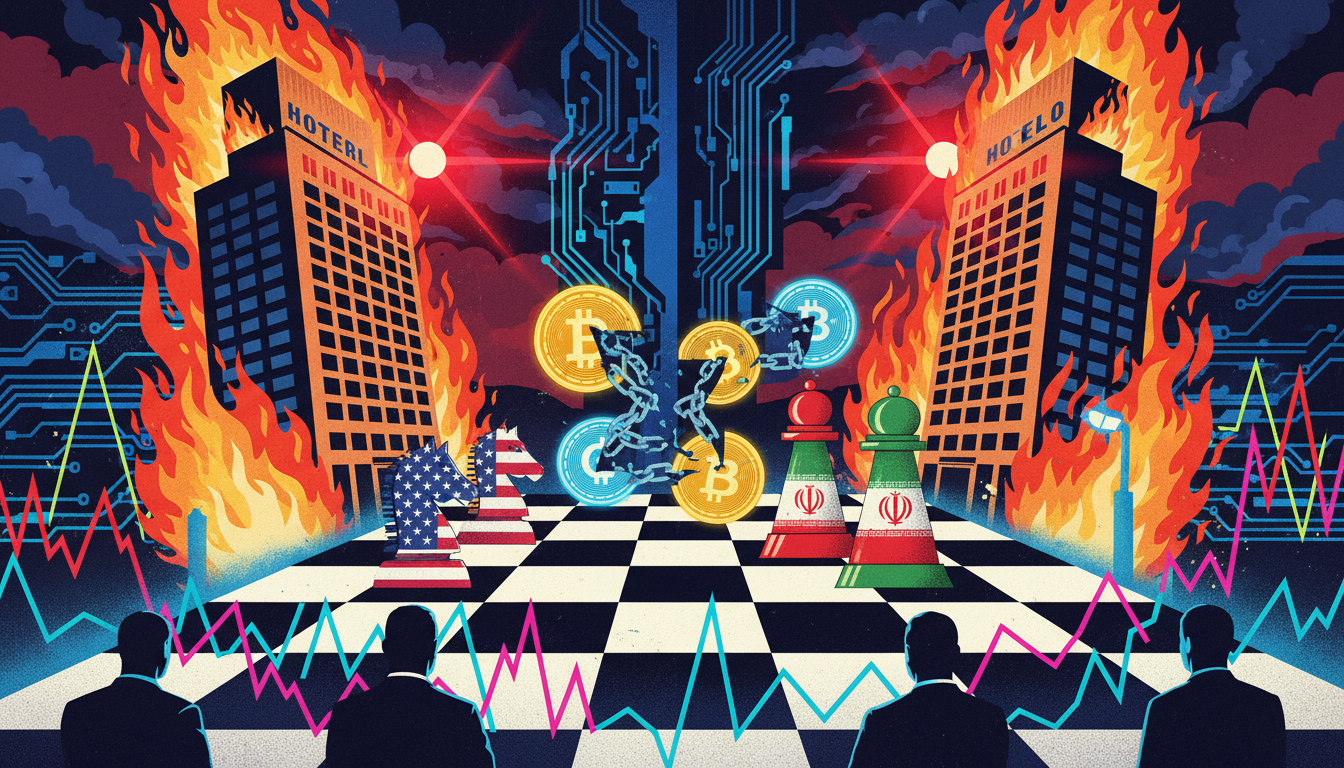
On March 27, 2026 (Eastern Time Zone), legislation concerning the market structure of the American cryptocurrency was pushed back into the fast lane by the Senate Banking Committee and, in a rare occurrence, received bipartisan public support. However, what truly stands in the way of reaching the legislative finish line is no longer the ideological debate of "whether to regulate cryptocurrency", but rather more specific and acute questions regarding the distribution of interests—how to design the interest and revenue models for on-chain tokens priced in USD, and who gets to share in them. Committee Chairman Tim Scott has communicated directly with top trading platforms such as Coinbase, emphasizing that “everyone is still at the negotiating table,” which indicates that the bill is still progressing, but also reveals that the window of opportunity is rapidly narrowing: if the industry cannot reach some compromise on the revenue model, this round of legislation could face repeated delays in the final stages.
Congress Hits the Fast Forward Button: Rare Bipartisan Sprint
This round of cryptocurrency market structure legislation was clearly pushed to the forefront on March 27, 2026, led by the Senate Banking Committee, with Tim Scott responsible for communicating key signals externally. Based on the current public information, the legislation has crossed the most difficult political threshold—bipartisan agreement has been reached on the framework that "there is a need to establish a relatively clear set of market rules for cryptocurrency assets”, which sharply contrasts with years of tug-of-war over "who has regulatory authority and whether the industry should be given space".
However, this consensus remains at a high level of abstraction—recognizing that a system needs to be built, but still in a state of unresolved status regarding how to implement the specifics, how different stakeholders share costs, and how to divide profits. In particular, issues concerning the allocation of interest on dollar-denominated tokens, custodial responsibilities, and tax treatment have yet to yield a definitive arrangement within both the committee and the industry. This stage of legislation signifies that the traditional path of “first principles then details” is yielding to the practical political logic of “first clarifying the interests”.
Looking over a longer timeframe, the U.S. has been struggling with cryptocurrency regulation for years; the contest over responsibilities among regulatory agencies and differing tolerances toward innovation and risk have kept legislation at the level of principle. This time, actions taken by the Banking Committee to advance legislation under the name of market structure represent an upgrade from the question of “who to regulate and with what license” to attempts to reconstruct order around "how trading, custody, payments, and profit distribution should be rewritten". It signifies that the U.S. is beginning to move from abstract regulatory principle games towards a reconfiguration around the micro-rules of the market, which is why industry participants view this round of legislation as a critical turning point.
The Tough Nuts at the Negotiating Table: The Battle Over Stablecoin Revenue Models
What truly stalls the legislative process is the design of the revenue model for dollar-denominated on-chain tokens: should users be allowed to automatically earn returns similar to deposit interest while passively holding, or should profits be more closely tied to “user activities” such as trading, payments, and lending, distributed as rewards? Behind these two models lie entirely different profit distribution patterns and regulatory sensitivities: the former is closer to "dollar deposits on-chain", where how returns are disclosed and whether it touches the regulatory red lines for securities or deposits will be scrutinized; the latter ties profits to specific actions, seemingly more akin to "reward programs", but still rife with controversy over how the total revenue pool is formed and managed.
Internally within the industry, there is already an obvious divide regarding profit arrangements. On one side are cryptocurrency native companies such as Coinbase, which wish to retain sufficient flexibility in revenue design to support platform competitiveness and user stickiness; on the other side is the traditional banking system, wary of the substitution effect of on-chain dollar products on interest distribution and payment channels, fearing that deposits and payment business may be eroded by competitors under regulatory arbitrage. In this confrontation, lawmakers must not only find a balance between regulatory safety and innovation space but also provide answers regarding the distribution issue of "who gets to take away this part of the interest" that can be explained to voters and the financial system.
Tim Scott emphasized in public statements that "everyone is still at the negotiating table", a phrase that clearly signifies in the current context: negotiations have not yet broken down, but also have not reached the level of “flip the table now.” Key provisions represented by revenue models have become the litmus test for whether the bill can be politically digested. As long as the conflicts surrounding revenue design have not found an acceptable compromise, legislation will continue to be refined at the committee level and will not easily enter the hard-hitting final vote stage.
Coinbase on the Front Line: Systemic Game from Revenue to Taxation
In this legislative battle, Coinbase occupies a prominent position. It is one of the main entry points for American retail and institutional investors into cryptocurrency assets and can be seen by Congress as an "organized and capable executor of compliance requirements". Tim Scott has communed directly with Coinbase, implying that it is not only viewed as a regulatory object but also as a negotiation counterpart capable of participating in designing new rules. This direct communication itself is Coinbase’s most important bargaining chip: once legislation is implemented, those who understand and influence the details earlier will have the advantage in compliance costs and business layout.
Coinbase's offensive strategy is not limited to the revenue model itself. Its Chief Policy Officer Faryar Shirzad has previously publicly called for the reform of cryptocurrency taxation rules, pointing out that the current tax system often treats frequent on-chain transactions and small gains on par with traditional assets, raising the compliance burden for ordinary users and imposing high costs on institutions when processing vast amounts of on-chain transaction records. For a leading platform like Coinbase, if it can promote clearer, more operable tax rules, it would not only reduce its own compliance burdens but could also further lock in users by providing tax tools and compliance services.
Tax rules intertwine with the revenue model for dollar-denominated tokens, directly affecting the willingness of American retail and institutional investors to participate. If the profits generated from passive holding are seen as taxable events that need to be accounted for individually, the real returns for users could be significantly reduced, and platforms would have to shoulder more reporting obligations. If returns are linked to specific activities, but tax law still does not clarify the boundaries between "rewards" and "interest", institutions will also face uncertainties in accounting and risk control. In this sense, Coinbase is not merely lobbying for a specific revenue model but is trying to reshape the entire cost structure and profit space of the U.S. cryptocurrency market through double rewrites of revenue and taxation.
Confrontation Between Banks and Cryptocurrency Entities: The Extended Battleground of Payment Discourse Power
From the perspective of traditional banks, the interest on dollar-denominated on-chain tokens and payment channels is not a technical issue, but something that concerns the core business of "where the money comes from and where it goes." Banks are highly sensitive not only about whether deposits are being migrated on-chain but also about whether on-chain liquidity bypasses the existing clearing systems and to what extent it weakens their control over payment and funding costs. As long as on-chain products can provide users with considerable and convenient returns, banks must respond defensively, fearing that regulation, in the name of "innovation", ultimately tacitly allows a decentralized "new deposit system" to develop in the shadows.
Former Governor of the People's Bank of China Zhou Xiaochuan once expressed views on payment systems and cryptocurrency applications, emphasizing the potential of new technology in cross-border payments and retail payments while warning against the financial stability and regulatory challenges that could arise. This perspective from the central bank and traditional financial system closely resonates with the American banking system's vigilance towards on-chain payment forms: the issue is not whether the technology is advanced but who controls the underlying settlement and data, and whether regulation can maintain visibility over the flow of funds.
In contrast, entities like Sticker Mule have started to support cryptocurrency payments, presenting a gentle but substantive challenge to the monopoly of traditional payment systems through actual business choices. For these companies, as long as settlement is more efficient, fees are lower, and cross-border transactions are more convenient, there is motivation to attempt to migrate some payments on-chain. Although specific operational data and effects have not been comprehensively disclosed, such cases already serve as a reminder to lawmakers: if regulation continues to be mired in disputes over interest and payment issues, the real economy may promote new payment forms through spontaneous adoption, gradually loosening the monopoly position of the traditional system outside regulatory sight.
What Happens If No Agreement Is Reached: Regulatory Red Lines and Global Racing
Without touching upon specific timelines and position details, it can be anticipated that if this round of legislation remains stuck on the revenue distribution issues of dollar-denominated tokens for a long time, the "ambiguous state" of U.S. cryptocurrency regulation will be passively extended. On one hand, the industry will continue to explore various revenue schemes within a regulatory gray area, while regulatory agencies will correct post-facto through case enforcement and verbal guidance, leading to unpredictable compliance costs. On the other hand, the boundaries of authority between Congress and regulatory agencies will also be difficult to clarify, resulting in a long-term market structure that remains unstable, "under the guise of rules, but based on cases".
From the perspective of global competition, whether legislation is implemented will affect the migration paths of capital, projects, and compliance landscapes. If the U.S. can provide a clear and predictable revenue and tax framework, some funds and projects may be willing to seek institutional dividends in the U.S. in exchange for compliance premiums; conversely, if high uncertainty persists, other jurisdictions that make moderate concessions in regulatory costs and flexibility may attract business models that are highly sensitive to profits and payments. Especially against the backdrop that dollar-denominated tokens have been widely used for global transaction settlements, if the U.S. delays in providing answers, it is equivalent to conceding the position of rule-maker.
Combining the current industry's game over revenue models, it can be foreseen that future compromise solutions will likely swing in several directions: either impose higher disclosure and capital constraints on passive revenues, reserving some interest space above a safety net; or encourage reward mechanisms tied to specific activities while setting hard regulatory thresholds on the formation and usage of the total revenue pool; also not ruling out differentiated regulatory paths for different types of issuers and scales of business to work on "who can issue, how to issue, and what the profit ceiling is". For all these possibilities, the only certainty is that specific regulations will not easily tilt entirely in favor of any one party.
From Revenue Contest to Order Redesign: The Power Redistribution of Cryptocurrency Dollars
Looking back at the legislative process led by the Senate Banking Committee, the real focus on the table is not whether on-chain technology itself is feasible but rather the long-term power distribution concerning who controls the interest and data of "cryptocurrency dollars". Once dollar-denominated tokens become an important vehicle for global transactions and store of value, interest income, transaction data, and payment channels together constitute a new profit pool for financial infrastructure. The legal questions have evolved from "can it be done" to "who will do it, what will it look like, and how will the profits be shared".
In this process, if the industry cannot first reach a new balance, regulatory frameworks will find it hard to take shape. At the current stage, the struggle between Coinbase, traditional banks, payment giants, and licensed financial institutions remains under high pressure, with each hearing and negotiation testing each other’s bottom lines. Legislation will only move from discussion drafts to a binding market order when all parties gradually accept some "imperfect but survivable" combination of revenue and tax schemes.
Looking forward, once the controversy surrounding the revenue of dollar-denominated tokens finds a politically feasible middle ground, the American cryptocurrency market is likely to enter a period of institutional dividends: compliance paths will be clear, capital can be laid out as per rules, institutions can design products within the established framework, and retail investors' compliance costs and expected returns will also be more predictable. At that time, the U.S. will not only "accommodate" cryptocurrency assets but will also establish a new financial order centered around cryptocurrency dollars from the top down. The current tug-of-war around interest allocation is just the sharpest and most pointed prologue before this new order takes shape.
Join our community, let’s discuss and become stronger together!
Official Telegram community: https://t.me/aicoincn
AiCoin Chinese Twitter: https://x.com/AiCoinzh
OKX Benefits Group: https://aicoin.com/link/chat?cid=l61eM4owQ
Binance Benefits Group: https://aicoin.com/link/chat?cid=ynr7d1P6Z
免责声明:本文章仅代表作者个人观点,不代表本平台的立场和观点。本文章仅供信息分享,不构成对任何人的任何投资建议。用户与作者之间的任何争议,与本平台无关。如网页中刊载的文章或图片涉及侵权,请提供相关的权利证明和身份证明发送邮件到support@aicoin.com,本平台相关工作人员将会进行核查。