Original | Odaily Planet Daily (@OdailyChina)
Author|jk
On March 25, Beijing Time, Binance released an official blog post, specifically delineating red lines for market maker behavior in the cryptocurrency market. Starting from the definition of market maker functions, the article outlines relevant risk signals associated with market makers and presents specific compliance requirements for project parties. Although no specific projects or institutions are directly named throughout the article, industry insiders widely believe that this piece is aimed at the increasingly rampant “Active Market Maker” operations model.
What does the article say?
The article begins by explaining what a market maker is: market makers provide liquidity for trading pairs by continuously placing buy and sell orders, with their core value lying in “balancing buy and sell orders to maintain liquidity, stabilize prices, and support orderly trading.” Whether in a centralized order book or a decentralized AMM pool, market makers are an indispensable part of market operations.
The article then shifts focus and points out six types of “risk signals”:
- Sale behavior inconsistent with token release plans: The article clearly states, “early, excessive, or frequent sales may indicate misalignment of incentive mechanisms or lax internal controls”;
- Unilateral trading behavior: Healthy market making should provide bilateral liquidity, “if there is a continuous occurrence of sell orders without corresponding buy orders, it may increase downward price pressure”;
- Cross-platform coordinated sell-offs: A large number of tokens being charged and sold simultaneously on multiple exchanges, “exceeding the normal liquidity rebalancing range,” is categorized as coordinated distribution rather than genuine market making;
- Mismatch between trading volume and price trend: High trading volume but stable prices may indicate “wash trading rather than real demand”;
- and severe price fluctuations under weak liquidity, “when liquidity is low or the order book is thin, even small transactions can trigger drastic price fluctuations, making prices more susceptible to artificial inflation or deflation”;
- and imbalance between trading volume and liquidity, “when liquidity is shallow, large transactions can easily drive price changes. Therefore, if an asset appears to be actively traded but the order book is not deep, the relevant activities may not represent genuine market demand.”
In the section outlining requirements for project parties, the language becomes more direct: large-scale sell-off behavior that leads to abnormal price declines (also known as dumping) is strictly prohibited; profit-sharing and principal-protected return models are banned; cooperation with third parties to manipulate prices or liquidity is not allowed; token lending agreements must clearly specify the use of tokens.
Didn’t mention Active Market Makers, yet every sentence refers to them
The so-called “Active Market Maker” model is a token operating strategy popular in the altcoin market: project parties lend large amounts of tokens to market makers, who actively intervene in price movements to attract retail investors before gradually offloading the tokens, sharing profits with the project party. The core characteristics of this model correspond highly with the risk signals outlined in the Binance article—cross-platform coordination, unilateral selling pressure, lack of transparency in lending agreements, and selling rhythms contrary to official token release plans.
While Binance did not directly name the concept of "Active Market Maker," its clear statements on “prohibiting profit-sharing and principal-protected return models” and “token lending agreements must clarify the use of tokens” have effectively been regarded as a public reprimand within the industry. Recent unusual price movements and on-chain behaviors of certain tokens have obviously triggered the exchange's sensitivities.
Is SIREN the trigger?
To understand the background of Binance's recent statement, one must clarify the situation with SIREN in recent days.
On March 22, SIREN broke above 2 USDT, with a 24-hour increase of up to 131%.
According to on-chain analyst Yu Jin, monitoring the top 54 addresses holding SIREN tokens, aside from a burn wallet and Binance Web3 wallet, the other 52 addresses appear to all be owned by the same controlling party—this entity holds 644 million SIREN, accounting for 88.5% of the total, worth as much as 1.44 billion US dollars.
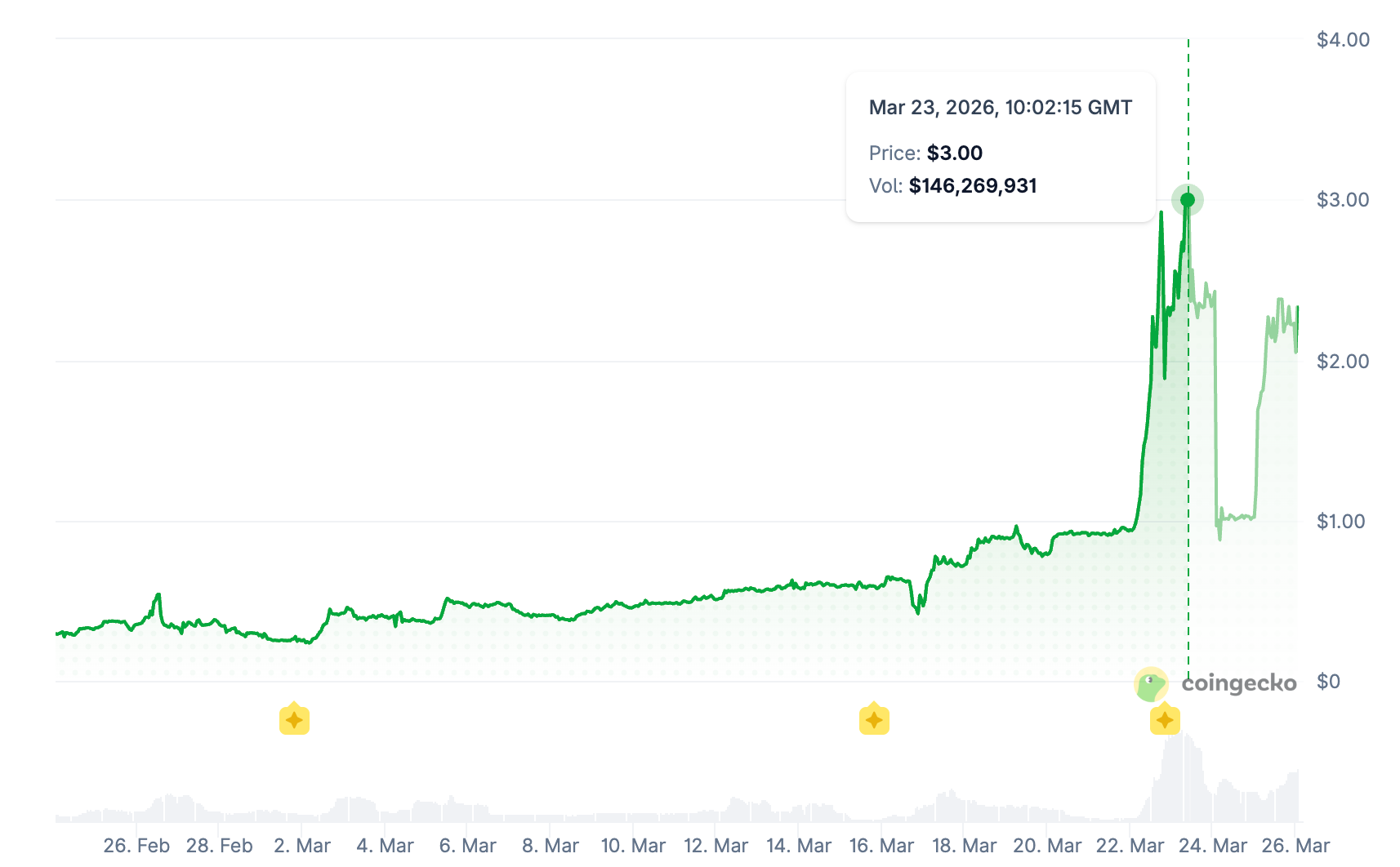
Siren's price movement. Source: Coingecko
When nearly 90% of a project's circulating chips are held by a single entity, it goes beyond the realm of normal market making. Meanwhile, as the controlling party profits from nearly all spot holdings and utilizes contracts, this explains SIREN's 30-fold increase in just a month and a half. This controlling party is suspected to be DWF Labs, which holds 3 million SIREN in its public wallet, and saw a 66.5% accumulation of tokens the day after transferring SIREN.
Then, on March 24, SIREN plummeted 59.38% in one day, dropping to 1.01 dollars, with its market cap evaporating from a high of 740 million dollars; however, by the 25th, the price rebounded to 2.4 dollars. Retail investors who entered the market chasing the trend likely became the last buyers in this game.
Binance is serious
The concluding statements of the article are intriguing. Binance indicated that it will “take swift and decisive action against any violations, including blacklisting violative market makers,” and included a reporting email to publicly solicit relevant clues from users and project parties.
For an exchange that typically presents a commercially neutral stance, such an open declaration implies a certain degree of “anger.” Coupling this with recent token price movements and the industry turning bearish, Binance’s actions appear more like drawing an industry red line, yet the specific degree of enforcement still needs observation.
Of course, there is another side to the issue: if the active intervention of market makers is entirely restricted, and liquidity trends toward being “natural,” some low-market-value tokens may lose even basic price fluctuations, leading to a decline in market activity. How to balance market integrity and trading vibrancy is likely to remain a question without a standard answer.
免责声明:本文章仅代表作者个人观点,不代表本平台的立场和观点。本文章仅供信息分享,不构成对任何人的任何投资建议。用户与作者之间的任何争议,与本平台无关。如网页中刊载的文章或图片涉及侵权,请提供相关的权利证明和身份证明发送邮件到support@aicoin.com,本平台相关工作人员将会进行核查。


