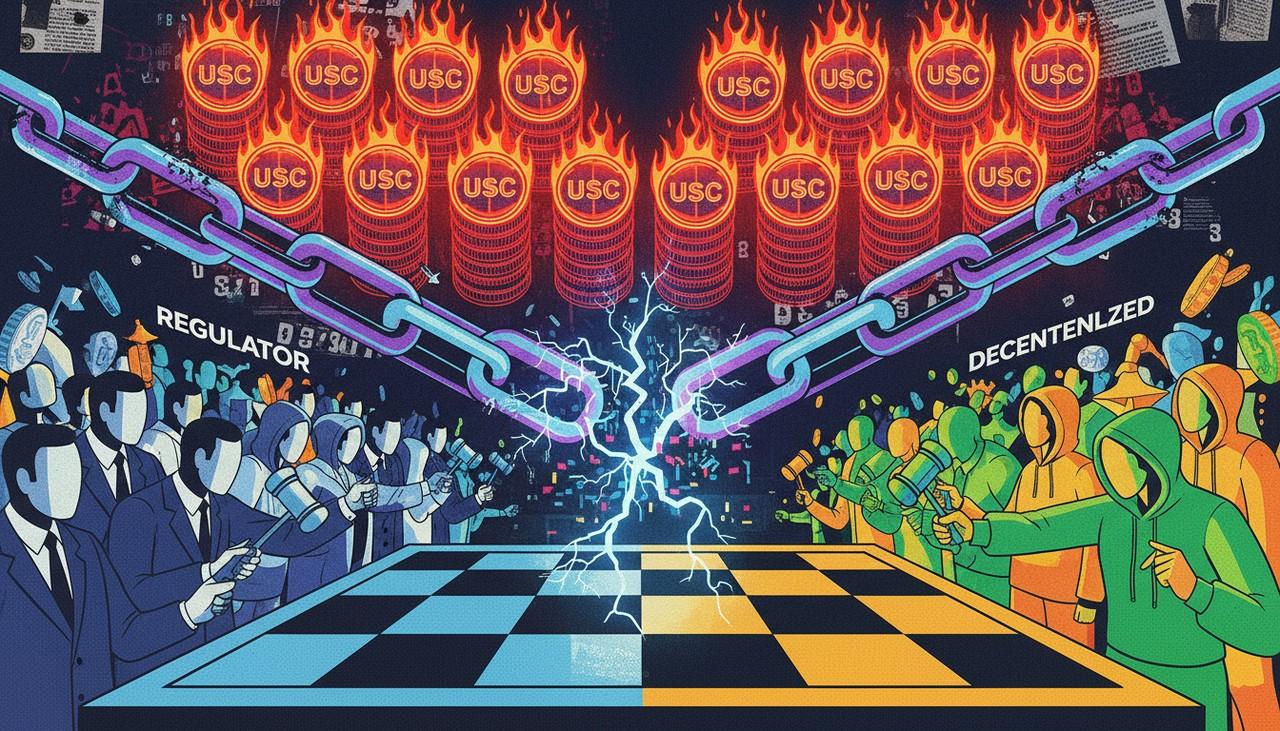
On March 24, 2026, while the trading day in East Eight was not yet over, military news from the Middle East and significant fund movements on the blockchain coincided almost in the same time window. On one side, frequent actions by the U.S. military and discussions about nuclear testing have led to a rapid contraction in global risk appetite; on the other side, within the cryptocurrency market, USDC was predominantly frozen, HYPE saw tens of millions of dollars sold off, and GOLD maintained its high leverage long positions, all tightening simultaneously. They compress "safe assets" and "risk games" onto the same balance sheet, raising a brutal question: With geopolitical tensions rising, will crypto assets serve as a safe haven, or will they become an accelerator for panic and leveraged liquidation?
82nd Airborne Division Deploys and Nuclear Testing Concerns
On March 24, news emerged that the commander of the U.S. Army's 82nd Airborne Division has been deployed to the Middle East, igniting tension. Subsequently, U.S. official Dinanno's remarks about assessing methods to resume nuclear testing were cited by multiple media outlets, marking the return of nuclear issues and tightening already fragile geopolitical expectations. Regardless of the technical details of the assessment's stage, this series of signals is often interpreted in the market as "upgrading options being put back on the table," psychologically pressuring risk assets.
Historically, similar military movements and nuclear test whispers tend to quickly elevate the market's subjective probability of extreme scenarios: funds instinctively retreat from equity assets and high-volatility varieties, shifting towards sovereign credit, short-duration bonds, and precious metals as traditional safe havens. Once this flight to safety is priced into macro assets, each subsequent military headline will be layered onto the foundation of "anticipated upgrades," amplifying volatility. It is only within such a macro atmosphere that observing the performance of cryptocurrency assets allows one to see whether they are an extension of traditional safe haven paths or a new, steeper battlefield for risk.
16 USDC Addresses Frozen
On the same day that geopolitical news was dominating the headlines, on-chain monitors noted that Circle froze 16 addresses related to USDC. Investigator ZachXBT revealed on social media that these addresses were involved in "business-related use," and that "the freeze has affected related business operations". There is no public information about the specific types of businesses corresponding to these addresses, but the sheer number and description indicate that these are not isolated personal accounts but rather closer to "operational nodes" being collectively put on pause.
This incident has once again brought the compliance pressures faced by centralized dollar tokens in extreme political environments back to the forefront. Circle has the technical and legal authority to freeze addresses unilaterally, and in the context of heightened U.S. regulations, this authority becomes more sensitive during macro tension periods. The overlapping of geopolitical conflict, sanction lists, and anti-money laundering requirements forces tools like USDC to make trade-offs between "global circulation" and "U.S. compliance obligations." For institutions relying on it for settlement and market making, tokens that are technically borderless will immediately reveal their vulnerability when encountering political boundaries.
A deeper impact lies in expectations. For a long time, the narrative in cryptocurrency has imagined "borderless funds," juxtaposed harshly with the reality that one can freeze 16 addresses at any time. For traders accustomed to using USDC on-chain, this will directly raise their pricing on on-chain censorship risk—not only concerns over being wrongly affected but also a systematic discount for the "freeze-able design." Some funds may start to reassess the weights of centralized versus decentralized assets in their portfolios, viewing "the existence of point freezing authority" as a new risk dimension.
HYPE Saw $20 Million Sell-Off
In stark contrast to the "static blockade" effect of the USDC freeze, the sharp sell-off on HYPE represents a vivid liquidity exodus. On-chain data shows that the institutional account High Stakes Capital concentratedly sold approximately 602,421 HYPE on March 24, with a countervalue of approximately 22,938,000 USDC, almost a one-time large-scale swap in the public market. Given the scale and concentration, this transaction appears more like a pre-planned "core extraction" operation rather than a casual reduction.
At a time when geopolitical uncertainty was rising, the institution opted to extract over 22 million USDC from HYPE and lock it into dollar-denominated assets; the motivation is not hard to understand: primarily to hedge macro risks, converting on-paper floating profits into controllable dollar positions; and secondly to avoid potential liquidity collapses that may occur in the coming days and weeks—long-tail assets often lack a buying margin in panic periods, leading to price downturns that far exceed expectations. For professional institutions, "getting out early," even if it means earning less, is an instinctive choice for performance and survival.
This level of selling pressure creates a chain reaction for HYPE itself and the broader long-tail assets. In the short term, heavy selling will quickly push HYPE prices down, triggering follow-up sell-offs and the passive expansion of automatic market-making intervals, amplifying volatility; in the medium term, holders of other tokens will read a signal from this transaction: during high uncertainty phases, institutions prefer to reduce allocations in story-driven, relatively illiquid assets, thus tightening risk appetite on a larger scale and compressing valuations and trading volumes in long-tail markets.
25x GOLD Long Positions Remain Unhedged
In sharp contrast to HYPE's decisive withdrawal is the high-leverage gamble on GOLD. Reports indicate that on March 24, one account held a nominal value of approximately 25.41 million dollars in 25x leveraged GOLD long positions, choosing not to reduce positions or hedge amidst the intertwining uncertainties of geopolitics, regulation, and liquidity, exposing its position to an extreme news cycle. Rough estimates using 25x leverage suggest that if the underlying price experiences a reverse fluctuation of a few percentage points, it could quickly erode margin space, pushing the account toward a margin call or even liquidation edge.
On one side, High Stakes Capital cashed out tens of millions of USDC for security, while on the same day, highly leveraged funds chained themselves to volatility—these two vastly contradictory behaviors illustrate the profound divides within the current cryptocurrency market: some participants viewed March 24 as a "window for withdrawing risk," while others saw the same window as the best timing to "bet on a big market movement." This divergence itself will reflect in prices as a more intense tug-of-war.
During extreme news cycles, the amplification effect of high-leverage liquidations is particularly pronounced. As military news, nuclear test assessments, and regulatory signals bombard the market, prices often exhibit erratic fluctuations, with high-leverage positions potentially swinging from profit to loss in minutes. If directional errors are made, 25x longs can be incrementally reduced or liquidated entirely by exchanges at a faster rate, resulting in passive market price sells and dragging spot prices and other derivative contracts down, forming a "chain of liquidations—price decreases—more liquidations" self-reinforcing loop.
Pakistan Offers Olive Branch in Discrepancy of Peace and Tension
On the same day, while the above-mentioned narratives of tension were unfolding, a contrasting message from the diplomatic level provided a different shade. The Prime Minister of Pakistan publicly stated a willingness to host U.S.-Iran dialogue and "welcome an end to Middle East wars through dialogue." Against the backdrop of long-standing U.S.-Iran tensions, this proposal for third-party mediation, even if from a single source, symbolizes that there are still attempts to find a political exit for the situation.
Historical experience shows that whenever local geopolitical risks escalate rapidly, the emergence of credible mediation or ceasefire expectations often leads to a peak and retreat in risk aversion: funds exit overcrowded safe assets, reconfiguring to risk assets, causing prices to rebound. However, this reversal is not linear; it resembles more of a "tug-of-war between hope and panic," with the market probing back and forth between new information and old wounds. Whether mediation can land and dialogue can sustain often lags behind the market's short-term reactions.
Placing this olive branch of peace alongside the earlier discussions of military upgrades, USDC freezes, HYPE sell-offs, and GOLD leveraged gambling reveals a highly torn picture: at the macro level, signals of risk and easing intertwine; at the micro level, some funds rush to exit while others elect to increase bets, with on-chain assets swinging wildly in the crevice between "risk aversion narrative" and "regulatory tightening" and "liquidity withdrawal." The cryptocurrency market is not isolated from geopolitics but is forced to price every shift in real-world sentiment.
Viewing the State of the Crypto Market Through This Tense Day
Looking back at the entire day of March 24, from the deployment of the 82nd Airborne Division to the Middle East and public discussions of nuclear test assessments to Circle freezing 16 USDC addresses, followed by High Stakes Capital's $22.93 million sell-off of HYPE and the $25.41 million 25x GOLD longs remaining unhedged, a clear main thread gradually emerges: the cryptocurrency market has never floated above the realities of the world. The escalation of geopolitical tensions will change the paths of funds seeking safety, while the compliance authorities' freezing powers will instantly sever some on-chain "blood vessels," and the choice of positions by institutions and retail traders will transform these variables into dramatic price tremors within hours.
It is foreseeable that the rift surrounding centralized compliance and decentralized anti-censorship will further split asset preferences and user preferences in the future. On one end lies high liquidity, strong compliance tools like USDC that can precisely freeze addresses under political pressure; on the other end are decentralized assets that emphasize non-freezability and anti-censorship but stand out more in the regulatory view. The migration of funds between these two extremes may become more directional—compliance-sensitive institutions will prefer the former, while those emphasizing sovereign risk and political neutrality will lean toward the latter.
Moving forward, at least three key variables will need continued observation. First, the trajectory of the geopolitical situation itself: whether military deployments and nuclear test assessments are fleeting probes or parts of a longer-term game will determine the base color of risk aversion and risk appetite. Second, whether regulatory actions continue to tighten, especially regarding policies regarding cross-border capital flows, address freezes, and on-chain scrutiny tools, will directly influence the pricing discounts of tools like USDC. Third, how the market will subsequently reprice censorship and leverage risks: Will the USDC freeze lead to a new layer of asset stratification? How will the outcomes of this HYPE sell-off and high-leverage GOLD positions change institutions' and retail traders' risk perceptions regarding the "geopolitical + leverage" combination? The answers will not be found in any single headline, but the harrowing day of March 24 has already provided a clear hint: the cryptocurrency market is being reshaped by the real world.
Join our community to discuss and grow stronger together!
Official Telegram community: https://t.me/aicoincn
AiCoin Chinese Twitter: https://x.com/AiCoinzh
OKX Welfare Group: https://aicoin.com/link/chat?cid=l61eM4owQ
Binance Welfare Group: https://aicoin.com/link/chat?cid=ynr7d1P6Z
免责声明:本文章仅代表作者个人观点,不代表本平台的立场和观点。本文章仅供信息分享,不构成对任何人的任何投资建议。用户与作者之间的任何争议,与本平台无关。如网页中刊载的文章或图片涉及侵权,请提供相关的权利证明和身份证明发送邮件到support@aicoin.com,本平台相关工作人员将会进行核查。