Original | Odaily Planet Daily (@OdailyChina)
Author | Golem (@web3_golem)
Whether Trump is a competent president is hard to evaluate, but he is definitely an excellent financial market operator.
On March 23, Trump started his antics regarding the US-Iran conflict. At 19:05 Beijing time, he posted on Truth Social stating that the US and Iran had conducted productive dialogue over the past two days and had postponed all military strikes against Iranian power plants and energy infrastructure for five days.
As soon as this statement was made, gold, which had recently plummeted due to inflation concerns and rising expectations of global interest rate hikes, rebounded instantly. According to Gate data, after Trump's post, gold, which had fallen for a day, rebounded by over $200, and S&P 500 futures rose nearly 4% in response. Meanwhile, Brent crude oil also fell from a low of $113 per barrel to $97, with a decline of over 14%.
However, within an hour, Iranian media came out to "debunk" the claims, stating that there had been no direct or indirect contact between the US and Iran. The Iranian Tasnim news agency even cited a senior Iranian security official as saying that Trump's statements were part of a "psychological war."
Faced with the backlash, Trump simply claimed, "I don’t know what the Iranian media is talking about" and tried to brush it off. To the spectators, it seemed like another instance of Trump's T.A.C.O. (Trump Always Chickens Out), but to traders, there were mixed feelings. This dynamic combination caused the market to fluctuate over a trillion dollars within hours.
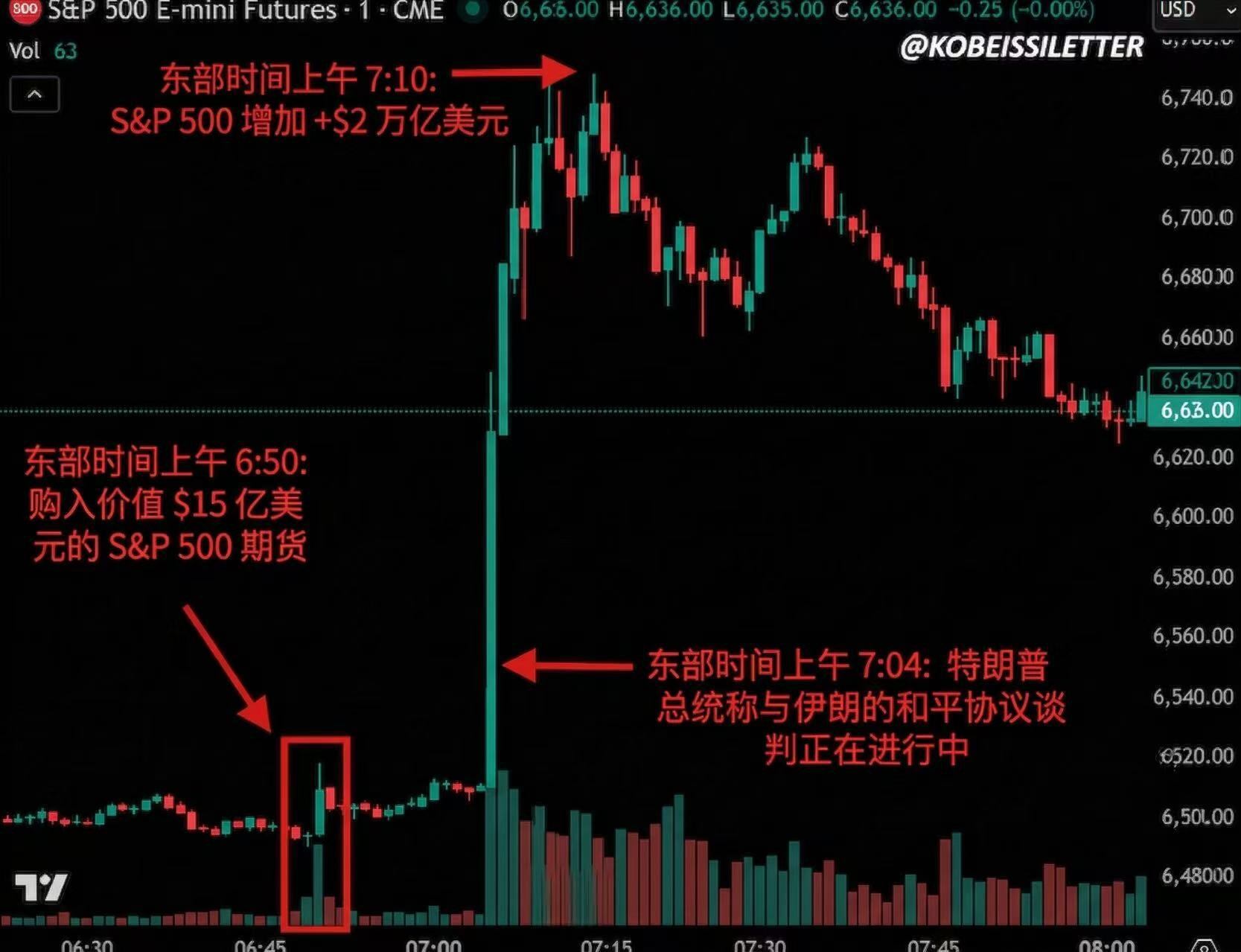
According to The Kobeissi Letter, 15 minutes before Trump’s post, an inexplicable large buy order for S&P 500 futures with a notional value of $1.5 billion appeared in the market, and due to the sheer size of the order, it pushed the S&P index up about 0.3% in one minute. Fifteen minutes later, the trader/institution who placed the $1.5 billion order secured a $60 million profit.
Besides this profit-taker, there were also traders who precisely timed their exit. According to the Financial Times, just 15 minutes before Trump's post, around 6,200 contracts of Brent crude and West Texas Intermediate crude oil futures were sold, with a notional value of $580 million.
Making large buy or sell orders just before major market news is announced isn't news trading; it resembles classic insider trading. But whether the source can be traced back to Trump remains uncertain. After all, this isn't the first time Trump has done such things. Iranian scholar Seyed Mohammad Marandi stated on X platform that "every week when the market opens, Trump makes such statements to suppress oil prices, and the five-day deadline he sets coincides exactly with the energy market's closure time."
In other words, those seemingly insider trades might instead be top traders who understand Trump's tactics. If Wall Street really studies Trump as a separate market trading indicator, it wouldn't be surprising, as his methods of influencing the market are not new, and they prove effective each time.
Last year's tariff debacle was the most typical case. On April 7, 2025, US stocks were reeling from Trump’s reciprocal tariff policies when suddenly news emerged that the White House was preparing to suspend tariffs for 90 days on most countries except China. As soon as the news broke, the Dow surged about 800 points, but soon afterward, the White House debunked it as "fake news," and the Dow ultimately closed down 629 points that day.
Not many questioned whether the rumor was disseminated by Trump's interested parties, but the answer soon followed.
On April 9, Trump first called for buying his stocks on Truth Social, stating, “THIS IS A GREAT TIME TO BUY!!! DJT.” A few hours later, he announced new tariff policies, which were essentially identical to the "fake news" circulating two days ago: suspending the 90-day "reciprocal tariffs" for countries not taking retaliatory measures, but raising tariffs on China to 125%. The market once again surged, with all three major indices hitting a significant rally not seen for days.
A mediocre operator can create a wave of gains with a piece of good news, while Trump can generate two waves with a single piece of good news.
Now, in a war environment, every word from the leaders and official media of the conflicting parties inherently carries price leverage. A strong statement can cause gold to surge instantly; a calming statement can lead risk assets to rebound immediately, showcasing the "law of market reactions."
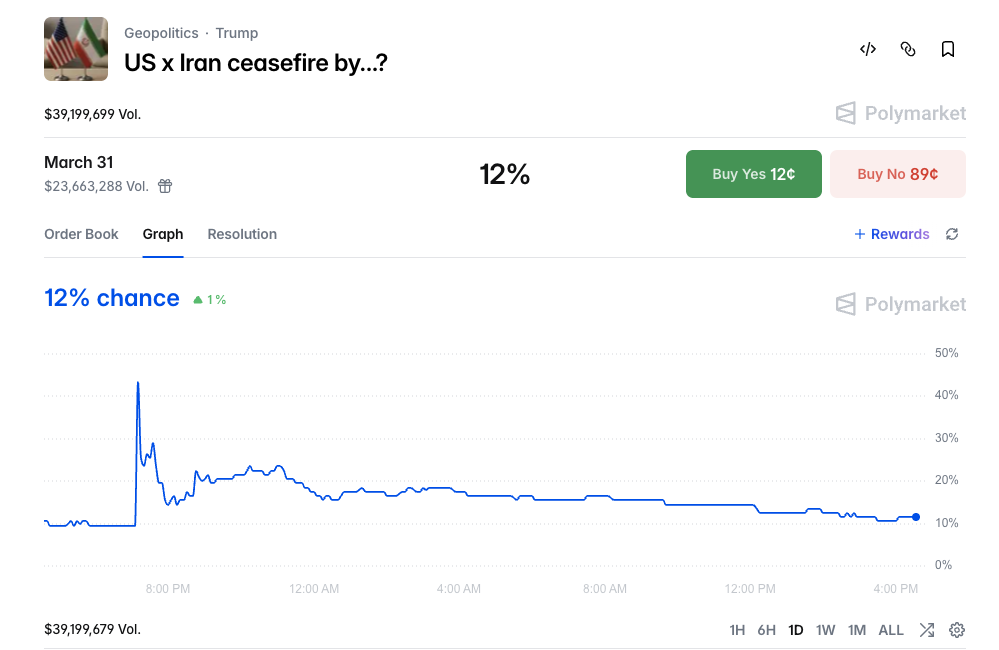
When encountering a master like Trump, even prediction markets that claim to stay ahead of the truth of events can be played like a fiddle. According to monitoring by the Odaily Seer Prophet Channel, after Trump stated that positive progress had been made in US-Iran dialogue, the probability of the event "the US and Iran will ceasefire by March 31" quickly rose to 54%; after it was discovered to be a farce, the probability swiftly fell back to 16%, and it has now dropped to 12%.
Did Trump intend to manipulate the market? The answer, of course, is affirmative. But did he do it solely for profit? If viewed this way, one overlooks a more cost-effective business behind it—the political dividends behind a rising stock market. As a businessman, Trump understands this economic calculation clearer than anyone.
When Trump campaigned for president in 2024, he promised to usher in a new period of Trump economic prosperity if elected. But economic construction also takes time, and economic prosperity is, for ordinary people, a subjective concept—having money to spend is prosperity, while not having money is not. Therefore, Trump urgently needs an immediate indicator to prove to voters that he is achieving results, so the thriving stock market became the best "substitute" for economic prosperity.
During his first term, he repeatedly flaunted record highs of the Dow and S&P, nearly treating the stock market as a personal scorecard for his administration. However, each time Trump influenced the stock market with his rhetoric, he sought to please not only shareholders, but also the capital and business owners behind them, because they are often either already or eventually become Trump's political donors.
This script has played out in the crypto space, where Trump was previously known as America's first "crypto president." This is because, during the election year of 2024 and the early days of Trump’s presidency in 2025, he frequently extended olive branches to the crypto industry by participating in crypto conferences, making various promises related to cryptocurrency, and enacting crypto-friendly laws, each of which provided upward momentum to the crypto market. In return, the crypto industry gave Trump the support of tens of millions of American voters and political donations worth hundreds of millions from crypto enterprises.
Manipulating the market without profit as the motive has also allowed Trump to exploit legal loopholes. Numerous US lawmakers and regulators previously accused Trump of profiting from manipulating the crypto market, but these accusations ultimately fizzled out because there was no direct evidence showing that Trump gained economic benefits from the market.
After the farce on March 23, some accused Trump of insider trading. White House spokesperson Kush Desai stated that the White House does not tolerate any officials using insider information for illegal profit, provided there is evidence. However, the "profit" referred to here mostly implies economic benefit. As for Trump? He has long distanced himself from the family business and retreated to the background, exhibiting a complex array of political and business maneuvers within legal loopholes.
This is where Trump’s true "skill" lies. He knows that in this world, power supersedes money; but he also understands how money can inversely influence power structures.
免责声明:本文章仅代表作者个人观点,不代表本平台的立场和观点。本文章仅供信息分享,不构成对任何人的任何投资建议。用户与作者之间的任何争议,与本平台无关。如网页中刊载的文章或图片涉及侵权,请提供相关的权利证明和身份证明发送邮件到support@aicoin.com,本平台相关工作人员将会进行核查。


