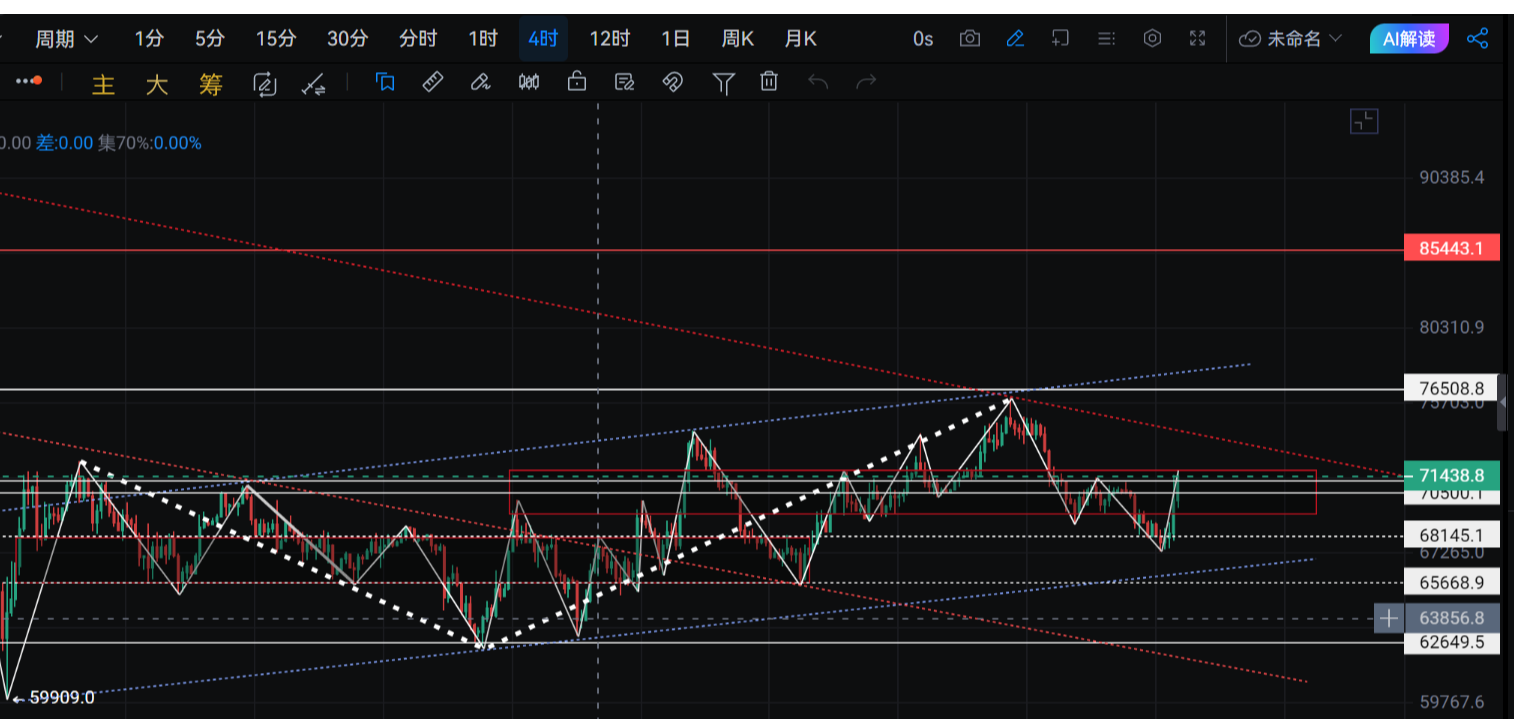
This week, the tension between the US and Iran is being pulled back and forth between escalation and de-escalation: on one side, the US is conveying messages through multiple countries and pushing to restart negotiations with Iran, while on the other side, Trump publicly stated that he has paused the attack plans on Iranian power plants and assessed that Iran "might reach an agreement within 5 days." Alongside this geopolitical main line, the price of Bitcoin surged from $76,000 before falling back to about $68,000, exhibiting extreme volatility. The intertwining of energy, war expectations, and risk aversion has led the market to rethink: in this round of the US-Iran ceasefire game, is Bitcoin merely a magnifying glass for short-term sentiment, or is it being used as a longer-term risk hedge?
Trump Hits the Pause Button: The Five-Day Window and Market Pricing
From the currently available information, the US has not suddenly "turned around," but is gradually releasing signals willing to negotiate through multiple channels such as Turkey, Egypt, and Pakistan, establishing a communication channel behind the scenes. Trump has chosen to speak out loudly during this process—on one hand, confirming the pause on the attack plans on Iranian power plants, and on the other hand, through media, releasing the judgment that "Iran is eager to reach an agreement and may do so in 5 days," throwing responsibility and time pressure back onto the other side, while also shaping a "controller" image for himself.
This notion of a "five-day window" is essentially a product of both political and market considerations. Once the outside world believes that some form of ceasefire or de-escalation is likely to be reached in the short term, the market will suppress pricing for extreme military escalation: the catastrophic upward movement of oil prices will be put on hold for now, and the sell-off pressure on global risk assets tied to it will also ease. For the crypto market, this expectation of "temporary safety" often means a cooling of the risk aversion premium, with some previously invested funds betting on an escalation of conflict opting to take profits, leading to a significant price retreat from the highs.
Tehran's Calculations: Energy Prices and Negotiation Chips
In contrast to Trump's narrative of a "negotiation window," Tehran emphasizes another set of logic: the reason the US has hit the pause button on attacks is to "avoid the surge in energy prices." This statement openly exposes America's Achilles' heel—the high dependency of the global oil and gas supply chain on the Middle East situation, while simultaneously reinforcing Iran's sense of leverage at the negotiating table.
The importance of the Strait of Hormuz is that it is one of the world's most critical transportation channels for crude oil and liquefied natural gas; once there is a risk of a blockade here, a sharp surge in oil and gas prices is almost guaranteed. Iran's domestic energy infrastructure is also a crucial part of the global supply system; any large-scale strikes on power plants or oil and gas facilities could quickly be amplified by the market as a signal of sustained supply damage. In this scenario, the more Tehran emphasizes energy and price expectations, the more it tells Washington: if you choose to continue escalating, the impact on the global market will not be limited to bilateral consequences.
For Iran, making energy and price expectations explicit is a negotiation strategy: it is not only reminding the US that the "cost of action" is extremely high, but also hinting to other countries reliant on Middle Eastern energy—you also have reasons to push the US to exercise restraint. This narrative, transmitted through the channel of oil price expectations to the financial market, further spills over to the emotional level of crypto assets, forming the invisible background noise of this round of the game.
The Arrival of Mediators like Turkey: Multi-Party Buffering and Expectation Adjustment
Given the limited direct communication space between the US and Iran, regional powers like Turkey, Egypt, and Pakistan have begun to play the role of shuttle mediators. According to public information, these countries have been continuously collecting and passing on messages between both sides, attempting to find feasible paths for a potential ceasefire or de-escalation plan. They maintain certain security and economic ties with the US while also having historical interactions with Iran on geopolitical and religious, as well as economic levels, thus naturally possessing the identity of an intermediary "who can call both sides."
Historically, regional powers opting to mediate serve both the practical need to maintain their own security environment and to avoid the spillover of conflict, as well as the opportunity to seize regional discourse power and international exposure. For countries like Turkey, playing the key coordinator in a major crisis not only consolidates their middle-ground position between the West and the Middle East but also allows them to gain better bargaining power in subsequent economic and energy cooperation.
The greatest market significance of multi-party mediation lies in reducing the tail risk of "misjudgment escalation." When investors see more than one country actively shuttling and the public narrative shifting from "war" to "mediation," the pricing for the most extreme scenarios will naturally be lowered. For crypto assets, this means that the risk aversion premium that was previously elevated due to panic circumstances will partially retreat, as funds begin to reassess: will the conflict be prolonged rather than spiraling out of control instantly? The price trajectory will also shift from "extreme upward spikes" to "slow repricing amidst repeated fluctuations."
From 76000 to 68000: Dual Pressures from Macro Data and Geopolitical Tension
In this geopolitical context, the price trajectory of Bitcoin displays a typical emotional amplification curve: first surging to around $76,000 under the overlay of panic and risk aversion expectations, and then falling back to around $68,000 as the narrative shifted from "possible escalation" to "negotiation window opening," coupled with some funds taking profits. According to single-source data, this almost $8,000 fluctuation occurred within a short time frame, reflecting the market's rapid switch between extreme emotions and rational reassessment.
The report from Bitfinex Alpha points out that the latest round of volatility is not driven solely by the West Asia situation; PPI data also played a crucial role: once inflation-related data deviates from expectations, it reignites discussions in the market regarding the path of monetary policy, thereby impacting the liquidity expectations of risk assets. When macro data and geopolitical tensions manifest concurrently, bullish and bearish sentiments are often magnified, with the crypto market responding more sharply as a high-beta asset.
During periods of geopolitical turbulence, the tug-of-war between the risk aversion buying and profit-taking is especially pronounced. Some funds view Bitcoin as a tool to hedge against traditional financial and sovereign risks and choose to increase their positions during times of intense pessimism; while others tend to realize profits after a rapid price surge, fearing that the situation might "open high and close low," ultimately being reverse-killed. The result of this counterbalancing force is severe short-term spikes and dips—rises are driven by crowding sentiment, while declines are due to softened expectations coupled with shifting positions.
The New Normal of Geopolitical Risk: The Magnifying Glass Effect in the Crypto Market
If we extend the timeframe, a gradually clear trend emerges: amidst multiple global shocks such as war, sanctions, and energy crises, Bitcoin and other cryptocurrencies are being increasingly regarded as an alternative "safe haven." From certain countries facing foreign exchange controls and capital outflow to regional conflicts causing concerns over local currency credibility, funds are starting to allocate part of their positions to on-chain assets in pursuit of cross-border movement and asset portability to hedge extreme systemic risks.
Behind this is the structural characteristics of the crypto market amplifying the immediate reactions to geopolitical conflicts:
● 24/7 uninterrupted trading means that any military or diplomatic news occurring at any time can immediately reflect in prices, without waiting for traditional market openings. The inexhaustible trading allows emotions to quickly resonate between global social media and trading terminals, forming a "news-emotion-transaction" cycle around the clock.
● Cross-border flow and regulatory gray areas enable some funds to transfer or hedge using on-chain assets when traditional financial channels are tightened or restricted. Once this liquidity channel proves feasible during a crisis, it will be included in more participants' "crisis plans," reinforcing the role of crypto assets in geopolitical risk scenarios.
At the same time, traditional safe-haven assets like gold and US bonds remain the first choice for global funds, but in the face of dual macro and geopolitical risks, subtle shifts in capital diversion patterns have emerged: some institutional and conservative funds continue to flow into gold and high-rated bonds, seeking risk control and regulatory friendliness; while others, more tolerant of volatility and sensitive to capital controls, tend to use cryptocurrencies like Bitcoin as a highly elastic supplementary hedging tool. The result is that during each round of geopolitical shocks, gold and Bitcoin often attract attention simultaneously, but their price performance rhythm and volatility differ significantly.
Ceasefire Expectations and Risk Aversion Emotion: Bitcoin Between Opportunity and Crisis
In conclusion, this round of the US-Iran ceasefire game has, on one hand, suppressed market pricing for the most extreme military escalation scenarios through signals like "pausing attacks" and "an agreement may be reached within five days," causing the risk aversion premium to recede in the short term; on the other hand, it has also strengthened the mid-term narrative: in a world where geopolitical conflicts are frequent and where energy and finance are highly coupled, cryptocurrencies like Bitcoin will be increasingly pulled onto the stage of risk aversion.
This also means that if the upcoming negotiations break down or become stalled for a long time, with threats of conflict escalation arising intermittently, the emotional path of Bitcoin is likely to exhibit a "magnifier" effect: when negative news is concentratedly released, short-term bursts of risk aversion and panic buying will push prices up; once the tense emotions ease, a quick arrival of profit-taking and expectation cooling will follow, leading to larger amplitude fluctuations.
For traders and allocators, what needs to be genuinely vigilant about is not the single event itself, but the risk of "focusing solely on one news item for trading." In an environment intertwined with macro data (such as PPI and other inflation indicators), monetary policy expectations, and geopolitical games, each sharp fluctuation in Bitcoin's price is often the result of multiple variables working together. How to interpret geopolitical news while balancing macro data and liquidity cycles may determine your risk exposure and position fate in this new normal more than attempting to predict the next headline news.
Join our community, let’s discuss and grow stronger together!
Official Telegram community: https://t.me/aicoincn
AiCoin Chinese Twitter: https://x.com/AiCoinzh
OKX Benefits Group: https://aicoin.com/link/chat?cid=l61eM4owQ
Binance Benefits Group: https://aicoin.com/link/chat?cid=ynr7d1P6Z
免责声明:本文章仅代表作者个人观点,不代表本平台的立场和观点。本文章仅供信息分享,不构成对任何人的任何投资建议。用户与作者之间的任何争议,与本平台无关。如网页中刊载的文章或图片涉及侵权,请提供相关的权利证明和身份证明发送邮件到support@aicoin.com,本平台相关工作人员将会进行核查。