Original Title: "Tearing Down the Polymarket Rankings of 40 Addresses, Only Three Ways to Make Money"
Original Author: Leo, Predictive Market Analyst
What is the strategy of those who made ten million dollars on Polymarket?
Using Data API + on-chain data, I reversed the top 20 rankings of the sports and crypto tracks.
40 addresses, over 100,000 transactions, analyzed one by one.
Not just looking at dashboard screenshots. Every buy, sell, and redemption was restored to strategic behavior.
Method: Polymarket Data API retrieves transaction records by address, LB API verifies profits and losses, on-chain REDEEM/MERGE data restores real cash flow. Each address has between 2,000 and 15,000 transactions.
After analysis, I found that whether in sports or crypto, the profitable addresses fall into three categories. The differences among the three categories are not in parameters, but in playing entirely different games.
First Type: Directional, Waiting Until the End After Buying Correctly
The most profitable strategy in the sports track is so simple that I initially didn't believe it.
Out of 18 valid addresses, 14 only buy and do not sell. They hold until settlement; if they win, they redeem, if they lose, they go to zero, and they do not make swings.
Despite only buying and not selling, the ways to profit are completely different.
swisstony: $494 million in trading volume, 1% return, net profit of $4.96 million. Fully automated, 353 transactions in 30 minutes, covering the five major leagues. Each match earns just a little, but the volume is huge.
majorexploiter: 39% return, maximum single bet of $990,000. Over 600 transactions nearly all placed on two Arsenal matches. Willing to place heavy bets; winning means hundreds of thousands.
One leverages volume, the other leverages betting, both have made millions. The methods are opposite, but they share one common point: information advantage regarding the events they bet on.
The Top of the Rankings is Slowing Down
kch123, ranking first in sports, has accumulated a profit of $10.35 million.
However, as of mid-March analysis, they lost $479,000 in the last 30 days. Their win rate in the last 7 days was only 31% (15 wins and 33 losses). All 14,303 transactions were buys, with 0 sales. An average of 493 transactions daily, with 74% of transactions spaced less than 10 seconds apart.
A machine that made ten million is slowing down. You wouldn't know this just by looking at the rankings; you have to analyze on-chain data to see it.
My Own Label Deceived Me
fengdubiying, ranked 13th in sports, has a profit of $3.13 million.
When I analyzed in bulk, I labeled them "selling dominant," making them seem like a swing trader.
Breaking down the data: 93.6% of returns come from redeeming, while sales constitute only 6%. The real strategy is concentrated betting on LoL esports. The maximum bet in a single market was $1.58 million (T1 vs KT Rolster), with a win rate of 74.4% and a risk-to-reward ratio of 7.5 to 1.
Sales are their stop-loss tool, not the main strategy. Looking only at the buying-to-selling ratio on the dashboard can lead you to completely misjudge what this person is doing.
Second Type: Structural, Making Money Without Relying on Predictions
The crypto rankings are a completely different species. In sports, they bet on direction; in crypto, they are the market makers.
Diving into the Crypto Top 5: Three are market-making bots running binary options on volatility, one is a price threshold market maker managing inventory with MERGE, and one specializes in arbitraging public milestone events (with a return rate of 43.3%).
Retail investors are betting on rises and falls, while leading players are the market makers.
How Market Makers Make Money
0x8dxd, BTC 5/15 minute volatility market maker.
94% of transactions are symmetrical limit orders, buying both up and down. Operates around the clock, with a median single transaction under $6. Buy price rises + falls by $1, and the spread in between is the profit. At least three independent addresses are running the same model.
Another market-making address is more extreme: It almost monopolizes the liquidity supply in the Economics category. 982 buys, 0 sells, six-figure PnL. They earn through maker rebates plus liquidity premiums.
Good Code Doesn't Equal Making Money
You might think making markets is guaranteed profit? There's an open-source Polymarket market-making bot on GitHub, with well-engineered code, real-time WebSocket data, risk controls (stop-loss + volatility freeze + downtime), and automatic position merging. The author admits: it doesn't make money.
The reason is that the pricing logic is penny jumping, inserting a penny before the existing optimal quote. In plain terms, it is just following orders without having its own pricing capability.
No matter how refined the code is, it is useless; market-making profitability depends on whether your pricing model can outperform the market.
Another data point worth noting: Based on analysis of on-chain transaction timestamps, over 70% of arbitrage profits in the Polymarket crypto price market are taken by bots with delays under 100 milliseconds. Less than 8% of wallets in the entire market are profitable. If the bot delay is in the seconds, it basically provides liquidity for high-frequency players.
Third Type: Cognitive, Placing Few Bets but Each One is Judicious
The third category of addresses is completely different from the first two. The trading frequency is very low; they might only make two or three trades a month, but every single one is backed by research.
Here are a few examples.
One address in the weather category uses publicly available data from the meteorological bureau to model, only entering when the win rate exceeds 0.77; they might only make two or three trades a month, with profits of several tens of thousands per trade. Another address has 89% of trades being buying NO, holding periods measured in months, with a lower win rate, but the average payoff multiple exceeds 9 times, covering all small losses with a few big bets.
One even more extreme: In the FDV (full result) market, it only does one thing: buys NO for 50-55 cents and waits to redeem it for $1. 100% win rate. It's not luck; it's that others didn't notice this pricing deviation.
However, cognitive types do not mean "deep enough research guarantees profit." I have analyzed a case where someone used 1.37 million lines of historical data to create a probability matrix for BTC price deviations; the backtesting results were perfect, but once rolling verification was applied, it collapsed directly. Market efficiency improves rapidly; what worked last month may have been arbitraged away this month.
The true edge for cognitive types is having a deeper understanding of a category than the market pricing, not just a more complex model.
Comparison of the Three Types of Lifestyles
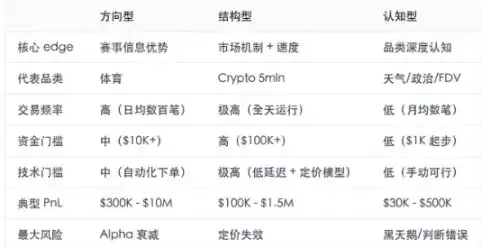
Comparison Table of the Three Lifestyles
What Am I Doing?
Having discussed others, let me talk about myself.
I am running several lines at once: crypto market-making (structural), sports probability pricing (directional), weather data modeling (cognitive). Each line is not large; I don't have the scale of 493 transactions daily like kch123, nor the trading volume of $494 million like swisstony.
After analyzing these 40 addresses, the most important thing I realized is: clarifying which game I am playing is more important than optimizing any parameters.
Playing directionally without an information advantage means even the best execution is just guessing. Playing structurally but lagging behind means you are the one being harvested. This is not motivational talk; it's what I told myself after analyzing the data.
Currently, each line is running small-scale validations, confirming the edge before scaling up. I'm not in a hurry to expand; I want to stabilize one or two categories first.
Data Sources: Polymarket Data API + LB API + Polygon on-chain data | Analysis period: January to March 2026
Want to try on Polymarket? Make sure you understand which game you want to play.
免责声明:本文章仅代表作者个人观点,不代表本平台的立场和观点。本文章仅供信息分享,不构成对任何人的任何投资建议。用户与作者之间的任何争议,与本平台无关。如网页中刊载的文章或图片涉及侵权,请提供相关的权利证明和身份证明发送邮件到support@aicoin.com,本平台相关工作人员将会进行核查。