A major expansion in Latin America’s digital asset infrastructure is underway as Ripple accelerates its regional strategy. Brazil, in particular, has emerged as a focal point for global fintech and crypto firms, driven by rapid digital payment adoption through systems like Pix, an instant payment system created by the Central Bank of Brazil, and a regulatory environment that is increasingly open to blockchain-based financial services.
Blockchain enterprise firm Ripple on March 17 announced an expanded Brazil presence, broader institutional offerings, and plans to seek a Virtual Asset Service Provider license. Monica Long, President at Ripple, stated:
“Latin America has always been a priority market for Ripple — not just because of the scale of the opportunity, but because Brazil has built one of the most advanced and forward-thinking financial ecosystems in the world.”
Read more.
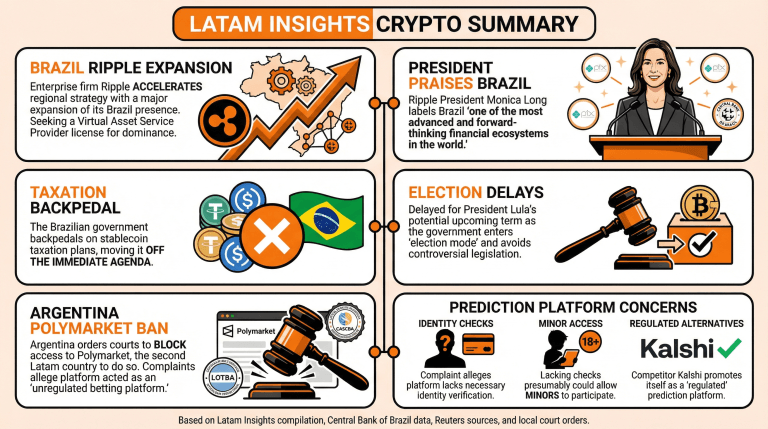
While local media reported that taxation of stablecoin transactions in Brazil was just weeks away, new data indicate that the government has shifted its action to other priorities.
According to sources consulted by Reuters, the Brazilian government will delay these measures for a hypothetical upcoming fourth term for President Luiz Inácio Lula da Silva as the government shifts into full election mode and avoids issuing controversial legislation.
“It remains on the radar. But it needs to be handled carefully, because tempers are running high in Brasilia,” a source stressed.
Read more.
Argentina has become the second country in Latam to block access to Polymarket, one of the largest prediction market platforms in the world.
The measure, ordered by local courts, is already in effect and results from a lawsuit initiated by the Buenos Aires City Lottery (LOTBA) and the Argentine Chamber of Casinos and Bingos (CASCBA), which complained that Polymarket operated as an unregulated betting platform in the country.
The platform lets users access its services without passing identity checks, which could presumably allow minors to participate in these contracts using credit cards or cryptocurrencies. Kalshi, a similar platform, features these checks and promotes itself as a “regulated” prediction market platform.
Read more.
FAQ
- Why is Ripple expanding its operations in Brazil? Ripple is targeting Brazil’s advanced financial ecosystem by broadening its institutional offerings and pursuing a Virtual Asset Service Provider license.
- Why is Brazil delaying its planned stablecoin tax? The government postponed the controversial tax legislation to avoid political friction ahead of the upcoming presidential elections.
- Why did Argentine courts block access to Polymarket? Local authorities banned the prediction market from operating as an unregulated gambling platform without mandatory user identity checks.
免责声明:本文章仅代表作者个人观点,不代表本平台的立场和观点。本文章仅供信息分享,不构成对任何人的任何投资建议。用户与作者之间的任何争议,与本平台无关。如网页中刊载的文章或图片涉及侵权,请提供相关的权利证明和身份证明发送邮件到support@aicoin.com,本平台相关工作人员将会进行核查。


