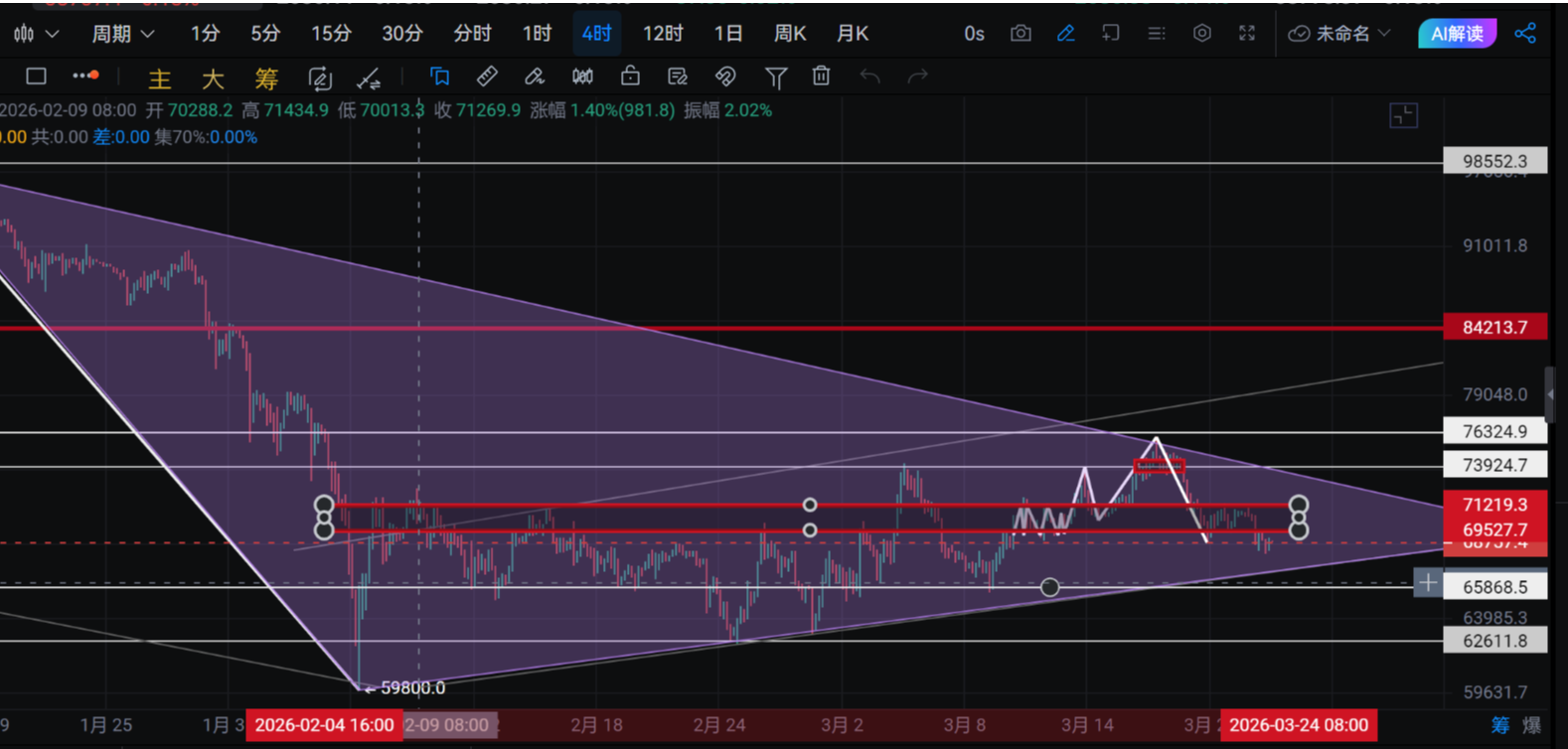
On March 22, 2026, U.S. Treasury Secretary Beeson defended the hardline actions of the U.S. and Israel against Iran by directly bringing the Strait of Hormuz to the center of global financial pricing—while supporting Trump's ultimatum of "48 hours to open Hormuz," he framed the potential cost as "50 days of price increases in exchange for 50 years of peace in the Middle East." In contrast, the Iranian Islamic Revolutionary Guard Corps publicly threatened to close the Strait of Hormuz and stated that "four retaliatory measures would be taken immediately," with both the maritime route and regional military power being pressed into high alert. During this period of heightened geopolitical tension, a previously unnoticed token SIREN saw its price soar 26 times to approximately 2.10 USD in just under 1.5 months, with 484.6 million tokens, about 66.5% of the total supply, rapidly concentrated into only 48 wallets. When the "Hormuz ultimatum" aligns with the "extreme surge of small-cap tokens + chip concentration" on the same time axis, the issue shifts from a simple coincidence to a proposition that must be questioned: is there an inevitable connection in emotional and expectation levels between the escalation of geopolitical price-fixing games and certain extreme trends in the cryptocurrency market?
The Countdown Button Pressed for Hormuz
On March 22, at 8:00 AM GMT+8, Beeson publicly endorsed Trump's Middle East strategy, supporting not only tough military and economic pressures on Iran but also explicitly standing by the ultimatum of "48 hours to open Hormuz." This presentation of the critical strait in a countdown format to global markets is itself an extreme test of risk appetite: 48 hours is not a technical window period, but more like a psychological countdown for all kinds of funds—either believe deterrence will work at the last moment or allocate assets in advance for the worst-case scenario of a blockade.
Even more impactful was the widely circulated statement: "Exchange 50 days of price increases for 50 years of peace in the Middle East." When a country's treasury secretary so plainly packages inflation costs and geopolitical stability, the market interprets it not just as a "peace-loving" stance but as an upward adjustment of official tolerance towards future prices and energy costs. For traders, this is tantamount to providing a broader "political rationality" band for inflation and oil price increases, where original concerns over interest rates and economic slowdown are greatly displaced by pricing pressures from disruptions in energy and shipping chains.
The Strait of Hormuz handles approximately 20% of global oil transportation, transforming the abstract "blockade risk" into a quantifiable impact pathway: once passage is obstructed, the first to come under pressure will be crude oil and shipping rates, followed by downstream refining, chemicals, and electricity prices. Only after that will inflation expectations and monetary policy space in various countries be affected. In this sense, Beeson's "50 days of price increases" is not an isolated macro slogan but is bound together with a global energy artery, a complex variable that is continuously disassembled and repriced by traders.
Against this backdrop, the Iranian Islamic Revolutionary Guard Corps's statement of "four retaliatory measures to be taken immediately" adds another layer of uncertainty to this shock chain. Although the details of these "four measures" are currently unknown, the combination of "immediate action" and "including closing the Strait of Hormuz" is enough to force the pricing models of both risk and safe assets to adjust their geopolitical premiums upward. Under this escalating sense of risk, traditional commodities, related stocks, and the forex market began to reflect potential impacts in advance, while more sensitive emotional assets that are easily ignited by narrative will naturally not remain absent.
SIREN Soars 26 Times: Coincidence or the Shadow of Expectations?
During the same phase of escalating geopolitical tension, the price curve of SIREN suddenly leapt out from the background noise. According to public data, in nearly 1.5 months, SIREN climbed from an almost unnoticed small-cap token to a dizzying increase of 26 times, reaching approximately 2.10 USD. The timelines across platforms have slight variations, but the overall profile is clear: a slow upward trend with low liquidity initially, followed by a few volume-driven surges, entering a phase of intense volatility and completing the shift from "marginal speculative asset" to "narrative sample" in a short time.
What is even more striking is the abrupt shift in its chip structure. On-chain data shows that approximately 484.6 million SIREN tokens were gradually concentrated into only 48 wallets, accounting for about 66.5% of the total supply. Such a high concentration is typically indicative of long-term lock-ups or institutional allocation in mature blue-chips but appears particularly anomalous for a highly volatile token still yet to land on mainstream exchanges. On one hand, there is a lack of broad liquidity support from top exchanges, and on the other, an extremely high concentration of holdings coupled with short-term sharp increases—this combination inherently amplifies external suspicions regarding "behind-the-scenes forces."
The irregularity lies not only in the increase itself but in the dislocation between price increases, liquidity, and compliance pathways. According to traditional logic, for a token to achieve a leap from an obscure asset to a hot asset, it typically requires listing on mainstream platforms, market-making, and narrative coordination; however, SIREN has already achieved the leap in price and chip concentration without completing this "conventional route." This indicates that its market participants' structure differs from traditional narratives and exposes a fact: there is significant asymmetry of chips and information between project parties, early large holders, and later retail investors.
It must be emphasized that current publicly available information cannot reveal the real identities and specific motivations of these aggregating addresses. We cannot confirm whether they are controlled by a single entity, nor can we assess whether the accumulation aims for long-term positioning, internal adjustments, or short-term stock manipulation. To interpret this high degree of opacity in concentration simply as a so-called "insider funding action" lacks factual basis and risks simplifying complex risks into conspiracy theories, misleading investment decisions. The only points that can be confirmed are two: the extreme price increase and the unusually concentrated chip structure.
The Resonance Boundary Between Geopolitical Tension and High-Risk Tokens
When we juxtapose Beeson's strong statements, the "48-hour countdown for Hormuz," and Iran's threat of "four retaliatory measures to be taken immediately" with SIREN's phase of rapid surges over the past 1.5 months, it’s hard not to be drawn in by this temporal overlap. Beeson's assertion on March 22 that "50 days of price increases for 50 years of peace in the Middle East" raised the global market's tolerance for future inflation and energy fluctuations, and around the same time, SIREN had completed the first two stages of rapid chip aggregation and price surges on-chain. In a highly narrative-driven market, such overlaps in timing can constitute a "story," but may not necessarily provide "evidence."
From the perspective of common capital behavior, in an environment of pervasive geopolitical tension, real major asset allocations usually revolve around crude oil, gold, government bonds, and certain key currencies. However, in the cryptocurrency realm, a different path is often observed: certain high-risk preferred funds begin to chase high-volatility small-cap coins that possess "narrative imagination"—especially those whose names, symbols, or backgrounds can be easily linked to real-world events. SIREN, as a previously unnoticed small token, once labeled with a certain "metaphorical tag" in this emotional environment, can easily become an amplifier for short-term capital games.
The sharp rise in concentration of holdings adds even greater structural risk within this "narrative arbitrage." When over two-thirds of the supply is controlled by a few wallets, price trends largely cease to represent "a game of dispersed participant expectations" and instead reflect the "emotional projections and rhythms of the controlling party." In an upward phase, this structure can create an almost unilateral upward effect; however, once the dominant holders begin to offload or hedge, a plunge and liquidity vacuum can likewise be quickly manufactured. Thus, viewing such assets as a form of "safe haven" is logically untenable and is more akin to layering financial self-created high leverage instability on top of geopolitical pressure.
A necessary boundary to draw is that, thus far, there is no public evidence indicating a direct interest or action correlation between U.S. senior policymakers and SIREN or the wider cryptocurrency market. What can be discussed is merely the indirect resonance between geopolitical rhetoric and market sentiment—Beeson and Iran's statements shape a macro narrative atmosphere that "permits greater volatility," while some high-risk assets in the cryptocurrency market serve as trading tools for sentiment and expectations in such an atmosphere. Speculations of "behind-the-scenes linkages" beyond this scope lack data support and analytical value.
If Oil Prices Spirals Out of Control: PoW Miners Stand on the Edge of Cost Lines
Compared to the short-term emotions surrounding SIREN, what warrants longer-term attention is how the risks related to Hormuz transmit through oil prices and electricity prices to PoW miners. Once the Strait of Hormuz—the route responsible for approximately 20% of global oil transportation—encounters substantial disruption, crude oil price increases will typically ripple through to various countries' electricity prices via power generation costs and distribution fees. For the PoW mining industry, which relies on cheap energy as a lifeline, this ceases to be abstract geopolitical news but becomes a direct "hidden tax" impacting daily cash flows.
From the perspective of mining electrical cost structure, electricity costs usually constitute the absolute majority of operating expenses, especially during periods where electricity prices and computational power competition are high. For mining operations located in regions already facing high energy costs and reliant on external fuel imports, persistent increases in oil and natural gas prices are likely to push them above the breakeven point—especially for mines that depend on outdated mining equipment and have lower energy efficiency ratios; even a small percentage rise in electricity prices could instantly push them from slight profitability into the red. Consequently, computational power distribution will further concentrate toward low-cost areas with ample hydro and coal power resources, creating a "geopolitical + energy" dual squeeze effect.
In extreme scenarios, some high-cost mines may be forced to shut down, resulting in a temporary decline in global computational power, while low-cost mining operations and their respective regions may gain a relatively larger share of computational power. This trend towards concentration in a handful of low-cost regions enhances the bargaining and narrative power of miners in those areas but also buries concerns about safety and decentralization—if computation power is excessively concentrated in a few jurisdictions or energy types, the overall network's ability to withstand risk will markedly decline if faced with regulatory scrutiny, energy interruptions, or natural disasters.
It is essential to note that the market often quickly discounts "rising oil prices" and "energy crises" to the prices of mining stocks and PoW asset prices during short-term emotional frenzies, while the actual cost transmission and capacity adjustments possess clear time lag. From changes in oil futures expectations to electricity price adjustment cycles, then to mines recalculating costs, relocating computational power, or shutting down equipment, this chain unfolds often over the course of months or even quarters. For investors, distinguishing the "emotional reactions within a few days" from the "cost realities after several months" is key to understanding the actual damage to the PoW sector in the current geopolitical fluctuations.
From Washington to Tehran: How the Market Turns Rhetoric into Chips
Beeson's statement of "sometimes one must escalate to deescalate" has been repeatedly cited by various media and social platforms after March 22. For most macro observers, this is an extension of the traditional strategic thinking of "ending war with war" and "trading deterrence for stability"; however, for traders, such a statement acts more like a future conflict zone expectation anchor—if "escalation" is viewed as a necessary process, asset prices will factored in larger volatility in advance before the escalation truly arrives. In other words, such rhetoric will be understood by the market as: the intensity and frequency of short-term risk events may exceed previous consensus.
Correspondingly, the Iranian Islamic Revolutionary Guard Corps's statement of "four retaliatory measures will be taken immediately," which does not provide a specific timetable or details, leaves significant room for imagination for the media and social platforms: from "closing the Strait of Hormuz" to "regional proxy actions," various speculations rapidly ferment in the absence of hard information. Panic and speculative emotions are amplified within this information vacuum and semantic ambiguity—details lacking and strong statements become easier for the market to interpret as "increasing black swan probabilities," thus accelerating movements in both risk-averse and speculative funds.
In the cryptocurrency trading community, these kinds of quotes often do not remain at the macro commentary level but are quickly translated into concrete "speculative tags" and "tradeable targets." Content creators and short-term funds will search for or create tokens with associative space in names, narratives, or images revolving around keywords like "Hormuz," "Strait blockade," and "energy war," compressing macro uncertainties into specific objects that can be opened, closed, longed, or shorted. Tokens like SIREN, which originally lacked a strong narrative foundation, once loosely tied to this macro context, easily ride the wave of emotional currents.
More concerning is that a tighter feedback loop is forming between geopolitical rhetoric, media embellishment, and on-chain funding behavior:
● One end is the hardline rhetoric from Washington and Tehran, providing the market with high-tension story material; media and social platforms amplify its drama through sensationalized headlines and fragmented dissemination, making "escalation," "blockade," and "retaliation" high-frequency emotional terms.
● The other end is the persistent demand for high-volatility returns in the cryptocurrency market, continually seeking out trading vehicles that can bear this emotion. Once a token is tagged accordingly, its price fluctuations may be referenced by content platforms as evidence of "market reactions," further reinforcing the narrative's influence.
When prices begin to drive narratives, and narratives, in turn, seek "justifications" for extreme price fluctuations, analysts need to maintain additional coolness: in this loop, what truly remains stable is humanity's desire for risk and reward, not any specific token or macro story.
Geopolitical Conflicts Will Not Disappear, but Market Narratives Will Eventually Retreat
In summary, the current phase resembles a typical risk accumulation moment: geopolitical uncertainty is concentrated and amplified at the Strait of Hormuz, energy and price anxiety is preemptively released through the statement of "50 days of price increases," while some small-cap tokens have completed dramatic price surges and chip redistributions within this macro backdrop. The triple intertwining of macro, energy, and high-risk tokens makes market sentiment susceptible to extremes in a short time, and these extreme trends, in turn, influence more participants’ judgments through price signals.
In this environment, various conspiracy theories lacking evidence often spread rapidly with an "explanatory" stance, while their practical assistance in trading decisions is nearly null. What can be clearly observed is the price of SIREN has tripled in value over nearly 1.5 months to about 2.10 USD, and that about 66.5% of the supply has been rapidly concentrated into a few wallets; what can be quantified is the basic transmission logic existing between oil prices, electricity prices, and miner costs. As for narratives regarding "behind-the-scenes manipulators" or "national teams infiltrating," in the absence of on-chain evidence and credible disclosures, they will more likely hinder risk identification rather than enhance the probability of success.
For investors, a more pragmatic approach is to pay attention to the evolution of the Hormuz situation, trends in oil prices, and changes in mining costs while setting clear position and liquidity safety boundaries for themselves in extreme行情标的 like SIREN. High-volatility small-cap coins offer not a "free lunch" during peaks of narrative but rather "high premium emotional options": what you pay are real funds and opportunity costs, for which you receive a return distribution shaped by a handful of chip holders and volatile sentiments.
Looking to the future, should the geopolitical situation show signs of easing, or if expectations of the Hormuz blockade cool, or if the market’s tolerance for "50 days of price increases" narrows, the narratives and assets currently driven higher by emotions may likely experience a "reflexive" correction—the stories that once supported price increases could be counter-corrected by price declines, with funds starting to retreat from high-risk edges into assets with more fundamental and liquidity support. In this cycle, what is truly worth retaining is sensitivity to data and structure, rather than an obsession with any single narrative.
Join our community, let’s discuss and become stronger together!
Official Telegram community: https://t.me/aicoincn
AiCoin Chinese Twitter: https://x.com/AiCoinzh
OKX Welfare Group: https://aicoin.com/link/chat?cid=l61eM4owQ
Binance Welfare Group: https://aicoin.com/link/chat?cid=ynr7d1P6Z
免责声明:本文章仅代表作者个人观点,不代表本平台的立场和观点。本文章仅供信息分享,不构成对任何人的任何投资建议。用户与作者之间的任何争议,与本平台无关。如网页中刊载的文章或图片涉及侵权,请提供相关的权利证明和身份证明发送邮件到support@aicoin.com,本平台相关工作人员将会进行核查。