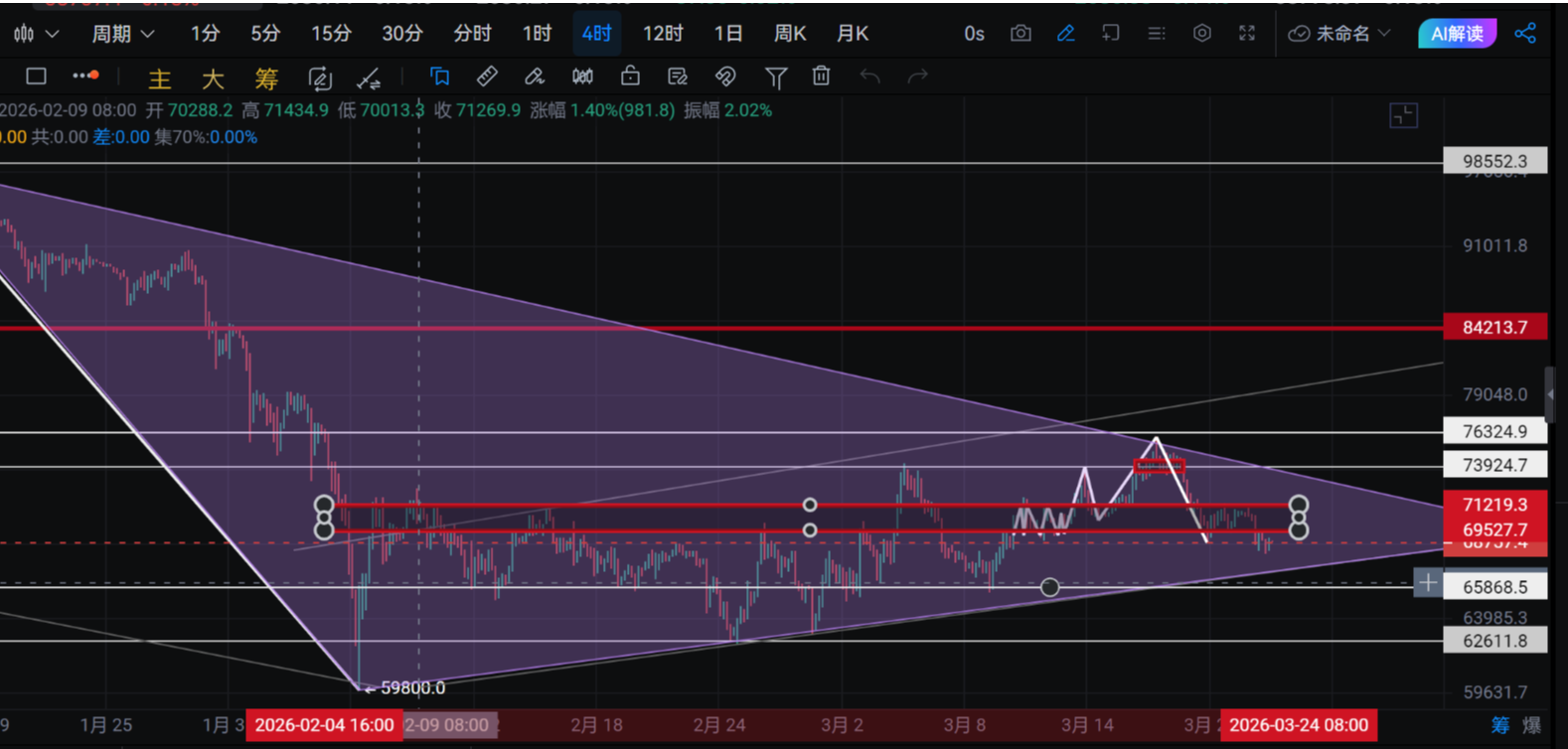
On March 22, 2026, East 8 Time, Bitcoin mining difficulty saw the second largest reduction in four and a half years. The confrontation between the US and Iran over energy corridors has escalated, small-cap tokens are experiencing significant control over circulating chips, and several seemingly unrelated events have overlapped on the same day in the report of risk assets. For miners, according to Golden Finance's calculations, under the current environment, some miners are facing an approximate paper loss of $19,000 for each Bitcoin mined; on the other hand, macro hedge funds are flexibly arbitraging on assets like gold, highlighting the structural pressure on funds with entirely different fates. In the context of rising geopolitical risks, cryptocurrencies such as Bitcoin should benefit from the "safe-haven" narrative, yet face the fundamental questioning of whether this narrative can persist amid the challenges of clearing hash power, concentrating chips, and regulatory shadows.
Rare downward adjustment in difficulty over four years: Miner steps...
In the past two months, Bitcoin mining difficulty has been continuously and significantly adjusted downwards: down approximately 11.16% in February, and another drop of 7.76% in March to 133.79 T, making this adjustment the second largest in four and a half years. The difficulty adjustment mechanism itself is merely an automatic feedback of price and hash power balance, but under high energy costs coupled with downward pressure on coin prices, this round of continuous "downward adjustment" feels more like a passive retreat of the hash power market rather than a brief fluctuation during industry expansion.
According to Golden Finance's calculation standards, under the current price and cost structure, some miners have to endure approximately $19,000 in losses on paper for each Bitcoin. This means that small and medium miners, who are already under tight cash flow, are the first to be pushed to the edge of shutting down, while large mining farms need to continuously sell off inventories or seek external financing to maintain operations. The short-term reduction in difficulty is advantageous for the remaining hash power to increase individual machine profits, but in the absence of substantial improvements on the cost side, it appears more like a mechanism to "buy time" rather than a fundamental solution to reverse profit structures.
Under such pressure, miner behavior is difficult not to affect on-chain supply and market sentiment. Some operating entities may choose to accelerate the reduction of their inventories to lock in still considerable fiat cash flows; marginal players might cut losses by shutting down, selling mining machines, or even migrating across regions, which could continue to lower the entire network's hash power in future adjustment cycles. A concentrated reduction in supply is often interpreted as a "miner surrender" signal, which, when combined with macro-negative factors, can amplify the market's imagination of downside risks, thereby dragging down sentiment and secondary valuations.
It is important to emphasize that the current data regarding "a loss of $19,000 per unit" does not have fully transparent statistical criteria and assumptions, and it is still unclear whether different regions' electricity prices, depreciation, financing costs, etc., are included. Treating this number as the true loss line for the entire industry is clearly not rigorous; investors are better off viewing it as a reference for stress ranges rather than an exact gauge to avoid being emotionally trapped by the narrative of "miners facing broad losses."
Shadow of hash power migration: Middle Eastern mining sites caught...
While the hash power market adjusts spontaneously, the geopolitical clouds over the Middle Eastern energy landscape add another layer of uncertainty to Bitcoin mining. On March 22, according to reports, The Iranian Revolutionary Guard threatened to close the Strait of Hormuz as one of the countermeasures against sanctions and military actions; the US responded with "all options are on the table," implying that actions against critical oil hubs, including Khark Island, remain possible. Once energy corridors are seen as pawns to be frequently upgraded, the entire region's electricity and infrastructure risk premiums will be reassessed.
The cost structure of Bitcoin mining highly relies on stable and cheap energy supply, and some countries in the Middle East have attracted a considerable scale of mining sites in recent years based on this reality. When the Strait of Hormuz and related energy facilities are placed on the geopolitical chessboard, these mining sites face not only price volatility but also extreme scenarios of power outages, limited power supply, and even asset security risks. Even if conflicts do not evolve into physical attacks, the expectations of risk alone can make hash power investments more conservative in regional layouts, with some projects that originally planned to migrate or expand to the Middle East potentially forced to delay or reroute to areas with more predictable regulatory and energy conditions.
Interestingly, if we apply the traditional asset hedging logic, in instances like the intensifying conflict between the US and Iran, gold and crude oil usually receive funding favor, while Bitcoin has often been packaged as "digital gold" in recent years. However, actual performances tend to be more complicated: the price fluctuations of cryptocurrencies during such windows of events often follow overall sentiment for risk assets rather than independently emerging as a safe-haven narrative. When funds evaluate their positions, they do not just ask "where is safe," but rather "where is there both volatility premium and liquidity exit," making Bitcoin, in the context of geopolitical conflict, at times a hedging tool and at other times a high-beta asset to be reduced.
If we extend our view to the assumption of "prolonged energy warfare," there is potential for the marginal costs of Bitcoin mining, the geographical distribution of hash power, and the regulatory risk premiums attached to it to be repriced. On one hand, regions with stable rule of law and energy policies may gain more voice during the migration of hash power; on the other hand, mining projects tightly bound to sensitive energy infrastructure will more frequently be included in sanctions, supply cuts, and regulatory investigations. Hash power will no longer just be a result of decisions based on technical and cost optimization, but increasingly a byproduct of geopolitical and financial compliance games.
Institutions arbitraging amid high volatility: From miners...
In stark contrast to miners struggling near the cost line, the operational pathways of macro hedge funds during the same time window create a vivid contrast. According to on-chain and position analysis account TheDataNerd, the institution Abraxas Capital recently closed its $GOLD short position, achieving approximately $2.67 million in paper profits. This operation bets on the price pullback of gold under specific macro narratives, and its timing is more influenced by interest rate expectations, risk-aversion sentiment, and liquidity conditions rather than the production cost curve of any single sector.
On one side are miners, who are passively shutting down production based on electricity prices and coin prices; on the other side are institutions that can flexibly switch their risk exposures between gold, commodities, and cryptocurrencies, facing completely different circumstances in the same macro volatility. The former has a rigid funding structure, with cash flow squeezed by both coin prices and mining difficulty; the latter seeks volatility premiums in futures, options, and cross-asset portfolios. This dislocation objectively exacerbates the market's "structural inequalities": when miners are forced to sell off assets due to losses, some hedge funds and trading institutions on the other end precisely harvest the gains from the resultant volatility.
Capital does not move linearly from "risk" to "safe-haven" between gold, crude oil, and cryptocurrencies, but rather switches strategies across different narratives and time scales. Once geopolitical conflicts escalate, gold may initially be snatched as a traditional safe-haven tool, crude oil may experience heightened volatility due to supply concerns, while Bitcoin sometimes serves as a "high-volatility chip" that can hedge certain funds’ expectations of fiat currency and inflation, but may also be the first to face reduction in the tightening liquidity environment. This path of "arbitrage first, hedging second" manifests that cryptocurrencies in macro storms act more as centralized conduits for liquidity and volatility.
However, it is essential to note that the specific profit figures regarding Abraxas Capital primarily derive from public tracking by a single analysis account and do not necessarily represent the general earning situation of the entire institution circle, nor can it be extrapolated to conclude that "institutions overall are profiting significantly in crypto and commodities." In the absence of systematic disclosure, such cases are more appropriate as samples for understanding institutional behavioral logic rather than statistical bases for investment decisions.
SIREN chips are highly locked...
Apart from macro and hash power games, risks related to the micro-level token structure are also amplifying the market's fragility. A small-cap token SIREN recorded about a 26-fold increase in a short time, and its controlling party has been detected to have consolidated about 66.5% of the circulating chips, corresponding to a market cap of about $1.04 billion. Such a high concentration of chips means this token presents a typical "high control market": prices can be easily pushed upwards in a narrow circulation, but once selling pressure is concentrated and released, a collapse can also occur in an extremely short time.
From the perspective of chip structure, high concentration means liquidity is essentially "locked in the hands of a few addresses," and the order depth seen by ordinary traders in the secondary market may not truly reflect the overall physical inventory. On one hand, this provides conditions for extreme short-term surges, where the controlling party can significantly drive prices with small incremental transactions; on the other hand, once liquidity runs dry at crucial moments, retail investors can easily lose their exit in a downward channel. This ease of rise and collapse is a direct portrayal of this structure.
The existence of extreme control contrasts sharply with the compliance and investor protection processes currently being experienced in the crypto industry. When regulators examine such cases, the focus will not only be on "whether the price has surged or plummeted" but will extend to whether information disclosure is sufficient, whether chip distribution constitutes de facto market manipulation, and whether the project party has engaged in misleading promotion, among other areas. For platforms and projects, the existence of such highly controlled tokens has, to some extent, delayed the pace at which mainstream institutional funds and conservative investors enter the field.
Currently, it can be publicly confirmed that the SIREN controlling address has completed large-scale consolidation on-chain, but whether these chips will choose to continue locking, sell in batches, or transfer to new holders through over-the-counter agreements remains undisclosed. In the absence of clear information, market narratives are often dominated by one-party project-led initiatives, and this severe information asymmetry itself is one of the sources of risk. Investors need to consciously maintain a certain distance from “official narratives” when facing such stories.
Dark corners of the on-chain world: From Brazilian wood...
The risks in the crypto world do not only stay at the price and chip level; foundational security and user-side attacks are also reshaping the landscape of market trust. Security research has revealed an Android malware disguised as a Brazilian social security refund application INSS Reembolso, which induces users to install it through phishing methods, thereby stealing their sensitive information and account permissions. Although the disclosure sources primarily center around a single security vendor, this case serves as a reminder that the security of on-chain assets is often breached at the weakest terminals and human links.
In the context of frequent attacks, some centralized platforms have begun to incorporate "full compensation for potential user losses" as part of their risk control and brand narrative. For example, when a platform halted USR related transactions, it emphasized that it would fully compensate potentially affected users, delivering a signal to the market that "even in the event of a black swan, the platform will cover it." The platforms are drawn into a "competition of responsibility" over risk control capabilities, compensation willingness, and security technology, which is actually pricing their own credit premiums.
Cybercrime, social engineering attacks, and platform credit narratives collectively shape retail investors' perceptions of the security of crypto assets. For general users lacking complex security configurations, whether to choose to self-custody wallets and whether to trust a particular exchange or custody institution largely depends on their subjective expectation of "whether someone will be responsible after a theft." Once this expectation is breached by significant events, it rapidly transforms into a risk aversion toward the entire segment, triggering funds to concentrate migration from long-tail assets to leading platforms and assets.
It should be noted that most information sources regarding such security incidents are highly concentrated in specific security companies or research institutions, and critical details such as attack chains, victim scales, and the amounts of losses are often difficult to obtain thorough cross-verification within a short time. In the absence of multi-party confirmations, over-reliance on single disclosures can easily result in "secondary disasters" in public opinion and sentiment. For investors, it is better to systematically examine device security, permission management, and platform selection risks based on their operational processes rather than amplifying imaginations in a state of panic.
Under the decentralized narrative: Who is paying for...
From miners' cash flow bleeding to the shadows of hash power migration under Middle Eastern energy games, to institutions arbitraging between gold and risk assets, the extreme structures of high-control tokens like SIREN, and the malicious software defenses in the dark corners of the on-chain world, March 22, 2026, presents a re-pricing landscape of the crypto market under multiple overlapping risks. Different participants are bearing drastically different pressures and opportunities at the same moment, and the entire market is being forced to reassess “who truly bears the risks.”
In this process, the narratives of "hedging, speculation, and games” operate in parallel yet are misaligned with each other. For some funds, Bitcoin remains a tool to hedge fiat, inflation, and geopolitical uncertainties; for others who value volatility premiums more, cryptocurrencies are merely chips that can be rapidly exchanged between macro narratives and thematic hotspots; while from the regulatory and institutional perspective, a long-term game between protecting investors and retaining innovation space is necessary. This diversification of narratives further differentiates the structure of investors while making it difficult for any single story to monopolize the interpretive authority in the market over the long term.
Looking ahead, the migration of hash power between different jurisdictions and energy environments, coupled with increased regulatory scrutiny in major economies and the constant exposure of security incidents, may prompt a portion of funds to actively flow back into leading assets and compliant channels. Leading assets inherently possess the capacity to absorb safe-haven and arbitrage funds during uncertain times due to their liquidity and brand effects, while compliant channels enhance institutional and conservative investors' willingness to participate through transparency and legal protection.
However, whether it's miner capitulation, institutional arbitrage, or geopolitical turbulence and security incidents, what we currently see seems more like the opening chapter of a new cycle rather than the conclusion. The subsequent evolution of the US-Iran situation, whether the risks related to the Strait of Hormuz manifest, and the trajectory of Bitcoin difficulty and hash power data in the upcoming adjustment cycles will all have a lasting impact on market sentiment and pricing logic. Interpreting current short-term volatility directly as "the ultimate answer" underestimates the complexity of geopolitical issues and overlooks the resilience of the crypto market's own adjustments and repairs.
Join our community, let's discuss and become stronger together!
Official Telegram community: https://t.me/aicoincn
AiCoin Chinese Twitter: https://x.com/AiCoinzh
OKX benefit group: https://aicoin.com/link/chat?cid=l61eM4owQ
Binance benefit group: https://aicoin.com/link/chat?cid=ynr7d1P6Z
免责声明:本文章仅代表作者个人观点,不代表本平台的立场和观点。本文章仅供信息分享,不构成对任何人的任何投资建议。用户与作者之间的任何争议,与本平台无关。如网页中刊载的文章或图片涉及侵权,请提供相关的权利证明和身份证明发送邮件到support@aicoin.com,本平台相关工作人员将会进行核查。