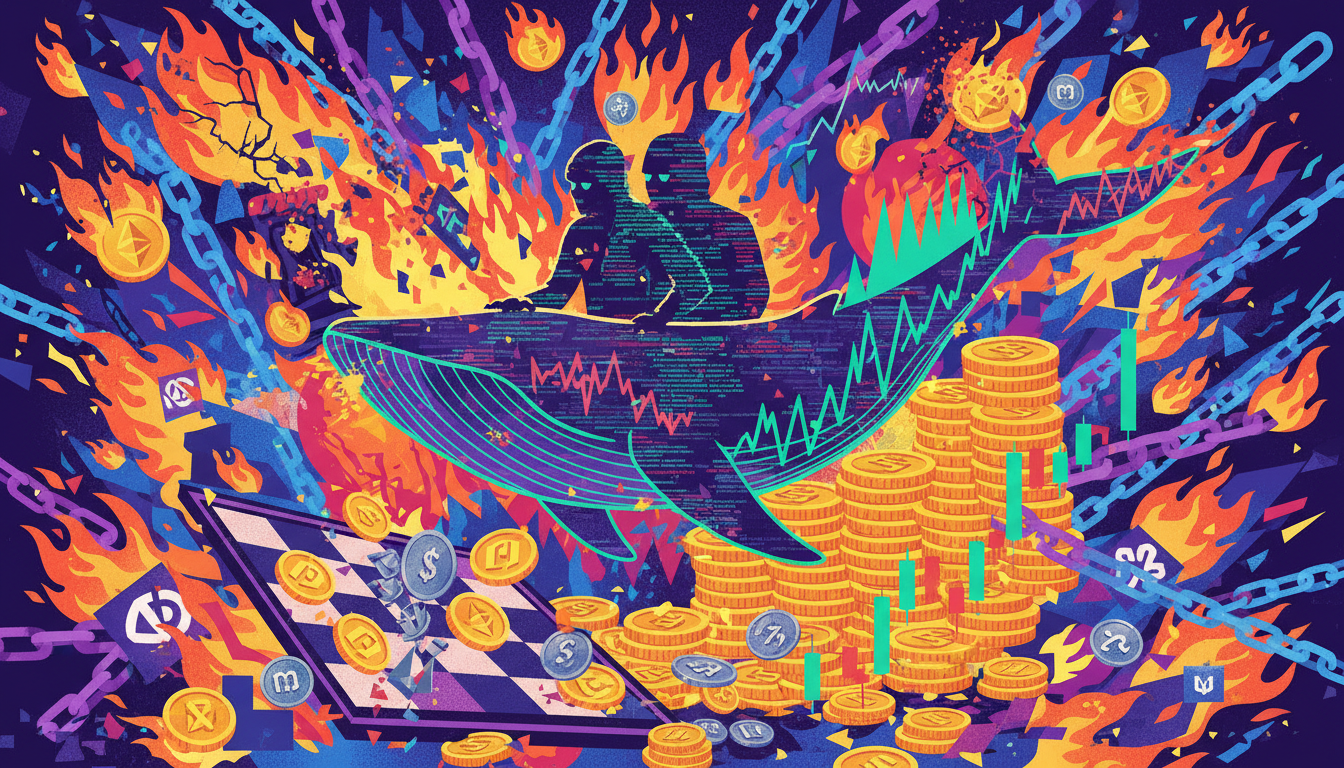
On March 22, 2026, East Eight Zone Time, the algorithmic currency USR issued by Resolv Labs suffered a fatal blow on-chain: the contract was exploited, and unauthorized large-scale issuance occurred, with newly minted USR rapidly sold off and converted into ETH. In a short period, the price of USR was directly breached from its anchor range, plummeting 93%-95% to 0.049-0.0701 USD, while the RESOLV token it was tied to also fell about 12%-13%, dropping to around 0.052 USD. The attacker profited approximately 11,422 ETH amidst the chaos, equivalent to about 23.66 million USD at the time. This incident not only shattered the so-called security myth of “algorithmic stability,” but also posed a sharper question to DeFi: when the algorithm anchor fails instantaneously, how much of the meticulously designed risk isolation between protocols can actually withstand the fire?
The Midnight of a 90% Plummet: USR's
Based on on-chain and market data retracement, the turning point of the day's attack and defense was the abnormal issuance of the USR contract. The attacker exploited the weak points of the contract mechanism to mint a large amount of USR far exceeding the normal range, with these new tokens not purchased from the market, but "generated out of thin air." Subsequently, this portion of USR was quickly dumped into the secondary market and related liquidity pools, exchanged for ETH in a concentrated sell-off manner in a very short time, amplifying the selling pressure instantly. Funds flowed from one side of the protocol to the attacker's address, and the price anchor was continuously breached in a short time, causing a cascading downward motion.
In terms of price, USR was directly knocked down from its original anchor price to the 0.049-0.0701 USD range, with a decline of as much as 93%-95%, almost a zeroing rhythm. At the same time, the RESOLV token, as the core asset of the ecosystem, was also sold off by the market, with the intra-day decline extending to 12%-13%, with the price falling to about 0.052 USD. This "double kill" of the "core asset + associated token" made the entire protocol switch from "normal operation" to "credit collapse" mode instantly.
If it were merely regular market selling pressure, even if the temporary drop was astonishing, buying and market-making mechanisms would still have a chance to buffer; however, this was due to the abnormal issuance caused by the contract being exploited, with the sell-off not stemming from panic emotions, but rather artificially magnified internal accounting within the protocol, essentially resulting in "systemically generated additional tokens," whereby any funds attempting to take on the load were paying for a flawed design. It is precisely for this reason that this plunge was not a severe but reversible market fluctuation, but a chain reaction resulting from the direct breach of design logic, rendering the entire price discovery mechanism ineffective.
The Algorithm Anchor Torn Apart: A Crisis of Trust
USR was packaged as an “algorithmically anchored” product, premised on the contract rules and incentive mechanisms being able to dynamically adjust supply and demand in different market environments, thus oscillating around a target price. However, when the contract itself contains defects that can be exploited for abnormal issuance, the so-called anchoring immediately shifts from "predictable adjustment" to "unlimited printing," with the algorithm no longer constraining supply, but becoming the leverage for attackers to manipulate asset pools. As long as the attack paths are opened, any finely designed parameters lose their meaning.
The plummeting data clearly illustrates this trust collapse: following the triggering of abnormal issuance and concentrated sell-off, the price of USR was directly smashed down to the 0.049-0.0701 USD range, with a drop of 93%-95%, almost equivalent to the market collectively abandoning the credit of this protocol in an extremely short time. The associated asset RESOLV decreased by 12%-13%, not because its own token model suddenly deteriorated, but rather because market expectations rapidly priced in the risks of the contract being exploitative and the algorithm anchor being unsustainable across the entire ecosystem.
The core conflict here lies in the extreme form of “point of trust” dependency on code correctness and incentive design in algorithmic products: as long as the algorithm operates normally, the anchoring has credibility; once a key link fails, with abnormal issuance and price feedback chains distorted, the system's reflexivity amplifies panic and sell-off, with users not distinguishing which line of code went wrong, but instead voting with their feet to exit altogether. This structure determines that a single point failure can trigger systemic stomping, rather than being limited to a small range failure of a given parameter.
Did the Firewall Work: Aave
After the incident, the first question asked in the DeFi sector was “will there be a chain reaction of liquidations.” Aave founder Stani.eth immediately stated, “The Aave protocol has no risk exposure to USR”. This simple statement embodies the entire firewall logic of mainstream lending protocols in terms of asset whitelisting, collateral parameters, and risk exposure management: only assets that have undergone strict evaluations will be included in the collateral and lending lists, and for high-risk or complex mechanism assets, exposures are simply not opened, effectively blocking potential contagion paths from the source. USR not being included in Aave's collateral pool ensured that this price crash did not spread through collateral liquidation channels.
Resolv Labs emphasized in an official statement that “the underlying collateral asset pool has not suffered losses”, indicating a certain degree of separation design between the "underlying collateral assets" and the "USR layer." The intention is that even if the USR price experiences severe fluctuations, the collateral asset pool will not be immediately depleted, theoretically reserving space for subsequent repairs, restructuring, and even user compensation. However, the limitations of this layered design are also very clear: when the issuance logic is exploited and assets within the protocol are massively exchanged for ETH and flow out, “the collateral asset pool not being damaged” is more of a temporal state description rather than a permanent security commitment.
From a counterfactual perspective, without Aave and other mainstream protocols' asset whitelisting isolation, if USR were widely accepted as collateral, the consequences of this collapse would not only involve the price of a single protocol halving, but also quickly transmit through the liquidation engine to lending pools, leveraged positions, and LP accounts, triggering cascading liquidations. Forced sales of quality assets to fill holes would further smash other asset prices, forming a “liquidity black hole.” This fire was kept localized largely due to the asset isolation and whitelisting system establishing a firewall in advance, rather than the system possessing inherent resistance to shocks.
The Disappearance of Twenty Million Dollars: Stolen
In terms of scale, the attacker profited about 11,422 ETH, equivalent to about 23.66 million USD at the time of the incident. On-chain data shows that this portion of ETH was quickly transferred out from the protocol side to the addresses controlled by the attacker, who then began to split and transfer it. Current public information can only sketch the preliminary outline of fund outflow from the protocol: concentrated at a few core addresses, then split into batches and moved interchangeably, with some nodes interacting with other on-chain services, displaying typical characteristics of “preparing for further laundering," though the details remain not entirely transparent.
Based on past incidents, the path of fund circulation seen in this case, including multi-hops and multiple address layers, is highly likely to overlap with common on-chain money laundering methods:
● Multiple address hops: Frequent transfers between new addresses aim to break down a single large sum into multiple small amounts, attempting to obscure the initial source and increase tracking difficulty.
● Cross-chain transfers via multiple bridges: Transferring ETH through cross-chain bridges to other public chain assets, then continuing to split; differing monitoring and compliance strengths on different chains can create temporary regulatory blind spots.
● Mixing services like tumblers: Pooling “clean funds” and “problem funds” into a unified fund pool, then disbursing according to proportion significantly reduces the traceability of individual transactions.
It is important to emphasize that in the currently available data, the specific whereabouts of about 104 ETH remain undisclosed, with related address and path information being absent. Because of this, subsequent on-chain tracking related to this over 20 million USD, along with collaboration from service providers and cross-border law enforcement cooperation, will likely become the focal point of the event's second half: how the attacker attempts to “launder” the funds, and how regulatory and analytical agencies progressively restore the funding map, will directly affect the ultimate cost and demonstration effect of this attack.
Next Steps for Algorithmic Stablecoins: Development
Looking back at the USR incident, the vulnerability of algorithmically anchored assets in extreme market conditions and exploited contracts has been magnified again. As long as there is room for the algorithm logic and contract permissions to be exploited, the anchoring promise can collapse within a few transactions, with the price free-falling by 93%-95%, with users not seeing “dynamic rebalancing” at first, but rather “credit clearing.” This also outlines a clear boundary for algorithmic products: any attempt to replace transparent collateral with complex algorithms must pre-empt the extreme scenario of “algorithm failure” rather than treating it as a black swan.
For protocol developers, building defense lines is no longer a simple “audit + on-chain” process, but a whole set of trade-offs from permission management, issuance control to real-time monitoring:
● Permission and minting limits: Minimize sensitive operations involving issuance and parameter adjustments in the contract, and introduce a hard minting cap or multi-signature mechanisms to avoid single point permissions turning into “unlimited printing machines” once leaked.
● Real-time monitoring and emergency mechanisms: Build real-time monitoring for abnormal minting and liquidity changes, automatically triggering alarms when the rate of issuance or fund flows deviates from normal ranges, and even preset “emergency freeze” options to limit further spread transparently. Of course, this will bring new value conflicts between “decentralization” and “emergency intervention,” needing to be clearly discussed in community consensus beforehand.
From the user's perspective, this incident directly exposed the risk blind spot of “focusing on returns without considering structure.” Whether participating in liquidity mining or holding such assets, investors need to seriously review three dimensions: firstly, whether the protocol is included in the whitelist of mainstream platforms, or explicitly excluded; secondly, whether there is clear isolation between underlying collateral assets and the issuance layer, and whether the collateral pool can independently survive in extreme cases; thirdly, the scale of risk exposure of the asset in other DeFi protocols, and whether, in the event of an incident, it will amplify losses through cross-protocol liquidations. Treating highly complex and singularly fragile algorithmic products as “robust income tools” often results in bearing the tail costs of systemic risks.
A Warning That Did Not Affect the Entire Network: Down
Returning to the starting point, the core of the USR incident is not complicated: the contract was exploited leading to abnormal minting, the algorithm anchor was torn open on-chain, and the price therefore plummeted to the 0.049-0.0701 USD range within a few transactions, with the associated token RESOLV also dropping, but the risk isolation mechanisms built by mainstream protocols like Aave temporarily blocked a broader systemic crisis. The fire was contained within the protocol and its neighboring assets, and the entire DeFi did not see an extreme scenario of “chain reaction liquidations day.”
However, this outcome of “only injuring a part without harming the whole” feels more like a combination of individual architectural designs and preemptive firewall effects, combined with a bit of luck, rather than being understood as “the industry being flawless.” Change the timing, alter the asset whitelist, or allow these algorithmic assets to gain broader collateral eligibility, the outcome may not stop at a single asset dropping by ninety percent, but rather the liquidation engine and liquidity pools simultaneously plummeting across multiple chains and protocols.
Looking forward to the future of algorithmically anchored assets and the DeFi ecosystem, real security iteration must shift from “post-remedy” to “pre-assuming failure”: at the outset of design, assume that the contract will be exploited, the predictive opportunities will fail, and the market-making will deplete, and based on this build isolation zones and circuit-breaker mechanisms; each attack should no longer just be a “one-off event” in PR announcements, but rather a hard metric for the next round of structural upgrades. Only when the system can maintain survivability amidst discrete failures, can the contributions of algorithms and decentralization to finance potentially deliver a “more robust” portion.
Join our community to discuss and grow stronger together!
Official Telegram group: https://t.me/aicoincn
AiCoin Chinese Twitter: https://x.com/AiCoinzh
OKX benefits group: https://aicoin.com/link/chat?cid=l61eM4owQ
Binance benefits group: https://aicoin.com/link/chat?cid=ynr7d1P6Z
免责声明:本文章仅代表作者个人观点,不代表本平台的立场和观点。本文章仅供信息分享,不构成对任何人的任何投资建议。用户与作者之间的任何争议,与本平台无关。如网页中刊载的文章或图片涉及侵权,请提供相关的权利证明和身份证明发送邮件到support@aicoin.com,本平台相关工作人员将会进行核查。