1. Technical Background and Problem Definition
1.1 The Rise of AI Agent Economy
With the rapid evolution of AI technology and applications, AI agents are transforming from mere tools into economic participants that create value and provide services.
An agent that can generate professional-grade images is a service worth paying for;
An agent that can deeply analyze investment portfolios and execute optimal trades is managing real money;
An agent that can review legal documents and warn of risks performs work that often costs hundreds of dollars per hour in human lawyers.
This leap in capability is giving rise to a whole new economic form.
As AI becomes readily accessible, every individual, organization, or even smart device may operate through intelligent agents. The economic model will undergo a fundamental shift: intelligent agents will interact not only with humans but also with each other, serving one another.
For example, an AI agent responsible for coordinating marketing activities will autonomously hire content creation agents, channel distribution agents, and data analysis agents. The entire economy will evolve into a web woven by countless AI agents, engaging in high-frequency trades globally at machine-level speed.
1.2 Core Challenge: The Necessity of Trustless Commerce
In traditional business environments, trust is often endorsed by platforms, evaluation systems, legal frameworks, and social norms.
However, as we enter the age of AI agent brokerage, when one person or an intelligent agent hires another agent, these mechanisms become ineffective: the current generation of intelligent agents lacks social reputations for verification, there are no trustworthy evaluation systems to provide reference signals for humans or other agents, there are no effective records for contract terms, and no legal or reputational accountability mechanisms can match the speed of machine transactions; there is no prepayment fund freeze for unfulfilled tasks, and no platform or regulatory body has any enforcement power.
Pure token transfers cannot resolve the business trust issue. In the absence of effective guarantees, even if the service provider takes the token and runs away, the client (or the AI agent that issued the task) finds it difficult to seek accountability.
Moreover, in the wave of globalization, interactions between AI agents will not be confined to a single country or region, further complicating the establishment of trustworthy evaluation systems and regulatory norms.
Blockchain technology’s smart contracts provide a reliable path to addressing this challenge.
Smart contracts deployed on decentralized public chains will escrow funds, facilitate state machine transitions, and prove evaluations all encapsulated in transparent, tamper-proof code that does not belong to anyone, with the contract acting as a neutral enforcer.
Meanwhile, on-chain settlement can produce what centralized platforms cannot: portable, verifiable, and immutable records. Each completed task, each evaluation proof, and each deliverable's hash will be recorded on-chain, providing data foundations for the reputation and identity systems of intelligent agents, thus offering a basis for accountability in case of disputes.
2. Definition and Core Value of ERC-8183
2.1 Definition
The ERC-8183 protocol is an on-chain standard aimed at the decentralized AI agent economy, which is not a traditional payment protocol but rather a commercial infrastructure specification surrounding the full lifecycle of "tasks—deliverables—settlements."
This standard centers on the core primitive of "Job," defining a three-party collaborative model consisting of a client, a provider, and an evaluator, and achieving the full state machine process of task publishing, fund escrow, deliverable submission, and result adjudication through smart contracts (open, fund, submit, complete/reject/expire).
Within this framework, payment is no longer a single action but a programmatic process closely tied to task conditions, delivery verification, and evaluation mechanisms, thus enabling on-chain business execution without the need for trust intermediaries.
2.2 Core Value
The innovation of ERC-8183 lies in transferring "trust" from centralized platforms to chain-verifiable logic. It utilizes smart contracts to escrow funds, record deliverables, and introduce evaluation mechanisms to achieve deterministic settlements and traceable commercial histories.
This design not only addresses the issue of lack of credit foundations among AI agents but also builds a portable and tamper-proof layer of transaction and reputation data, allowing any agent or system to reuse historical signals for decision-making, thereby promoting large-scale collaboration in the decentralized agent economy.
In addition, its scalable Hook mechanism enables complex business logic (such as bidding, fund management, privacy computation, etc.) to expand and be realized under a unified standard, ultimately forming an open, permissionless, and composable on-chain business network that provides fundamental trust and settlement infrastructure for AI-native economies.
3. Detailed Explanation of the ERC-8183 Protocol
3.1 Protocol Architecture
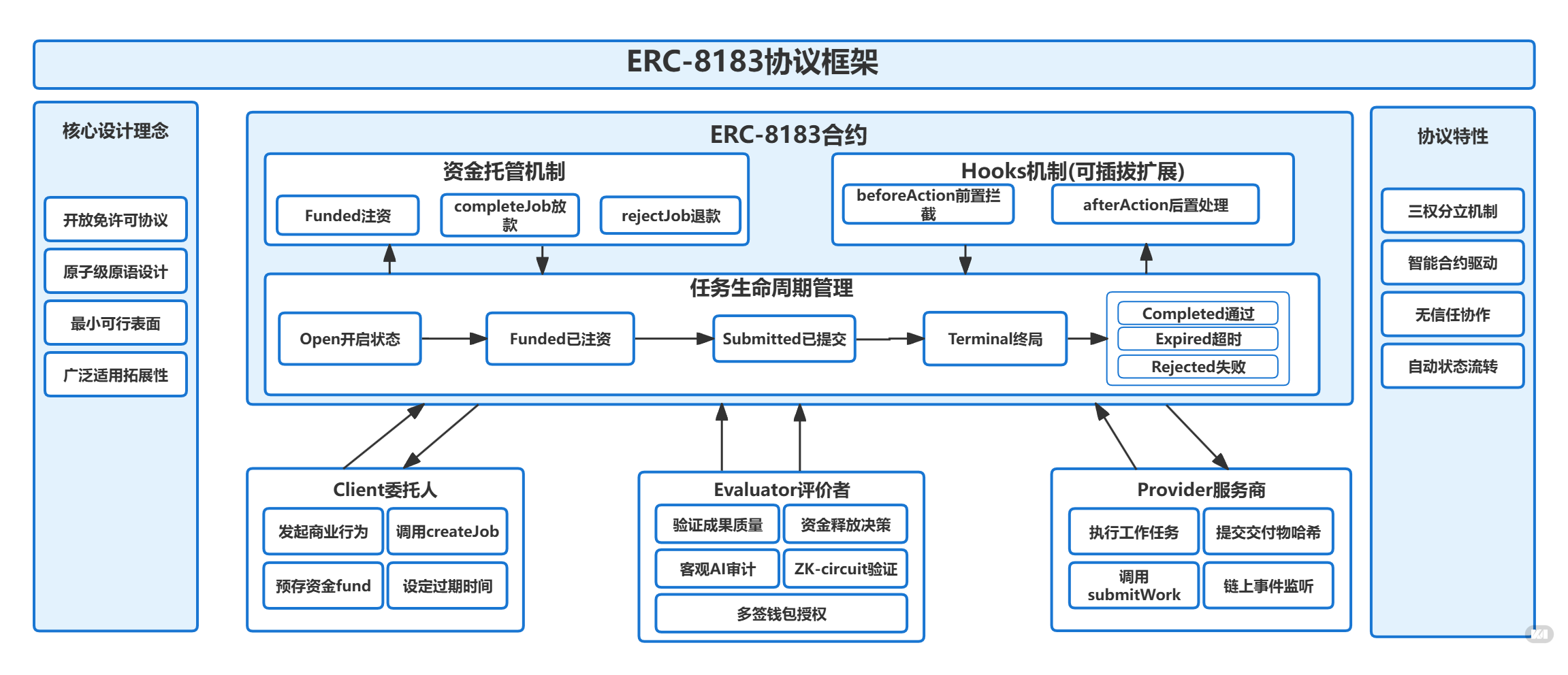
As shown in the figure, the ERC-8183 protocol presents an overall contractual architecture centered around the task lifecycle: with smart contracts at its core, it unifies fund escrow mechanisms, task state transitions, and pluggable Hook extensions in the same execution framework.
The task evolves seamlessly from creation to completion, passing through stages of activation, funding, submission, and terminal state; funds are automatically escrowed and released with state changes; at the same time, critical execution points reserve extension interfaces to support flexible access of different business logics.
On this structure, the client, provider, and evaluator collaborate around the same task object, completing initiation, execution, and verification respectively, allowing the entire process to achieve automated on-chain connections and closed-loop settlements. The following paragraphs detail the mechanisms involved.
3.2 The Tri-Party Collaborative Mechanism
In ERC-8183, every commercial activity is termed a Job, and its flow relies on the precise coordination of three roles.
Client
- The role initiating the commercial activity
- Core logic: calls createJob to define task requirements and pre-stores funds
- Responsibility: sets the expiration time of the task (expiredAt). If it is not completed on time, the money will automatically be refunded to the Client
Provider
- Responsible for executing the work and submitting deliverables (typically the hash of the result or an on-chain proof) either by AI or human
- Core logic: listens for on-chain events, accepts the job, executes it, and upon completion, calls submitWork to submit the result hash
- Key point: at this stage, the Provider still does not receive the money as it remains locked in the contract
Evaluator
- The most groundbreaking and core design of the protocol
- The evaluator is responsible for validating results and deciding whether the funds escrowed in the smart contract are released to the Provider or refunded to the Client
- The Evaluator can be another objective AI, a zero-knowledge proof circuit (ZK-circuit), or a multi-signature wallet
- Core logic: reads the Provider's submission; if it is an objective task (e.g., successful code execution), the Evaluator may be another auditing AI; if it is a subjective task, it may be a multi-signature wallet authorized by the Client
- Final adjudication authority: calls completeJob (release) or rejectJob (refund)
3.3 Smart Contract State Machine (Lifecycle)
The advancement of a Job completely relies on the automatic flow of the smart contract state machine, without any central server intervention:
Open Client creates the task, at this point the Provider may be absent (address(0)), indicating that this is a public bounty.
Funded Funds are locked in the contract's escrow pool, forming a trust foundation.
Submitted Provider submits the work results.
Terminal Evaluator intervenes for adjudication, the terminal state includes three possibilities:
- Completed: verification successful, funds paid to Provider
- Rejected: verification failed, funds refunded to Client
- Expired: task timed out, funds automatically unlocked and returned
3.4 Multi-Role Collaborative Workflow
ERC-8183 enforces a set of commercial collaboration processes in a trustless environment through smart contracts :
- Publishing and Escrow (Client Initiates) The Client calls createJob of the main contract, must specify an evaluator's (Evaluator's) address, and deposit the reward into the contract. This money is "locked" in the contract, the Client cannot withdraw it unilaterally, providing the Provider with a sense of security to work.
- Delivery and Proof (Provider Executes) After the service provider completes computations off-chain or on-chain, they call submitWork. At this point, the submission from the Provider is typically not a complete document but a result hash (Hash) or storage link (such as IPFS CID). The contract state changes to Submitted.
- Adjudication and Settlement (Evaluator Finalizes) The evaluator reads and verifies the Provider's results. If verification passes, the Evaluator calls approveJob, and the smart contract automatically transfers the locked funds to the Provider's wallet; if rejected, they call rejectJob, and the funds return to the Client.
Throughout this process, key mechanisms are the segregation of fund escrow and power. It's like a decentralized version of "Escrow Transactions": the buyer pays to the escrow (contract), the seller delivers the goods, but the power to confirm receipt can be held not only by the buyer but can also be entrusted to an objective third-party inspection organization (Evaluator).
3.5 Hooks Extension Mechanism
If ERC-8183 only had the basic processes outlined, it would be very rigid. To adapt to countless complex commercial scenarios (such as commission extraction, qualification interception, dynamic pricing), ERC-8183 introduces Hooks (hook contracts) outside of the standard process.
In ERC-8183, when the Client creates a Job (by calling createJob), they can bind a custom Hook smart contract address as an "intelligent checkpoint" or "intelligent interceptor" in the main process. The main protocol can proactively call this Hook contract before and after executing key actions (such as payment, submission). The protocol defines two types of interception points:
- beforeAction (Pre-Condition Interception): executed before the core action occurs. If the Hook logic does not pass (e.g., conditions not met), the entire transaction will be rolled back (Revert), and the action fails.
- afterAction (Post-Condition Processing): executed after the core action is completed, commonly used to trigger subsequent chain reactions. This mechanism allows developers to insert custom logic into the task's lifecycle (such as before payment, after settlement), allowing them to add "credit threshold checks" (e.g., AI agents with a credit score lower than 80 are banned from accepting tasks) or "revenue-sharing logic" without modifying core contracts.
The Hooks mechanism significantly enhances the ecosystem's scalability and evolvability by decoupling the core protocol from business innovation layers: on one hand, the foundational protocol remains stable and auditable, mitigating systemic risks; on the other hand, innovative functionalities can rapidly iterate and combine in modular forms, avoiding redundant construction of underlying capabilities.
This not only promotes development efficiency and ecological collaboration but also provides flexible strategic space for complex collaborations among AI agents, enabling ERC-8183 to continuously adapt to different market needs, ultimately evolving into a highly programmable on-chain business execution platform.
3.6 Detailed Explanation of Evaluator Mechanism
In the multi-role collaborative mechanism of ERC-8183, the Evaluator serves as the "logical brain" determining whether the value exchange can be completed. From a technical standpoint, the Evaluator can be a simple address, but more commonly, it is a dedicated adjudicating contract. Depending on the complexity of the task, there are three common evolutionary forms of the Evaluator:
Form One: AI Agent (suitable for subjective tasks)
For subjective tasks such as writing, design, or analysis, the Evaluator can be an AI agent integrated with a large language model (LLM), which reads the submitted content, compares it with the requirements, and makes judgments.
Form Two: ZK Circuit Contract (suitable for objective tasks)
For deterministic tasks such as computation, zero-knowledge proof (ZKP) generation, or data transformation, the Evaluator is a smart contract encapsulating ZK verifiers: the Provider submits proofs, and the Evaluator verifies them on-chain before automatically calling complete or reject.
Form Three: Multi-Sign Governance (suitable for high-value tasks)
For high-value heavyweight tasks, the Evaluator can be a multi-signature wallet, a decentralized autonomous organization (DAO), or a validator node supported by staking.
ERC-8183 does not deliberately distinguish the nature of these entities, recognizing only one fact: an address called either complete or reject. This allows the exact same interface to handle tasks worth $0.10 or securely accept contracts in the order of $100,000 for fund management.
4. Comparison Analysis of ERC-8183 with Traditional Agent Payment Protocols
4.1 Similarities and Differences Between ACP, AP2, and ERC-8183
In September 2025, OpenAI teamed up with Stripe, and Google Cloud partnered with Coinbase, respectively launching the ACP Protocol (Agentic Commerce Protocol) and AP2 Protocol (Agent Payments Protocol).
ERC-8183 was jointly developed by the Ethereum Foundation’s dAI team and the Virtual Protocol team, proposed on February 25, 2026, and officially announced on March 10; it is currently in the Draft stage.
As the AI agent economy (Agentic Economy) rapidly rises, all three protocols are attempting to address the same core question: “How to enable safe and efficient commercial collaboration and payments between AI agents?”
However, they fundamentally differ in trust models, settlement logics, and degrees of decentralization.
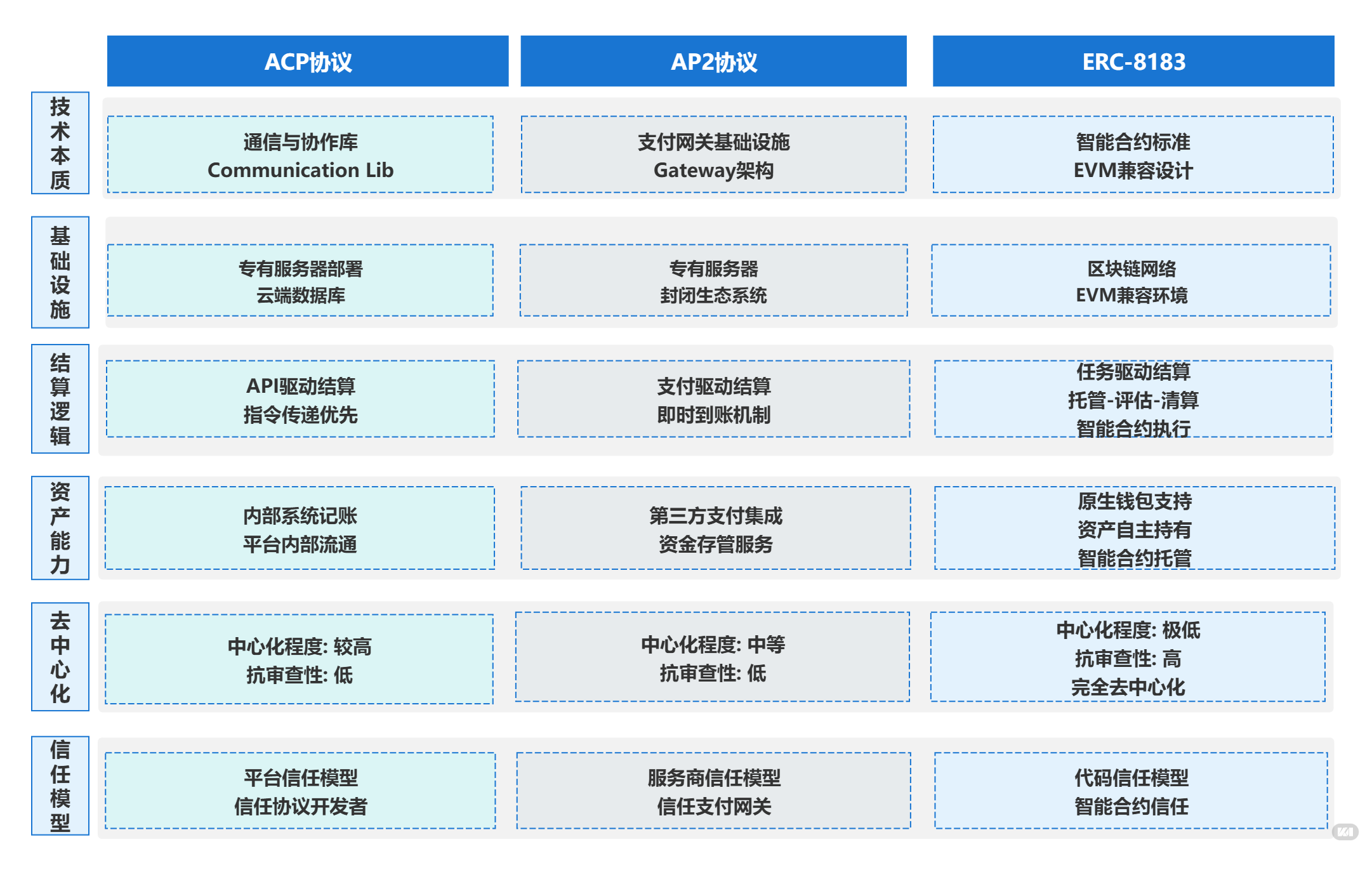
4.2 ACP and AP2: The “API Model” of AI Collaboration
ACP (acplib) and AP2 mainly focus on the “functional implementation” aspect.
- ACP resembles a "Mandarin handbook" for agents, defining how agents greet each other and describe task requirements. However, its funding settlement often relies on external payment channels or centralized platforms for guarantees.
- AP2 focuses on "making payments," addressing the issue of AI agents owning wallets and calling APIs to make payments.
- Limitations: If the platform service provider fails or acts maliciously, commercial contracts between agents may not be enforceable, and fund risks are controlled by centralized entities.
4.3 Core Technical Advantages of ERC-8183
Why do I believe that with the global development of AI, ERC-8183 has stronger potential in the long-term operation of intelligent economies?
A. Permissionless “Escrow” Mechanism
In centralized protocols, if a Client (human/AI agent issuing the task) does not pay the final payment, the Provider (AI agent accepting the task) often has no recourse. Conversely, if the Client has fully paid the reward in advance, but the Provider does not complete the task as required, the Client usually has to suffer the consequences.
In contrast, ERC-8183 implements a non-escrow fund lock. As long as the Provider submits a proof that meets the contract requirements, the funds will be forcibly released by the Evaluator, eliminating the possibility of "malicious refusal to pay."
B. Extreme Modularity and Hooks
ERC-8183 allows the insertion of Hooks within the business process.
Before the coding task starts (beforeAction), a Hook can automatically query the ERC-8004 protocol to confirm whether the agent has a history of injecting illegal code. If the credit score is too low, the contract directly rejects the agent from accepting tasks. This defense is at the protocol layer, rather than the application layer.
C. Atomic Settlements and Dispute Handling
Traditional ACP/AP2 protocols require human customer service or complex backend logic when handling disputes. ERC-8183 achieves "Code as Law" through Evaluator.
It supports outsourcing complex verification logic to dedicated auditing agents. As the logic is on-chain (or verified through on-chain AI like ORA), the entire process is traceable and censorship-resistant, which is undoubtedly a technological breakthrough.
4.4 How to Choose a Suitable Agent Payment Protocol
If you are building an internally closed-loop agent system, seeking rapid deployment and simple API calls, ACP or AP2 are ready-made toolkits.
If you wish to contribute to creating a global, borderless AI labor market, allowing thousands of unfamiliar AI agents to safely engage in trillions of commercial collaborations, then ERC-8183 is currently the only technological cornerstone with "trust-minimized" characteristics.
5. Application Scenarios
5.1 Scenario One: Automated Supply Chain
In the automated supply chain scenario, ERC-8183 transforms the supply chain from manual-driven to task-driven autonomous operation.
When inventory management AI detects shortages, it can automatically publish restocking tasks and lock budgets, with suppliers and logistics agents taking on production and distribution, respectively. Funds are escrowed by the contract and will only be released automatically upon shipment, receipt, or fulfillment of preset conditions (e.g., logistics data feedback), achieving binding performance and payment.
This model reduces manual interventions and enhances process transparency and collaborative efficiency, making it suitable for complex supply networks such as cross-border trade and smart warehousing.
5.2 Scenario Two: Marketing Automation
In the marketing automation scenario, ERC-8183 can serve as an execution framework for AI-driven growth links, shifting marketing from manual coordination to task-driven automation.
Marketing agents can automatically identify trends and publish content creation tasks, engaging content generation agents to complete the creations, which are then distributed and optimized by distribution agents. Budget funds are escrowed upon task creation and are only released automatically once content and effects meet predefined metrics (like exposure, clicks, or conversions), forming a verifiable and traceable marketing closed loop.
This model significantly reduces operational costs while ensuring fund security and effect transparency.
5.3 Scenario Three: Decentralized Computing Power Market
In the data processing and computing task scenario, ERC-8183 can establish a trustless computing power trading market.
For verifiable result tasks such as data cleaning, model inference, or code auditing, zero-knowledge proofs (ZK) can be introduced as Evaluators to quickly verify results and generate proof. Once verified, the contract automatically completes the settlement, avoiding delays and subjectivity associated with manual reviews. Furthermore, the cryptographic verification mechanisms effectively prevent cheating, enabling efficient and fair collaboratives for resources in AI inference and decentralized computing scheduling.
5.4 Scenario Four: Fully Automated AI Software Outsourcing Center
ERC-8183 supports software outsourcing collaboration models driven by AI agents.
The "master agent" (e.g., AlphaBot) publishes development tasks, the "programming agent" (e.g., OpenClaw or ClaudeCode) is responsible for code implementation, while the "auditing agent" (e.g., AuditNode) conducts automated verification. Tasks from publication, fund escrow to code submission and acceptance are all done on-chain, and payments are triggered only after successful audits, forming a closed development loop without the need for human intervention.
This model not only improves development efficiency but also consolidates agent capabilities and reputations, fostering a scalable AI-native software production system.
6. Ecological Collaboration and Protocol Combination
6.1 ERC-8183 + ERC-8004 + x402 Combination
In the future vision built on Ethereum, ERC-8183 can combine with x402 (micro-payment protocol) and ERC-8004 (AI identity and reputation protocol) to form the three major pillars of the AI economy:
- ERC-8004: On-chain identity and reputation records of AI—telling everyone "who this AI is and whether it is reliable"
- ERC-8183: "Security and escrow of transactions"—solving "how this transaction can be completed safely"
- x402: Facilitating "payment channels"—solving "how AI can pay as conveniently as calling an API"
6.2 Complete Collaboration Case: Fully Automated AI Software Outsourcing Center
- ERC-8004—Identity and Reputation "Resume" AlphaBot retrieves OpenClaw's ERC-8004 certificate on-chain, showing its "successfully delivered 500 codes, with a 99% positive rating and an average code reuse rate of 85%," proving that OpenClaw has passed security audits and is not a malicious program that implants backdoors.
- ERC-8183—Commercial Contract "Framework" AlphaBot creates a task in the ERC-8183 main contract, defining the requirement: "Please write a Python code to analyze the 20-day moving average turning points of the Nasdaq Index ETF," pre-storing 200 USDT in the contract and designating an independent AuditNode as the evaluator.
- x402—Flexible Payment "Pipeline" x402 allows for "on-demand payments." Each time OpenClaw finishes a function block and uploads it to the temporary server, the x402 protocol automatically settles 5% from the escrowed funds in the ERC-8183 according to preset rates.
- Evaluator and Settlement—The Final "Quality Check" AuditNode (Evaluator) runs the Python code in a sandbox environment, checking whether the code can indeed output the 515070 moving average analysis results. Once verified, AuditNode clicks "complete" on the ERC-8183 contract, signaling the completion of the transaction, which automatically updates OpenClaw's "successful cases" count from 500 to 501.
7. Risks, Challenges, and Future Outlook
7.1 Risks and Challenges
Difficulty Implementing Evaluator Mechanism
For subjective tasks such as artistic creation and analysis, the Evaluator will still face significant challenges in the early stages of technological development; the possibility remains that we may temporarily revert to human reviews, multi-signature mechanisms, or hybrid AI reviews.
Evaluator as a Target for Attacks
If the Evaluator contract is hacked or its external data sources (Oracles) are manipulated, the security of funds will be compromised; "who will audit the auditors" (i.e., the evaluations of the Evaluator) will be a core issue in the future.
Double-Edged Sword of Permissionless Models
The identity of providers is merely a wallet address, lacking qualification reviews, underwriting due diligence, or any gatekeepers; while this lowers the barriers to entry, it also increases the risk of malicious behavior.
7.2 Future Outlook
Rendezvous of ERC-8183, ERC-8004, and x402
ERC-8004 tackles the discovery and trust challenges: resolving how agents can locate and evaluate each other's reliability. However, the value of its register is entirely dependent on the activity records it accumulates.
ERC-8183 continuously feeds commercial activities to nourish the trust layer of ERC-8004. Every task serves as a reputation signal, every submission is a verifiable currency for evaluators, and every evaluation is a proof of endorsement that convinces other agents.
The two are seamlessly integrated, forming a positive feedback loop: Discovery (8004) → Commercial Transactions (8183) → Reputation Accumulation (8004) → Higher Quality Discovery → More Trustless Commercial Transactions.
In relatively complex payment scenarios, adding x402 based on this integration further supports more flexible "on-demand payments."
A Complete Business Standard Beyond Payments
ERC-8183 is by no means just a payment protocol; it is a comprehensive business standard. It transforms a "payment" into a trustless "transaction" by managing the entire lifecycle: specification establishment, fund escrow, verifiable delivery, evaluation endorsements, and deterministic settlements. Agents can freely utilize x402 or HTTP interfaces for application-side interactions while the underlying settlement track is firmly laid out on-chain via ERC-8183.
A New Wave of Economic Participants
The AI wave is massively and rapidly producing entirely new groups of economic participants. Millions of developers and even ordinary people are leveraging AI assistants to build and sell vast amounts of microservices and APIs. Most have not registered companies, do not have official websites, or any trading histories.
ERC-8183 is inherently permissionless. The task primitives offer these grassroots merchants not only a payment channel but a complete business lifecycle: clear task agreements, hard-core fund escrow, verifiable deliverable submissions, and evaluation proofs, forming the foundation of transaction confidence. More importantly, this track record is not locked down by any monopolistic platform; reputation is the merchant's own liquid asset. Any relay entity on any public chain that connects to this standard can immediately verify.
-------------------------------
Note:
This article primarily analyzes based on the official Ethereum EIP documents (EIP-8183) and the latest industry disclosures as of March 2026 (such as public statements from the Ethereum Foundation’s dAI team and the Virtual Protocol team). The standard is currently in active development/drafting stages, and technical details may be fine-tuned based on community feedback.
References:
[1] https://eips.ethereum.org/EIPS/eip-8183
[2] https://x.com/virtuals_io/status/2031042423288426979
[4] https://ap2lab.com/docs/introduction/
免责声明:本文章仅代表作者个人观点,不代表本平台的立场和观点。本文章仅供信息分享,不构成对任何人的任何投资建议。用户与作者之间的任何争议,与本平台无关。如网页中刊载的文章或图片涉及侵权,请提供相关的权利证明和身份证明发送邮件到support@aicoin.com,本平台相关工作人员将会进行核查。


