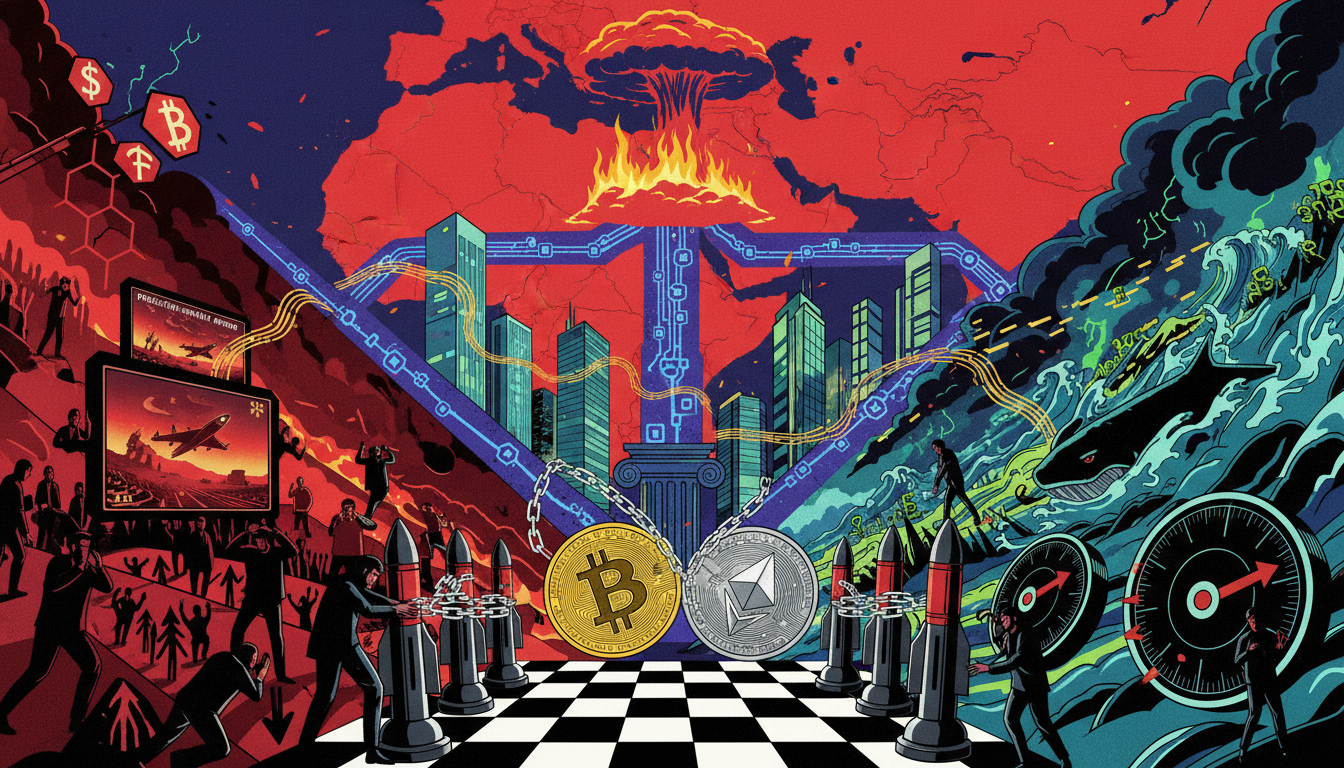
On March 21, 2026, Eastern Eight Time, a member of the prediction market platform Polymarket team, Mustafa, posted a teaser on X saying "There will be a major announcement next Monday," deliberately adding a coin symbol, immediately filling a previously calm timeline with imaginative possibilities. The community and media instinctively related this information to "a new round of financing" or "platform token issuance," but as of now, there has been no substantial confirmation from official sources. Meanwhile, after a recent rebound, Bitcoin has encountered resistance again, geopolitical conflicts, the U.S. and Israel's war with Iran entering its fourth week, and a net outflow of 253 million dollars from spot ETF funds have visibly weakened risk asset sentiment. A platform-level positive narrative is now intertwined with an overall cold market reality: can an as-yet-unrevealed positive expectation lift the gradually receding risk appetite, or will it merely become another short-term speculation "emotional firework"?
A coin symbol post ignites the expectations gamble
This teaser posted by Mustafa on X lacks lengthy explanations, no clear business keywords, only "major announcement next Monday" and a coin symbol. It is precisely this low information density and strong suggestive expression that quickly catalyzed a chain reaction of speculation and reposting within the crypto circle: from KOL retellings, to media quick reports, and then to screenshots circulating in the community, the narrative swiftly escalated from "an official statement" to "the entire net is waiting" within hours.
Surrounding this post, the community quickly formed several mainstream guesses: Firstly, a new round of large-scale financing, believing that Polymarket is expected to gather more mainstream capital after compliant prediction markets like Kalshi; secondly, a platform token issuance, with even visions of "dual benefits from financing + token issuance." Based on currently available information, these speculations largely stem from media interpretations and market associations, and have not received any official confirmation. The specific content of the announcement, financing parties and valuation information remain in an information vacuum. In other words, what the market is trading at this moment is a silhouette of a "presumed good news," rather than hard data that can be priced by models.
However, in the crypto world, expectations themselves are an asset that can be traded. A post with a coin symbol is enough to be packaged into a new narrative of "potential valuation reassessment" or "industry leader benefits are on the way," entering the emotional cycle of secondary markets. Community topics, media headlines, KOL tweets, and off-market chats continuously amplify this teaser, gradually transforming from "source of information" to a "consensus atmosphere"—whether it is rational is secondary; more importantly, it provides short-term funds with a story framework to bet on.
BTC rebound meets whale sell-off: risk appetite is contracting
In sync with the rising expectations for Polymarket, Bitcoin's price path tells a completely different story. According to market analyst Murphy, when BTC recently rebounded to the range of 70,000 to 71,000 dollars, on-chain monitoring detected large whale addresses choosing to sell heavily in this area. This means that even when prices briefly returned to previous highs, larger funds chose not to continue betting upward, instead actively reducing positions and cashing out in critical ranges.
At the same time, the mining company Bitdeer maintained a state of zero Bitcoin holdings, sending a clear signal to the market: in an environment of high volatility and increasing macro uncertainty, major players on the industrial side are also more willing to control risk exposure rather than "expressing assets" to endorse high optimism in pricing. Whale sell-offs at highs and mining companies clearing positions illustrate a collective picture of "large players shrinking risk."
The shadow of geopolitical conflicts has intensified this cautious sentiment. The war between the U.S., Israel, and Iran has entered its fourth week; statistics show that during this period, BTC prices have seen a weekly drop of approximately 5%, with market fears of "black swans escalating further" being repeatedly digested. On a macro level, risk-averse sentiment is rising, risk assets are under pressure, and the dominant narrative has shifted from "endless rise" to "potential abrupt halt at any moment." In this context, speculative funds are more inclined to take smaller positions and shorter cycles—rather than betting on direction with long-term allocations, they would rather engage in stepwise trading around short-term events like "positive announcements": pre-positioning, betting on volatility at the moment of release, and then exiting quickly. This choice is a natural response to the adjustment of market risk appetite.
ETF net outflows and on-chain anomalies: excitement is more fragile and short-lived
Shifting the perspective from individual behavior back to central funds, one can see a more intuitive "step back." The spot Bitcoin ETF has recorded a net outflow of 253 million dollars in the last two days, indicating that some of the institutional funds that previously flowed into crypto through compliant channels are now withdrawing and observing. Such funds are typically seen as relatively mild in risk appetite and long in decision cycles; their decision to reduce holdings pauses the market’s "upward imagination."
On-chain, there have also been notable movements that are difficult to interpret as a clear directional signal: 270.83 BTC were transferred from Bitstamp. The single transaction size is not extreme, but it is enough to remind the market that capital migration is occurring between "exchanges—on-chain—off-market." Whether this is structural turnover or temporary exit for risk isolation remains without more public details to substantiate, but it at least indicates that the location of funds is becoming more noteworthy than the price itself.
When funds withdraw from high Beta assets and turn to observation, any excitement brought by favorable announcements will naturally become more fragile and short-lived: lacking sustained support, upward price movements resemble emotional amplification under weak liquidity, rather than being led by structural funds entering the market for price reconstruction. In this configuration, short-term funds may choose to bet on assets related to Polymarket, using "announcement expectations" as tools for going long or hedging; but for larger mainstream funds, the current priority remains controlling drawdowns and compressing leverage, rather than betting heavily on opaque events.
Comparison of Kalshi's 10 billion financing: the valuation of the sector has risen, but imagination does not equal reality
To understand why the market is willing to attribute such high weight to a teaser from Polymarket, one must take a look at the entire prediction market sector. According to public reports, the compliant prediction platform Kalshi has completed a financing round of over 1 billion dollars led by Coatue, with leading mainstream capital collectively betting, significantly enhancing this niche sector's status from the perspective of traditional finance and technology investments: prediction markets are no longer just marginal products but are regarded as one of the infrastructures potentially accommodating larger-scale financialization demands.
Kalshi's size, compliant path, and capital structure provide a visible valuation anchor for the sector. Capital will naturally use it as a reference to reassess the potential upper limits for projects in the same sector: if the compliant path is clearer and market education is gradually completed, platforms like Polymarket, which are closer to crypto-native communities and possess strong topic amplification capabilities, theoretically also have an opportunity to be included within the "high growth upper limit" imaginative framework. However, in the absence of specific valuation and financing round information on Polymarket, such benchmarking can currently only remain at the level of "range imagination," and not serious modelable numbers.
For the secondary market, "benchmark-like imagination" is the most easily transacted and prone to becoming the material for bubbles: on one hand, Kalshi's over 1 billion dollar financing brings enhanced visibility to the sector; on the other hand, Polymarket's significant announcement remains undecided, and both are naturally stitched together by public opinion, generating narrative premiums. Once the announcement's content is interpreted by the market as a signal of "moving closer to Kalshi," valuation imagination will be rapidly pushed higher; but if follow-up information disclosure and real business progression cannot keep up with the expectations being hyped, these premiums will also be squeezed out at the same speed, leaving a spike in prices and backlash in sentiment.
Narrative and game intertwine: from pre-announcement positioning to result unveiling
In such a narrative field, the typical trading path before and after the announcement can almost be scripted: first is the pre-positioning phase, where knowledgeable or self-perceived "earlier informants" begin to slowly build positions in related assets, and community sentiment shifts from discussion to betting; next is the moment of announcement landing when prices surge, with the announcement published and media simultaneously pushing, rapidly pushing prices higher against a backdrop of relatively limited liquidity; finally, there is differentiation and selling in the expectation realizations phase, with some choosing to "sell at first sight," while others expect "a second wave of rising," causing increasing long-short divergences and amplified volatility.
Behind this is the long-term game of retail and institutional players under information asymmetry: who is manufacturing expectations, who is using expectations to complete liquidity conversion. The resource-advantaged side can layout in advance during the information haze and then amplify fluctuations through topic dissemination and sentiment guidance, ultimately achieving the transfer of chips when the announcement lands or emotions peak; while the information-disadvantaged side often can only be passively entering when "everyone is discussing," taking on higher price risks.
If the content of Polymarket's announcement falls short of the high expectations of "financing + token issuance" constructed by the market itself, the risk of a踏踏踩 can not be ignored. Price levels may experience "high open low close" or even "needle-like pullbacks," while sentiment can swiftly shift from excitement to disappointment or even anger, making it easy for some high-leverage funds to be liquidated in such instant reversals. Conversely, if the announcement exceeds current mainstream expectations—such as bringing genuinely unexpected signals regarding business layouts, capital support, or compliance progress—then the next key lies in whether it can resonate with the macro environment and funding conditions: whether ETF outflows slow down, whether geopolitical risks temper temporarily, and whether whales and mining companies begin to re-add positions. Only when these external conditions align can Polymarket's positive narrative have a chance to evolve from a "noise event" into a part of a new narrative thread, rather than a fleeting local carnival.
From suspense to realization: Polymarket will become a thermometer, not a savior
Integrating current information reveals a somewhat ironic pattern: against the backdrop of macro coolness, capital withdrawal, and whales selling at highs, the market focuses a significant amount of attention and chips on an as-yet-undisclosed positive announcement. For Polymarket, this demonstrates the emotional appeal of the prediction market sector; but for the overall market, it resembles a "lack of mainline emotional reliance."
During this phase of highly incomplete information, any imagination related to financing or token issuance requires sufficient restraint. For traders, it is more important to clearly differentiate: Am I trading a narrative, or betting on a fundamental change that has already occurred? The former entails accepting higher emotional volatility and shorter holding periods, while the latter requires more solid data and logical support. Blurring the lines between the two is often the starting point for being "educated" by the market.
A more pragmatic strategy is to view this Polymarket announcement as a window to observe—a thermometer for the prediction market sector and risk appetite. The announcement content, market response, price curve, and transaction patterns over the next few days will collectively inform us: in an environment of geopolitical conflict, ETF net outflows, and major players contracting risk, whether the market is still willing and able to pay premiums for new narratives.
Regardless of the ultimate strength or weakness of the announcement, the market will provide a quick and direct answer through prices. For every participant, the more critical question is not "Is the news good or bad?" but: in this uncertain theater, is my leverage manageable, and can my positions withstand the pullbacks after a miss or excessive excitement? Prioritizing risk management over narratives may indeed be the most valuable lesson from this round of suspense.
Join our community, let's discuss together and become stronger!
Official Telegram community: https://t.me/aicoincn
AiCoin Chinese Twitter: https://x.com/AiCoinzh
OKX welfare group: https://aicoin.com/link/chat?cid=l61eM4owQ
Binance welfare group: https://aicoin.com/link/chat?cid=ynr7d1P6Z
免责声明:本文章仅代表作者个人观点,不代表本平台的立场和观点。本文章仅供信息分享,不构成对任何人的任何投资建议。用户与作者之间的任何争议,与本平台无关。如网页中刊载的文章或图片涉及侵权,请提供相关的权利证明和身份证明发送邮件到support@aicoin.com,本平台相关工作人员将会进行核查。