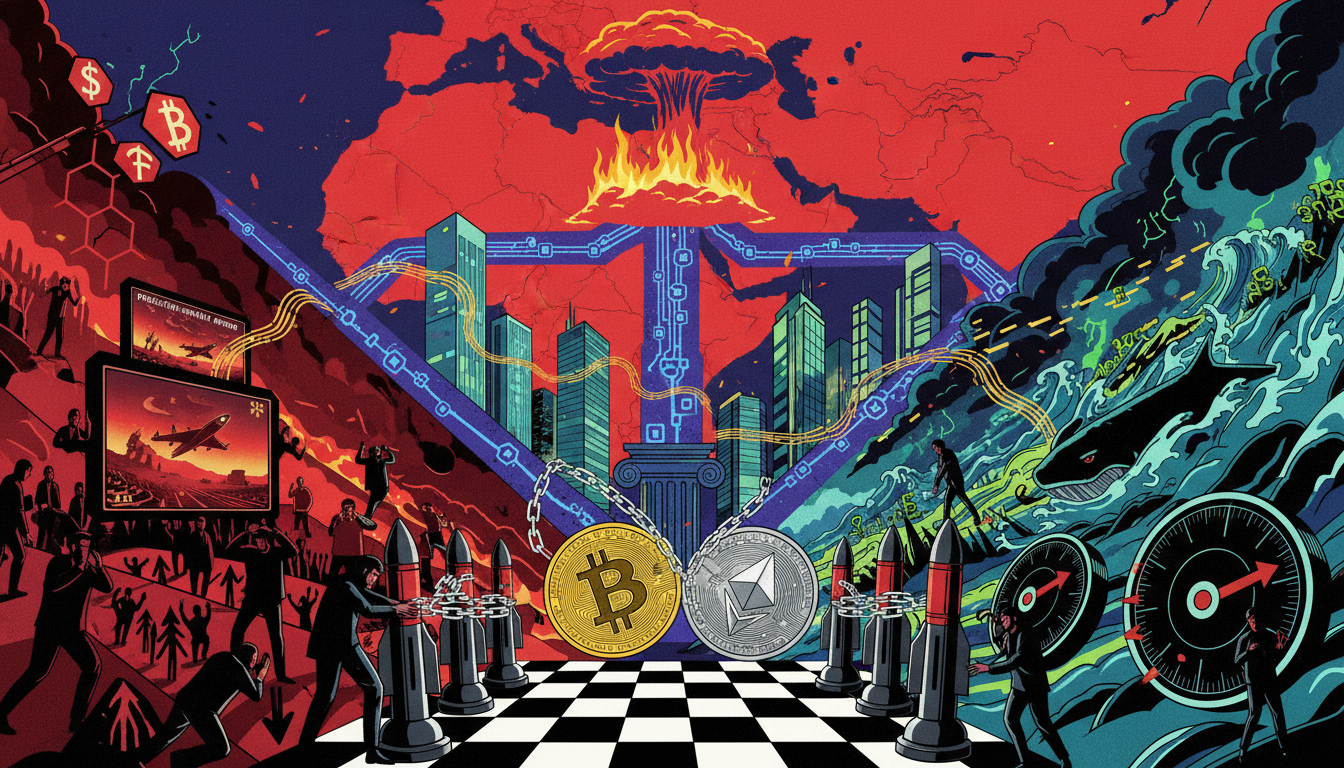
This week, under the Eastern Eight Time Zone, the Middle East situation and the Federal Reserve's path, which were originally parallel clues, began to intertwine: on one side, the escalation of the Israel-Iran conflict ignited systemic concerns over energy and trade chains; on the other side, the market, which was originally confident in “interest rate cuts within the year,” was suddenly forced back onto the track of “renewed interest rate hike expectations” by inflation that was higher than expected and strong employment data. Under the resonance of these two forces, global stocks, bonds, currencies, and precious metals experienced synchronized turbulence, US Treasury yields soared, global bond market yields reached new highs in years, while gold, seen as the ultimate safe-haven asset, fell sharply by about 11% in a week, marking the largest single-week decline since 1983, and the traditional logic of “safe-haven = gold + US Treasury” was decisively broken. As the safe-haven sequence was forced to be rearranged, an increasingly realistic question was presented before the funds: in the current context of amplified geopolitical risks and prolonged high interest rate shadows, why are institutions and big players beginning to reassess the position of cryptocurrencies like Bitcoin in the safe-haven landscape?
The Middle East Front Ignites the Market: Synchronized Misalignment of Stocks, Bonds, and Currencies
The Israeli Defense Forces targeting Tehran propelled the previously existing tension, which had remained at the level of “verbal warfare” and proxy conflict, toward a more direct sovereign confrontation. The market quickly began to price in a larger-scale Middle Eastern conflict: not only the war itself but also the potential ripple effects on energy supply, shipping routes, and global trade chains. Once crude oil and transportation costs rise, the risks of a resurgence of inflation would be amplified, and the price pressures that the US and Europe had worked hard to suppress might resurface within weeks or even months.
This geopolitical escalation did not exist in isolation but was superimposed on an already fragile asset price structure. On certain trading days, the Nasdaq fell more than 2% in a single day, with technology stocks and high-valuation growth stocks being the most affected, while global bond market yields continued to rise, with several key maturities hitting new highs in years, reflecting a massive retreat of capital from risk assets such as stocks, concentrating towards the dollar and US Treasuries. The strengthening of the US dollar index and soaring Treasury yields constituted a typical combination of “cash is king” and “high interest rate refuge,” compressing the pricing space for all risk assets.
Even more lethal is that this round of shocks compounded the previously accumulated pressures of inflation and fiscal deficits. The energy and security premiums triggered by the Middle East situation led the market to re-examine the question of “how long will high interest rates last,” as fear expanded from “will there be another rate hike” to “will it remain high for a longer time.” Geopolitical conflicts triggered a repricing of commodities and supply chains, while high deficits and debt issuance demands forced investors to reassess the risk compensation of bonds at higher yield levels – interwoven, the “longer and higher” rate path transitioned from policy discussion to a real threat.
Resurgence of Federal Reserve Rate Hike Expectations: 30% Probability Tears Apart the “Rate Cut Consensus”
In this context, market expectations for the Federal Reserve's policy trajectory underwent a significant reversal: the probability of interest rate hikes returned to around 30%, marking a drastic shift compared to the previous consensus around multiple interest rate cuts within the year. The loosened cycle, which was originally seen as a “matter of time,” has now been repackaged as an “uncertain event,” directly elevating the instability of all asset discount rate assumptions, as the pricing model shifted from “how to benefit from easing” to “how to endure prolonged high interest rates.”
According to public reports from Bank of America, the current market pricing of interest rate hikes is not unfounded, but rather tied to three major conditions: first, the labor market must maintain overall stability, and employment data cannot significantly worsen; second, inflation needs to continue to rise or remain sticky at least on stubborn indicators; third, Federal Reserve Chair Powell's tenure and policy continuity must be confirmed. These three conditions together constitute the threshold for interest rate hikes, explaining why even a probability of about thirty percent is sufficient to trigger a substantial reassessment of asset prices — because it strikes at the foundation of the market's previous narrative of “soft landing + steady rate cuts.”
The repricing of interest rate expectations formed multi-layered transmission to the stock market, foreign exchange market, and global liquidity. Firstly, the discount rate at the stock market valuation end has been generally elevated, systematically compressing the intrinsic value of high-growth, long-duration assets; secondly, the dollar has strengthened under the dual support of “high interest rates + safe-haven demand,” creating pressure on non-US economies and commodities, forcing some emerging markets to tighten in tandem, further draining global liquidity. This macro environment has laid the groundwork for the later “counter-trend plunge” of gold and the relative resilience of Bitcoin: when high interest rates return to the forefront, the competition between safe-haven assets becomes a matter of “who can survive under yield and liquidity pressures.”
Gold Plummets 11%: Cracks in the Traditional Safe-Haven Anchor
In the traditional textbook scenario of “war + interest rate hike expectations,” gold should have been the biggest beneficiary. However, COMEX gold futures fell by about 11% in a single week, marking the largest single-week decline since 1983, creating a strong sense of temporal misalignment. Geopolitical tension did not push gold prices higher; instead, under the reflection of high interest rate panic and tightening liquidity, it evolved into a concentrated selling of precious metal positions, where traditional safe-haven paradigms were ruthlessly torn apart by market realities.
To explain this “abnormal” behavior, interest rates and leverage are keywords that cannot be overlooked. Gold, as a non-yielding asset, faces sharply rising opportunity costs in a high interest rate environment — holding one ounce of spot gold or an additional long position means forgoing more certain interest income, especially in a phase where short-term and medium-to-long Treasury yields are soaring together. Meanwhile, as bond and dollar yields rise, some institutions and speculative funds using leverage to hold gold face dual pressures of increasing margin demands and soaring financing costs, causing the pressures to de-leverage and add margin to rapidly amplify the downward momentum of prices.
Historically, gold usually plays the role of the “last buyer” during multiple rounds of crises: whether it is a financial crisis, sovereign debt risk, or geopolitical conflicts, it often strengthens amid simultaneous declines in stocks and bonds. However, this round of declines seems more like a shift in pricing power — from a narrative of geopolitical safe-haven to a new order where “interest rates and liquidity matter most.” In the current context of slowing central bank balance sheet expansion, rising real dollar yields, and more sensitive institutional risk control models, gold is no longer the only “unconditional safe-haven anchor,” but rather included in a basket of assets that need to balance interest rate costs and liquidity constraints.
Initial Resilience of Crypto Assets: From Bitcoin to the Emergence of “Digital Safe-Haven”
In contrast to the extreme conditions of gold, the internal cryptocurrency market presents a vastly different picture. Cryptoquant analyst Darkfost pointed out that under the dual impact of a bear market environment and geopolitical uncertainties, altcoins have continued to underperform Bitcoin, with funds contracting layer by layer, and risk appetite undergoing a “de-leveraging + short-tail” rebalancing within crypto. This means the market has not collectively abandoned crypto assets but has completed a round of risk-off migration towards leading assets within the system.
Bitcoin's performance in a high interest rate and conflict environment is especially significant. Compared to the more than 2% large drop in high-valuation tech stocks like the Nasdaq in a single day and a 11% plunge in gold over a single week, Bitcoin's retracement at multiple key points has been more controllable, with some phases even showing relative rebounds. This “relative resilience” strengthens its narrative as a “digital safe-haven asset.” Although Bitcoin itself remains highly volatile, it is gradually transitioning from a high-beta speculative product to an alternative configuration target with hedging value in specific macro scenarios among a basket of assets.
From the perspective of funding behavior, a commonality during high volatility phases is that funds prefer the most liquid, clearest narratives, and the highest institutional participation assets. For the crypto market, this means that Bitcoin receives “safe-haven buying” preference over the vast majority of altcoins, while smaller market cap, illiquid, and less convincing projects become the first sacrificial victims of de-leveraging. This is not only a hedge iteration between traditional assets and crypto assets but also a case of “survival of the fittest among safe-haven assets”: within gold, there is a migration from high-leverage speculative positions to central banks and long-term holders, while within crypto, there is a concentration from long-tail altcoins to Bitcoin and a very small number of leading assets.
Micro-Slice of Rebalancing Funds: Contrasting XRP ETF and XAUT
If we narrow the perspective down to specific fund flows, we can observe micro slices of rebalancing among institutions and large players between stocks, bonds, gold, and crypto. For example, a certain XRP ETF recorded a net inflow of about 1.9782 million USD in a single day, indicating that even in an overall cautious macro environment with a shrinking risk appetite, some capital still chooses to gradually establish or increase crypto exposure through compliant financial products. Such ETFs provide a more controllable compliant framework and liquidity channels, allowing traditional capital to experiment in crypto assets under measurable risks.
In sharp contrast, the token linked to gold has faced passive de-leveraging. Some on-chain data indicates that two major addresses collectively suffered losses of about 1.73 million USD from selling XAUT during gold's plummet. This not only reflects the direct impact of falling gold prices on the valuation of on-chain assets but also reveals the vulnerability of the dual leverage structure of “physical + on-chain” in extreme market conditions. When spot gold crashes trigger risk control, relevant linked tokens often simultaneously endure redemption pressure and margin pressures, forming a chain-selling pressure that transmits from the traditional market to the on-chain world.
These seemingly scattered fund flows, however, show a high degree of consistency in the macro picture: on one side, through mainstream compliant products like XRP, there is a tentative allocation of crypto exposure; on the other side, the proportion of on-chain assets linked to physical gold is passively cut back during gold’s drop. Institutions and large players are utilizing ETFs, on-chain assets, and traditional stock-bond commodity combinations to continuously adjust their positions among different assets in a small-step, fast-running manner, reconstructing their “safe-haven portfolios.”
Redrawing the Landscape of Safe Havens: A Starting Point of New Narratives Rather Than an Endpoint
Looking at this round of shocks, geopolitical conflicts and interest rate hike expectations do not simply overlap but constitute a pressure test for “safe-haven consensus.” The escalation of the Israel-Iran conflict has amplified energy and safety premiums; the rise in the probability of Federal Reserve rate hikes to around 30% has pushed asset discount rates and financing costs higher. Under the influence of these dual forces, the long-term consensus that “gold = ultimate safe-haven anchor” faced an unprecedented challenge, with gold falling instead of rising under the shadow of war, and its single-week plummet of 11% became the most concrete annotation in this cognitive reconstruction.
In such an environment, crypto assets have not instantaneously replaced gold, nor can it be said that they have firmly claimed the “new safe-haven throne.” The reality is closer to a transitional state: Bitcoin, with its relative resilience and narrative advantage, is vying for the discourse power of “digital safe haven” amidst a continuing underperformance of altcoins and a layered contraction of capital; while a large number of long-tail tokens, under the squeeze of high interest rates and regulatory games, reveal their liquidity and fundamental weaknesses. The function of safe-haven is transitioning from “asset category labels” to a refined selection of “specific assets + specific scenarios.”
Looking ahead to the next few quarters, the Federal Reserve’s policy path, the evolution of the Middle East situation, and the structural adjustments in institutional asset allocation will continuously reshape the landscape of safe havens in a high-dimensional game. For investors, what is truly worth focusing on is no longer the price volatility of a day or two, but the resonance signals of macro data (inflation, employment, interest rate expectations) and on-chain fund flows (ETF subscriptions/redemptions, movements of whale addresses): how does monetary policy change risk appetite baselines? How do geopolitical events trigger rebalancing? How does traditional capital layer in through compliant products and on-chain assets? Strategically positioning at these intersections is much more likely to find one’s pricing power in the reconstruction of the next round of safe-haven narratives than merely tracking the short-term fluctuations of a single asset.
Join our community to discuss and become stronger together!
Official Telegram Community: https://t.me/aicoincn
AiCoin Chinese Twitter: https://x.com/AiCoinzh
OKX Welfare Group: https://aicoin.com/link/chat?cid=l61eM4owQ
Binance Welfare Group: https://aicoin.com/link/chat?cid=ynr7d1P6Z
免责声明:本文章仅代表作者个人观点,不代表本平台的立场和观点。本文章仅供信息分享,不构成对任何人的任何投资建议。用户与作者之间的任何争议,与本平台无关。如网页中刊载的文章或图片涉及侵权,请提供相关的权利证明和身份证明发送邮件到support@aicoin.com,本平台相关工作人员将会进行核查。