Fitch Ratings reported that its Privately Monitored Ratings (PMR) default rate reached 9.2% for full-year 2025, marking a sharp increase from 8.1% the year prior and exceeding commonly referenced bank-loan peaks from the global financial crisis.
The figure has quickly circulated across financial circles, amplified by viral charts and market commentary pointing to the sheer scale of the private credit sector — now estimated at roughly $1.8 trillion in assets under management.
Private credit, often described as direct lending, involves nonbank institutions extending loans to middle-market companies. These borrowers typically fall below $100 million in EBITDA and rely on financing for buyouts, refinancing, or expansion — a niche banks largely retreated from after post-2008 regulatory tightening.
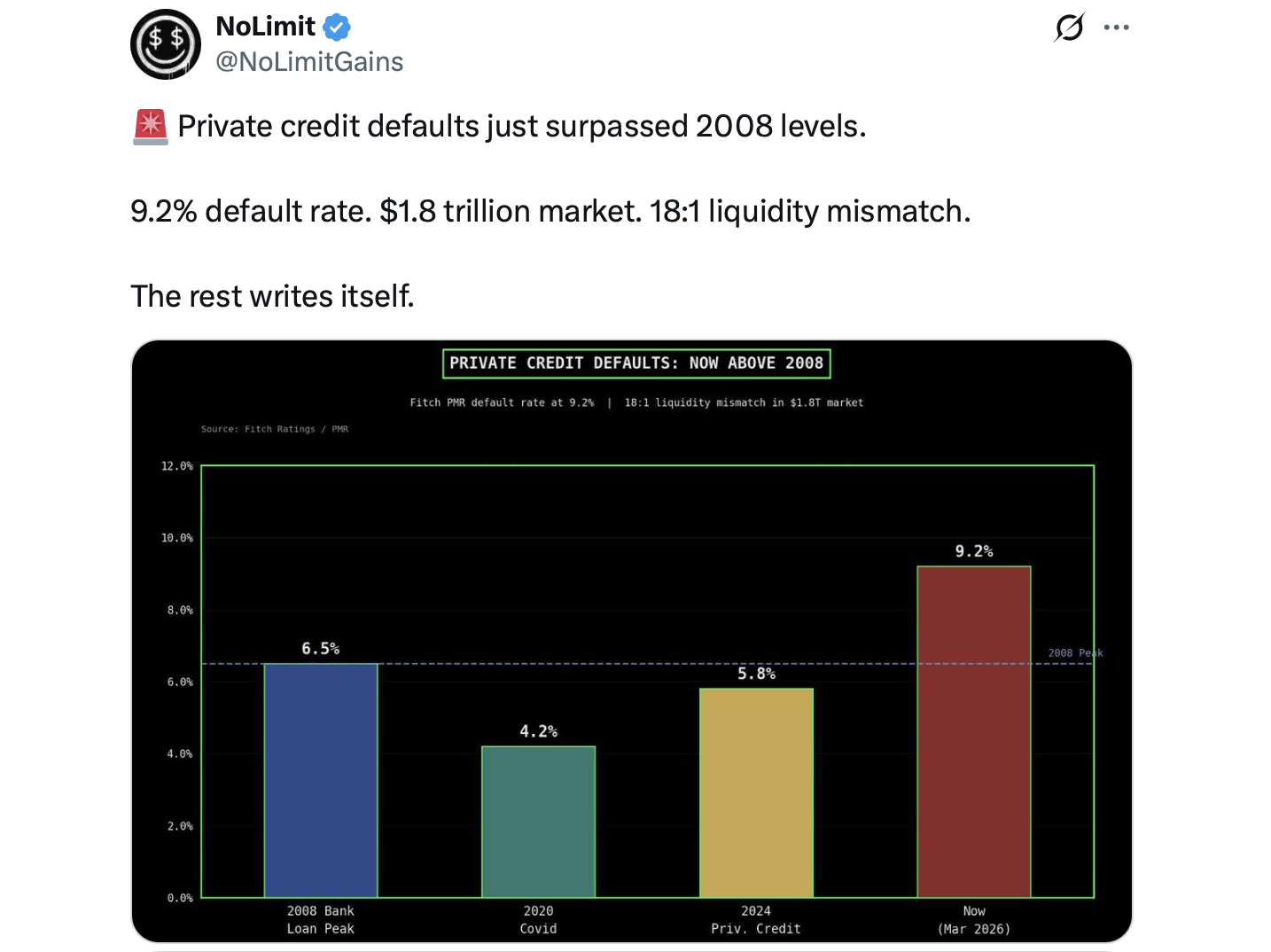
Image source: X
That retreat opened the door for asset managers such as Blackstone, Apollo, Ares, and KKR to build sprawling lending businesses. What started as a workaround has evolved into one of the fastest-growing corners of modern finance.
But growth has come with trade-offs.
Fitch’s data shows defaults were concentrated among smaller borrowers, with companies generating $25 million or less in EBITDA posting a 15.8% default rate, compared with just 4% for larger issuers. The culprit is hardly mysterious: higher interest rates have made floating-rate debt far more expensive, squeezing companies with thinner margins.
Even so, the headline number comes with an important caveat — losses remain relatively contained.
In many cases, lenders have opted for flexibility over force. Rather than pushing companies into bankruptcy, private credit managers frequently extend maturities, allow payment-in-kind (PIK) interest, or restructure terms. Fitch found that most resolved cases in 2025 delivered near-par recoveries, with only modest losses in a minority of situations.
That distinction matters. Defaults may be rising, but they are not translating into the kind of widespread lender losses seen during the financial crisis. Still, another issue is harder to finesse: liquidity.
The same market that has grown to $1.8 trillion operates with limited secondary trading capacity — estimated around $100 billion — creating an approximate 18-to-1 mismatch between assets and liquidity.
In practical terms, that means investors can’t easily exit positions if sentiment shifts.
That tension is already showing. Several large private credit funds have faced redemption pressure in early 2026, prompting some managers to limit withdrawals or inject capital to stabilize flows. Publicly traded business development companies (BDCs), which offer a window into the sector, have also traded at notable discounts to their underlying asset values.
As cited by Bloomberg, in a recent podcast, Lotfi Karoui, a multi-asset credit strategist at Pimco, stressed:
“The big lesson of all of this is that, from an investor standpoint, this is a little bit of a wake-up moment.”
The mismatch becomes especially relevant as private credit expands beyond institutional portfolios into wealth channels. Semi-liquid funds — often marketed with periodic redemption features — may promise access, but the underlying loans remain stubbornly illiquid.
For now, the system is holding. There is no immediate sign of the kind of systemic stress that defined 2008, and banks are less directly exposed to this segment. Meanwhile, a growing pool of distressed debt capital is waiting on the sidelines, ready to purchase troubled assets if conditions worsen.
Looking ahead, the key variables are familiar: interest rates, economic growth, and refinancing conditions. A prolonged period of elevated borrowing costs could push more companies toward restructuring, particularly as debt maturities stack up in 2026 and 2027.
At the same time, industry forecasts remain optimistic. Some projections suggest private credit could double again in size by the end of the decade, driven by continued demand for yield and flexible financing.
That optimism, however, now comes with a sharper edge.
Defaults are climbing, liquidity is finite, and the illusion of easy exits is being tested in real time — a reminder that even the most sophisticated corners of finance still answer to basic math.
- What is private credit?
Private credit refers to loans made by nonbank lenders to companies, often outside traditional public debt markets. - Why are defaults rising in private credit?
Higher interest rates have increased borrowing costs, pressuring smaller companies with floating-rate debt. - Are investors losing money from these defaults?
Losses have been limited so far due to loan restructurings and high recovery rates. - What is the liquidity mismatch in private credit?
It refers to the gap between large asset holdings and relatively small secondary market capacity for selling those loans.
免责声明:本文章仅代表作者个人观点,不代表本平台的立场和观点。本文章仅供信息分享,不构成对任何人的任何投资建议。用户与作者之间的任何争议,与本平台无关。如网页中刊载的文章或图片涉及侵权,请提供相关的权利证明和身份证明发送邮件到support@aicoin.com,本平台相关工作人员将会进行核查。


