Original Title: Mapping Out Crypto's Midterms Fate
Original Author: David Christopher, Bankless
Translator: Peggy, BlockBeats
Editor's Note: The 2026 U.S. midterm elections may become a key variable in the direction of the crypto industry.
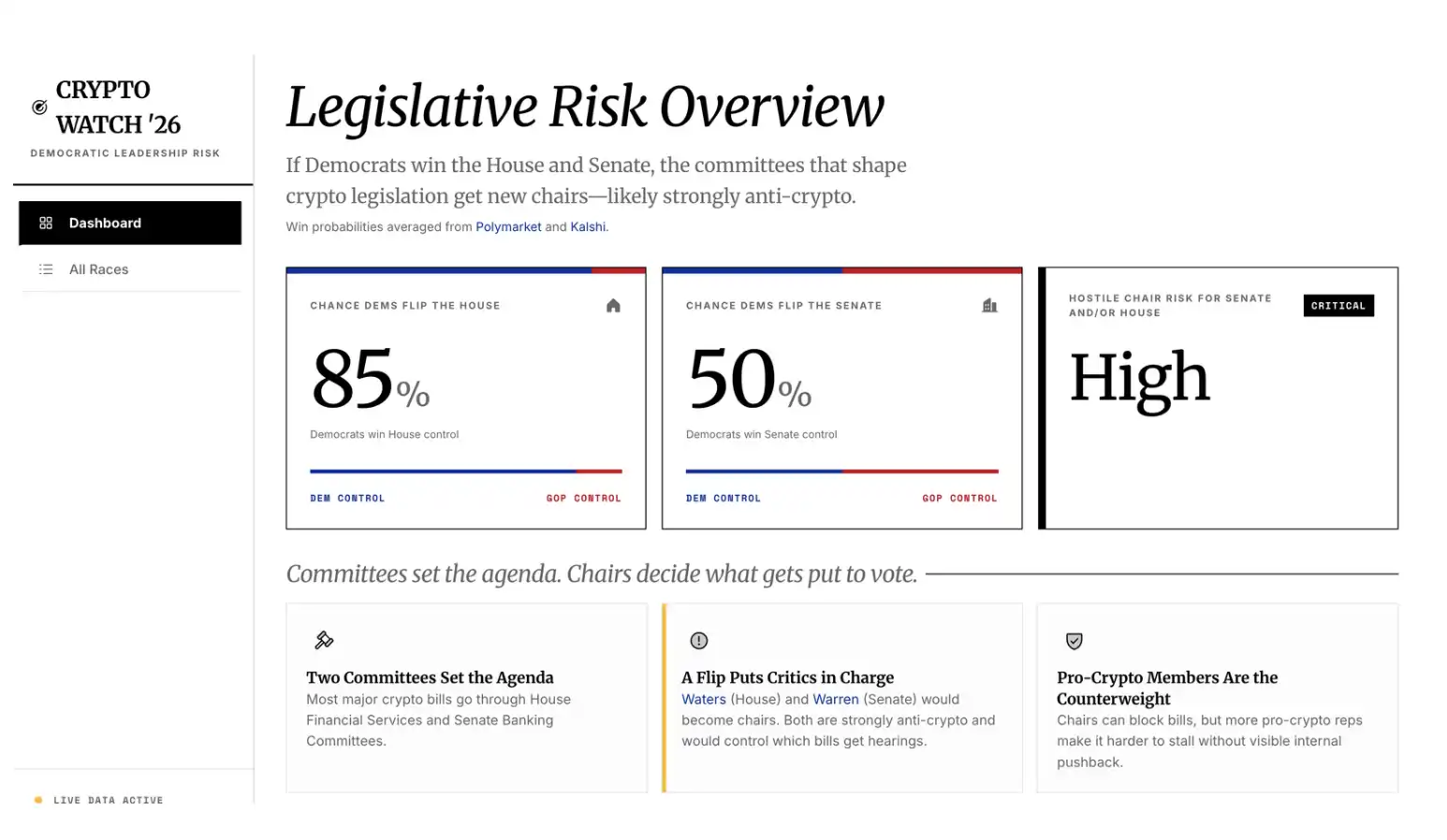
From the perspective of expected outcomes, prediction markets generally believe that the Democratic Party has a greater chance of regaining the House of Representatives, and even the possibility of controlling both chambers of Congress. If this scenario occurs, control of key congressional committees will shift, with Maxine Waters and Elizabeth Warren respectively leading the House Financial Services Committee and the Senate Banking Committee.
However, what really needs attention is not "who supports crypto," but "who controls the agenda."
This article highlights an underestimated risk based on a cross-analysis of prediction markets, candidate positions, and congressional structure: even if bipartisan support is forming, if it cannot enter the committee process, such support has virtually no practical significance. Control over hearings, deliberations, and scheduling allows committees to directly decide the fate of a bill without a vote.
Structurally, this is the core contradiction: although a considerable proportion of Democratic lawmakers have shifted to support crypto on specific bills, this support has not translated into control at the committee level. In the critical phases of determining legislative fate, the overall structure remains cautious or even opposed.
With the potential power realignment brought by the midterm elections, the crypto industry now faces not just short-term policy fluctuations, but a deeper, systemic uncertainty: the path to regulatory clarity may be interrupted before it truly unfolds.
Thus, a relatively clear scenario can be formed: in a baseline scenario, regulatory progress is likely to enter a stagnation period; in a more pessimistic case, core legislation such as stablecoins and market structure may become completely stalled, with short-term policy benefits nearly evaporating.
Below is the original text:
How bad will this midterm election be for the crypto industry? As the possibility of the Democratic Party sweeping both the House of Representatives and the Senate in the midterm elections continues to rise, I want to take a closer look at what the existing polls are actually signaling to us and what it means for the future of the crypto industry.
To this end, I referred to data from prediction markets, as well as databases like Stand with Crypto (SWC) that track candidates' positions on the crypto industry. While integrating this information, I also set up a visualization panel: after obtaining the data, I built the frontend using Cursor, connected the logic with Claude Code, and completed the final deployment through Vercel.
Although the data is still being supplemented, I have established a database that tracks districts led by Democratic candidates, mapping them with their positions on crypto issues and the congressional committees they may enter. This allows me to initially outline the contours of the policy environment for the coming months: on the surface, it seems to have operational space, but upon closer observation, there are indeed deeper structural issues lurking within.
One Unexpected Point
Firstly, the support for the crypto industry within the Democratic Party is actually greater than the outside world imagines—at least on certain specific bills.
In the House of Representatives, 101 Democratic lawmakers (about 48% of the caucus) voted in favor of the GENIUS Act; in the Senate, 18 Democratic lawmakers (about 40%) voted to advance the bill through the approval process. This indeed constitutes a bipartisan support coalition. However, this support is bill-specific, and once it enters the committee stage, where the legislation truly begins to operate, this coalition will quickly dissolve.
And therein lies the problem.
Where Power Comes From
Crypto-related legislation never goes directly to a full-house vote.
Whether it is stablecoins, market structure, or SEC regulatory authority, all matters must first go through committee review. The House Financial Services Committee (HFSC) and the Senate Banking Committee are the two key places where crypto bills' fates are at stake (bills related to market structure also require the involvement of the Agriculture Committee to address CFTC regulatory portions). The committee chair determines which issues can hold hearings, which can enter line-by-line deliberation (markup), and which will be quietly dragged into procedural stasis. If the chair opposes a bill, they do not even need to initiate a vote; they can simply not schedule it and directly shelve it.
Recent Republican chairs have demonstrated how this power can be used to advance the legislative process. For example, Senate Banking Committee Chair Tim Scott pushed the GENIUS Act through the committee and guided its passage in the Senate; former House Financial Services Committee Chair Patrick McHenry led the FIT21 Act, the first major crypto market structure bill to pass in the House. Current Chair French Hill has continued this momentum by advancing relevant legislation, including the CLARITY Act (although it is currently stalled in the Senate), and continuing to hold hearings on digital assets and capital market modernization.
What Happens If the Democrats Win Big?
In the U.S. Congress, the majority party controls all committee chair positions, without exception.
If the Democrats take the House, they will dominate all House committees; if they also take the Senate, they will control all Senate committees. Within the majority party, chair positions are typically filled by seniority.
In the House Financial Services Committee, the most senior Democrat is Maxine Waters; in the Senate Banking Committee, it is Elizabeth Warren. It is well known that both lawmakers have opposed almost all major crypto bills. Warren opposed the GENIUS Act during the review phase on national security grounds, while Waters called it an all-out crypto scam.
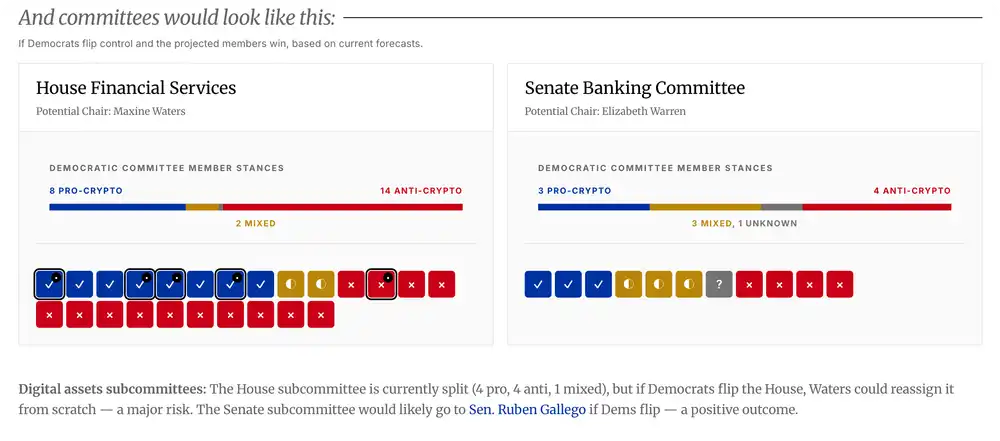
The more critical mechanism lies within the House: once control shifts, all subcommittees will be reshuffled. The majority party can not only decide seat proportions but can also influence new member assignments. At that time, Waters will have significant influence on the membership makeup of the Financial Services Committee (HFSC) and its subcommittees, including the selection of leaders for the digital assets subgroup. While she cannot unilaterally decide all nominees (party leadership and the caucus will also participate), she can certainly steer the overall structure toward a more anti-crypto faction aligned with her position.
In fact, the current membership of the Democrats in HFSC is already skewed towards a critical stance on the crypto industry, with members like Brad Sherman, Stephen Lynch, Emanuel Cleaver, and Sylvia Garcia. While there are also Democratic lawmakers supportive of crypto, such as Jim Himes, Bill Foster, Ritchie Torres, Josh Gottheimer, and Vicente Gonzalez, who can form a certain level of checks and balances, under Waters’ chairmanship, they do not control the agenda-setting authority.
The Situation in the Senate: Slightly Better, But Still Limited
The landscape of the Senate Banking Committee is relatively not as dire. If Elizabeth Warren becomes chair, the committee will exhibit a mixed structure: there will be relatively supportive members of crypto, such as Mark Warner, Ruben Gallego, and Angela Alsobrooks, as well as clear opposing voices, like Tina Smith, along with some members with more uncertain stances.
There is a marginal benefit here: if the Democrats win the Senate, then Gallego, who performs well in the Stand with Crypto (SWC) scoring system, is likely to chair the digital assets subgroup committee. While Warren still controls the overall committee agenda, Gallego can at least carve out some space for pro-crypto voices at the subgroup committee level.
The Really Key Factor is These Election Seats
A more realistic issue is that most of the Democratic lawmakers who support crypto are not currently on the House Financial Services Committee (HFSC) or the Senate Banking Committee.
They can certainly vote in favor when the bills go to full-house votes and can exert pressure on party leadership to some extent (though in the current highly partisan context around crypto issues, most may not be willing to stick their necks out). However, one thing they cannot do is force the committee chair to advance a piece of legislation into the process.
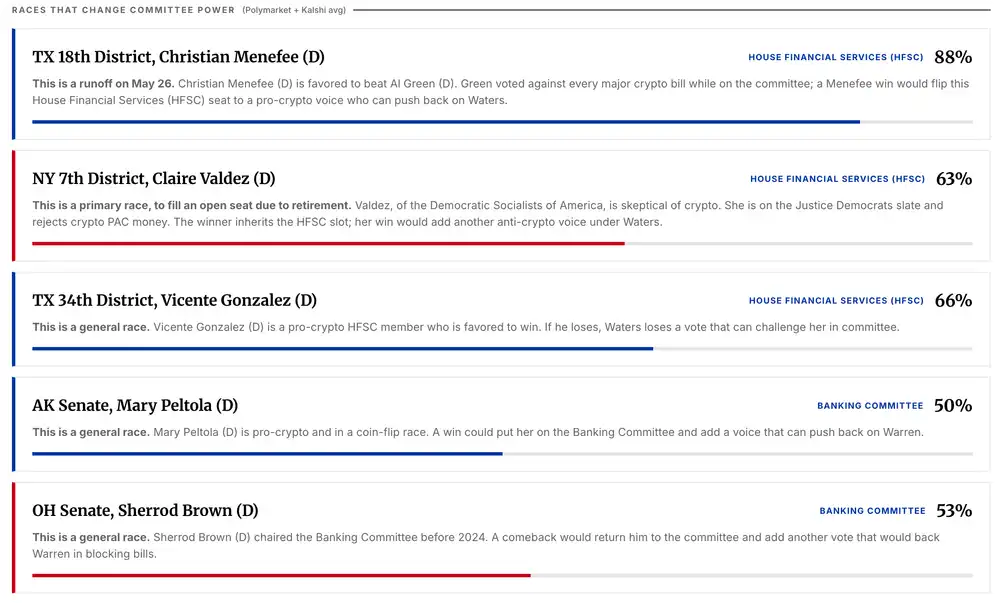
Thus, what truly influences the direction of crypto policy is actually the election results of a few key districts—these elections will directly change the composition of committees, thereby determining whether bills have the opportunity to be discussed, rather than just voted on.
Conclusion on the Midterm Election
The outlook for the House is rather grim.
If the Democrats flip the House with an 85% probability, then it is almost certain that Maxine Waters will become the chair of the Financial Services Committee (HFSC). She can not only rearrange the seats of various subcommittees but also controls the agenda-setting authority. The so-called bright spots are very limited— for example, Menefee may take Green's seat, Gonzalez may successfully be re-elected—these can only provide a certain level of checks and balances but will not change the fundamental issue of who holds the gavel.
The Senate remains the key battleground, but the situation deteriorated further last night.
In the Illinois primary, Juliana Stratton defeated Raja Krishnamoorthi. Considering the Stand with Crypto (SWC) scoring, as well as Fairshake's $7 million investment opposing her, it can be roughly concluded that Stratton belongs to the firm anti-crypto camp.
More frustrating is the overall structure: supportive Democrats do indeed exist. About 47% of the Democratic lawmakers in both chambers have supported the GENIUS Act, while 37% in the House supported the CLARITY Act. But the issue is— the fate of bills does not depend on a full-house vote.
What truly determines fate is the committee phase. And in committee votes related to market structure, there is an almost complete partisan divide. Those that do support do not translate into actual influence in critical decision-making arenas.
Crypto should not have become such a highly partisan issue. Supportive Democrats do exist—only they are not in positions of power.
This data panel is still being continuously improved, and I will continue to update in the coming weeks and months. But even in the current incomplete data, the overall pattern is already quite clear: the House will likely become the main obstacle, and the Senate remains the only place worth putting energy into.
免责声明:本文章仅代表作者个人观点,不代表本平台的立场和观点。本文章仅供信息分享,不构成对任何人的任何投资建议。用户与作者之间的任何争议,与本平台无关。如网页中刊载的文章或图片涉及侵权,请提供相关的权利证明和身份证明发送邮件到support@aicoin.com,本平台相关工作人员将会进行核查。


