On March 19, the U.S. Securities and Exchange Commission (SEC) officially approved the modification of Nasdaq rules, allowing securities to be traded in a "tokenized form" on its exchange. This decision marks the most substantive step toward blockchain technology in traditional capital markets, attracting widespread attention from the global financial industry.
This is not just a minor technical adjustment, but rather an "official handshake" between traditional finance and the crypto world. According to the rules, eligible U.S. stocks will be allowed to be traded and settled in the form of blockchain tokens. This article will organize the core points of this historic event and the far-reaching implications behind it through a visual representation.
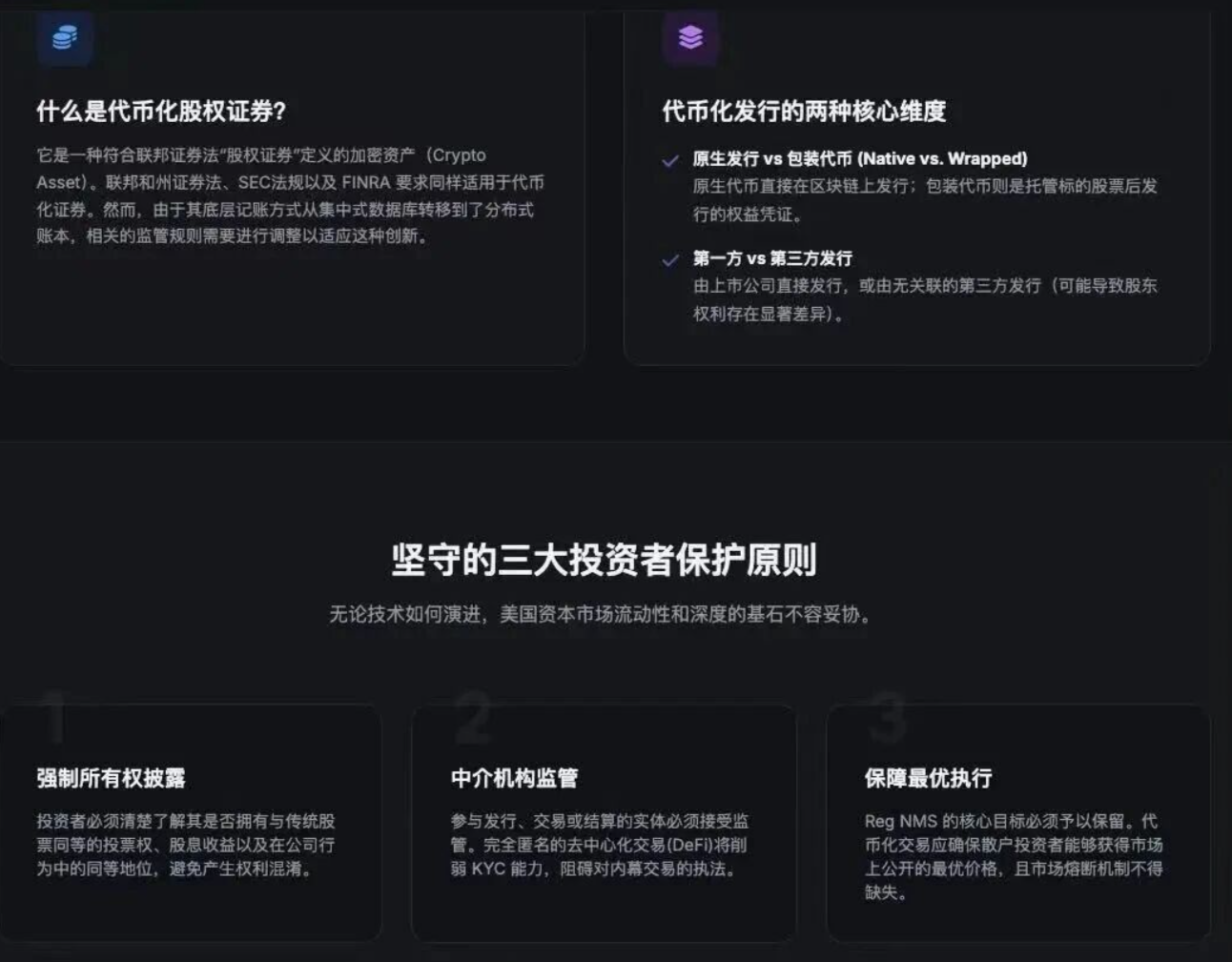
1. Core Mechanism: A "Dual Track" System of Tradition and Innovation
The pilot scheme approved by the SEC is not intended to overturn the existing trading logic but to introduce the efficiency of blockchain while retaining the rigor of traditional finance, forming a unique "dual track" operational model.
● Same Order Book, Same Share, Same Rights: According to the plan submitted and approved by Nasdaq, tokenized stocks will be traded in the same order book as traditional stocks. This means investors can place orders under the existing trading interface but can choose whether to settle in traditional or tokenized form. More importantly, tokenized stocks have the same CUSIP numbers (security identification numbers), trading symbols, and shareholder rights (such as dividends and voting rights) as ordinary stocks, ensuring “same share, same rights.”
● Settlement Through DTCC: Although blockchain technology is adopted, the settlement stage will still occur through the pilot framework of the Depository Trust & Clearing Corporation (DTCC). This design utilizes the potential of blockchain to improve efficiency while remaining within the strict existing U.S. financial clearing system, reducing systemic risks.
● Applicability: The pilot will initially not cover all stocks but will be limited to Russell 1000 Index component stocks, as well as exchange-traded funds (ETFs) tracking major indices like the S&P 500 and Nasdaq 100. These targets have the best liquidity and are most suitable as experimental fields.
2. Why "Go on the Chain"? 24/7 Trading and Global "Digital Pipeline"
The traditional U.S. stock market only has 6.5 hours of trading time each day, and the settlement cycle (though shortened to T+1) still has delays. Tokenization provides a possibility to solve these pain points.
● Realize 24/7 Trading: Once stocks are "on the chain," in theory, they can achieve real-time trading all year round, just like Bitcoin. TD Securities analysis points out that this will completely break through the time limitations of traditional stock trading and the bottleneck of settlement efficiency.
● Build a "Digital Pipeline" for U.S. Dollar Assets: Industry insiders believe that the tokenization of U.S. stocks hides deeper strategic intentions. Frontier technology investor Zheng Di analyzes that this allows global investors—especially those in countries where local currencies are depreciating and lack quality investment targets—to bypass the cumbersome process of opening accounts with traditional brokers and directly funnel funds into the U.S. stock market on the chain through stablecoins. This is equivalent to building a "digital pipeline" for U.S. dollar assets, more efficiently converting global U.S. dollar liquidity into demand for U.S. stock assets.
3. Arms Race on Wall Street: Not Just Nasdaq
Nasdaq is not the only player in this transformation. Faced with the blue ocean of tokenization, its old rival, the New York Stock Exchange (NYSE), has long been gearing up.
● NYSE's Strategy: In January of this year, the parent company of the NYSE, Intercontinental Exchange (ICE), announced that it is building a trading platform using blockchain technology to enable 24/7 trading of tokenized stocks and ETFs. At the same time, ICE also made a strategic investment in the cryptocurrency exchange OKX, attempting to bridge the compliant market and the crypto market.
● Technical Cooperation: To ensure the successful implementation of technology, Nasdaq has chosen to collaborate with Payward, the parent company of the cryptocurrency exchange Kraken, to design a "conversion channel" that allows tokenized stocks to be seamlessly transferred between regulated markets and on-chain markets.
4. Regulatory Direction: Technological Neutrality and Penetrative Management
The SEC's approval is not a principle-less "relaxation"; the regulatory agency has clearly defined its red lines.
● Principle of Technological Neutrality: Institutions such as the Federal Reserve and the Federal Deposit Insurance Corporation (FDIC) jointly issued a clarification document stating that the risk capital treatment for eligible tokenized securities should be the same as for their non-tokenized forms. The regulation looks at the essence of the asset rather than its technological form.
● Prevent Market Fragmentation: In response to potential "shadow liquidity" or disputes over pricing power, the SEC emphasizes that regardless of the technological form used, as long as it meets the definition of a security, it must comply with federal securities law registration and information disclosure requirements and implement penetrative management.
5. Challenges and Outlook: The Struggle for Pricing Power and Future Landscape
● Although the prospects are bright, the popularization of tokenization still faces challenges. Zhejiang Securities analysis points out that once 24/7 trading is achieved, the pricing power of traditional exchanges during non-trading hours (which account for 70% of the day) may be snatched by 24-hour trading platforms like Robinhood, profoundly changing the global asset price discovery mechanism.
● The approval obtained by Nasdaq this time is one of the most significant milestone events in the financial markets of 2026. It not only means that traditional assets are beginning to migrate to blockchain, but also indicates that the way global capital flows will undergo fundamental changes. For ordinary investors, buying and selling U.S. stocks in the future may be as simple as transferring money now; for the United States, this may be a new trump card in maintaining its global financial hegemony. As the pilot gradually lands in the coming months, we will witness how this history is written.
Join our community to discuss and become stronger together!
Official Telegram community: https://t.me/aicoincn
AiCoin Chinese Twitter: https://x.com/AiCoinzh
OKX Welfare Group: https://aicoin.com/link/chat?cid=l61eM4owQ
Binance Welfare Group: https://aicoin.com/link/chat?cid=ynr7d1P6Z
免责声明:本文章仅代表作者个人观点,不代表本平台的立场和观点。本文章仅供信息分享,不构成对任何人的任何投资建议。用户与作者之间的任何争议,与本平台无关。如网页中刊载的文章或图片涉及侵权,请提供相关的权利证明和身份证明发送邮件到support@aicoin.com,本平台相关工作人员将会进行核查。


