The rapid rise of autonomous AI agents has fueled a sprawling ecosystem of integrations tied to Openclaw, an open-source framework for autonomous agents previously known as Clawdbot and Moltbot. Since late 2025, Openclaw has accumulated more than 250,000 Github stars and sparked a wave of tools designed to let AI agents trade assets, access blockchain data, manage wallets, and even launch tokens on their own.
At the heart of this shift is the idea that AI agents can operate as independent economic actors—executing trades, sending digital assets, analyzing markets, and interacting with blockchains without constant human supervision. Developers are building these systems using modular capability packages (MCPs), standardized payment protocols like x402, and onchain identity systems such as 8004, forming the technical backbone of what many developers are calling the emerging “agent economy.”
Exchanges and Trading Platforms on the Move
Exchanges have been among the fastest to embrace the trend, eager to ensure that if autonomous agents are going to trade crypto, they will likely do it on their platforms.
Binance, the world’s largest crypto exchange by volume, released seven AI agent skills, including Binance Spot Skill, Query Address Info, Query Token Info, Crypto Market Rank, Meme Rush, Trading Signal, and Query Token Audit. These tools allow AI systems to query blockchain data, assess token security, track market rankings, and execute trades through standardized interfaces compatible with Openclaw agents.

Image source: X
Other trading platforms quickly followed. OKX introduced Openclaw-compatible tools through its OnchainOS framework, enabling AI agents to manage wallets, initiate payments, read market data, and execute trades with permission-based controls designed to prevent runaway automation.
Crypto.com rolled out its “Agent Key” feature, a secure API access system that allows AI agents to trade with built-in safeguards such as weekly spending caps and scoped permissions. The company says the system enables both retail and institutional users to deploy trading agents without granting full access to accounts.
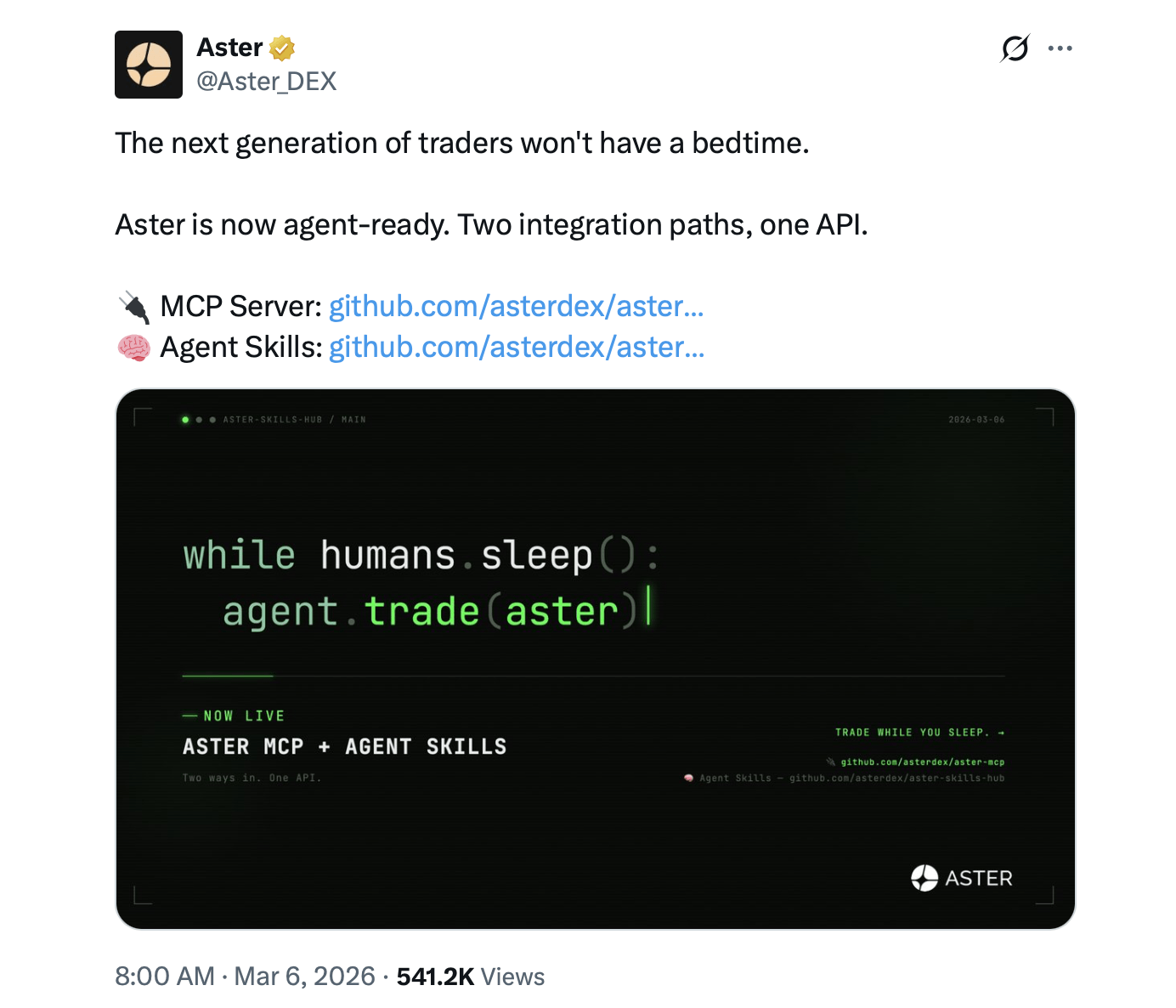
The perp DEX Aster published an MCP server and agent skills this week. Image source: X
Decentralized exchange ( DEX) platforms are also getting in on the action. Pancakeswap launched “PancakeSwap AI,” giving agents the ability to swap tokens, manage liquidity positions, and run yield farming strategies automatically onchain. The largest DEX by trading volume, Uniswap, has also released agentic skill sets.
“Agents execute on Uniswap,” the DEX wrote earlier this week. “We’ve released seven new Skills giving structured access to core Uniswap protocol actions. Your starting point for agentic workflows onchain.”
This week, Mastercard disclosed a partnership with Google to develop “Verifiable Intent,” an initiative designed to advance agentic commerce, including applications involving x402. “When AI agents act with real money, consumers aren’t just looking for speed or convenience,” Mastercard wrote.
The payments giant added:
“They expect clarity about what was authorized, confidence that instructions were followed, and protection if something goes wrong. As autonomy increases, trust cannot be implied. It must be proven.”
Another crypto infrastructure firm expanding into AI-driven markets is Bitget Wallet, which released an Openclaw-compatible skill that allows agents to monitor whales, analyze K-line data, check token contract security, and identify arbitrage opportunities across multiple blockchains.
Data and Analytics Firms Feed the Machines
If AI agents are going to trade markets autonomously, they need a steady stream of reliable data. Analytics firms have stepped in to supply exactly that.
Coinmarketcap (CMC), for instance, launched a modular capability package that provides real-time cryptocurrency market data to AI agents. The company also integrated x402 payment support for API usage and released specialized skills designed for Openclaw agents and Claude Code integrations.
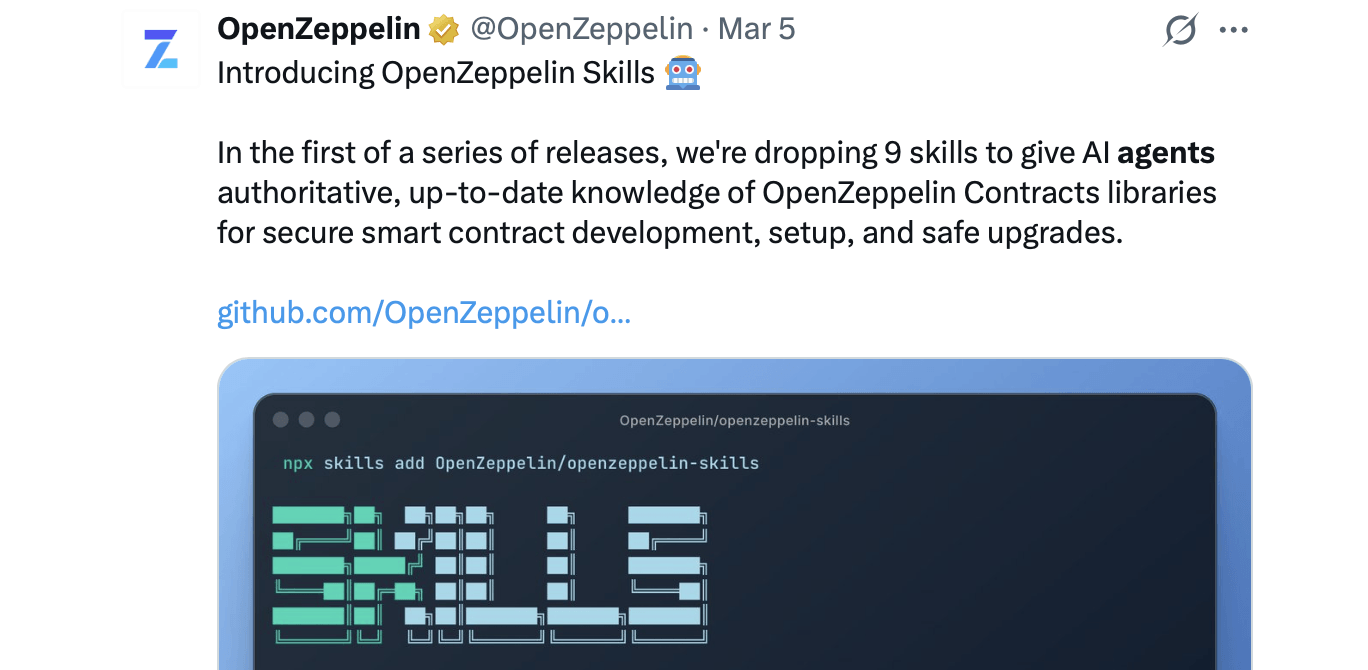
Image source: X
Blockchain analytics firm Nansen introduced a command-line interface tool that allows agents to access blockchain intelligence, including smart-money tracking and token analytics. The blockchain security firm specializing in smart contract development and protection, Openzeppelin, released agent skills this week.
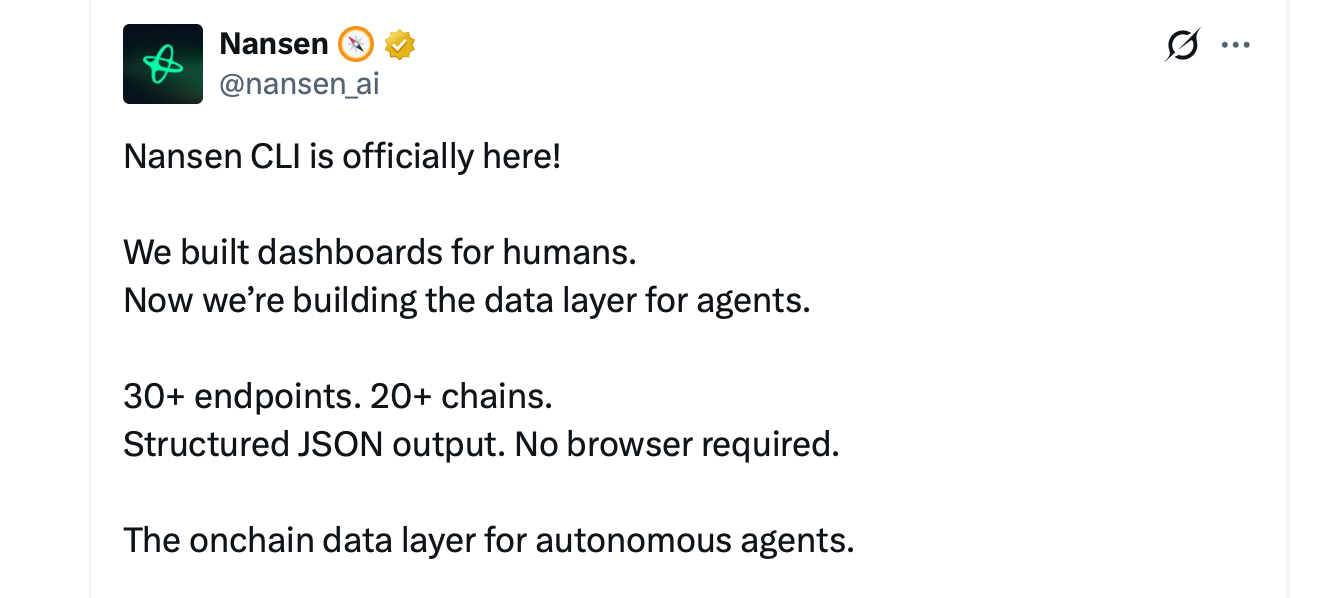
Image source: X
Meanwhile, Dune Analytics rolled out an MCP server on March 2 that allows AI agents and LLMs to pull onchain data from more than 100 blockchains. Agents can run queries, generate charts, and perform structured analysis autonomously, essentially turning AI into a self-service blockchain analyst. Earlier this week, Dune wrote:
“Dune MCP is live. Plug Dune directly into @claudeai, @ChatGPTapp, @cursor_ai, and more. Search tables. Write queries. Build charts. Check Usage. All from a single prompt. Your AI just became a Dune power user.”
Security-focused analytics companies are also entering the picture. Anchain.ai released an MCP integration designed to provide compliance tools such as sanctions screening, fraud detection, and risk scoring. The system runs on Amazon Web Services (AWS) infrastructure and allows agents to perform blockchain investigations automatically.
Infrastructure Projects: Build the Rails for the Agent Economy
While exchanges and analytics firms provide market access and data, a separate group of projects is building the infrastructure that allows AI agents to operate financially.
Payments infrastructure is evolving as well. Circle unveiled a micropayment primitive known as “Nanopayments,” capable of handling transactions as small as $0.000001. The idea is to enable machine-to-machine payments between AI agents conducting small automated tasks.
Another project, Circuit & Chisel, launched the Agent Transaction Protocol (ATXP), which is backed by support from Stripe, Polygon Labs, and Samsung Next. The protocol is designed to allow AI agents to participate in digital commerce without requiring manual human oversight.
Wallet providers are experimenting with agent-friendly integrations too. Phantom released a Connect SDK plugin on the Cursor AI marketplace that allows agents to integrate wallet functionality directly into applications.

Image source: X
On the Base blockchain, Bankrbot launched an updated toolkit allowing agents to manage treasuries, execute trades, and automatically fund API or language model usage through trading revenue.
Privacy and identity infrastructure is also expanding. Virtuals.io introduced an Agent Commerce Protocol designed to power marketplaces for autonomous agents while incorporating privacy layers such as Mute_swap, which draws on technology associated with Monero.
Token Creation and Onchain Automation Tools
Developers are also building tools that allow AI agents to create and manage blockchain assets directly.
op0.live released tools that allow agents to generate tokens on the Solana blockchain using natural-language commands. The system includes a zero-dependency skill package, an MCP server, and REST APIs that agents can invoke automatically.
On the Base network, Clawnch_Bot offers an automated launchpad for agent-created tokens and includes perpetual fee economies tied to the Moltbook ecosystem.
Another project, Clawdbotatg, is developing decentralized applications for liquidity vesting alongside a prediction system known as Clawdviction that allows agents to forecast market outcomes.
AI Agent Economies Begin to Form
Several projects are building entire ecosystems around the concept of autonomous agents interacting with each other economically.
Fetch.ai has long pursued the idea of decentralized agent economies where autonomous programs discover services, negotiate transactions, and execute them onchain.
Bittensor stands among the most significant initiatives within the decentralized AI sector. Put simply, it aims to construct a blockchain-powered marketplace for artificial intelligence in which AI models compete, collaborate, and earn cryptocurrency rewards.
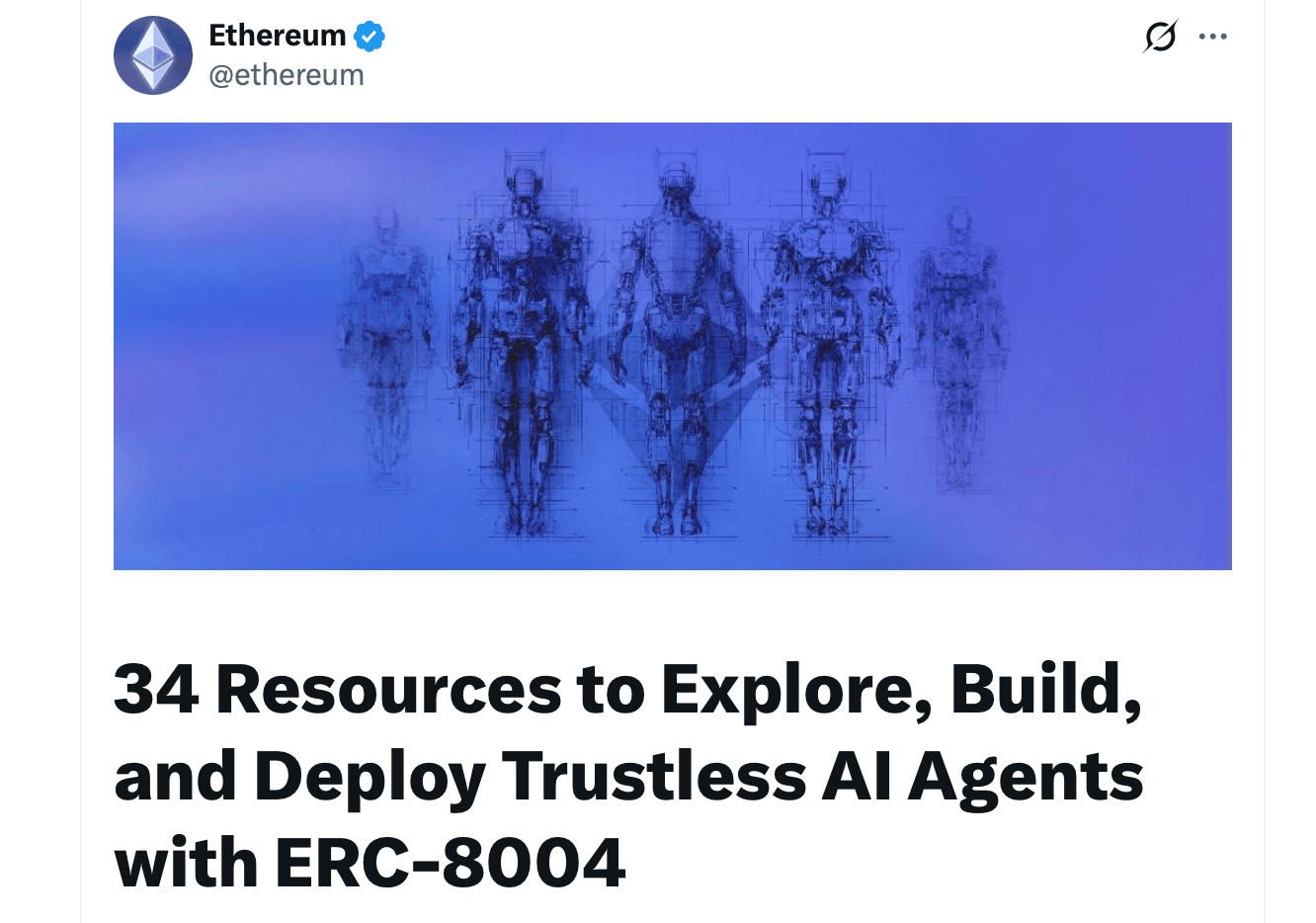
Ethereum published an article on X sharing 34 resources for AI agents and their development. Image source: X
Trading-focused platforms are also emerging. Senpi AI offers trading agents capable of executing strategies on the HyperliquidX exchange using more than 45 tools and automated deployment in under two minutes.
Meanwhile, Ethy Agent is preparing an autonomous trading assistant infrastructure that expands AI trading capabilities across Ethereum-based markets.
Base Ecosystem Emerges as an Agent Development Hub
The Base ecosystem has quickly become one of the most active hubs for AI agent experimentation.
Projects such as Junoagent provide infrastructure for building autonomous businesses that operate with minimal human oversight.
Developer tools like KellyclaudeAI enable agents to deploy revenue-generating apps, including mobile applications such as FocusedFasting on iOS.
Other projects, including FelixcraftAI, focus on helping agents build and manage blockchain applications while operating at what developers describe as “CEO-level autonomy.”
Infrastructure providers like Moltlaunch and Neynar offer deployment tools, token launch capabilities, and decentralized social integrations that agents can use programmatically.
Taken together, these developments suggest the crypto industry is preparing for a future where software agents—not just human traders—participate directly in digital markets.

Image source: X
Whether that future unfolds smoothly remains to be seen. Autonomous systems capable of trading assets, launching tokens, analyzing blockchain data, and managing financial operations introduce efficiency but also raise questions about governance, oversight, and accountability.
Judging by the pace at which exchanges, analytics firms, and infrastructure providers are rolling out agent-ready tools, the industry appears to be making a sizable bet that AI-driven finance is not just coming—it may already be logged in and trading.
Still, anyone experimenting with these emerging agentic tools would be wise to approach them with a healthy dose of caution. Many of the integrations and protocols described above are new, rapidly evolving, and likely to contain bugs, quirks, and unexpected behaviors as developers refine them.
Users should always practice strict operational security (OpSec), safeguard wallets and private data, and conduct thorough due diligence before allowing any AI agent, code, or skill sets to interact with funds or sensitive systems. As with any early-stage technology, participants should only commit assets and data they are willing to lose, remain alert for potential exploits or malicious actors, and remember that while the agent economy is advancing quickly, it is still very much a work in progress.
- What is Openclaw in crypto AI development?
Openclaw is an open-source framework that enables autonomous AI agents to interact with exchanges, blockchains, and APIs. - Why are crypto companies building AI agent tools?
Companies are creating these integrations so AI agents can analyze markets, execute trades, and interact with blockchain networks automatically. - What are MCP servers in the AI agent ecosystem?
MCP servers provide standardized access to blockchain data, analytics tools, and APIs so AI agents can retrieve information securely. - Which crypto companies are releasing AI agent skills and tools?
Major contributors include Binance, Crypto.com, OKX, CoinMarketCap, Dune Analytics, Fetch.ai, Autonolas, Circle, and multiple projects within the Base ecosystem.
免责声明:本文章仅代表作者个人观点,不代表本平台的立场和观点。本文章仅供信息分享,不构成对任何人的任何投资建议。用户与作者之间的任何争议,与本平台无关。如网页中刊载的文章或图片涉及侵权,请提供相关的权利证明和身份证明发送邮件到support@aicoin.com,本平台相关工作人员将会进行核查。


