The Dow Jones Industrial Average fell about 948 points, or roughly 1.95%, trading near 47,790 by midday. The S&P 500 declined around 88 points, or 1.28%, to about 6,781. The Nasdaq Composite dropped roughly 268 points, or about 1.17%, hovering near 22,540. Smaller-cap stocks faced steeper pressure, with the Russell 2000 sliding more than 2%, signaling broad risk aversion across U.S. equities.
Markets opened slightly higher but reversed course late in the morning as geopolitical tensions intensified in the Middle East. Reports tied to military escalation involving Iran triggered renewed concern over potential disruptions to global energy supply routes, particularly the Strait of Hormuz, which carries roughly 20% of the world’s seaborne oil shipments. Reuters reports that at least nine commercial vessels have been attacked since the war started.
On March 5, Iran’s IRGC lobbed missiles and dispatched explosive drone boats at commercial shipping, hitting vessels including the Marshall Islands-flagged MKD Vyom gasoline tanker, which burst into flames leaving one crew member dead and several injured, and the Palau-flagged Skylight near Oman, forcing its crew to scramble for evacuation.
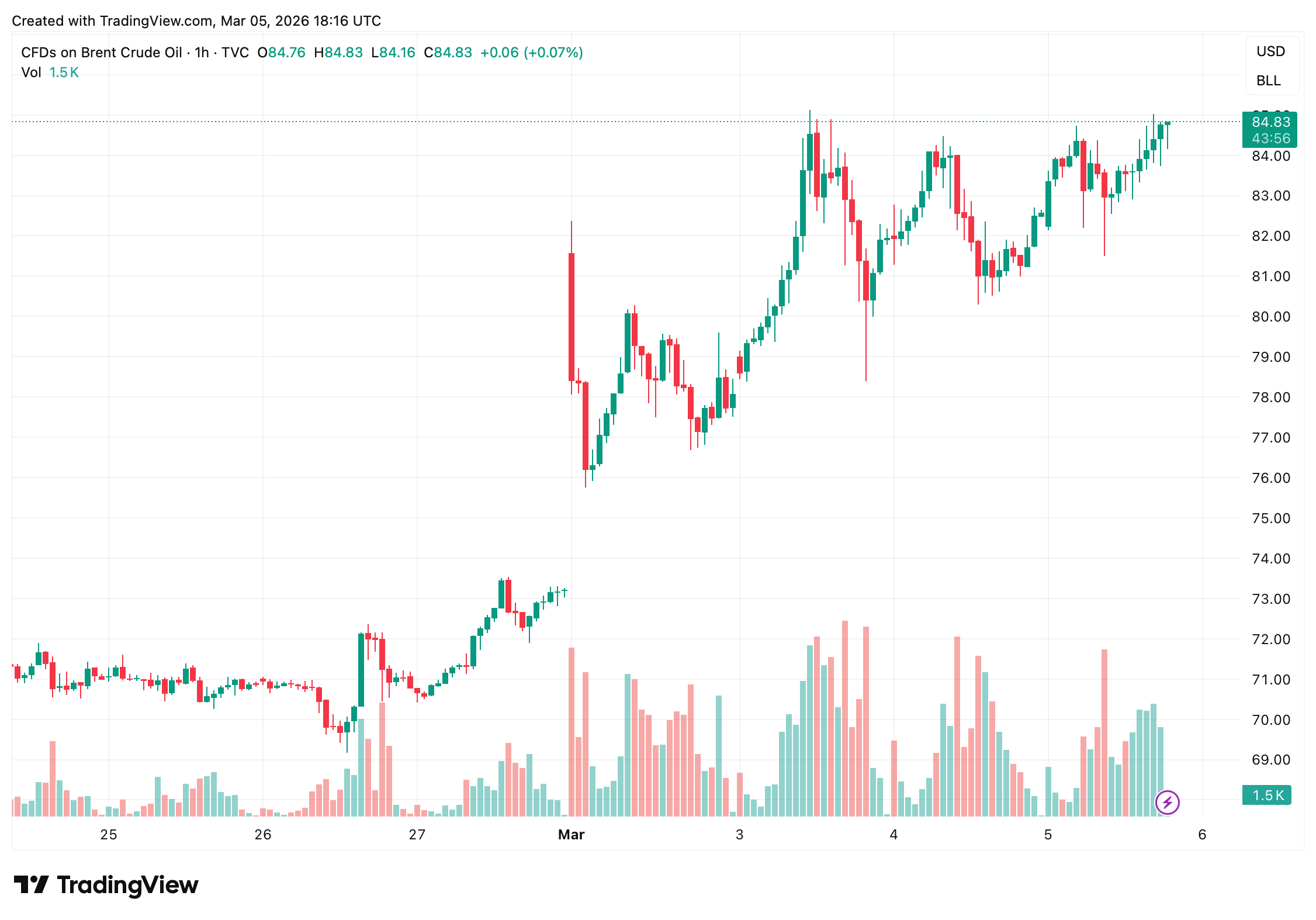
Brent Crude on March 5, 2026, at 1:16 p.m. EST.
Energy markets reacted quickly. West Texas Intermediate crude climbed nearly 6% to around $79 per barrel, while Brent crude traded near $84. The move revived inflation concerns just as investors were debating when the Federal Reserve might begin easing monetary policy later this year.
Volatility followed suit. The CBOE Volatility Index (VIX), often described as Wall Street’s “fear gauge,” jumped more than 16% to about 24.7, reflecting rising demand for downside protection and a clear shift toward defensive positioning.
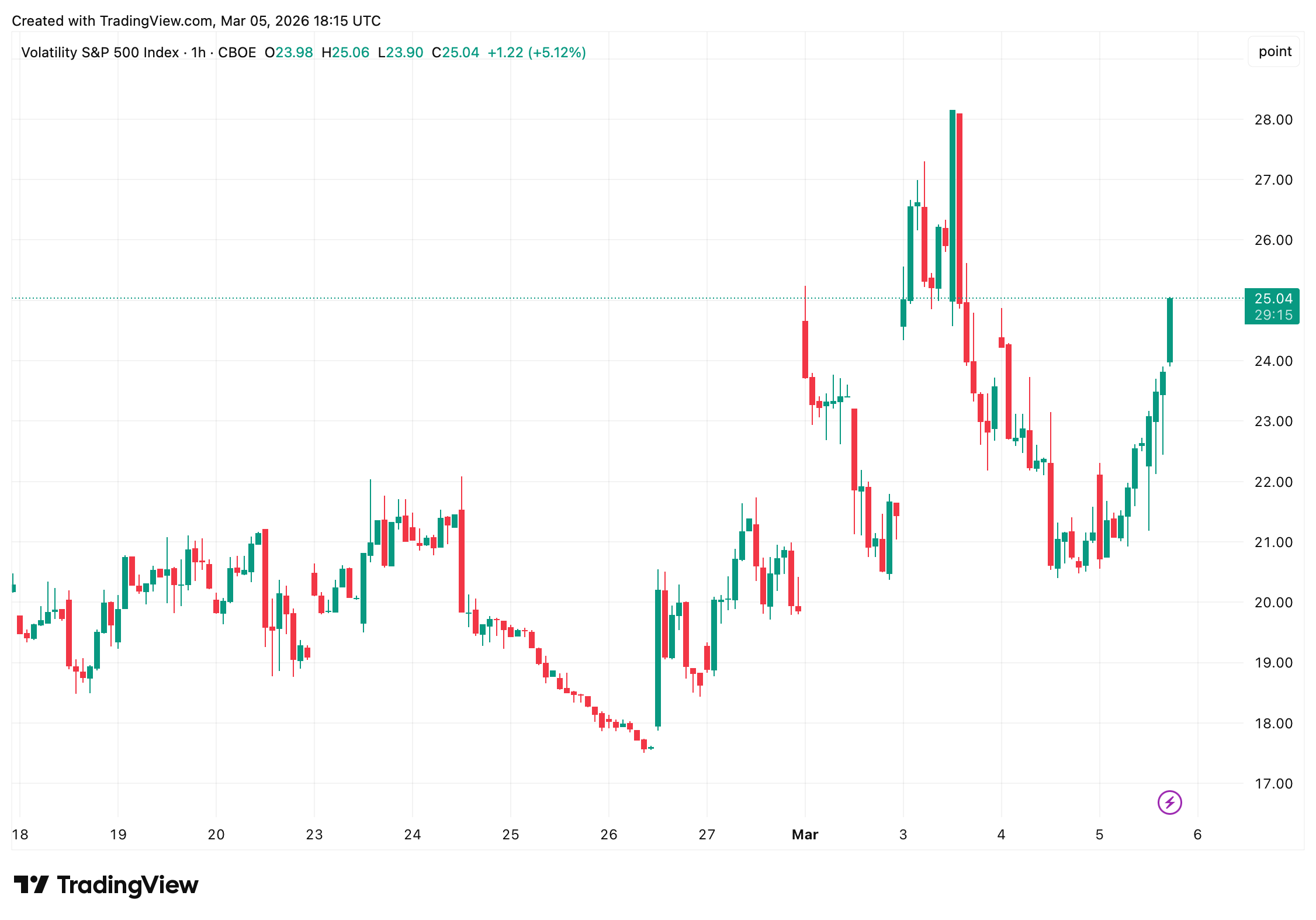
VIX on March 5, 2026, at 1:16 p.m. EST.
Sector performance mirrored the shift in sentiment. Energy companies held up better than the broader market as oil prices advanced, while transportation stocks dropped more than 3%. Financial firms also struggled, with shares of Morgan Stanley falling roughly 2.7% following reports of layoffs tied to cost-cutting efforts.
Technology stocks, which had been among the year’s strongest performers, moved lower as investors trimmed exposure to growth-oriented sectors. The Nasdaq 100 fell about 1.2%, reflecting broad pressure across large-cap technology names.
Defensive sectors offered only modest refuge. Utilities slipped about 1.08%, declining less than the broader market but still reflecting cautious positioning as investors rotated away from risk assets.
Commodity markets highlighted the broader uncertainty. Gold remained elevated near $5,150 to $5,180 per ounce but edged slightly lower as a stronger U.S. dollar offset safe-haven demand linked to geopolitical tensions.
Energy logistics also drew attention. Rates for liquefied natural gas tankers reportedly jumped from about $40,000 per day to nearly $300,000 amid disruptions tied to Middle East instability, tightening global fuel supply expectations.
China added another layer of pressure after instructing its largest refiners to suspend diesel and gasoline exports to preserve domestic supply, a move that amplified concerns about fuel availability across Europe and Asia.
Overseas markets presented a mixed picture. Japan’s Nikkei index climbed roughly 4%, while South Korea’s Kospi rebounded sharply after suffering a historic drop earlier in the week. European equities traded mostly lower as rising energy costs threatened economic growth across the region.
Economic data released Thursday had limited influence on trading, as geopolitical developments dominated investor attention. Markets are now looking ahead to Friday’s closely watched U.S. nonfarm payrolls report, which could shape expectations for Federal Reserve interest rate decisions later this year.
Right now, CME’s Fedwatch tool shows the prospects of a cut are quite slim. For the remainder of the week, traders are watching two primary variables: oil prices and developments in the Middle East. Stabilization in crude could help calm equities, but continued escalation in the region would likely keep volatility elevated.
Historically, markets often recover after geopolitical shocks, but timing those rebounds remains difficult. For now, investors appear to be adopting a cautious stance — stepping back from risk while waiting for clearer signals from both energy markets and global policymakers.
- Why is the U.S. stock market falling on March 5, 2026?
Escalating Middle East tensions and a sharp rise in oil prices have increased inflation fears and triggered risk-off trading across equities. - How are major U.S. indexes performing today?
The Dow is down roughly 948 points, the S&P 500 has fallen about 1.3%, and the Nasdaq Composite is lower by around 1.2% in midday trading. - Which sectors are under the most pressure today?
Transportation, financials, and technology stocks are among the biggest decliners, while energy companies are holding up better due to higher oil prices. - What economic events could move markets next?
Investors are focused on Friday’s U.S. nonfarm payrolls report, which may influence expectations for Federal Reserve interest rate decisions.
免责声明:本文章仅代表作者个人观点,不代表本平台的立场和观点。本文章仅供信息分享,不构成对任何人的任何投资建议。用户与作者之间的任何争议,与本平台无关。如网页中刊载的文章或图片涉及侵权,请提供相关的权利证明和身份证明发送邮件到support@aicoin.com,本平台相关工作人员将会进行核查。


