In recent months, a silent paradigm shift is taking place in the field of AI.
The conversational large models like ChatGPT, Claude, and Gemini are essentially still "advisory AI"—humans ask questions and wait for answers. However, the emergence of a new class of tools is pushing the role of AI from "providing suggestions" to "direct execution": they can autonomously access applications, complete processes, and collaborate across platforms, truly becoming digital employees for users.
The core of this change is the rise of the autonomous AI Agent framework ecosystem, represented by OpenClaw.
1. What are the four major frameworks?
OpenClaw: The most feature-rich and the riskiest
OpenClaw (originally named Clawdbot / Moltbot) is currently the most representative open-source autonomous AI assistant framework, breaking through 200,000 GitHub Stars in just a few weeks. It combines a plugin (Skills) system with large models, giving AI true execution capabilities:
- Proactively execute commands: organize files, check emails, schedule appointments
- Control systems and applications: automatically send emails, run scripts, extract document content
- Cross-platform access: supports over 15 channels including WhatsApp, Telegram, Slack, iMessage, Teams
- ClawHub plugin marketplace: over 1,000 community extension features
NanoClaw: Safety isolation first
Born out of the security issues with OpenClaw. Each Agent runs in an independent Linux container, limiting the attack's explosion radius through OS-level isolation—even if Prompt Injection succeeds, the attacker can only affect a single container, with the host machine completely unaffected. Currently, it primarily supports the WhatsApp platform.
Nanobot: Minimal + MCP standard protocol
Produced by the HKU DS laboratory. With only 4,000 lines of Python code, it fully implements the MCP (Model Context Protocol) standard interface led by Anthropic. The core logic is "do not do everything oneself, but rather become the host for tools," supporting multiple platforms like Telegram, Discord, and WhatsApp.
PicoClaw: AI assistant on $10 hardware
Produced by hardware vendor Sipeed, it is a single binary written in Go, specifically designed for embedded devices: occupying 10MB of memory, with a startup time of 1 second, supporting RISC-V architecture, and can run on the $10 LicheeRV Nano. Interestingly, 95% of its core code is automatically generated by AI Agents.
2. Security models: This is the essential difference
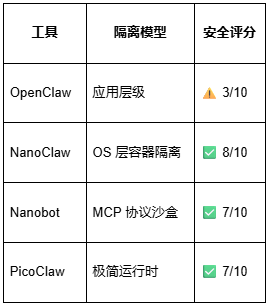
The issue with OpenClaw is not "having vulnerabilities," but rather that it is "structurally difficult to fix." A security audit in January 2026 discovered 512 vulnerabilities (8 of which are severe). Cisco officially characterized it as a "security nightmare," and Aikido Security bluntly stated that "attempting to protect OpenClaw is absurd." The root causes are:
- 430,000 lines of code cannot be fully audited
- Hundreds of malicious plugins have already been found in the ClawHub marketplace (some of which explicitly state to curl data to the attacker's server)
- After token hijacking, attackers can remotely execute any commands
- There are "zero-click attacks"—simply reading a Google Doc can trigger a complete attack chain
NanoClaw's logic is "isolation is better than defense." It does not attempt to patch application layer vulnerabilities, but instead rigidly limits worst-case scenarios using OS layer containers. This is a security property that can be proven and audited.
The security of Nanobot comes from "transparency and minimization." Its 4,000 lines of code can be read in "8 minutes" and it has a very short dependency chain; the MCP standard interface has clear and auditable boundaries.
The security of PicoClaw comes from an "extremely minimal runtime." The 10MB binary means a very low attack surface, with no complex dependency trees and no plugin marketplace. However, it lacks active isolation mechanisms, categorizing it as a "small target" rather than having a "shield."
Security ratings for each tool (reference Shareuhack assessment):
3. Technical architecture comparison
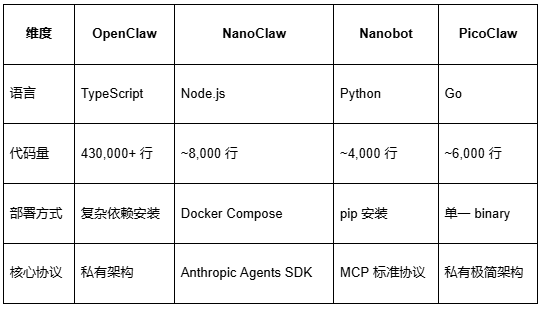
A few common misconceptions:
PicoClaw's 10MB does not include the AI model. It is merely the runtime for the Agent, with inference still calling cloud APIs. If complete local inference is desired (such as with Ollama), memory requirements immediately jump to 4GB or more.
Nanobot's MCP provides a structural advantage. The MCP Server you write can be reused by any host supporting that protocol—if Nanobot stops maintenance, the toolchain can transition at zero cost. OpenClaw's ClawHub plugins are a private ecosystem and completely non-portable.
NanoClaw's single-process architecture is intentionally designed. The Node.js coordinator and each Agent running in independent containers allow for a quick kill of a single container in case of trouble, without affecting anything else.
4. Hardware thresholds
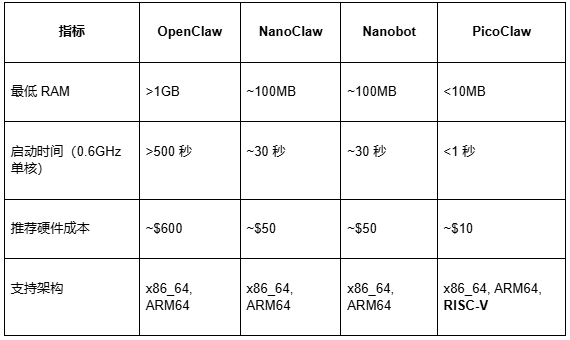
PicoClaw starts up 500 times faster—this is not a gimmick. On low-end devices, OpenClaw takes nearly 9 minutes to start, whereas PicoClaw takes less than 1 second. Current RISC-V support is also unique to PicoClaw, with LicheeRV Nano ($10-15) being its primary target platform.
5. Functional boundaries: Which needs only OpenClaw can satisfy
80% of users only require basic chat + tool invocation, and lightweight alternatives are fully sufficient. However, the following needs are currently only covered by OpenClaw:
- Browser automation (Playwright): automatically fill forms, click buttons, scrape dynamic web pages—none of the other three frameworks offer this
- Multi-Agent collaboration: complex tasks decomposed for concurrent processing by subordinate Agents
- Full-stack integration across 15+ platforms: NanoClaw only supports WhatsApp, PicoClaw focuses on Telegram/Discord, while OpenClaw is the only option covering iMessage, Signal, and Teams
Note: Although ClawHub has over 1,000 plugins, hundreds of malicious plugins have already been discovered. The original authors recommend completely disabling them in production environments (using --no-skills mode). This "advantage" is significantly diminished.
6. Four commercialization pathways
Path One: Monetization through plugins
Develop exclusive plugins for high-frequency business scenarios (such as "contract auto-generation + review") and sell them within the tool ecosystem or internally within companies. The business model is flexible: one-time purchases, subscription models, or pay-per-call can all be implemented.
Path Two: Subscription for automated services
Provide standardized automation service packages for small and medium-sized enterprises: smart customer service, data analysis, multi-platform content publishing, and automation of internal processes. Subscription by month or year is the easiest way to scale monetization.
Path Three: Customized deployment for enterprise intranets
For data-sensitive industries such as finance and healthcare, deploy custom solutions within the intranet, with data never leaving the internal network. High customer unit price and strong stickiness make this suitable for service providers with technical capabilities to enter.
Path Four: Content operations for individuals and small teams
Nanobot runs locally, generating multiple versions of content in bulk; optimizing formats based on platform differences (long articles for Zhihu, short articles for public accounts, Douyin scripts, Instagram posts); monetizing through ad-sharing, paid columns, or content subscriptions. Low cost and easily replicable.
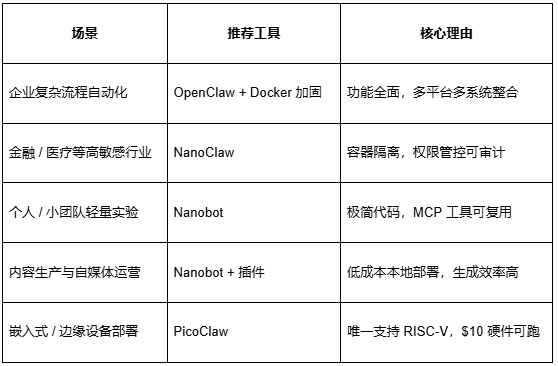
7. Selection guide
The essence of selection is not to pick the "best," but to choose the one "that best matches your constraints."
Ask yourself four questions:
- How sensitive is the data? → Sensitive data should use NanoClaw (container isolation is provable) or Nanobot (auditable code). OpenClaw is a no-go in sensitive environments.
- How limited is the hardware? → Only PicoClaw requires 512MB RAM; any of the three lightweight solutions can work for 100MB–1GB; >1GB should consider OpenClaw.
- Do you need browser automation? → Only OpenClaw offers this, but requires strict Docker isolation and should not be used in production environments.
- Do you value long-term tool reusability? → Choose Nanobot; the MCP ecosystem is the most promising long-term bet.
Conclusion
AI automation is no longer a "future concept," but a productivity tool that can be directly implemented. Whether for businesses looking to reduce costs and improve efficiency or individuals starting content ventures, this wave of intelligent transformation provides clear and viable commercial pathways.
The key logic remains unchanged: understand the pain points of the scenario, choose the right tools, and design a closed-loop business model.
By achieving these three points, AI automation is not just an efficiency tool but a new infrastructure for creating sustainable economic value.
免责声明:本文章仅代表作者个人观点,不代表本平台的立场和观点。本文章仅供信息分享,不构成对任何人的任何投资建议。用户与作者之间的任何争议,与本平台无关。如网页中刊载的文章或图片涉及侵权,请提供相关的权利证明和身份证明发送邮件到support@aicoin.com,本平台相关工作人员将会进行核查。


