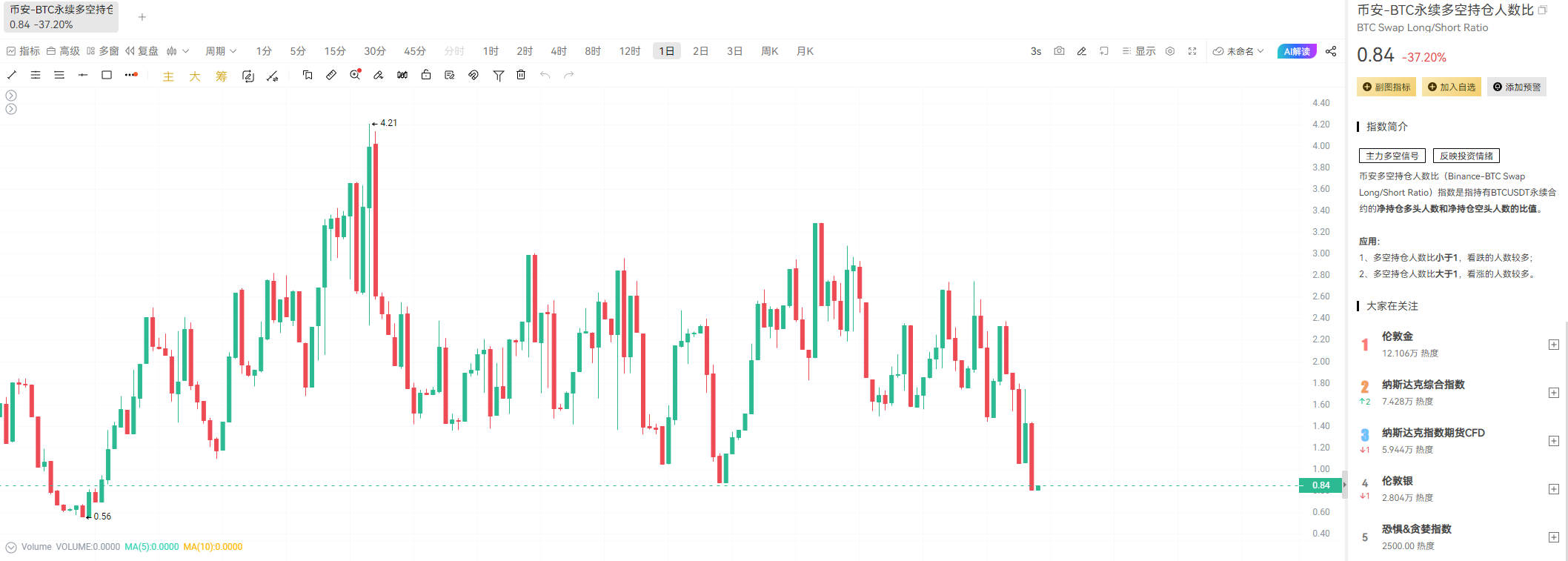
In the past 24 hours, for traders closely monitoring contract data in the Bitcoin market, the mood has felt like riding a roller coaster that rapidly plunges and slowly ascends. If you have been paying attention to the BTC contract long-short ratio on the OKX platform, you would see a shocking set of numbers: falling continuously from above 1.60 in the morning, it dropped to as low as 0.81 in the afternoon without any resistance.
What does 0.81 signify? It means that at that moment, for every long account held, there were nearly 1.23 short accounts lurking. Retail investors' bullish faith seemed to collapse at that moment. However, as of March 5 at 15:00, this line, which almost broke, finally halted its downward trend and slightly rebounded to around 0.87.
Is this slight 0.06 rebound a "bull trap" during a downturn, or a "first glimmer of dawn" where market sentiment truly hits bottom?
1. Extreme Sentiment: The "Bloody Chips" Behind 0.87
● The long-short ratio, as the most intuitive "thermometer" for observing retail sentiment, often indicates a reversal in market direction when it reaches extremes. When this ratio hovers above 1.60, it suggests that retail investors are overly bullish, making the market overheated; while when it drops below 0.90 or even touches as low as 0.81, it indicates that retail panic has reached its peak.
● This afternoon, data from the OKX platform displayed a typical panic exhaustion pattern. The curve did not continue to accelerate downwards at the low of 0.81, but instead began to slowly oscillate upwards within the extremely low range of 0.85-0.88.
● The technical implications of this trend are worth pondering: While the number of accounts holding long positions remains far fewer than those with short positions, the number of "cutting losses" has clearly decreased. Those who should have fled have mostly done so during the drop in the morning; those who haven't either feel numb after being trapped or are "lying flat" die-hard bulls. The proportion of short accounts remains high, but the rate of their increase has significantly slowed, indicating that the momentum for shorting is also beginning to exhaust.
● In the derivatives market, this stabilization at an extremely low ratio is often seen by experienced traders as a strong precursor to a "oversold rebound." It typically corresponds to the moment when market sentiment's deepest despair has passed, and short-term selling pressure is near its end. Although retail investors remain in a panic, major institutions may have begun quietly acquiring chips and positioning long positions at this level where most dare not be bullish.
2. The Game Behind the Data: Who is Shedding Weapons and Who is Entering the Market?
To understand the bloody scent behind these data, we must view it in conjunction with the broader derivatives market.
● Just a few days ago, the market was completely shrouded in the shadow of bearishness. In early March, while Bitcoin struggled around $68,000, the funding rate weighted by open contracts even fell into negative territory, with short sellers willing to pay a small fee to maintain their positions, reflecting extreme caution and disdain for the bulls in the derivatives market at that time. Even analysts pointed out that in earlier February, the market experienced one of the most extreme weekly oversold ranges in history.
However, trends are always born in despair.
● The subtle changes in the OKX long-short ratio today are highly consistent with the overall market deleveraging process. Data shows that since October last year, the scale of open contracts in the futures market has significantly shrunk, with more than half of the leveraged capital being wiped out. This large-scale deleveraging, though painful, results in a healthier market.
● It means that the previously accumulated speculative positions have been largely cleared out, and the systemic risk of a chain reaction explosion in the market has been significantly reduced. Recently, the total amount of forced liquidations in a single day has struggled to break $150 million, compared to previous instances of liquidations of 500 million or even 1 billion. The market's "fragility" is decreasing.
● When panicking retail investors cut their last long positions at a long-short ratio of 0.81, what is smart money doing? Data shows that although the funding rate is still struggling, the active buy/sell ratio (Taker Buy/Sell Ratio) has quietly climbed to 1.16, indicating that active buyers are beginning to outnumber active sellers. The last time this ratio reached similar levels was in June last year, and afterward, the market welcomed a significant upward trend.
3. Restructuring Market Structure: More than Just a Rebound, It's a Breather
The low rebound in the long-short ratio is not merely a numbers game; it reflects a profound restructuring of market structure.
1. The "Locking" Effect in Supply
● On-chain data provides support from another dimension. The number of Bitcoin reserves on exchanges has decreased to about 2.73 million BTC, setting a recent low. When investors withdraw tokens from exchanges to private wallets, it usually signifies a reduced willingness to sell on the spot. This tightening of supply provides a natural ground for price stability.
2. Quiet Influx of Institutional Funds
● While retail investors are leaving due to fear, traditional capital is speeding up its entrance. Data shows that on Monday and Tuesday of this week, the cumulative fund inflow into Bitcoin spot ETFs in the United States reached nearly $700 million, marking a dramatic reversal from months of steady outflows. The K33 research institution also pointed out in its report that despite geopolitical instability, Bitcoin has shown relative stability, suggesting that the strongest phase of selling pressure may have passed.
3. Favorable Policy Winds
● Meanwhile, Washington's more proactive push for crypto policies is reshaping market expectations. President Trump recently urged Congress to expedite digital asset legislation, and Kraken has even become the first crypto firm to connect to the Federal Reserve's payment system. These advancements at the infrastructure level are paving the way for the industry's long-term development.
4. Risks Still Exist: Not Time to Be Complacent
Of course, while the long-short ratio of 0.87 brings hope, it is by no means the beginning of a celebration. The market still faces significant resistance that cannot be ignored.
● First, there is still "floating loss" on-chain lurking. According to statistics, approximately 43% of Bitcoin supply is still in a state of loss. Once the price rebounds to the cost line of these chips, selling pressure from those looking to break even could emerge at any time, limiting the height of the rise.
● Second, the key psychological price levels have not been effectively broken. The current range of $76,000-$78,000 is viewed as a watershed point between bulls and bears, representing not only a significant technical resistance but also the average cost zone for some listed companies (such as Strategy). The struggle between the two sides in this area is bound to be intense.
● Lastly, macro-level uncertainties still exist. The probability of a Fed rate cut in March remains extremely low, and the high-interest rate environment continues to pressure risk assets.
Today's OKX long-short ratio has struggled to rise from the low of 0.81 to 0.87. Though it is merely a slight fluctuation, it acts like a needle, piercing through the previously extremely suppressed panic balloon. It indicates to us that: the phase of blind selling due to panic may truly be over.
The extremely low long-short ratio combined with the continuous inflow of ETFs and tightening on-chain supply is slowly waking the market from the pessimism of "not believing in rebounds." Though the road ahead remains bumpy, and the trapped positions above continue to weigh heavily, the most furious storm may have already passed.
For traders, what may be needed now is not blind chasing of prices up or continued pessimistic shorting, but rather, like those quietly accumulating chips, to maintain high caution while preparing to welcome the confirmation signal of a true breakout. As analysts say, understanding the logic behind indicators is more important than chasing short-term price fluctuations—because in this market, sentiment always leads prices.
Join our community to discuss and become stronger together!
Official Telegram group: https://t.me/aicoincn
AiCoin Chinese Twitter: https://x.com/AiCoinzh
OKX welfare group: https://aicoin.com/link/chat?cid=l61eM4owQ
Binance welfare group: https://aicoin.com/link/chat?cid=ynr7d1P6Z
免责声明:本文章仅代表作者个人观点,不代表本平台的立场和观点。本文章仅供信息分享,不构成对任何人的任何投资建议。用户与作者之间的任何争议,与本平台无关。如网页中刊载的文章或图片涉及侵权,请提供相关的权利证明和身份证明发送邮件到support@aicoin.com,本平台相关工作人员将会进行核查。


